10 Key Points from Morgan Stanley’s 24th Annual Global Healthcare Conference

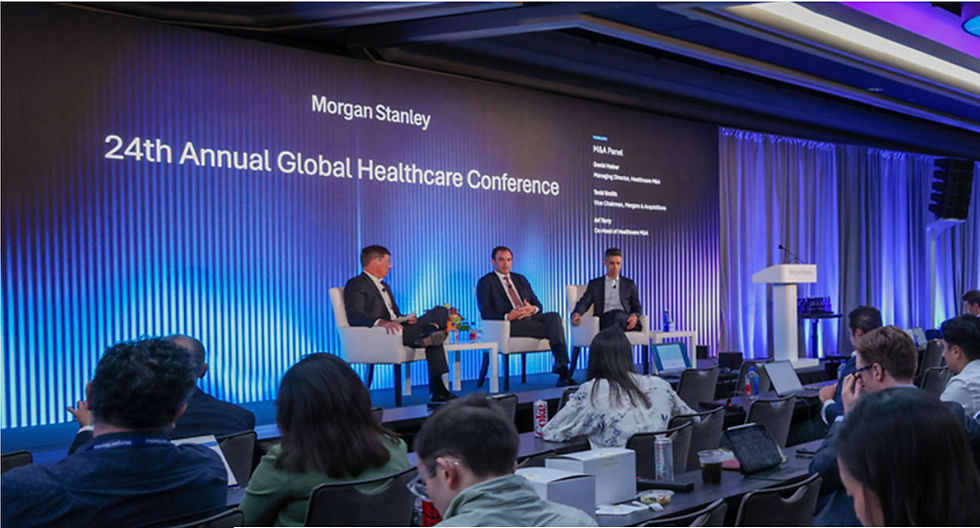
Morgan Stanley's 24th Annual Global Healthcare Conference ran in New York from Monday 14 to roughly Wednesday 16 September 2026, drawing around 3,000 investors and executives across biopharma, biotech, medtech and health services. Company sessions were the usual fireside-chat format with live webcasts: Merck's CEO Robert Davis and R&D head Dean Li spoke on the Monday, and Tuesday featured Amgen (Jay Bradner and CFO Thomas Dittrich), AbbVie, STERIS, Sight Sciences and others, with J&J, GRAIL, Schrödinger, Cytokinetics, Vir, Eikon and BrightSpring also on the roster.
Morgan Stanley's own published wrap-up (16 September) framed three headline themes: new innovation around Alzheimer's, the expanding reach of GLP-1 therapies beyond their original indications, and AI's capacity to accelerate drug development and cut costs, with the bank putting potential healthcare savings from AI at $300–900 billion by 2050. Featured voices included John Collins, Morgan Stanley's global head of M&A, on deal trends, Wellhub CEO Cesar Carvalho on corporate wellness, and BeOne Medicines co-founder John Oyler on cancer treatment access and trial innovation.
From the company sessions, AbbVie was a notable one: it said it has offset $18bn of Humira erosion with $28bn of growth from other platforms, flagged its Apogee acquisition as its most significant deal since Allergan, and confirmed its entry into obesity via the amylin asset from Gubra. Transcripts for a long list of other presenters (Sarepta, Dyne, Zentalis, Getinge, ORIC, Inventiva and more) are available on Seeking Alpha and Investing.com.
Core Themes & Highlights
Market Rebound & M&A Momentum: Investor sentiment rebounded from previous headwinds, supported by resilient procedure volumes, stronger healthcare utilisation, and a clearer macroeconomic backdrop encouraging capital deployment and strategic dealmaking.
Emerging Biotech & Novel Platforms: Presentations heavily emphasized next-generation modalities, including targeted protein degradation, AI-accelerated drug discovery, in vivo gene editing, and new therapeutic candidates for neurodegenerative diseases.
Global Innovation Dynamics: Discussions highlighted the expanding role of cross-border partnerships and China's growing footprint as a high-speed, cost-efficient engine for biopharma innovation and clinical development.
The Next Wave of Metabolic Treatments: While first-generation GLP-1 injectables have seen widespread adoption, executive sessions focused on next-generation oral formulations, long-term supply chain scale-up, and broader payer/Medicare coverage frameworks.
Regulatory & Policy Landscape: Panels examined stabilising U.S. drug-pricing dynamics, accelerated approval mechanisms designed to maintain competitive parity in biopharma, and CMS oversight shifting toward clinical outcomes and risk-adjustment data integrity.
10 Key Points from Morgan Stanley’s 24th Annual Global Healthcare Conference
Rebounding Investor Confidence: After a cautious 2025, healthcare investment and dealmaking are picking up, supported by strong healthcare utilisation rates and clearer macro conditions.
Easing U.S. Policy Uncertainty: Executives reported a more predictable domestic policy environment, as key concerns surrounding tariffs, vaccine guidance, international drug pricing, and affordability have largely stabilised.
China as an Innovation Powerhouse: Biopharma and biotech innovation has become a Chinese national priority, presenting opportunities for global cross-border partnerships while increasing competitive pressure due to China's faster, lower-cost drug development cycles.
Faster Regulatory Approvals: U.S. regulators are expected to expedite drug approval pathways, in part to maintain competitive parity with the accelerating pace of drug development in China.
CMS Dual Focus on Stability and Lower Prices: Leadership from the Centers for Medicare & Medicaid Services (CMS) emphasised a policy agenda centred on lowering out-of-pocket costs for patients while preserving industry stability and transparency.
Shift Away from Coding Intensity: CMS is pushing managed care programs toward measurable health outcomes and data accuracy, aiming to curb aggressive risk-adjustment coding practices that artificially inflate federal spending.
Untapped GLP-1 Growth Potential: Despite rapid adoption across diabetes and obesity indications, biopharma leaders noted that overall GLP-1 market penetration remains low relative to its addressable population.
Oral GLP-1s Expand the Market: The emergence of oral GLP-1 formulations is expanding total patient reach rather than cannibalising existing injectable therapies.
Expanded Medicare Access for Weight-Loss Drugs: Medicare's pilot program offering specific weight-loss therapies to Part D beneficiaries for a flat $50 monthly fee enrolled 6,000 patients within 60 days, signaling broader long-term access.
Operational and R&D Efficiencies via AI: Artificial intelligence is increasingly deployed to shorten clinical development cycles, improve drug discovery screening, and streamline commercial and hospital administration workflows.


Comments