VSP Investments: Institutional Investment Strategy and Operational Value Creation in High Tech Life Sciences, Technology Driven Healthcare

Corporate Foundation and Capital Allocation Philosophy
VS Principal Investments AG, operating commercially as VSP Investments, is an independent lead investment firm headquartered in Zug, Switzerland, with an operational footprint spanning major financial and technology hubs including London, Dubai and New York. Registered under Swiss Commercial Register identifier CHE-443.567.725, the firm manages capital assets anchored by a heritage of over 175 years in the life sciences and healthcare sectors.
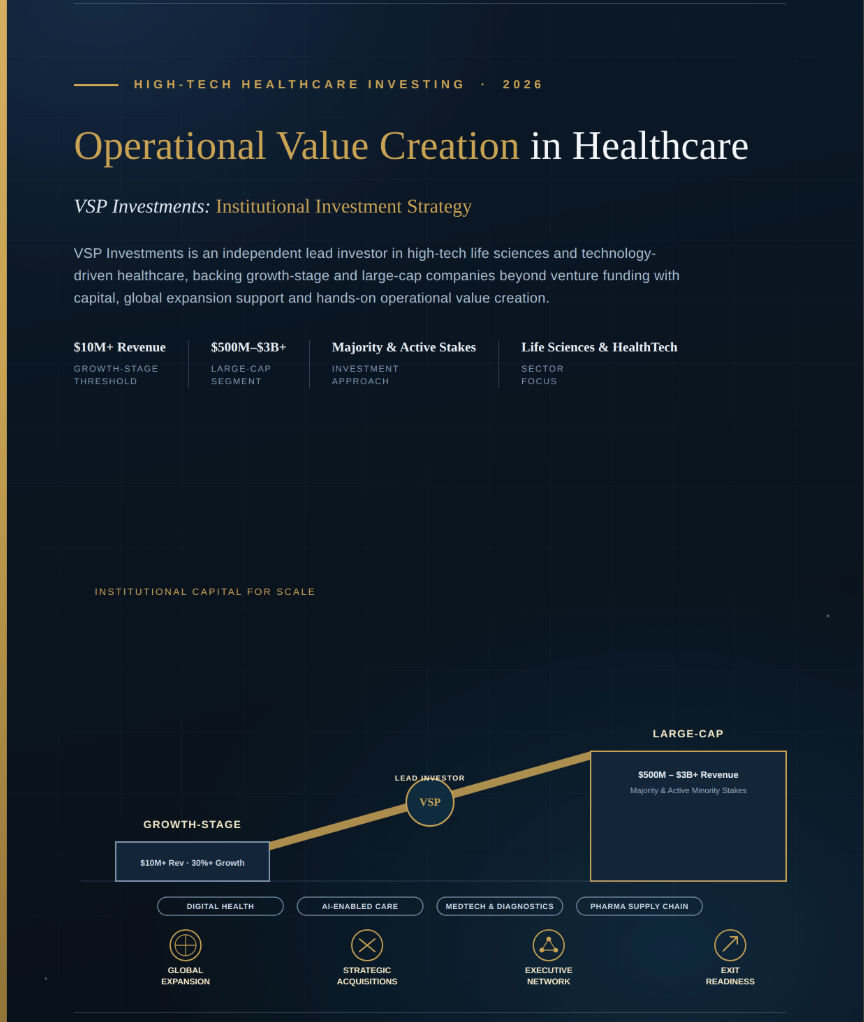
Rather than operating as a passive financial sponsor or early stage venture capital vehicle, the firm positions itself as an active, operator led lead investor targeting middle market and large cap healthcare enterprises. The firm focuses on technology driven healthcare and life sciences companies that have advanced beyond early clinical and technical validation stages and require strategic growth capital, operational institutionalisation, and cross-border expansion capabilities.
The capital allocation framework at VS Principal Investments AG is divided into two discrete investment vehicles: Growth-Stage Investments and Large Cap Solutions. Each platform addresses specific balance sheet requirements, ownership structures, and operational stages of commercial growth.
Dual-Track Capital Allocation Engine
The Growth-Stage investment strategy targets middle-market innovators demonstrating validated commercial adoption and scalable business models. To qualify for capital deployment under this strategy, candidate companies must generate a minimum annual revenue of $10 million while maintaining an organic growth velocity of at least 30% per year. Financial discipline is enforced through a strict profitability threshold requiring target firms to be free-cash-flow positive or to demonstrate a clear operational path to cash flow breakeven within 12 to 18 months. Governance structures require strong ownership alignment, focusing on founder-led or management-owned enterprises seeking a long-term industry specialist partner. Capital deployment takes the form of majority ownership stakes or active minority positions accompanied by a mandatory seat on the board of directors.
The Large Cap Solutions platform serves established healthcare and life sciences enterprises requiring complex capital restructuring, liquidity solutions, or buy-and-build capital. This strategy targets market-leading platforms with annual revenues ranging from $500 million to over $3 billion and underlying earnings before interest, taxes, depreciation, and amortization (EBITDA) between $200 million and $1 billion or more. Partner candidates demonstrate organic growth rates between 15% and 40% annually. Under this strategy, equity tickets up to $1.5 billion are deployed alongside structured debt co-financing to facilitate founder wealth diversification, early investor buyouts, family succession resolutions, and transformational international acquisitions.
Investment Parameter | Growth-Stage Strategy | Large Cap Solutions Strategy |
Minimum Target Revenue | $10 million+ | $500 million to $3 billion+ |
EBITDA / Profitability Threshold | Free-cash-flow positive or break-even within 12–18 months | $200 million to $1 billion+ EBITDA |
Annual Organic Revenue Growth | 30%+ per year | 15% to 40%+ per year |
Ownership & Governance Structure | Majority or active minority with mandatory board seat | Majority, co-investment, or structured buyout |
Target Ownership Alignment | Founder-led or management-owned | Founder-, family-, or management-owned |
Capital Deployment Range | Strategic growth capital & operational scaling | Equity up to $1.5 billion; structured debt co-financing |
Sector Mandate and Risk-Adjusted Asset Allocation
VS Principal Investments AG maintains a focused target mandate aimed at non-binary, infrastructure-critical domains within life sciences and healthcare technology. The firm focuses capital allocation on commercial enablers while excluding binary regulatory risk categories.
Core Target Domains and Strategic Exclusions
The target mandate encompasses four primary high-tech sub sectors:
Digital health platforms and healthcare/life sciences artificial intelligence, focusing on vertical software platforms engineered for clinical workflows, digital surgery solutions, healthcare system interoperability, remote monitoring, novel care delivery, and bio-analytics.
Life science tools and research infrastructure, covering bioprocessing tools, omics platforms, research diagnostics, viral vector technologies, and high-tech contract research (CRO) and contract development and manufacturing (CDMO) service enablers.
High-tech pharmaceutical supply chain infrastructure, targeting enterprise software and hardware systems designed for compliance, traceability, bio-analytics, and supply chain management across pharmaceutical manufacturing.
High-growth medical technology niches, prioritising specialised technology enabled medtech, digital surgery hardware, and diagnostic technologies.
Conversely, the firm strictly enforces strategic exclusions across four traditional healthcare verticals. Capital is not allocated to pure-play biotechnology or therapeutic drug discovery platforms, classical pharmaceutical companies (including generic and specialty pharmaceutical manufacturers), traditional insurance payers, or classical healthcare delivery services and physical care facilities.
Mandate Category | Included Target Subsectors | Explicitly Excluded Verticals |
Primary Domain | Digital Health & Vertical Healthcare AI Platforms | Pure-Play Drug Discovery & Biotechnology |
Tools & Infrastructure | Bioprocessing Tools, Omics & Diagnostic Research Infrastructure | Generic & Specialty Pharmaceutical Manufacturers |
Supply Chain & Enterprise Software | Pharma Traceability, Compliance & Supply Chain Bio-analytics | Traditional Insurance Payers |
Care Delivery Enablers | Technology-Enabled MedTech & Digital Surgical Infrastructure | Traditional Physical Healthcare Services & Facilities |
Strategic Rationale for Non-Binary Sector Selection
The decision to exclude drug discovery, classical pharmaceuticals, and traditional service providers represents a structural risk-mitigation strategy. Pure-play biotechnology firms carry high clinical trial failure rates, extended regulatory approval timelines, extreme capital intensity, and vulnerability to macro-level funding shifts. In contrast, life science tools, bioprocessing equipment, bio-analytics software, and supply chain enablers benefit directly from global biopharmaceutical research and development expenditures without taking on direct clinical trial or patent cliff exposure.
Similarly, classical healthcare services and traditional payers face structural headwinds, including rising clinical labor costs, complex reimbursement models, and regulatory caps on operating margins. By focusing on life science tools, digital health enablers, and high-tech MedTech niches, the firm captures stable demand, recurring software and consumable revenue streams, favourable gross margin profiles, and predictable cash flow generation.
Operational Value Creation and Global Scaling Mechanics
To drive capital appreciation across portfolio holdings, VS Principal Investments AG utilises an operational execution framework termed "Beyond Capital". This strategy relies on an international operator network composed of former healthcare executives, board chairs, regulatory leaders, and domain experts.
Cross-Border Expansion and US Market Entry
For European and regional high-tech healthcare firms, entering the United States market represents a major catalyst for valuation growth, but it carries significant execution risks. The firm deploys dedicated operational resources out of its New York office to support portfolio assets in managing Food and Drug Administration (FDA) regulatory frameworks, establishing local executive leadership teams, securing commercial payer reimbursement codes, and building North American sales operations. This localized support allows regional scientific leaders to scale into global market platforms.
Inorganic Growth and Institutionalisation
In addition to organic expansion, the firm accelerates market penetration through structured buy-and-build M&A strategies. The investment team assists portfolio management in sourcing, negotiating, and integrating vertical, horizontal and add-on acquisitions. This rigorous deal evaluation approach prevents common acquisition mistakes, such as overpaying for adjacencies or acquiring cyclical assets during market peaks.
Concurrently, middle-market and family-owned healthcare businesses frequently encounter growth bottlenecks due to informal governance, fragmented cap tables, or succession challenges. The firm addresses these challenges by restructuring management equity incentives, formalizing legal and data privacy compliance across international jurisdictions, executing founder buyouts, and institutionalizing operational governance ahead of strategic exits or public stock listings.
Commercial Dynamics and Structural Moats in Healthcare Artificial Intelligence
Research conducted by the firm indicates that enterprise artificial intelligence within healthcare and life sciences has reached operational maturity, establishing unit economics that diverge from generalist consumer technology platforms.
Financial Acceleration and Retention Metrics
Transactional data across North American, European, and Middle Eastern markets demonstrates that mature healthcare AI vendors generate robust financial profiles that align with the firm's growth criteria. Commercialized enterprise platforms in this category generate annual revenues ranging between $10 million and $300 million. Multi-year institutional contracts frequently scale to total account values of $40 million to $60 million.
Customer churn rates among these providers remain low because these systems embed directly into core clinical, diagnostic, and manufacturing workflows. Consequently, specialized AI platforms achieve positive cash flow and unit profitability within 12 to 18 months of commercial deployment, contrasting sharply with the prolonged cash burn typical of horizontal software platforms.
Regulatory and Clinical Entry Barriers
In consumer software, algorithmic models tolerate marginal error rates; however, in clinical and life science environments, diagnostic errors or software failures carry significant legal liabilities and patient health risks. This dynamic creates high structural entry barriers that protect clinically validated healthcare AI vendors against generalist technology providers and Big Tech entrants. Market leadership requires proprietary clinical data integration, seamless interoperability with institutional Electronic Health Record (EHR) systems, specialised regulatory clearances, and long-standing trust with institutional clinical committees. These stringent validation requirements convert regulatory compliance into a long-term competitive moat.
Leadership Architecture, Governance Paradigms and Operational Decision Frameworks
The leadership team at VS Principal Investments AG combines deep molecular biology background with expertise in private equity, investment banking, legal operations, and scaling high-growth businesses.
Strategic Methodologies in Boardroom Governance
The firm applies multidisciplinary governance frameworks derived from theoretical physics, clinical medicine, and cognitive psychology to board management and investment diligence.
Dr. Nadiia Wyttenbach developed the Quantum Physicist Exercise to address confirmation bias during corporate acquisitions. In quantum mechanics, subatomic particles operate under physical laws that counter macro-world intuition. Similarly, corporate executives cannot simply project core operational experience onto adjacent market acquisitions, which represent 90% of strategic deals. Acquirers must evaluate every target market as a new system, removing prior assumptions to measure operational variables objectively. This practice prevents missteps, such as a stable life sciences tools company overpaying for a cell and gene therapy target to counter obsolescence fears, only to discover post-acquisition that the target depends on highly cyclical venture-backed biotech budgets.
A second governance paradigm, adapted from clinical medicine, is the Second Patient model. In medical practice, treating a patient effectively requires assessing family and environment dynamics. In corporate governance, visible operational symptoms, such as inconsistent strategic execution or underperforming finance functions—frequently stem from an underlying root cause within the board or shareholder structure. Resolving operational bottlenecks requires identifying and addressing these underlying owner dynamics, founder frictions, or board composition gaps.
The firm also applies Unmet Needs Analysis, derived from cognitive psychology, to reveal unconscious anxieties that skew executive decision-making. Corporate leadership teams often pursue overvalued acquisitions or abrupt strategic shifts to manage underlying fears of competitive disruption. Identifying these internal psychological drivers during deal diligence helps maintain capital discipline and prevents overpayment.
Partner Execution Rules and Exit Engineering
The operational investment strategy enforced by Partner Paul Hemings incorporates five core rules: maintaining deep clarity on founder motivations and cap-table realities; establishing alignment across governance rights and economic incentives; reverse-engineering exit strategies from initial capital deployment; quantifying operational complexity during scaling; and maintaining non-negotiable integrity standards across partner relationships.
Complementing this, Partner Reda Rebib’s public listing framework structures an initial public offering not as a final liquidity event, but as a total transformation of operational governance. Going public subjects a firm to ongoing quarterly earnings calls, public market scrutiny, and institutional investor expectations. Management teams that treat the listing day as the finish line often experience post-listing share price decline. The firm enforces operational, financial, and strategic reporting institutionalisation well in advance of an IPO to protect long-term market valuation.
Executive Leader | Functional Role & Location | Academic Credentials | Key Background & Experience |
Dr. Nadiia Wyttenbach | Chief Investment Officer (Zug) | PhD in Molecular Health (ETH Zurich), MSc (Max Planck), MBA (HSG) | Redalpine, Partners Group, Sartorius, Kieger Asset Management |
Paul Hemings | Partner, Investments (London / Zug) | Finance & Operational Entrepreneurship | 2x Founder (Ground zero to exit), Healthcare Investment Banking |
Valeria Hegnauer | General Counsel (Zug) | Advanced Law & Management degrees (LSE, McGeorge) | Partners Group (Head of Legal Europe, SVP Portfolio Governance), Schoenherr |
Dr. Bracy Fertig | US Expansion & Executive Networks (New York) | PhD, MRes, BSc in Biochemistry & Pharmacology (Glasgow) | Caresyntax (VP Strategy), IBIS Capital, Diagnostic Platform CEO |
Reda Rebib | Partner, Investments (Zug / Dubai) | Public Markets & Financial Advisory Specialist | Public Markets Advisory, Capital Structuring, Cross-Border M&A |
Shih-Chen Huang, CAIA | Partner, Business Development (London) | CAIA Charterholder | Institutional Investor Relations, Capital Formation, Strategic Partnerships |
Strategic Synthesis
VS Principal Investments AG provides a specialized investment model within high-tech healthcare and life sciences. By prioritising commercially scaled, non-binary subsectors, including vertical healthcare AI, bioprocessing tools, specialised MedTech, and digital supply chain software, the firm captures sector growth driven by global healthcare expenditure while insulating capital from binary clinical trial risks.
Through its dual-track investment structure across Growth-Stage capital and Large Cap Solutions, the firm deploys growth funding, executes succession solutions, and structures major equity transactions up to $1.5 billion.
Supported by a global operator network, dedicated US market expansion capabilities out of New York, and disciplined boardroom governance frameworks, VS Principal Investments AG transforms middle-market category leaders into institutionalised, global market platforms.




Comments