Nelson Advisors: Ambient Intelligence in Clinical Operations - Architectural Analysis and Enterprise Implementation of M42's Ossi Platform

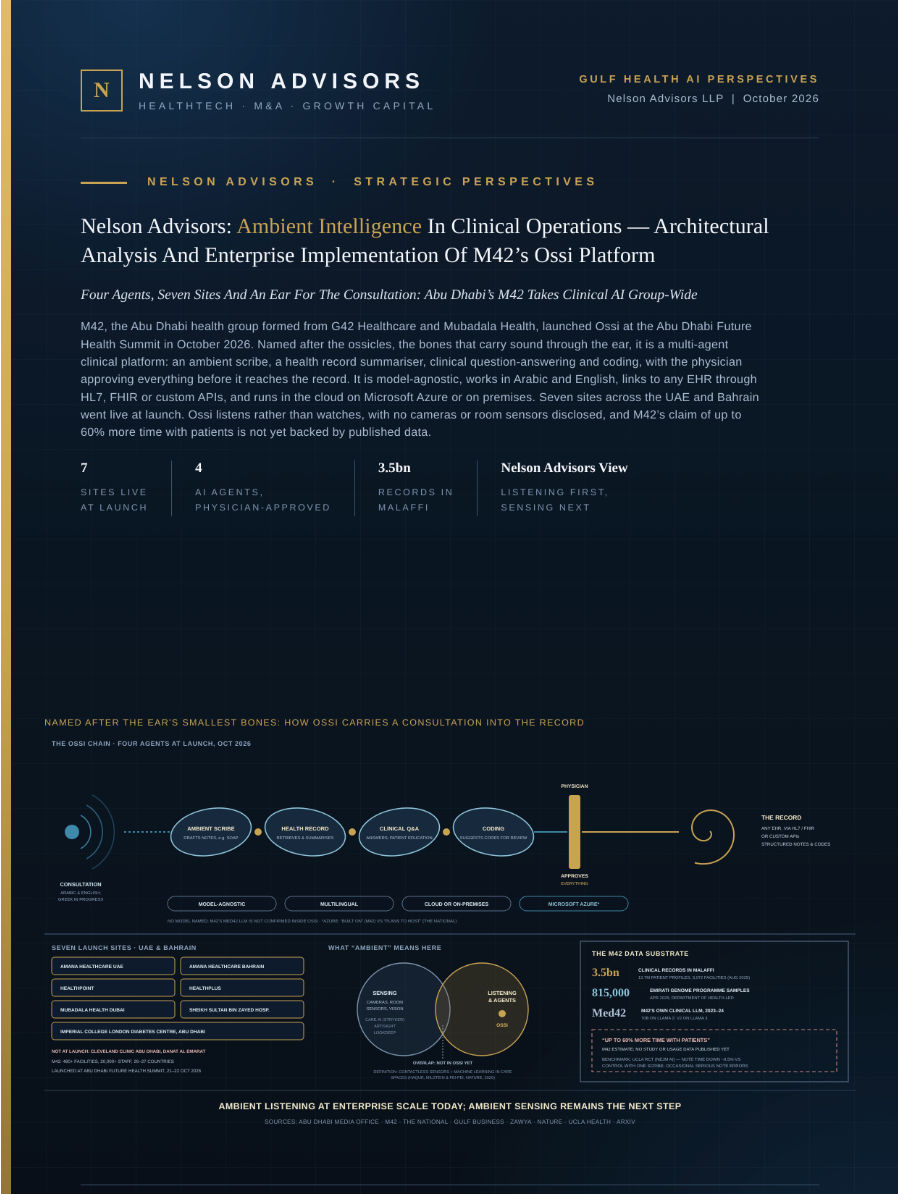
Strategic Context
The excessive documentation burden imposed on modern healthcare systems represents one of the most critical contributors to clinician burnout, cognitive fatigue, and clinical operational inefficiency worldwide. In response to this systemic strain, Abu Dhabi-based tech-enabled healthcare enterprise M42 unveiled Ossi, an enterprise grade ambient artificial intelligence clinical platform.
Formally introduced in October 2026 at the Abu Dhabi Future Health Summit, Ossi represents an engineering and commercial partnership between M42 and Microsoft, combining sovereign clinical software design with Microsoft Azure's hyperscale cloud and artificial intelligence infrastructure.
Engineered to sit beside existing Electronic Medical Record (EMR) systems rather than replacing legacy database architectures, the platform deploys a multi agent topology to orchestrate pre-consultation synthesis, intra-consultation ambient documentation, and post consultation administrative coding.
M42 was established in 2023 through the strategic consolidation of G42 Healthcare and Mubadala Health, creating an integrated powerhouse combining specialized hospital networks, genomics research and national-scale health data infrastructure. Operating regional digital health backbones, including the Abu Dhabi Health Data Services (ADHDS) and the Malaffi Health Information Exchange (HIE), M42 occupies a unique vantage point spanning centralised health informatics and bedside clinical delivery.
The platform’s etymology reflects its biomimetic functional philosophy. The name "Ossi" is derived from the ossicles, the three micro-bones within the human middle ear that mechanically amplify, refine and transmit acoustic signals to the inner ear. Functioning analogously, Ossi passively captures ambient clinical acoustic dialogues, extracts pertinent clinical facts, strips conversational irrelevancies and augments clinical context by cross-referencing longitudinal patient records and evidence-based clinical guidelines.
The system reflects an expanding technological alliance between G42, M42, and Microsoft, which includes enterprise-scale cloud migrations and the integration of M42's clinical large language models, such as the 85.1 percent USMLE-scoring Med42, into the Microsoft Azure AI model catalog. Ossi serves as the operational clinical expression of this alliance, transitioning ambient generative AI from experimental benchmarks into high throughput clinical practice.
Platform Architecture and Multi Agent Framework
Ossi is architected around an extensible, model agnostic, multi agent framework built on M42's proprietary software design and supported by Microsoft Azure AI infrastructure. Rather than relying on a single, monolithic large language model that is prone to context window saturation and unconstrained hallucination, Ossi routes complex clinical interactions through four specialised cognitive agents. This separation of responsibilities guarantees that specific tasks, such as acoustic phoneme transcription, chronological record parsing, clinical guidelines retrieval and billing code taxonomy matching, are handled by dedicated sub-modules with task-specific guardrails.
The system architecture runs across cross-platform environments, including desktop workstations, clinical tablet interfaces, and mobile devices, providing real time synchronisation with institutional databases. By remaining LLM agnostic, the platform retains the architectural latitude to leverage diverse foundational models hosted within Microsoft Azure, balancing cost, inference latency and clinical domain expertise.
Agent Designation | Consultation Phase | Core Functional Mandate | Primary Input Streams | Output Artifacts | Clinical Oversight Level |
Health Record / Patient Summary Agent | Pre-Consultation | Synthesis of historical longitudinal clinical records and care gap detection | Historical EMR encounters, lab panels, radiology archives, active drug profiles | Chronological pre visit summaries, abnormal trajectory alerts, triage checklists | Clinician passive review prior to encounter |
Ambient Scribe Agent | Intra Consultation | Continuous multi-party acoustic transcription and clinical document drafting | Multi-speaker ambient room audio, multilingual clinical dialogue | Structured SOAP notes, drafted specialty referral letters | Active clinician review, voice-editing, and signature |
Clinical Q&A / Chat Agent | Intra & Post Consultation | Contextual decision support and dynamic patient education drafting | Physician natural language queries, clinical protocols, regional guidelines | Evidence-based treatment suggestions, localized bilingual patient education materials | Clinician discretion and discretionary validation |
Coding Agent | Post Consultation | Semantic extraction and mapping of clinical documentation to billing taxonomies | Validated clinical notes, procedural interventions, diagnostic rationale | Candidate ICD, CPT, and Evaluation and Management (E&M) codes | Dual authorisation by clinician and medical billing staff |
A major technical attribute of Ossi’s acoustic and NLP pipeline is its regional language optimization. Clinical consultations across Middle Eastern healthcare systems frequently present complex sociolinguistic challenges, particularly intra sentential code switching, where healthcare professionals and patients rapidly alternate between regional Arabic dialects, Modern Standard Arabic and technical English medical terminology.
Ossi's underlying speech to text and tokenisation pipelines are trained to process multi dialect code switching without phonetic breakdown, distinguishing between conversational narrative and precise clinical symptomatology. In addition to processing Arabic and English, the platform’s engineering roadmap includes localisation for European and Mediterranean languages, including Greek, to facilitate broader international scalability.
Tri Phasic Clinical Workflow Mechanics
The operational integration of Ossi spans the entire patient care continuum, avoiding the fragmentation common to point solutions that address only documentation transcription. By embedding continuous intelligence before, during and after the consultation, the platform eliminates documentation friction without requiring physicians to divert their physical attention from the patient to keyboard based data entry.
Encounter Phase | Platform-Driven System Actions | Direct Clinician Workflow Actions | Standardised Output Formats |
Pre Consultation | • Extracts and clusters multi-source longitudinal EMR data • Highlights historical abnormal lab curves and imaging notes • Matches active diagnoses against clinical care protocols | • Reviews consolidated chronological pre-encounter brief • Authorizes nursing pre-visit preparation checklists • Formulates visit focus prior to entering exam room | Longitudinal executive summary, nursing triage checklist, diagnostic trend table |
Intra Consultation | • Passively parses ambient conversational acoustics • Differentiates physician statements from patient symptom narratives • Synthesises structured SOAP notes in background • Translates medical plans into patient instructions | • Engages in direct, uninterrupted physical and verbal consultation • Queries Chat Agent for evidence-based therapy pathways • Requests patient education documents in appropriate dialect | Live draft SOAP note, point of care clinical queries, bilingual patient education hand outs |
Post Consultation | • Formats unstructured transcript into hospital-specific templates • Extracts clinical rationale to suggest matching ICD/CPT codes • Prepares comprehensive specialty referral letters • Dispatches verified files to core EMR via FHIR APIs | • Appends omitted physical exam findings via voice dictation • Executes verbal or tactile inline corrections of draft text • Signs attestation for medical record entry • Approves proposed billing and coding selections | Signed EMR progress note, finalised referral communication, validated billing code batch |
In the pre-consultation phase, the Health Record Agent eliminates the extensive preparation times typically required for chronic and subspecialty patients. In high complexity specialties such as medical oncology, endocrinology, or multi-system rheumatology, clinicians routinely expend considerable time cross-referencing historical encounters, biopsy findings, radiological progression reports and complex pharmacotherapies. The agent automatically synthesises this multi-year history into a standardised pre-visit diagnostic summary, pinpointing active therapeutic trajectories and generating pre-encounter nursing checklists for vital screening protocols.
During the intra consultation phase, the clinician initiates ambient listening across an authorised mobile terminal, workstation microphone, or tablet interface. The Scribe Agent structures the ambient stream dynamically, removing ambient noise, clinical interruptions, and non-clinical conversational exchanges while drafting documentation in the standard Subjective, Objective, Assessment, and Plan (SOAP) layout. Simultaneously, the physician can interact with the Clinical Q&A Agent to cross reference verified clinical guidelines or local health department protocols, as well as generate patient education summaries in clear, localised Arabic for printing or transmission to digital patient front doors.
In the post consultation phase, the clinician performs an expedited review of the generated documentation. Using conversational voice editing commands or keyboard input, the physician refines the synthesised draft. Concurrently, the Coding Agent evaluates documented clinical decisions and procedures, proposing compliant International Classification of Diseases (ICD), Current Procedural Terminology (CPT), and Evaluation and Management (E&M) codes. The physician verifies the output and upon formal attestation, the platform synchronises the finalised documentation directly into the hospital's central EMR.
EMR Interoperability and Regional Infrastructure
A central engineering priority of the Ossi platform is its non disruptive, side by side integration model. Historically, hospital implementations of external cognitive tools have experienced low clinical adoption due to interface fragmentation, workflow disruptions and clunky manual copy paste requirements. Ossi is designed to sit alongside existing hospital electronic medical records without altering the underlying clinical information system, operating as a synchronised, parallel intelligence layer.
To maintain an EMR agnostic deployment capability across diverse health IT ecosystems, Ossi utilises a tri-part interoperability suite. The platform employs Health Level Seven (HL7) messaging protocols for transactional event messaging, admission, discharge and transfer (ADT) feeds, and institutional schedule tracking. For dynamic, programmatic clinical data queries and documentation writing, Ossi integrates with Fast Healthcare Interoperability Resources (FHIR) RESTful APIs, facilitating bidirectional synchronisation of standardised resources including Condition, Observation, DiagnosticReport, and DocumentReference.
Where legacy health informatics platforms lack native modern FHIR endpoints, the system communicates via bespoke enterprise APIs engineered to interface securely with proprietary database layers.
This standards compliant interoperability is augmented by M42’s institutional relationship with Abu Dhabi Health Data Services, the operating entity of Malaffi. As the regional Health Information Exchange for Abu Dhabi, Malaffi connects 100 percent of public and private hospitals across the emirate, aggregating clinical records for over 12.2 million unique patient profiles across more than 3,000 facilities. Ossi operates within an ecosystem engineered for data liquidity, allowing its record retrieval and pre-visit summarisation engines to reference connected health data networks using open standards.
Multi Centre Deployment Footprint across the UAE and Bahrain
Rather than executing an isolated laboratory proof-of-concept, M42 simultaneously activated Ossi across seven prominent clinical facilities within its regional operating network, exposing the platform across acute, ambulatory, subspecialty, and long-term care environments.
Healthcare Center | Geographic Territory | Facility Classification | Clinical Focus & Specialty Diversity | Operational Role in Ossi Network |
Healthpoint | Abu Dhabi, UAE | Multi-Specialty Acute Hospital | Inpatient and day surgery, orthopedics, gastroenterology, sports medicine | Complex surgical, endoscopic, and research-heavy documentation validation |
HealthPlus Network | UAE (Multi-Site) | Distributed Ambulatory Center | Reproductive health, fertility (IVF), women's health, family medicine | High-volume outpatient specialty documentation and rapid-turnaround charting |
Mubadala Health Dubai | Dubai, UAE | Multi-Specialty Outpatient & Day Clinic | Primary care, family medicine, internal subspecialties, day surgery | Ambulatory primary care workflow optimization and general practitioner efficiency |
Sheikh Sultan bin Zayed Hospital | Al Batayeh (Sharjah), UAE | 200-Bed Military-Civilian Hospital | Multidisciplinary acute care, 24/7 emergency medicine, military family health | Large-scale inpatient, trauma, and Northern Emirates community care evaluation |
Imperial College London Diabetes Centre | Abu Dhabi, UAE | Tertiary Academic Specialty Center | Complex endocrinology, metabolic management, diabetes complications | Chronic disease management, longitudinal lab analysis, and multi-visit tracking |
Amana Healthcare UAE | UAE (Multi-Site) | Complex Post-Acute Hospital | Inpatient medical rehabilitation, long-term complex care, pediatric therapy | Interprofessional documentation, long-term multidisciplinary care plans |
Amana Healthcare Bahrain | Bahrain Bay, Bahrain | Post-Acute & Sub-Acute Center | Comprehensive sub-acute rehabilitation, transitional care, restorative therapy | Cross-border Azure cloud deployment and international expansion testing |
The multi centre footprint provides significant operational diversity. Sheikh Sultan bin Zayed Hospital in Sharjah, a 45,000-square-meter acute facility operated through an institutional military civilian partnership between M42 and the UAE Ministry of Defence, presents high-volume inpatient and emergency encounters across more than 20 surgical and medical disciplines.
In contrast, the Imperial College London Diabetes Centre in Abu Dhabi tests the platform's ability to track long-term chronic patient panels characterized by complex metabolic and pharmaceutical variables. Deployments at Amana Healthcare facilities across the UAE and Bahrain Bay test the software's capability to assist multi-disciplinary therapy teams, nursing workflows, and post-acute treatment transitions across regulatory jurisdictions.
Regulatory Compliance, Data Governance and Safeguards
Deploying ambient artificial intelligence systems within clinical environments introduces rigorous regulatory and technical requirements concerning patient confidentiality, sovereign data localisation, and medical negligence liability. The governance framework supporting Ossi was developed to align directly with federal healthcare laws in the United Arab Emirates, data protection mandates established by the UAE Cyber Security Council and standards set by the Department of Health Abu Dhabi.
To satisfy regional data residency requirements, Ossi utilizes Microsoft Azure sovereign cloud instances hosted within secure UAE data centers. Identifiable clinical dialogues, transcribed records, and patient identifiers are processed within local data protection perimeters, mitigating the jurisdictional vulnerabilities associated with routing protected health information to overseas cloud regions. Network transactions are subject to enterprise encryption standards in transit and at rest, alongside strict role-based access controls (RBAC).
To manage patient safety risks, the system addresses clinical hallucination, where generative models fabricate medical conditions, medication dosages, or clinical findings, through an enforced "human-in-the-loop" governance model:
The platform does not possess autonomous write, commit, or order authority within host EMR databases. Every summarised record, progress note, and suggested billing code is generated strictly in provisional draft status. Under regional healthcare law and institutional clinical governance guidelines, full medical-legal accountability remains exclusively with the licensed healthcare provider.
The physician must review, correct any clinical nuances, and electronically sign the documentation before it becomes a permanent legal record. From an IT governance perspective, enterprise buyers must note areas requiring continued evaluation.
Public vendor disclosures have not yet published standardised clinical metrics, such as Word Error Rates across colloquial Arabic dialects, multi-specialty transcription error rates, or formal external algorithmic safety audits. Independent empirical clinical auditing will remain vital as deployments transition from affiliated M42 facilities to broader third-party networks.
Measurable Clinical Impact and Healthcare Economics
Early operational metrics from Ossi's deployment across the UAE and Bahrain point to substantial efficiency gains in clinical administrative workflows and resource allocation.
Clinical Operational Dimension | Conventional Baseline Practice | Performance with Ossi Implementation | Primary Clinical & Economic Driver |
Complex Chart Review (e.g., Medical Oncology) | 180 to 240 minutes per complex encounter | Less than 10 to 15 minutes per complex encounter | Health Record Agent synthesizes multi-year diagnostics into chronological briefs |
Clinician-Patient Face-to-Face Time | 30% to 40% of encounter spent facing workstation screen | Up to 60% increase in direct face-to-face engagement | Scribe Agent captures conversation silently in background |
Documentation Latency | Hours of delayed evening charting ("pajama time") | Real-time, at-elbow SOAP draft generation for immediate signing | Automated conversion of room acoustics to structured clinical templates |
Billing & Coding Capture Efficiency | Manual physician code selection or retroactive back-office audits | Real-time ICD, CPT, and E&M semantic recommendations | Coding Agent cross-references clinical narrative to maximize reimbursement capture |
Medical Examination Performance Benchmark | 60.0% standard passing score (USMLE) | 85.1% zero-shot accuracy achieved by M42’s Med42 LLM | Curated clinical domain dataset fine-tuning on hyperscale architecture |
The most immediate operational impact of the platform is the mitigation of chart review bottlenecks in high-complexity outpatient settings. In subspecialty care, reviewing extensive longitudinal records often strains hospital scheduling, forcing clinicians to complete administrative preparation outside standard working hours. Compressing this review window from up to four hours down to less than 15 minutes enables subspecialty clinics to expand appointment capacity while maintaining thorough diagnostic evaluations.
Qualitative feedback from practicing clinicians reinforces these operational metrics. Primary care physicians at Mubadala Health Dubai report smoother consultation workflows, while specialised orthopaedic surgeons at Healthpoint note reductions in documentation fatigue, fewer language translation errors, and better maintenance of individual clinical voice.
From a revenue cycle management (RCM) perspective, the platform strengthens operational margins by reducing billing friction. In traditional healthcare administrative workflows, fatigued clinicians frequently under-document secondary diagnoses or select imprecise diagnostic codes to save time, leading to down-coding, denied claims, and downstream reimbursement leakages. By parsing clinical text comprehensively, the Coding Agent suggests high-fidelity ICD and CPT coding combinations that reflect true clinical acuity, accelerating claims adjudication, reducing rejections, and optimising hospital revenue integrity.
Strategic Implications and Global Outlook
The development and deployment of Ossi marks a notable shift in digital health strategy, moving away from reactive point software toward proactive ambient intelligence. Supported by M42's Digital Health Solutions platform and built on Microsoft Azure, the system is designed to expand beyond its foundational footprint in Abu Dhabi, the Northern Emirates, and Bahrain.
Through its enterprise collaboration with Microsoft, M42 is positioning Ossi for international expansion, targeting multi-facility health systems across Europe, North America, and emerging markets in the Global South. The engineering expertise gained from operating within Abu Dhabi's complex healthcare demographic, specifically managing multi lingual code-switching, fragmented private-public payer environments, and diverse EMR standards, provides a resilient architectural foundation for global deployment.
By functioning as an EMR-agnostic layer, maintaining human clinical attestation, and supporting workflows across all consultation phases, Ossi offers a compelling operational model for ambient clinical AI. Long-term success will rely on continuing transparent algorithmic auditing, publishing empirical diagnostic error metrics, and consistently returning valuable administrative time to the physician-patient relationship.
Nelson Advisors > European Healthcare Technology Investment Banking
Nelson Advisors specialise in Mergers and Acquisitions for European HealthTech, MedTech, Digital Health, Healthcare IT, Healthcare AI companies in the Lower to Mid Market ranging from $25M to $250M EV. www.nelsonadvisors.co.uk
Healthcare.Digital is the Google News approved HealthTech and MedTech Thought Leadership platform for Nelson Advisors, positioning them as a specialised authority on European Healthcare Technology M&A and strategic corporate development. https://www.healthcare.digital
Nelson Advisors publish Europe's Leading Healthcare Technology Investment Banking Newsletter every week, join 5000+ HealthTech and MedTech subscribers today! https://lnkd.in/e5hTp_xb
Nelson Advisors LLP
Hale House, 76-78 Portland Place, Marylebone, London, W1B 1NT
Meet Nelson Advisors @ Events in 2026
Digital Health Rewired > March 2026 > Birmingham, UK
NHS ConfedExpo > June 2026 > Manchester, UK
HLTH Europe > June 2026, Amsterdam, Netherlands
HIMSS AI in Healthcare > July 2026, New York, USA
Bits & Pretzels > September 2026, Munich, Germany
HealthInvestor Healthcare Summit > September 2026, London, UK
World Health Summit 2026 > October 2026, Berlin, Germany
HLTH USA 2026 > October 2026, USA
Global Health Exhibition 2026 > October 2026, Riyadh, Saudi Arabia
Web Summit 2026 > November 2026, Lisbon, Portugal
MEDICA 2026 > November 2026, Düsseldorf, Germany
Leaders in Health Summit 2026 > November 2026, London, UK
Venture Capital World Summit > December 2026, Toronto, Canada
Meet Nelson Advisors @ Events in 2027
Digital Health Rewired > March 2027 > Birmingham, UK
Barclays Health Elevate > March 2027, London, UK
NHS ConfedExpo > June 2027 > Manchester, UK
HLTH Europe > June 2027, Amsterdam, Netherlands


Comments