Nelson Advisors: The Strategic and Architectural Implications of Nvidia’s Investment in Doctolib for European Healthcare

Transaction Architecture and Corporate Structuring
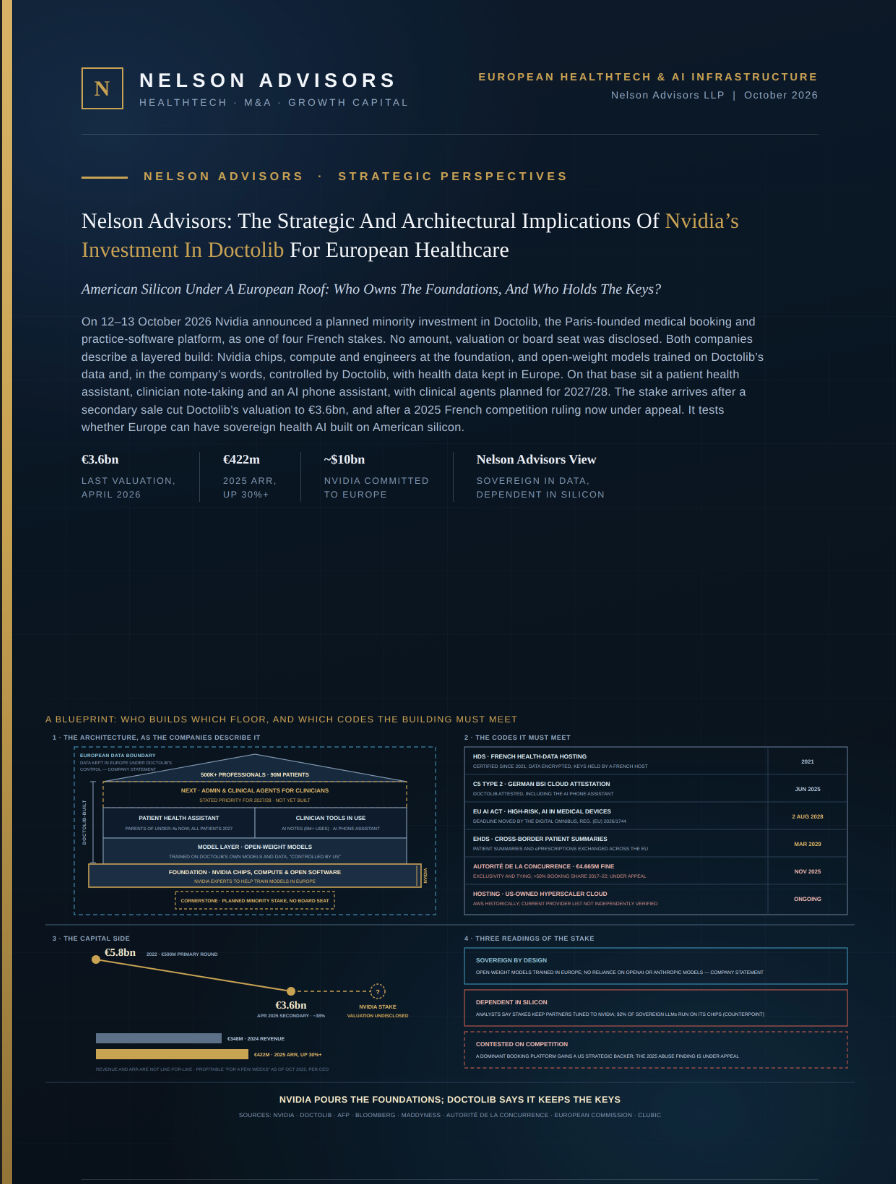
In October 2026, Nvidia Corporation entered into a definitive agreement to acquire a minority equity stake in Doctolib, the preeminent European digital health platform. Unveiled by Nvidia Chief Executive Jensen Huang during an executive reception at Place Vendôme in Paris alongside French Economy Minister Roland Lescure, the transaction was announced in parallel with minority positions in three additional French frontier technology ventures: Genesis AI, Pigmen and Entalpic.
The investment forms a programmatic element of Nvidia’s multi billion dollar European capital deployment strategy, which includes nearly $10 Billion in capital commitments across the continent, the recent $12.9 Billion acquisition of France founded artificial intelligence platform Hugging Face, and a $250 Million compute commitment dedicated to the United Kingdom’s AI safety and foundational research infrastructure.
Transaction Parameter | Detail | Strategic Context |
Investing Entity | Nvidia Corporation (Santa Clara, CA) | Securing downstream domain-specific compute demand across vertical industries. |
Target Entity | Doctolib (Paris, France) | Dominant European medical scheduling, electronic patient record, and workflow operator. |
Investment Structure | Minority equity stake (financial terms undisclosed) | Non-controlling balance sheet investment via corporate venture capital. |
Governance Allocations | Zero board representation / no supervisory seat | Structures the investment to insulate against European digital sovereignty blowback. |
Doctolib Enterprise Valuation | ~€3.6 Billion in secondary transactions (spring 2026) | Represents a market-clearing discount from the €5.8 Billion peak valuation achieved in 2022. |
Target Operational Footprint | 580,000 healthcare professionals; 100 million patients | Primary operational footprint spanning France, Germany, Italy, the Netherlands, and the UK. |
Target Operating Financials | €422 Million ARR (2025); operating profitability reached | Achieved cash-flow self sufficiency, de-risking external capital dependence. |
A critical detail of the transaction is Nvidia’s concession to forego representation on Doctolib’s supervisory board. This deliberate exclusion decouples financial and technical backing from operational governance, neutralising immediate political resistance concerning foreign corporate oversight of essential national health data channels. Because Doctolib crossed into operational profitability during fiscal year 2025 and sustained recurring revenues exceeding €422 million, the transaction was not driven by balance-sheet insolvency or liquidity requirements.
Rather, the infusion represents a strategic co-development pact designed to provide the platform with specialised machine learning engineering personnel, priority allocation of high-density graphics processing units (GPUs) and the systems software necessary to build proprietary healthcare models.
Technological Convergence: Hardware Infrastructure and Proprietary Clinical Models
The operational foundation of the Doctolib-Nvidia partnership accelerates a fundamental shift in European enterprise AI: the abandonment of third party, closed source foundation models accessed via external Application Programming Interfaces (APIs) in favour of sovereign, vertically integrated small and medium language models. Relying on offshore frontier models, such as those operated by OpenAI or Anthropic, presents acute regulatory, latency and data protection vulnerabilities for European healthcare systems. In response, Doctolib has structured its technical roadmap around training, pruning and self-hosting domain-adapted models within European legal and physical boundaries, relying directly on Nvidia’s hardware and open-source software libraries.
This migration builds on an existing one year operational partnership between the two companies that has now expanded into joint engineering workflows. Nvidia’s engineering teams are providing architectural guidance to optimise training pipelines for clinical automated speech recognition (ASR) and natural language generation, targeting the complex linguistic realities of European healthcare. These clinical models must process multilingual doctor-patient dialogues characterised by dense medical terminology, colloquial patient symptom descriptions, rapid speaker turn-taking, and localised pharmacological nomenclatures across French, German, Italian and English.
To support real-time consultation documentation without perceptible latency, the underlying models are trained and executed on Nvidia’s accelerated computing architectures, including Blackwell and Hopper infrastructure deployed in sovereign European cloud facilities such as Scaleway’s regional sites, utilising Nvidia’s specialised toolkits, such as cuDF and the Nemotron model families. Model distillation, quantisation and tensor acceleration allow Doctolib to compress parameter counts while maintaining high diagnostic and summarisation fidelity. This architecture yields a critical economic and clinical outcome: reducing the unit compute cost per clinical encounter to a level where ambient AI documentation and real-time clinical synthesis can be bundled sustainably into standard software subscriptions without external API fees.
Clinical Workflow Modernisation and Patient Facing Care Trajectories
The technical collaboration targets operational bottlenecks across the European healthcare sector, which is increasingly burdened by aging demographics, structural clinician deficits and administrative fatigue. The resulting clinical toolsets segment into two interconnected operational environments: physician facing administrative automation and citizen-facing preventative health coordination.
Application System | Intended End Users | Underlying Technical Mechanism | Clinical and Administrative Objective | Operational Horizon |
Assistant de Consultation (Ambient Scribe) | General Practitioners and Allied Specialists | Edge-transcribed clinical ASR, structured medical entity extraction, and prompt-based clinical templating. | Eliminates keyboard data entry during visits; compiles clinical synthesis, prescriptions, and specialist referral drafts in under 15 seconds. | Commercial production; over 12 million consultations documented to date. |
Clinical Decision Support (CDS) | Outpatient Practitioners and Hospital Clinicians | Retrieval-Augmented Generation (RAG) mapped to clinical guidelines, drug-interaction indices, and patient history. | Flags therapeutic counter-indications, suggests preventative diagnostic tests, and calculates longitudinal clinical risk metrics. | Advanced research validation with French public academic institutes. |
Administrative and Practice Agents | Medical Secretaries and Administrative Staff | Multi-task language models executing inbound call triage, scheduling logic, and dynamic billing parsers. | Automates practice intake queues, complex insurance code translation, and cross-provider document sorting. | Progressive phased rollout across outpatient clinics throughout 2026–2027. |
Personal Health Companion | Registered Patients (General Population) | Patient-facing conversational model with integrated health-literacy translation and triage routing. | Translates medical jargon into accessible summaries, tracks chronic disease regimens, and navigates patient booking pathways. | 400,000 active pilot users; full deployment scheduled for 2027. |
The primary vector of transformation is administrative de-burdening. In outpatient medical practices across Western Europe, physicians allocate between one-third and one-half of consultation time to administrative input, medical record maintenance, and coding tasks.
The ambient Consultation Assistant operates passively in the consultation room, transcribing the physician-patient exchange, extracting vital signs, diagnostic hypotheses, and prescribed regimens, and formatting the data into formal medical records in under 15 seconds. The clinical interface relies strictly on a "human-in-the-loop" structure; no clinical synthesis, prescription, or referral letter can be merged into an official patient dossier without the explicit review, manual modification, and final authorisation of the practitioner. This maintains clear malpractice accountability while returning direct conversational time to patient care.
Simultaneously, the development of the Personal Health Companion represents an architectural pivot from reactive consultation management to proactive health navigation. Operating across Doctolib's existing European patient base, the tool acts as an always-accessible health intermediary. The companion helps demystify technical medical correspondence, contextualises laboratory diagnostics, sends preventative screening prompts, and conducts preliminary algorithmic triage to recommend the appropriate care setting. By intercepting non-urgent cases and guiding patients toward appropriate primary care or pharmacy pathways, the system is designed to alleviate chronic overcrowding in emergency departments and reduce the misallocation of acute hospital resources.
Regulatory Friction, Data Sovereignty and the Legal Architecture
The entrance of an American technology giant into the equity structure of a central repository of European health records intensifies the debate over digital sovereignty, data governance and regulatory compliance. To reconcile public sensitivities with technological collaboration, Doctolib and European regulators rely on a bifurcated structural framework that isolates sovereign clinical data from globalised computing power.
Under this operational architecture, sensitive medical data never touches external infrastructure.
Patient dossiers, voice transcriptions and clinical interactions remain strictly within certified European health data hosting facilities (Hébergeur de Données de Santé, HDS) and local server nodes under the sole legal control of Doctolib, maintaining full compliance with the General Data Protection Regulation (GDPR) and ISO 27001/27701 certifications. All model distillation, fine-tuning and inference execution take place within these European cloud zones.
Nvidia’s role is strictly confined to the supply of accelerated hardware, systems architectures, and open software frameworks; its equity ownership confers neither rights to inspect underlying patient databases nor operational governance over the data controllers. By training open-weight foundation models locally on dedicated hardware, Doctolib effectively circumvents the legal vulnerabilities associated with US cloud providers subject to the extraterritorial jurisdiction of the US CLOUD Act.
Despite these jurisdictional safeguards, the venture operates amid persistent domestic scrutiny regarding the secondary commercial reuse of sensitive population records. In August 2026, Doctolib launched an advanced artificial intelligence clinical research initiative in collaboration with public research bodies, including Inria, INSERM, and Université Paris Cité’s HeKA laboratory.
The program leverages pseudonymised consultation notes, historical prescriptions, and diagnostic records drawn from Doctolib’s patient base to establish clinical risk estimation metrics and evaluate the probabilistic certainty of generative models in medical contexts. To process these clinical datasets, Doctolib invoked the French Data Protection Authority’s (CNIL) Reference Methodology MR-004, an administrative mechanism that dispenses with individual, affirmative prior consent for public-interest health research, provided that individuals are notified and granted a direct opt-out.
This mechanism has triggered legal and ethical challenges from patient advocacy organizations and civil liberties groups, such as the Ligue des droits de l'Homme. Critics argue that the opt-out mechanisms are buried within user account menus, effectively exploiting consumer inertia to feed proprietary algorithmic engines. The participation of Nvidia—a commercial firm with a multi-trillion-dollar enterprise value—magnifies public concern that non-consensual European health data is being extracted to generate intellectual property for commercial systems, even when governed under public research rubrics.
Furthermore, as Doctolib transitions its toolsets from ambient administrative transcription to automated clinical decision support and patient-facing triage, the regulatory classification of its portfolio changes under European law. Under the European Union Artificial Intelligence Act (EU AI Act), software systems intended to assist clinicians in diagnostic reasoning or triage individuals during acute medical events are classified as High-Risk AI systems. This designation imposes stringent pre-market conformity assessments, detailed algorithmic documentation, rigorous bias testing against diverse patient demographics, and automated post-market logging architectures.
Concurrently, under the European Medical Device Regulation (EU MDR 2017/745), decision-support algorithms that infer clinical risk or alter patient trajectories fall outside the scope of simple administrative documentation and require Class IIa or higher CE-mark certification. Navigating this dual regulatory matrix requires extensive clinical trials, formal institutional auditing, and extended development cycles that significantly complicate the speed of enterprise deployment.
Market Dynamics: Platform Monopolies, AI Scribes and Hybrid Sovereignty
The strategic alliance between Nvidia and Doctolib alters the competitive ecosystem across European healthtech, creating profound structural headwinds for modular, venture-backed startups while clarifying the boundaries of European technology independence.
Over the preceding three years, European venture capital financed a competitive wave of focused digital health startups developing ambient medical transcription tools and clinical copilots. Entities such as Nabla in France, Tandem Health in Sweden (which secured an €86 million funding round in 2026 to position itself as Europe’s ambient clinical infrastructure), Heidi Health, and Corti have developed highly accurate, specialized clinical transcription products. However, modular AI scribes face a major go-to-market barrier: EHR integration friction. To deliver economic value, a third-party scribe must integrate into heavily fragmented, regionally siloed, and often closed practice management platforms and hospital information systems.
Doctolib commands a massive competitive distribution advantage. By natively embedding its consultation assistant directly into its dominant scheduling, teleconsultation, and electronic patient record interface, Doctolib eliminates software context switching and integration costs for its 580,000 healthcare professionals.
Because Doctolib can cross-subsidize its ambient AI assistant through its comprehensive enterprise practice-management tiers, point-solution transcription startups face platform disintermediation and pricing pressure. The commercial threat is compounded by Doctolib’s aggressive expansion into international markets, evidenced by its acquisition of UK-based Medicus Health to capture market share within National Health Service (NHS) general practice networks.
Concurrently, the partnership exposes the foundational paradox of Europe’s technology autonomy agenda. European political leaders frequently champion complete "Sovereign AI," envisioning an indigenous software, data, and hardware stack isolated from American or Chinese technology dependency. In the digital health domain, Doctolib demonstrates that algorithmic and data sovereignty is attainable: European health data remains stored in certified local repositories, and model architectures are designed, fine-tuned, and controlled by European engineers in concert with regional academic bodies.
However, this algorithmic layer remains entirely reliant on foreign hardware. There is currently no European commercial alternative to Nvidia’s accelerated computing architectures, memory bandwidth, and software stacks capable of training and serving multi-modal medical models at national scale. European healthcare has thus adopted a "hybrid sovereignty" model: digital health operations maintain European data sovereignty and application logic, but run on American computing hardware.
This structural hardware dependency has drawn renewed attention to the venture capital strategies of mega-cap chipmakers. Financial observers, including the International Monetary Fund, have highlighted the risks of circular financing in corporate technology investments. Under this economic model, dominant hardware manufacturers take strategic minority equity stakes in AI scale-ups, which subsequently allocate substantial portions of that invested capital toward the investor's hardware systems, cloud instance hours, and proprietary developer ecosystems.
While Nvidia rejects the premise that these capital commitments represent balance-sheet engineering—arguing that minority investments provide the non-dilutive computational fuel necessary to catalyze Europe's enterprise ecosystem, the commercial outcome is clear: by aligning with Doctolib, Nvidia entrenches its CUDA architecture as the foundational standard for European healthcare computing, raising switching costs and marginalising potential semi conductor alternatives from AMD, Intel, or prospective European open architecture silicon initiatives.
Long Term Outlook for European Healthcare Delivery
The integration of Nvidia’s accelerated computing systems into Doctolib’s European operations signals the transition of digital healthcare from basic logistical coordination into intelligent operational automation. Over a three to five year horizon, this alignment points to four structural developments across the European digital health landscape:
First, ambient clinical documentation will transition from a discretionary efficiency tool to a mandatory standard of practice across European health systems. As documented deployment exceeds tens of millions of clinical encounters, the administrative savings realised by outpatient practices will alter healthcare labour economics. General practitioners using ambient scribes can recover significant administrative hours weekly, expanding patient appointment capacity and relieving structural primary care shortages across rural and underserved areas.
Second, the technical architecture of healthcare computing will consolidate around federated, locally hosted, parameter efficient language models rather than centralised, general purpose frontier platforms. The operational and legal demands of European healthcare favour models that perform discrete medical tasks, ambient dictation, diagnostic code synthesis and clinical risk evaluation, within local server architectures. Doctolib's strategy will serve as an enterprise template for hospitals and regional health authorities looking to deploy localised intelligence without sending sensitive patient data across international borders.
Third, platform consolidation will attract heightened antitrust intervention from European competition authorities. In late 2025, France’s Autorité de la concurrence sanctioned Doctolib with a €4.6 million fine for abuse of dominance, citing anticompetitive exclusivity clauses and the tied bundling of teleconsultation services to its core booking platform. As Doctolib embeds proprietary AI scribes, practice management billing tools, clinical decision systems and consumer facing health navigation tools into an integrated software ecosystem, regulatory scrutiny will intensify regarding potential self-preferencing and the foreclosure of independent healthtech entrants.
Fourth, the ongoing controversy surrounding the secondary use of clinical records under research frameworks like MR-004 will force a definitive legal reconciliation between commercial artificial intelligence training and European privacy law. With public concern growing over big tech's presence in health systems, the European Health Data Space (EHDS) and national privacy regulators will face increasing pressure to clarify secondary data reuse rules. Regulators must delineate clear boundaries between scientific research and commercial model training, establishing explicit standards for whether commercial scale-ups may extract value from public health data without affirmative patient consent.
Nvidia’s capital backing of Doctolib confirms that the focus of artificial intelligence has moved beyond generic foundation models to specialised vertical deployment. By anchoring the world's leading accelerated computing stack within Europe’s most widely used outpatient network, the transaction establishes the core infrastructure and exposes the unresolved dependencies of sovereign clinical intelligence operating within a global technology framework.
Nelson Advisors > European Healthcare Technology Investment Banking
Nelson Advisors specialise in Mergers and Acquisitions for European HealthTech, MedTech, Digital Health, Healthcare IT, Healthcare AI companies in the Lower to Mid Market ranging from $25M to $250M EV. www.nelsonadvisors.co.uk
Healthcare.Digital is the Google News approved HealthTech and MedTech Thought Leadership platform for Nelson Advisors, positioning them as a specialised authority on European Healthcare Technology M&A and strategic corporate development. https://www.healthcare.digital
Nelson Advisors publish Europe's Leading Healthcare Technology Investment Banking Newsletter every week, join 5000+ HealthTech and MedTech subscribers today! https://lnkd.in/e5hTp_xb
Healthcare.Digital serves as a research platform for Nelson Advisors’ perspectives on deals, valuations and structural shifts reshaping Global Digital Health, MedTech, Healthcare AI and Health IT. https://www.healthcare.digital
Nelson Advisors is one of Europe's leading mergers and acquisitions advisory firms, exclusively dedicated to the dynamic and rapidly evolving healthcare technology sector. With a deep understanding of market dynamics and technological advancements, they empower innovative HealthTech companies and strategic investors to navigate complex transactions and achieve their growth ambitions. www.nelsonadvisors.co.uk
#NelsonAdvisors #HealthTech#MedTech#DigitalHealth #HealthIT #Cybersecurity #HealthcareAI #FemTech#ConsumerHealth #Mergers #Acquisitions #Partnerships #Growth #Strategy #NHS #UK #Europe #USA #Canada#Commonwealth#CorporateDivestitures #VentureCapital #PrivateEquity #Founders #SeriesA #SeriesB #Founders #SellSide #TechAssets #Fundraising #BuildBuyPartner #GoToMarket #PharmaTech #Genomics
Nelson Advisors
Hale House, 76-78 Portland Place, Marylebone, London, W1B 1NT
Meet Nelson Advisors @ Events in 2026
Digital Health Rewired > March 2026 > Birmingham, UK
NHS ConfedExpo > June 2026 > Manchester, UK
HLTH Europe > June 2026, Amsterdam, Netherlands
HIMSS AI in Healthcare > July 2026, New York, USA
Bits & Pretzels > September 2026, Munich, Germany
HealthInvestor Healthcare Summit > September 2026, London, UK
World Health Summit 2026 > October 2026, Berlin, Germany
HLTH USA 2026 > October 2026, USA
Global Health Exhibition 2026 > October 2026, Riyadh, Saudi Arabia
Web Summit 2026 > November 2026, Lisbon, Portugal
MEDICA 2026 > November 2026, Düsseldorf, Germany
Leaders in Health Summit 2026 > November 2026, London, UK
Venture Capital World Summit > December 2026, Toronto, Canada
Meet Nelson Advisors @ Events in 2027
Digital Health Rewired > March 2027 > Birmingham, UK
Barclays Health Elevate > March 2027, London, UK
NHS ConfedExpo > June 2027 > Manchester, UK
HLTH Europe > June 2027, Amsterdam, Netherlands



Comments