European Digital Health Investment Banking: 10 Key Structural Drivers Accelerating Lower to Mid Market Growth (2026 to 2030)


Executive Summary and Macroeconomic Landscape
The European digital health and healthcare technology sector is undergoing an institutional realignment. Valued at approximately $96.68 billion in 2025 and projected to expand to $222.22 billion by 2030 at a compound annual growth rate (CAGR) of 18.11%, the market has moved beyond the speculative retail funding cycles that characterised the zero interest rate policy (ZIRP) era.
Alongside this software-driven expansion, the broader European medical technology industry maintains an annual asset base of roughly €170 billion with a positive net trade surplus of €5 billion, underscoring the deep industrial foundation upon which digital transformation is taking place. While the initial post-pandemic environment was characterised by a sharp valuation correction and private venture contractions, the market from 2025 onward has stabilised into a disciplined, institutional merger and acquisition (M&A) environment focused heavily on the lower to mid market (LMM). In this domain, corporate entities typically generate between €5 million and €50 million in annual recurring revenue (ARR) and command enterprise values (EV) ranging from €25 million to €250 million.
This market maturation is marked by a divergence between deal value and deal volume. European healthcare and life sciences transactions demonstrated resilience through 2025, recording an 87% surge in transaction value to reach €31.8 billion in the first half of the year, even as overall transaction count contracted by 8%. This concentration reflects an institutional flight to quality, wherein strategic acquirers and financial sponsors prioritize proven, defensible assets over early-stage, unproven business models.
Private equity buyout capital has emerged as the primary growth engine of this consolidation. Sponsor-backed buyout volume across European healthcare expanded by 276% to €29.6 billion, contributing to an annual buyout total of approximately $59 billion in Europe within an aggregate global healthcare private equity market of $191 billion.
Because enterprises in the lower to mid market comprise more than 80% of all corporate operating entities across European digital health, clinical artificial intelligence, Healthcare IT (HCIT), and medical education technology, they represent the primary destination for private equity dry powder and strategic corporate development initiatives. Macroeconomic pressures, structural workforce shortages, and pan-European regulatory codifications have established ten durable structural drivers that are accelerating transaction volume, programmatic rollups, and valuation multiple expansions across this segment through 2030.
Sub-Sector Segment | EV / Revenue Baseline Multiples (2025–2026) | EV / EBITDA Multiples (Profitable Targets) | Core Valuation Determinants and Operational Benchmarks |
AI-Native Clinical & Diagnostic Solutions | 6.0x – 8.0x+ | 15.0x – 18.0x+ | Proprietary clinical training datasets, CE mark certification under EU MDR (Class IIa/IIb), transparent glass-box decision logic, and auditable adherence to the EU AI Act. |
Reimbursed Digital Therapeutics (DTx) & RPM | 5.5x – 7.0x | 11.0x – 14.0x | Permanent statutory listing status (e.g., German DiGA, French PECAN), demonstrable clinical health economics, and integration into hospital workflows. |
Core Clinical Infrastructure & EMR Middleware | 4.5x – 6.5x | 14.0x – 20.0x | Net revenue retention (NRR) > 115%, gross margins > 75%, multi-year recurring public hospital contracts, low annual churn (< 4%), and native HL7/FHIR compliance. |
Medical Workforce Management & Clinical EdTech | 4.0x – 6.0x | 10.0x – 14.0x | Enterprise B2B software contracts, institutional integration with hospital trusts and universities, low clinician onboarding friction, and verifiable staffing cost reductions. |
Non-Reimbursed Consumer Health & Wellness | 1.5x – 3.0x | 6.0x – 9.0x | High consumer churn rates (> 5% monthly), direct exposure to consumer spending volatility, unverified clinical outcomes, and continuous digital customer acquisition expenditure. |
1. Demographic Deficit: The One Million Clinician Shortfall Driving Mission-Critical Automation
The primary operational catalyst compelling European healthcare systems to deploy software solutions is a demographic deficit within the clinical labor force. Independent assessments from the World Health Organization (WHO) project a structural shortfall of 940,000 to 1,000,000 healthcare professionals across the European Region by 2030. This supply contraction is compounded by an aging medical establishment, with roughly 40% of practicing doctors across one-third of European nations nearing statutory retirement age, and approximately one in three clinicians currently older than 55. Structural fatigue and bureaucratic strain have exacerbated this dynamic, with one in four European physicians routinely logging more than 50 hours per week, driving between 11% and 34% of the active clinical workforce to consider departing the profession.
Constrained by fiscal realities and public expenditure ceilings, European sovereign health systems cannot address this labour supply failure purely through wage increases or cross-border recruitment. Consequently, hospital administrative boards, integrated regional care trusts and private clinic operators are treating software applications as essential labour substituting infrastructure. Capital allocations have shifted toward lower to mid market vendors offering workflow automation, including ambient clinical voice recognition, automated medical coding, algorithmic triage and predictive bed capacity orchestration.
These technologies demonstrably liberate 20% to 35% of a clinician’s shift from routine clerical input, directly expanding outpatient throughput and clinical capacity without adding staff. Lower to mid market software vendors addressing these documentation and scheduling burdens command baseline enterprise valuation multiples between 5.5x and 7.5x revenue, reflecting high buyer interest in assets that demonstrate measurable, labour sparing returns on investment.
2. Regulatory Darwinism: The EU AI Act and the Glass-Box Valuation Premium
The operational environment for healthcare artificial intelligence in Europe is entering a phase of regulatory stratification. With the European Union Artificial Intelligence Act (EU AI Act) enforcing comprehensive statutory requirements for high-risk systems by August 2026, medical software platforms face rigorous conformity assessments, strict algorithmic quality standards, and continuous post-market surveillance. Concurrently, the European Medical Device Regulation (MDR 2017/745) and In Vitro Diagnostic Regulation (IVDR 2017/746) have reclassified clinical software into higher-risk categories predominantly Class IIa, IIb, and Class III, under Rule 11, requiring notified-body auditing and longitudinal clinical validation.
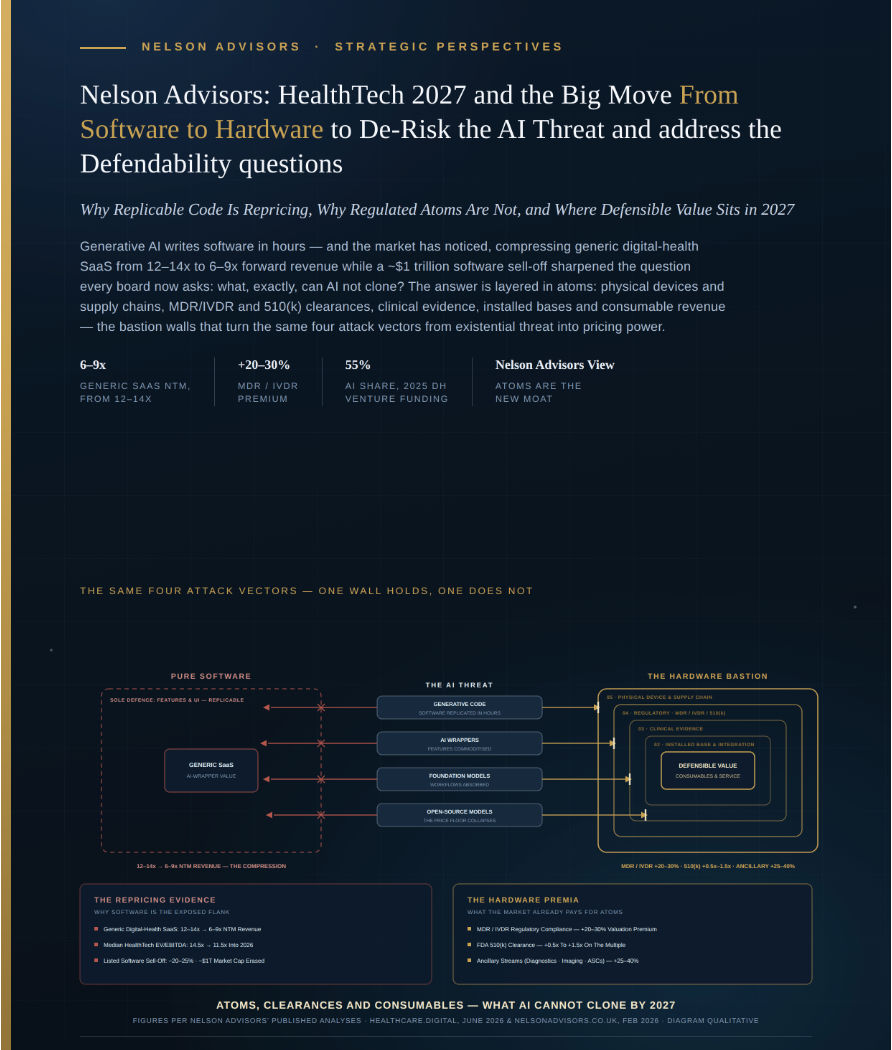
This overlapping regulatory architecture has introduced an institutional filter across the lower to mid market. Unvalidated software wrappers, solutions that query third party, commercial foundation models via generic API endpoints without explainability or underlying IP, face multiple compression or deal abandonment during institutional due diligence. Healthcare procurement authorities cannot deploy unexplainable systems that risk diagnostic hallucinations, data sovereignty violations, or regulatory non-compliance.
Conversely, clinically validated, explainable "Glass Box" artificial intelligence platforms, which feature auditable diagnostic pathways, transparent decision logic and verified training on curated clinical cohorts are capturing valuation premiums of up to 35% over legacy peers. Diversified healthcare conglomerates, including Siemens Healthineers, Philips and Medtronic, are actively acquiring mid market European medical AI platforms. By acquiring targets that already possess approved CE marks under MDR and compliant architectures under the EU AI Act, corporate acquirers bypass multi year notified body backlogs and internal development cycles.
Regulatory Domain | Legislative Mandate & Enforcement Date | Technical, Clinical, & Audit Requirements | Structural Valuation & M&A Deal Impact |
High-Risk Medical AI Systems | EU AI Act (Regulation EU 2024/1689); statutory enforcement by August 2026. | Detailed technical documentation, risk management systems, verified training data governance, logging of algorithmic operations, and human oversight mechanisms. | Generic LLM wrappers face valuation compression to 2.0x–3.5x EV/Revenue; compliant "Glass Box" architectures capture up to a 35% valuation premium. |
Medical Device Software (MDSW) | EU MDR 2017/745 & IVDR 2017/746 (Rule 11 Reclassification). | Demonstration of clinical efficacy via controlled clinical trials, post-market clinical follow-up (PMCF), and conformity assessments by designated Notified Bodies. | Certified targets serve as strategic acquisition shortcuts for multinational acquirers seeking to bypass multi-year notified body bottlenecks. |
Algorithmic Data Governance | EU General Data Protection Regulation (GDPR) and Article 10 of EU AI Act. | Strict data minimization, patient consent validation, zero cross-border leakage, and localized bias monitoring across representative clinical cohorts. | High enterprise defensibility; strategic acquirers pay premiums (6.0x–8.0x+ revenue) for software with clean, auditable training data provenance. |
3. Pan European Scaling Unlocked by the European Health Data Space
A major historical factor depressing valuation multiples for European health technology companies relative to their US peers has been market fragmentation. Fragmented national regulatory structures, disparate localised electronic health record (EHR) systems and regional data governance interpretations historically confined early-stage ventures to their domestic markets, preventing them from achieving continental scale. This structural friction is shifting with the enactment of the European Health Data Space (EHDS) under Regulation (EU) 2025/327.
The EHDS establishes a unified market architecture for digital health technologies across all 27 EU member states. Between 2025 and 2027, secondary implementing acts are establishing binding technical standards, cybersecurity baselines, and semantic specifications centred on Fast Healthcare Interoperability Resources (FHIR). By 2029, primary use regulations will mandate cross-border interoperability via the European Electronic Health Record Exchange Format (EEHRxF), ensuring that patient summaries, electronic prescriptions, medical images and laboratory reports move across member-state borders. By 2031, the secondary use framework (HealthData@EU) will become operational, granting researchers and health software developers structured, secure access to de-identified longitudinal health data.
By replacing fragmented national barriers with unified technical and data-sharing standards, the EHDS expands the total addressable market (TAM) for specialised software from individual domestic markets to a cohesive bloc of over 450 million citizens. Strategic acquirers and financial sponsors are focusing M&A on lower-to-mid market infrastructure platforms that act as connective tissue for this ecosystem. Targets specialising in FHIR-native interoperability middleware, automated pseudonymisation tools and Health Data Access Body (HDAB) integration gateways are securing valuation multiples between 5.5x and 7.0x revenue, as buyers position themselves to capture the upside of unified pan-European health data exchange.
EHDS Phase | Statutory Timeline | Operational Milestones and Regulatory Objectives | Lower-to-Mid Market M&A Positioning |
Phase I: Foundation & Standardization | 2025 – 2027 | Formulation of technical implementing acts, semantic dictionaries, and cross-border API standards based on FHIR and open protocols. | High strategic demand for middleware vendors capable of bridging legacy hospital archives with modern interoperability layers. |
Phase II: Primary Cross-Border Use | Operational by 2029 | Mandatory interoperability under the European EHR Exchange Format (EEHRxF); real-time access to patient histories, imaging, and e-prescriptions across all member states. | Pure-play vertical SaaS providers can expand cross-border with minimal software re-architecting, supporting broader geographic rollups. |
Phase III: Secondary Commercial R&D | Scaled by 2031 | Full operationalisation of HealthData@EU; access to de-identified, longitudinal clinical datasets for research and algorithmic training via Health Data Access Bodies (HDABs). | Premium valuations (5.5x–7.0x sales) for platforms controlling organised, clean clinical registries and compliant data-governance tools. |
4. Sponsor Buy and Build Playbooks and Institutional Multiple Arbitrage
Financial sponsors have structured systematic buy-and-build strategies across European healthcare IT, viewing software as an attractive asset class characterised by recurring subscription revenues, mission-critical workflow stickiness and defensive margins. Backed by significant private equity dry powder, sponsor buyout activity in European healthcare reached record heights through 2025 and 2026, driven by corporate carve-outs, generational founder transitions and cross border rollups.
The underlying mechanics of the mid market programmatic rollup rely on multiple arbitrage coupled with operational leverage. A private equity sponsor typically acquires a market-leading regional platform company generating between €15 million and €40 million in ARR and €3 million to €8 million in EBITDA, at an entry multiple of 10.0x to 12.0x EV/EBITDA. Following the initial platform acquisition, the sponsor systematically acquires smaller, fragmented software providers across adjacent geographies or clinical sub-disciplines. These add-on acquisitions (€1 million to €5 million in EBITDA) are typically completed at lower entry multiples of 6.0x to 8.0x EV/EBITDA.
Value creation is realised through platform integration: moving disparate, single tenant systems to a shared, multi tenant cloud architecture; centralising administrative, legal, and compliance overhead and cross-selling modular software extensions across the combined customer base. Once the consolidated platform reaches an institutional scale, typically exceeding €15 million to €25 million in combined EBITDA, the sponsor can exit the platform to an upper middle market private equity fund, sovereign wealth manager, or global enterprise buyer at an expanded valuation multiple of 14.0x to 18.0x+ EV/EBITDA.
This playbook is demonstrated by specialised software investors like Main Capital Partners, which has executed rollups through platforms such as POLYPOINT for DACH healthcare workforce management, IQ Messenger for clinical messaging in the Benelux region and VideoVisit in the Nordics. Similar consolidation programs are expanding across digital pathology, laboratory information systems (LIS), and specialised radiology workflows.
Core Platform Consolidator | Financial Sponsor / Backer | Regional Platform Asset | Target Sub-Sector & Execution Rationale | Typical Add-On Valuation Multiples | Scaled Exit Multiple Expectation |
POLYPOINT | Main Capital Partners | DACH Regional Operations | Clinical workforce management, shift scheduling, and institutional hospital resource planning. | 6.0x – 8.0x EV/EBITDA | 14.0x – 17.0x EV/EBITDA |
IQ Messenger | Main Capital Partners | Benelux & Northern Europe | Vendor-neutral medical alarms, nurse call communication, and mission-critical event management. | 6.5x – 8.5x EV/EBITDA | 14.0x – 16.5x EV/EBITDA |
VideoVisit | Main Capital Partners | Nordics (Finland, Sweden) | Virtual social care delivery, remote consultations, and municipal elderly care automation. | 5.5x – 7.5x EV/EBITDA | 13.5x – 16.0x EV/EBITDA |
Specialist Pathology / LIS Rollups | Various Middle-Market PE Sponsors | Pan European Cross-Border | Digital slide scanning management, diagnostic tracking, and automated laboratory middleware. | 7.0x – 8.5x EV/EBITDA | 15.0x – 18.0x+ EV/EBITDA |
5. Post ZIRP Capital Realignment and the Venture-Backed Series B Bottleneck
The ending of the zero interest-rate environment has altered the capital structure and late stage funding dynamics of venture backed European digital health companies. Between 2020 and 2022, access to inexpensive growth equity incentivised early stage operators to prioritise aggressive user acquisition and topline growth over near term operational profitability. In the current market, however, late stage venture capital deployment has become selective, creating a capital bottleneck for companies seeking Series B and Series C rounds.
A large cohort of digital health companies that secured Series A funding between 2021 and 2023 have exhausted runway extensions and bridge financings. These businesses often struggle to secure new institutional venture capital due to elevated investor criteria: institutional venture funds now require demonstrated unit economics, customer acquisition cost (CAC) payback periods under 18 months, net revenue retention rates exceeding 110% and a clear path toward near term free cash flow generation.
This funding dynamic has generated a consistent pipeline of sell side advisory mandates for lower to mid market investment banks. Well capitalised private equity platforms and cash generative corporate incumbents are acquiring venture-backed assets that possess proven technology and regulatory approvals but lack the balance sheet to support standalone commercial scaling.
Corporate finance advisors are bridging valuation discrepancies through structured transaction mechanisms, including performance-contingent earn outs, contingent value rights (CVRs), synthetic secondary recapitalisations and rollover equity structures. These mechanisms allow early stage venture investors and founders to secure liquidity while providing upside exposure within a better capitalised operating platform.
Historical ZIRP Operating Archetype (2020–2022) | Current Disciplined Market Archetype (2026–2030) | Core Investment Banking Implication |
Top-line growth prioritized over unit economics; reliance on unmonetized registered users and non-paying pilot agreements. | Operational profitability, positive EBITDA margins and capital-efficient recurring contract expansions. | Platforms that fail to demonstrate cash-generative unit economics face multiple compression and liquidity-driven sales processes. |
Continuous venture funding rounds raised every 12 to 18 months at upward-ratcheting valuation multiples. | Tight growth-equity environment; investors require proof of scalable unit economics and sustainable payback periods. | An active pipeline of mid-market carve-outs, trade sales and structured rescue consolidations for viable point solutions. |
Clean, all cash transaction structures executed at elevated revenue multiples (8.0x–15.0x+ ARR). | Structured deal terms utilising milestone driven earn-outs, contingent value rights (CVRs), and equity rollovers. | M&A advisors structure risk sharing earn-outs tied directly to regulatory milestones, reimbursement listings, and ARR retention hurdles. |
6. Hospital CIO Point Solution Fatigue and Core EHR Platform Rationalisation
Healthcare provider networks, regional hospital systems, and Chief Information Officers (CIOs) across Europe are actively managing "point-solution fatigue". Over the past decade, clinical procurement teams contracted dozens of disconnected, specialised digital applications to address specific departmental needs, including isolated apps for diabetes tracking, musculoskeletal (MSK) rehabilitation, patient scheduling and clinician shift communication.
This uncoordinated software adoption generated significant technical debt, fragmented clinical data across non-interoperable silos, multiplied software licensing expenses and created security vulnerabilities across hospital IT networks.
Hospital CIOs and regional healthcare commissioning bodies, such as Integrated Care Systems (ICSs) in the United Kingdom, are actively rationalising vendor rosters. Enterprise procurement policies now prioritise unified, modular clinical suites that integrate directly with the central Electronic Medical Record (EMR) or Hospital Information System (HIS). Single function point solutions face contract termination upon renewal unless they can demonstrate interoperability within broader clinical workflows.
This procurement shift is driving two distinct M&A dynamics in the lower to mid market. First, specialised point solutions are executing horizontal mergers, such as combining remote behavioural health tools with cardio-metabolic disease platforms, to offer comprehensive chronic care suites capable of competing for enterprise tenders.
Second, pan European HIS incumbents are acquiring targeted software modules to incorporate specialised functionality into their core systems. Major platform consolidators, such as Dedalus Group (backed by Ardian), CompuGroup Medical, and Nexus AG (taken private by TA Associates for €1.21 billion), are systematically acquiring mid market vendors across laboratory software, clinical messaging and patient engagement. These acquisitions allow core EHR providers to protect their competitive position and capture a larger share of hospital IT budgets.
Incumbent Core System Consolidator | Primary Regional Foothold | Capital Architecture & Structural Posture | Strategic Focus for Lower-to-Mid Market Bolt-On M&A |
Nexus AG | DACH, Nordics, France | Taken private by TA Associates for €1.21B equity value (~€1.22B EV; 19.3x EBITDA). | Specialty clinical modules: Laboratory Information Systems (LIS), digital pathology, ambient transcription, and hospital resource planning. |
Dedalus Group | Southern Europe (Italy, France, Spain), DACH, UK | Backed by Ardian; Pan-European hospital information system (HIS) market consolidator. | Unified patient portals, clinical communication engines, diagnostic decision support tools, and enterprise interoperability layers. |
CompuGroup Medical (CGM) | Pan-European footprint; ambulatory EHR dominance in DACH | Subject to institutional private equity interest and take-private evaluations (CVC bid at ~€1.25B EqV). | Integrated e-prescribing modules, ambulatory telemedicine platforms, patient communication portals, and billing software. |
EMIS Group | UK primary care infrastructure | Acquired by Optum (UnitedHealth Group) for £1.24B EV (21.0x–23.5x EBITDA). | Community medicine integration, patient analytics dashboards, and bi-directional integration with the central NHS App infrastructure. |
7. Statutory Codification of National Digital Health Reimbursement Pathways
A fundamental impediment that historically restricted the enterprise valuations of European digital therapeutics (DTx) was the lack of clear public reimbursement mechanisms. Early stage applications often relied on direct consumer out of pocket payments or private corporate wellness subsidies, resulting in high customer churn and volatile unit economics.
The introduction of dedicated national statutory reimbursement frameworks has transformed this landscape, turning accredited digital applications into reimbursable clinical assets that meet institutional underwriting criteria.
Germany established the foundation for this framework through the Digital Healthcare Act (DVG) and its Digitale Gesundheitsanwendungen (DiGA) registry, which enables physicians to prescribe approved software applications to over 73 million statutory health insurance beneficiaries. In 2026, the German framework is expanding to cover lower-risk Class IIb medical devices under MDR, expanding the addressable scope of reimbursable digital therapeutics.
France followed with its Prise en Charge Anticipée Numérique (PECAN) fast-track framework under Decree No. 2023-232, which provides a one year window of temporary public reimbursement for digital therapeutics and remote monitoring solutions while final clinical utility data is collected. Unlike early iterations of the German framework, the French system incorporates pricing controls, capping digital therapeutic reimbursement at a maximum of €780 per patient annually, while bifurcating remote patient monitoring payments into separate technical fees for software providers and clinical fees for medical teams. Similar value-based statutory pathways have launched or are advancing across Belgium (mHealthBelgium), Austria and the Nordic markets.
This statutory codification provides financial sponsors and strategic acquirers with predictable, public-payer backed recurring revenues. The clinical trials and regulatory reviews required to secure permanent listing establish meaningful competitive moats around approved products.
Consequently, digital therapeutic and remote monitoring platforms that have achieved permanent statutory reimbursement trade at premium enterprise multiples of 5.5x to 7.0x revenue and 11.0x to 14.0x EBITDA in lower to mid market transactions. In contrast, non reimbursed direct to consumer health applications face valuation discounts, trading between 2.0x and 3.5x revenue due to higher customer acquisition costs and less defensible market positions.
National Jurisdiction | Statutory Reimbursement Framework & Legal Authority | Eligible Medical Device Classification | Reimbursement Architecture & Financial Structure | Strategic Valuation Multiple Impact |
Germany | DiGA Fast-Track; Federal Institute for Drugs and Medical Devices (BfArM). | MDR Class I and Class IIa; broadening to include lower-risk Class IIb starting in 2026. | 12-month provisional listing on preliminary evidence; transition to permanent directory listing following proven clinical or structural benefit. | Reimbursed platforms command 5.5x–7.0x EV/Revenue and 11.0x–14.0x EV/EBITDA. |
France | PECAN Fast-Track (Decree No. 2023-232); ANS and Haute Autorité de Santé (HAS). | MDR Class I, IIa, IIb, and select Class III devices. | 12-month non-renewable coverage based on presumption of innovation; structured follow-up applications to permanent LPPR or LATM registries. | Valuations match German DiGA levels; strong strategic interest from multinational MedTech consolidators. |
Belgium | mHealthBelgium Validation Pyramid (National Institute for Health & Disability Insurance - RIZIV/INAMI). | MDR CE-marked software (Level M1 through M3). | Tiered three-level validation process; Level 3 enables full social security integration and physician reimbursement. | Assets achieving Level 3 serve as regional expansion platforms for broader Western European market consolidation. |
8. Care Decentralisation and the Left Shift Toward Virtual Wards
Sustained hospital occupancy rates exceeding 90% across European urban healthcare systems have accelerated policy initiatives to shift care delivery out of acute facilities and into home and community environments. This trend is highlighted in England's 10-Year Health Plan (Fit for the Future), developed following the Darzi Review's operational assessment of the National Health Service. The policy mandates three primary transformations: transitioning from acute hospital settings to community-based care, shifting from reactive illness management to proactive prevention, and modernising analogue workflows into digital-first delivery models.
Central to this policy is the expansion of virtual wards and continuous remote patient monitoring (RPM). Under national targets, remote physiological monitoring for cardiovascular and complex respiratory diseases is scheduled to become a standard of care across regional Integrated Care Systems by 2028.
This decentralisation requires clinical-grade remote monitoring software, algorithmic early-warning systems and secure communication links to primary care networks. Emerging providers such as Doccla, Luscii and Huma are providing the digital infrastructure that allows hospitals to manage acute and post-operative patients from home, tracking vital signs and automating clinical escalation pathways.
In the investment banking landscape, businesses delivering decentralized care infrastructure are in high demand. Strategic acquirers and private equity sponsors are targeting mid-market vendors whose software platforms integrate with medical devices, provide automated clinical triage, and connect with central hospital information systems. Platforms that help healthcare systems reduce hospital readmissions, shorten inpatient length of stay, and avoid physical capital expenditures command premium valuations, positioning them as essential operational infrastructure for European healthcare delivery.
Strategic Priority | Policy Framework & Healthcare Objectives (2026–2030) | Core Digital Health Infrastructure Requirement | Lower-to-Mid Market M&A Targets |
Hospital-to-Community Redistribution | England 10-Year Plan / Pan-European Care De-escalation: shifting treatment to community hubs and personal residences. | Decentralized EMRs, automated patient intake software, and interoperable remote telemetry platforms. | Ambulatory clinical documentation platforms, specialty outpatient suites, and community clinic operations software. |
Universal Virtual Ward Operationalisation | Mandated virtual ward utilisation for cardiovascular, frailty, and chronic respiratory cohorts by 2028. | Real-time clinical telemetry dashboards, predictive biometric deterioration algorithms, and continuous IoT integration. | Hospital-at-home software platforms, remote biometric tracking tools, and connected medical device integration software. |
Centralised Digital Access Portals | Adoption of universal patient interfaces (e.g., the NHS App) as the front door to public health delivery. | Open FHIR APIs, secure identity verification, and bi-directional record exchange systems. | Automated triage tools, digital appointment management software, and patient-reported outcome measures (PROMs) platforms. |
9. Sovereign IT Mandates, Critical Infrastructure and NIS2 Cybersecurity Compliance
The regulatory landscape governing healthcare data security in Europe has made cybersecurity and data sovereignty central to hospital procurement and corporate M&A due diligence. Under Directive (EU) 2022/2555 (the NIS2 Directive), the healthcare sector is designated as essential critical infrastructure, subjecting hospital trusts, healthcare operators and their third party software suppliers to strict digital security standards and rapid incident-reporting mandates.
Significantly, Article 20 of the NIS2 Directive establishes direct legal liability for corporate management boards, making C-suite executives personally accountable for institutional cybersecurity non-compliance.
At the same time, European public healthcare authorities are emphasising sovereign data architectures to protect patient information from foreign regulatory exposure, including access requests under the US CLOUD Act. In France, strict regulations require platforms managing electronic health data to maintain Hébergeur de Données de Santé (HDS) certification, ensuring that clinical information is processed in secure, authorized facilities. In Germany, the Federal Office for Information Security (BSI) enforces similar data-protection baselines across hospital cloud deployments.
These compliance mandates have driven M&A interest in lower-to-mid market vendors specialising in healthcare cybersecurity and Internet of Medical Things (IoMT) security. Hospitals cannot secure complex networks of connected devices, such as diagnostic imaging platforms, physiological monitors and infusion systems, using generic enterprise security software.
Consequently, acquirers are purchasing specialised cybersecurity providers that offer automated medical device discovery, continuous vulnerability management, and clinical network segmentation. Vendors that possess verified sovereign hosting architectures and compliant security profiles represent attractive targets for multinational acquirers seeking compliant entry into Continental European healthcare systems.
Regulatory Framework | Target Entities & Jurisdictional Application | Mandatory Cybersecurity Standards | Direct M&A and Enterprise Value Implications |
NIS2 Directive (EU 2022/2555) | Healthcare providers, hospital networks, diagnostic centers, and third-party software supply chains. | Multi-factor authentication, end-to-end data encryption, automated incident reporting, and continuous cyber risk assessments. | Personal C-suite liability under Article 20 accelerates M&A interest in specialized medical device security vendors. |
French HDS Certification | All digital health applications, cloud hosts, and platforms managing French patient health information. | Six-tier audit verification covering physical data security, access control, disaster recovery, and sovereign hosting infrastructure. | HDS certification serves as a gating criteria for French market entry, supporting valuation premiums for certified assets. |
German BSI Cloud Security & GDPR | German statutory hospital infrastructure and statutory health insurance (GKV) integrations. | Implementation of the BSI C5 criteria catalog, zero cross-border data leakage, and technical pseudonymisation. | Acquirers require full data-residency verification during financial and technical due diligence processes. |
10. AI Native Unit Economics, Workforce Decoupling and Structural Margin Expansion
The financial architecture of high-performing European digital health platforms has diverged from older healthcare software business models. Historically, first-generation healthcare IT and technology enabled services companies scaled by expanding headcount in customer onboarding, clinical support and manual data processing. This operational structure capped gross margins at 65% to 75% and limited ARR generated per full-time employee (FTE) to between $200,000 and $400,000.
Modern AI-native digital health platforms are decoupling revenue growth from operational headcount expansion. By deploying automated API integrations, synthetic data for model training and automated clinical documentation, these platforms achieve structural operational leverage.
Operating Metric | Legacy Tech-Enabled Healthcare Services | First-Generation Cloud Healthcare SaaS | AI-Native Enterprise Digital Health Software |
ARR Generated per FTE $ / €) | $100,000 – $200,000 | $200,000 – $400,000 | $500,000 – $1,000,000+ |
Enterprise Gross Margin (%) | 40% – 55% | 65% – 75% | 75% – 85%+ |
Integration & Implementation Duration | 6 – 18 Months | 3 – 6 Months | 1 – 4 Weeks (Automated FHIR APIs) |
Annual Net Revenue Retention (NRR) | 95% – 105% | 105% – 115% | 115% – 125%+ |
Core Operational Benchmark Standard | EBITDA Breakeven Focus | Standard Cloud Metrics | Structurally Meets the Rule of 40 |
For investment banks, these operational characteristics support more flexible financing structures and faster transaction timelines. AI-native companies can scale from €10 million to €30 million in ARR with minimal incremental hiring, allowing incremental revenue to translate directly into free cash flow. These financial profiles make AI native platforms priority acquisition targets for private equity sponsors and strategic buyers, supporting exit valuations between 15.0x and 18.0x+ EV/EBITDA.
Strategic M&A Structuring and Cross-Border Value Creation (2026 to 2030)
For investment banking advisory teams and corporate development executives operating in European digital health, executing transactions in the lower to mid market requires structured approaches to deal terms and valuation gaps. Straightforward, all cash transaction structures frequently encounter friction due to differing valuation expectations between founders, early venture investors and disciplined financial buyers.
To resolve these pricing disparities, corporate finance advisors are structuring transactions with contingent consideration mechanisms. Milestone driven earn-outs tied to regulatory and commercial milestones, such as securing MDR Class IIb conformity assessments, transitioning from PECAN provisional status to permanent LPPR reimbursement, or achieving cross-border EHR interoperability under EHDS guidelines, allow acquirers to manage risk while providing sellers with pathways to realise their target valuations.
Simultaneously, secondary recapitalisations and continuation funds are increasingly utilised to provide liquidity to early venture capital funds with expiring mandates, transferring assets into institutional ownership structures that support multi-year buy and build consolidation.
European Region | Prevailing M&A Characteristics & Market Dynamics | Typical Entry Multiples | Regional M&A Strengths & Transaction Catalysts |
DACH (Germany, Austria, Switzerland) | Fragmented market, high transaction volume (~160 healthcare M&A deals annually), and strong statutory frameworks. | 6.0x – 13.0x EV/EBITDA; 1.2x – 2.9x EV/Sales. | High availability of privately held platform assets; established statutory reimbursement via the German DiGA framework. |
Nordic Countries (Sweden, Finland, Denmark, Norway) | Advanced digital literacy, single-payer systems, and centralized national health databases. | 10.0x – 14.0x EV/EBITDA; 4.0x – 6.0x EV/Sales. | Predictable software economics, high net revenue retention (> 120%), low annual churn (< 5%), and scalable cloud architectures. |
United Kingdom | Active early-stage capital formation ($4.2B HealthTech funding in 2025), coupled with fragmented procurement. | 8.0x – 15.0x EV/EBITDA; 3.8x – 5.3x EV/ARR. | The NHS 10-Year Health Plan provides clear policy direction, but commercial procurement is distributed across 42 Integrated Care Systems. |
Benelux & France | Cohesive public-health policies, established national fast-tracks (PECAN), and strict sovereign hosting rules. | 7.0x – 12.0x EV/EBITDA; 3.5x – 5.5x EV/Sales. | Favourable launchpad for pan-European expansion; structured regulatory fast-tracks support predictable commercial pathways. |
Investment banks are also taking advantage of geographic arbitrage across European markets. While the United Kingdom remains a major hub for early stage capital formation, its healthcare commercialisation environment is distributed across 42 individual Integrated Care Systems (ICSs), which can lead to prolonged pilot cycles and high customer acquisition costs.
Conversely, the DACH and Nordic regions offer established platforms for buy and build strategies. The DACH region provides market scale, a steady supply of founder led businesses, and attractive entry valuations. The Nordic markets feature single payer healthcare models, unified personal identity frameworks, high digital adoption and low customer churn (< 5%), enabling software vendors to consistently deliver Net Revenue Retention rates exceeding 120%.
By structuring acquisitions that combine an operational base in the DACH or Nordic regions with international distribution channels, advisors can build scalable pan European platforms positioned for acquisition by multinational corporate buyers or global private equity funds.
Conclusion
Between 2026 and 2030, lower to mid market European digital health investment banking will be characterised by greater institutional discipline, regulatory convergence, and software consolidation. Macroeconomic demographic realities, highlighted by the impending one million clinician deficit projected by the WHO, have made workflow automation, ambient documentation and clinical triage tools essential operational investments for public and private healthcare providers. Concurrently, the technical and regulatory integration enabled by the European Health Data Space will address the national market fragmentation that historically limited European health technology valuations, creating a unified addressable market of over 450 million citizens.
Valuation multiples will remain stratified, with capital flowing disproportionately toward platforms that combine regulatory compliance with demonstrable financial performance. Companies that achieve permanent statutory reimbursement under established pathways such as DiGA and PECAN, maintain certified compliance under the EU AI Act and MDR, adhere to NIS2 cybersecurity standards and generate high ARR per employee will command premium valuations (14.0x to 18.0x+ EV/EBITDA and 6.0x to 8.0x+ EV/Revenue).
For investment banks, financial sponsors and corporate development leaders, navigating this market will require executing programmatic buy and build strategies, bridging valuation spreads through structured earn outs, utilising geographic arbitrage across DACH and Nordic platforms and consolidating specialised point solutions into integrated enterprise clinical suites.
Nelson Advisors > European HealthTech, MedTech, Digital Health Investment Banking
Nelson Advisors specialise in Mergers and Acquisitions, Partnerships and Investments for Digital Health, HealthTech, MedTech, Health IT, Consumer HealthTech, Healthcare Cybersecurity, Healthcare AI companies.www.nelsonadvisors.co.uk
Nelson Advisors regularly publish Thought Leadership articles covering market insights, industry trends, deal commentary, market analysis & predictions @ https://www.healthcare.digital
Nelson Advisors publish Europe's Leading Healthcare Technology Investment Banking Newsletter every week, join 5000+ HealthTech and MedTech subscribers today! https://lnkd.in/e5hTp_xb
Nelson Advisors pride ourselves on our DNA as ‘Founders advising Founders.’ We partner with entrepreneurs, boards, corporates, venture capital and private investors to maximise shareholder value and investment returns.www.nelsonadvisors.co.uk
#NelsonAdvisors #HealthTech#MedTech#DigitalHealth #HealthIT #Cybersecurity #HealthcareAI #FemTech#ConsumerHealth #Mergers #Acquisitions #Partnerships #Growth #Strategy #NHS #UK #Europe #USA#Canada#Commonwealth#CorporateDivestitures #VentureCapital #PrivateEquity #Founders #SeriesA #SeriesB #Founders #SellSide #TechAssets #Fundraising #BuildBuyPartner #GoToMarket #PharmaTech #BioTech #Genomics
Nelson Advisors LLP
Hale House, 76-78 Portland Place, Marylebone, London, W1B 1NT
Meet Nelson Advisors @ 2026 Events
Digital Health Rewired > March 2026 > Birmingham, UK
NHS ConfedExpo > June 2026 > Manchester, UK
HLTH Europe > June 2026, Amsterdam, Netherlands
HIMSS AI in Healthcare > July 2026, New York, USA
Bits & Pretzels > September 2026, Munich, Germany
World Health Summit 2026 > October 2026, Berlin, Germany
HealthInvestor Healthcare Summit > October 2026, London, UK
HLTH USA 2026 > October 2026, USA
Barclays Health Elevate > October 2026, London, UK
Web Summit 2026 > November 2026, Lisbon, Portugal
MEDICA 2026 > November 2026, Düsseldorf, Germany
Venture Capital World Summit > December 2026 Toronto, Canada

Nelson Advisors specialise in Mergers and Acquisitions, Partnerships and Investments for Digital Health, HealthTech, MedTech, Health IT, Consumer HealthTech, Healthcare Cybersecurity, Healthcare AI companies.www.nelsonadvisors.co.uk




Comments