Nelson Advisors: HealthTech 2027 and the Big Move From Software to Hardware to De-Risk the AI Threat and address the Defendability questions

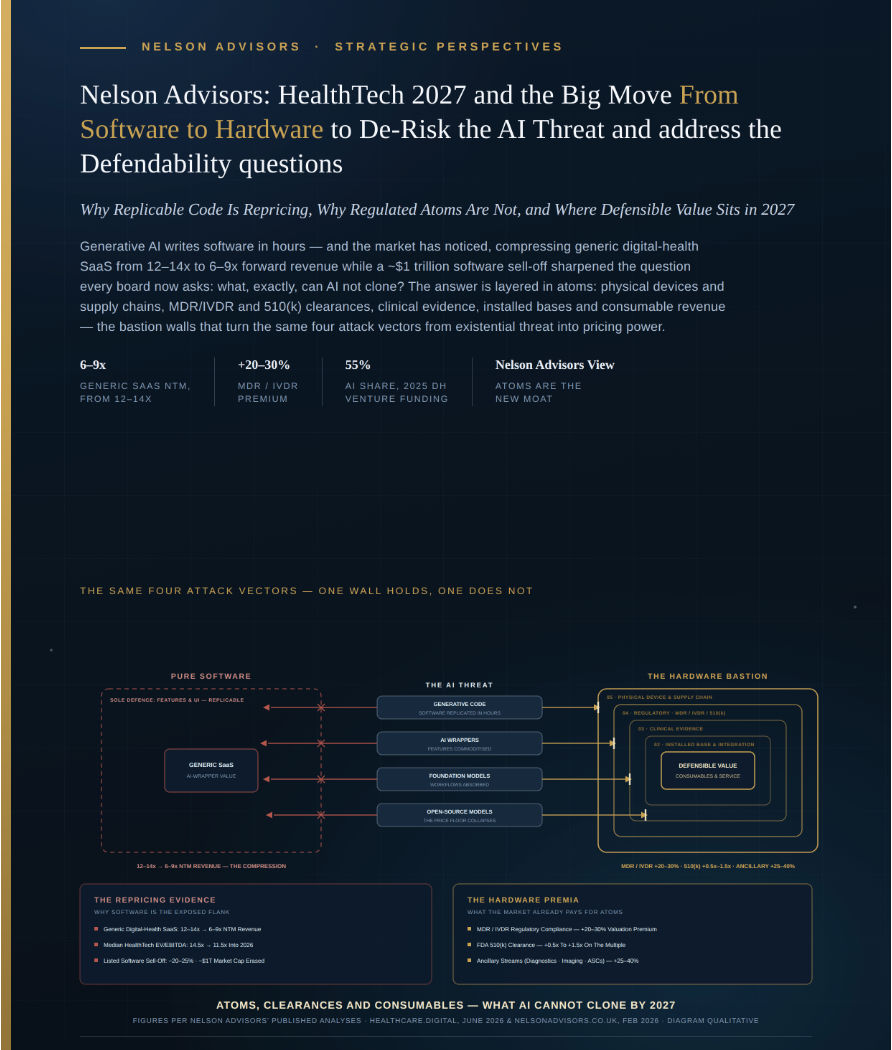
For fifteen years the smartest money in HealthTech had a simple thesis. Software eats the world, healthcare is the biggest and slowest-moving industry on earth, and so the biggest returns would come from software companies that digitised, automated and re-platformed the way care is delivered, paid for and administered. Asset-light, high gross margin, infinitely scalable and defended by data, workflow lock-in and the sheer difficulty of selling into hospitals and payers.
That thesis is now under real pressure and the pressure is coming from the very technology that was supposed to be its next chapter. Generative AI has made software cheaper to build, faster to copy and harder to defend than at any point since the cloud era began. The question every board, every investment committee and every founder in HealthTech is now asking is the same one: what, exactly, is our moat when a foundation model can generate our product?
This post argues that one of the most important answers to that question in 2027 will be physical. We expect a visible shift in both investor appetite and founder ambition towards HealthTech companies that build hardware, or that own a hardware layer as part of a full-stack proposition. Not because hardware is easy, but precisely because it is hard and because hardness is what defensibility looks like in a world where software has become abundant.
The AI threat to HealthTech software is real and it is not theoretical
It is worth being precise about what the threat is, because it is easy to overstate in either direction.
The first-order threat is to the cost of building software. Tools that write, test and ship code have compressed the time and headcount needed to produce a credible application from years and dozens of engineers to months and a handful. A HealthTech SaaS product that took a Series A to build in 2019 can be prototyped by a small team in a fraction of the time today. That is wonderful for founders and terrible for anyone whose valuation rested on the assumption that their product was hard to replicate.
The second-order threat is to the application layer itself. The large model providers and the hyperscalers are no longer content to sell tokens; they are moving up the stack into vertical workflows, including clinical documentation, prior authorisation, revenue cycle, patient communication, coding and triage. When a general-purpose model with a well-designed agent framework can perform the task that a point-solution SaaS company was built to perform, the SaaS company's software becomes a thin wrapper, and thin wrappers do not command venture multiples.
The early-2026 sell-off in public software stocks, triggered in part by exactly this fear, was a warning shot that private-market HealthTech investors have not forgotten.
The third-order threat is to the traditional software moats. Proprietary data is less defensible when models can be trained or fine-tuned on synthetic and public data to comparable performance. Workflow integration is less defensible when agents can operate across systems that were never designed to talk to each other. Network effects are less defensible when the switching cost of moving from one AI-native tool to another is low. Even the most cherished HealthTech moat, the difficulty of selling into the NHS or a US health system, is being eroded as buyers consolidate onto a small number of platforms and as the incumbents in electronic health records ship their own AI features into an installed base that already trusts them.
None of this means HealthTech software is dead. It means that the average HealthTech software company is more exposed than it was, that the gap between the winners and everyone else will widen, and that "we have an AI feature" has stopped being a differentiator and become table stakes. For investors trying to underwrite a five-to-seven-year hold, and for founders trying to build something that will still matter in 2032, this is an uncomfortable place to be.
Why hardware answers the defensibility question
Ask a generative model to write a patient-scheduling application and it will do so in an afternoon. Ask it to design, prototype, validate, manufacture, certify, distribute and support a continuous glucose monitor, a surgical robot, a wearable cardiac patch, an implantable neuro-stimulator or a point-of-care diagnostic device, and you will discover the limits of abundance very quickly.
Hardware defensibility in HealthTech rests on a stack of moats that compound and almost none of them can be collapsed by better code.
Regulatory moats. A medical device that has cleared the FDA through 510(k), De Novo or PMA, or carries UKCA or CE marking under the EU Medical Device Regulation, holds an asset that took years, millions and a great deal of institutional learning to obtain. That clearance is tied to a specific design, a specific manufacturing process and a specific quality management system. A competitor cannot fork it. The very regulatory burden that makes founders groan is the same burden that keeps the field clear once you are through.
Physical data moats. The most valuable data in healthcare is not the data that already sits in an EHR; it is the data that has never been captured because no device existed to capture it. Continuous glucose, continuous blood pressure, sweat biomarkers, intracranial pressure, gait, sleep architecture, cardiac rhythm at population scale. The company that owns the sensor owns the only source of that signal, and the AI models trained on it are proprietary in a way that models trained on scraped clinical notes never will be. In an era where software data moats are being eroded, sensor data moats are being created.
Manufacturing and supply chain moats. Getting a device from a working prototype to a validated, scalable, cost-effective production line is a discipline in its own right, involving supplier qualification, design for manufacture, tooling, yield optimisation, sterilisation, packaging, cold chain and logistics. It is slow, capital-intensive and full of tacit knowledge. That is exactly why it is defensible.
Intellectual property moats. Software patents are notoriously weak and increasingly hard to enforce. Hardware patents, on mechanisms, materials, sensor architectures, form factors and manufacturing processes, remain genuinely enforceable and are routinely the deciding factor in medtech litigation and licensing.
Clinical evidence and reimbursement moats. A device backed by randomised trials, real-world evidence, published outcomes, a reimbursement code and inclusion in clinical guidelines is embedded in the practice of medicine. Displacing it requires a competitor to run the same trials and win the same codes, which takes years and cannot be accelerated by a better prompt.
Distribution and installed-base moats. Once a device is in the operating theatre, on the ward, in the pharmacy or on the patient's arm, it carries with it consumables, service contracts, training, software subscriptions and a relationship. The razor-and-blade economics of medtech are as old as the industry and they remain one of its most durable features.
Put these together and you get something that HealthTech software has struggled to offer investors in the last two years: a credible story about why the company will still be here, and still be growing, when the next model release lands.
AI is not the enemy of hardware. It is the accelerant
The obvious objection is that AI is coming for hardware too. That is true in one sense and misleading in another.
AI is transforming how hardware is designed and built. Generative design, simulation, digital twins,
automated firmware development, AI-driven quality inspection and predictive maintenance are compressing hardware development timelines in the same way that code generation has compressed software timelines. The pre-clinical and regulatory phases are being accelerated by AI-assisted documentation and evidence synthesis.
Founders who understand this can build hardware companies faster and cheaper than any previous generation, which lowers the barrier to entry without lowering the barrier to defensibility.
More importantly, AI needs hardware. The value of a diagnostic model is bounded by the quality of the signal it receives, and the quality of the signal is a hardware problem. The frontier of clinical AI is not better algorithms on the same old inputs; it is new sensors producing new inputs at higher resolution and higher frequency than ever before, and models that learn from them. Continuous multi-analyte wearables, ambient sensing in the home, AI-native imaging and ultrasound, robotic surgery with real-time guidance, brain-computer interfaces, smart implants and closed-loop drug delivery are all AI businesses whose defensibility lives in the physical layer. The term now in common use for this is physical AI, and healthcare is its most obvious and most valuable application.
The strategic implication is that the most valuable HealthTech companies of the next decade will be neither pure software nor pure hardware. They will be full-stack: a proprietary device that captures a proprietary signal, a proprietary model that interprets it, and a software and services layer that delivers the result into a clinical workflow and captures recurring revenue. The hardware is the moat. The software is the margin. The AI is the multiplier. Companies that already look like this, in continuous glucose monitoring, surgical robotics and consumer wearables, are precisely the ones that have held their valuations while the software-only cohort has been repriced.
What we expect from investors in 2027
We expect 2027 to be the year that the shift from software to hardware in HealthTech becomes visible in the funding data rather than merely in conference-panel conversation. Several forces are converging.
The first is the search for defensibility described above. Venture investors are, in the end, in the business of underwriting durability, and the questions in investment committee have changed. Two years ago the question was "how big is the TAM and how fast can you grow?" The question now is "why does this company exist in three years if the model providers decide to do what you do?" Hardware companies have a clear answer; many software companies do not.
The second is the return of hard tech as an asset class. The last few years have seen a substantial reallocation of venture capital towards defence, energy, space, robotics, semiconductors and advanced manufacturing, driven by geopolitics, re-shoring, government industrial policy and a generational recognition that atoms matter as much as bits. Funds that built hard-tech competence for those sectors are now looking for adjacent applications, and healthcare, with its enormous markets and clear regulatory pathways, is the natural next stop. Expect more generalist and deep-tech funds to build medtech and health-hardware practices, and expect more crossover between defence, robotics and health-hardware investing than at any time since the 1980s.
The third is the maturing of the capital stack for hardware. One of the historical reasons investors avoided hardware was that it needed patient, staged capital and the ecosystem to provide it was thin. That is changing. Venture debt, equipment financing, non-dilutive grant funding, government innovation programmes, strategic corporate venture arms and specialist medtech growth funds have all deepened, and the increasing use of contract manufacturers and outsourced regulatory and quality services has reduced the fixed cost of getting a device to market.
Hardware is still capital intensive, but it is less capital intensive relative to software than the folklore suggests, particularly once you account for the cost of customer acquisition in a crowded software market.
The fourth is the behaviour of strategic acquirers. The large medtech and diagnostics groups, together with the pharmaceutical companies building device and digital businesses, have consistently paid premium multiples for hardware-enabled companies with clearance, evidence and installed base, and they are increasingly the most active buyers in the lower and mid-market. Software-only HealthTech exits, by contrast, have become harder to underwrite as acquirers ask the same defensibility questions that investors ask. Venture investors follow exit liquidity, and in 2027 exit liquidity in HealthTech will favour companies with something physical to sell.
The fifth is simple portfolio construction. Funds that are heavily exposed to application-layer HealthTech software are looking at correlated risk: a single advance in foundation models can impair a dozen portfolio companies at once. Hardware provides diversification against that risk in a way that another software bet cannot.
Taken together, we expect to see more first-cheque investors willing to lead hardware seed rounds, more Series A and B capital for companies with early clinical data and a clear regulatory path, more growth capital for scale-ups moving from clearance into commercialisation, and a marked increase in the number of funds that describe themselves, without embarrassment, as investing in "HealthTech hardware" or "physical health AI".
What we expect from founders in 2027
The founder side of the shift will be just as significant, and in some ways it is already further along than the investor side.
The generation of founders who spent the last decade building HealthTech SaaS has learned two things the hard way. The first is that a beautiful product with a great team can still be commoditised in a single model release. The second is that the customers they spent years learning to sell to, clinicians, hospitals, payers, are more receptive to a device that changes what is physically possible than to another piece of software that changes how something is administered. Many of those founders are now asking what they could build if they let themselves solve a physical problem and increasing numbers are choosing to find out.
They are also entering hardware with advantages their predecessors did not have. AI-assisted design and simulation shorten the road to a working prototype. Contract manufacturers and design houses offer medtech-grade development as a service. Regulatory consultants, quality management platforms and outsourced clinical operations lower the fixed cost of compliance. Component ecosystems built for consumer electronics and robotics, sensors, batteries, radios, processors, are cheaper and more capable than ever. And the software half of a full-stack company, the part that was once the whole company, can now be built by a small team quickly, freeing capital and attention for the hardware that actually matters.
We expect to see founders concentrating on a handful of high-value themes. Continuous, non-invasive biosensing, in wearables and patches that measure what was previously only measurable by blood draw. Home and ambient care hardware that allows hospitals to move acute and chronic care into the home safely. AI-native imaging and point-of-care diagnostics that bring high-end capability to primary care and low-resource settings. Surgical and interventional robotics, including the next wave of smaller, cheaper, more specialised systems. Neurotechnology and brain-computer interfaces, where the physical layer is inseparable from the clinical value. Smart drug delivery and closed-loop therapeutics. And the unglamorous but enormous category of hardware for the healthcare workforce, from logistics and pharmacy automation to sterilisation and monitoring.
The founders who succeed will not be the ones who abandon software. They will be the ones who understand that the software business model, recurring revenue, high margins, data compounding, is best defended when it is anchored to a device that nobody else can make. The playbook is not "hardware instead of software". It is "hardware so that the software is worth something".
The honest caveats
It would be irresponsible to write about a shift to hardware without acknowledging why investors avoided it in the first place. Hardware is hard. Development cycles are longer, capital requirements are lumpier, gross margins are structurally lower, working capital ties up cash, and a manufacturing or supply chain failure can be fatal in a way that a software bug rarely is. Regulatory timelines can slip by years. Reimbursement can take longer still. Product recalls are existential. The failure modes are more numerous and less forgiving, and the skills required, mechanical, electrical, regulatory, clinical, operational, are scarcer than software engineering and harder to assemble in one team.
Not every founder should build hardware and not every investor should fund it. Those who do will need to underwrite longer timelines, structure capital in stages that match technical and regulatory milestones, and pay far more attention to unit economics, cost of goods and manufacturing scalability than the software era ever required. They will need boards that understand quality systems and design controls, and they will need to resist the temptation to raise venture capital at software-style valuations against a hardware-style risk profile.
There is also a legitimate argument that the correct response to the AI threat is not to flee software but to
build better software: AI-native, workflow-deep, embedded in the parts of care where trust, liability and regulation still favour specialist vendors. Some of the best HealthTech companies of 2027 will be exactly that. But the bar has risen, the number of software companies that clear it is smaller than the number that raised money in 2021, and for many teams the honest conclusion is that a physical product offers a better risk-adjusted path to something durable.
The M&A lens
From where we sit, advising founders and boards on transactions in the lower to mid market, the shift is already visible in the conversations we have.
Strategic buyers are prioritising targets that bring them a device, a sensor, a signal or a manufacturing capability they cannot build internally, and they are willing to pay for regulatory clearance, clinical evidence and installed base. They are more sceptical of software-only assets unless those assets are deeply embedded and demonstrably resistant to substitution.
Due diligence has changed accordingly: the defensibility section of the process now asks explicitly how the business would be affected by the next generation of foundation models, and hardware-enabled companies have an easier time answering.
We expect 2027 to bring more acquisitions of hardware-enabled HealthTech companies by medtech, diagnostics, pharma and, increasingly, by large technology companies building health-hardware ecosystems. We expect more software companies to seek hardware partners or acquisitions of their own to shore up their defensibility and more hardware companies to acquire software and AI teams to complete their stack. We also expect private equity, which has historically preferred the predictable cash flows of healthcare software, to build increasing comfort with hardware-enabled recurring revenue models, particularly where consumables and service contracts provide the annuity that software subscriptions used to.
For founders contemplating an exit, the practical implication is that the story the market wants to hear has changed. It is no longer enough to show growth and gross margin. Buyers want to know what you own that cannot be generated, and in 2027 the most convincing answer to that question will increasingly be something you can hold in your hand.
Conclusion
The software era of HealthTech is not ending, but its unquestioned dominance is. Generative AI has made software abundant, and abundance is the enemy of defensibility. The companies that will command premium valuations, attract the most durable capital and achieve the strongest exits over the next few years will be the ones that anchor their intelligence in the physical world, in devices that capture signals nobody else can capture, that clear regulatory bars nobody else has cleared, and that sit in clinical and consumer settings nobody else can reach.
We expect 2027 to be remembered as the year that HealthTech investors and founders stopped treating hardware as the difficult, capital hungry cousin of software and started treating it as the foundation of a defensible business. The moat, it turns out, was never the code. It was the thing the code runs on.
Nelson Advisors > European HealthTech, MedTech, Digital Health Investment Banking
Nelson Advisors specialise in Mergers and Acquisitions, Partnerships and Investments for Digital Health, HealthTech, MedTech, Health IT, Consumer HealthTech, Healthcare Cybersecurity, Healthcare AI companies.www.nelsonadvisors.co.uk
Nelson Advisors regularly publish Thought Leadership articles covering market insights, industry trends, deal commentary, market analysis & predictions @ https://www.healthcare.digital
Nelson Advisors publish Europe's Leading Healthcare Technology Investment Banking Newsletter every week, join 5000+ HealthTech and MedTech subscribers today! https://lnkd.in/e5hTp_xb
Nelson Advisors pride ourselves on our DNA as ‘Founders advising Founders.’ We partner with entrepreneurs, boards, corporates, venture capital and private investors to maximise shareholder value and investment returns.www.nelsonadvisors.co.uk
#NelsonAdvisors #HealthTech#MedTech#DigitalHealth #HealthIT #Cybersecurity #HealthcareAI #FemTech#ConsumerHealth #Mergers #Acquisitions #Partnerships #Growth #Strategy #NHS #UK #Europe #USA#Canada#Commonwealth#CorporateDivestitures #VentureCapital #PrivateEquity #Founders #SeriesA #SeriesB #Founders #SellSide #TechAssets #Fundraising #BuildBuyPartner #GoToMarket #PharmaTech #BioTech #Genomics
Nelson Advisors LLP
Hale House, 76-78 Portland Place, Marylebone, London, W1B 1NT
Meet Nelson Advisors @ 2026 Events
Digital Health Rewired > March 2026 > Birmingham, UK
NHS ConfedExpo > June 2026 > Manchester, UK
HLTH Europe > June 2026, Amsterdam, Netherlands
HIMSS AI in Healthcare > July 2026, New York, USA
Bits & Pretzels > September 2026, Munich, Germany
World Health Summit 2026 > October 2026, Berlin, Germany
HealthInvestor Healthcare Summit > October 2026, London, UK
HLTH USA 2026 > October 2026, USA
Barclays Health Elevate > October 2026, London, UK
Web Summit 2026 > November 2026, Lisbon, Portugal
MEDICA 2026 > November 2026, Düsseldorf, Germany
Venture Capital World Summit > December 2026 Toronto, Canada


Comments