Mapping Microsoft’s Potential Healthcare AI and Technology Acquisition Horizons Across North America, Europe and the Commonwealth

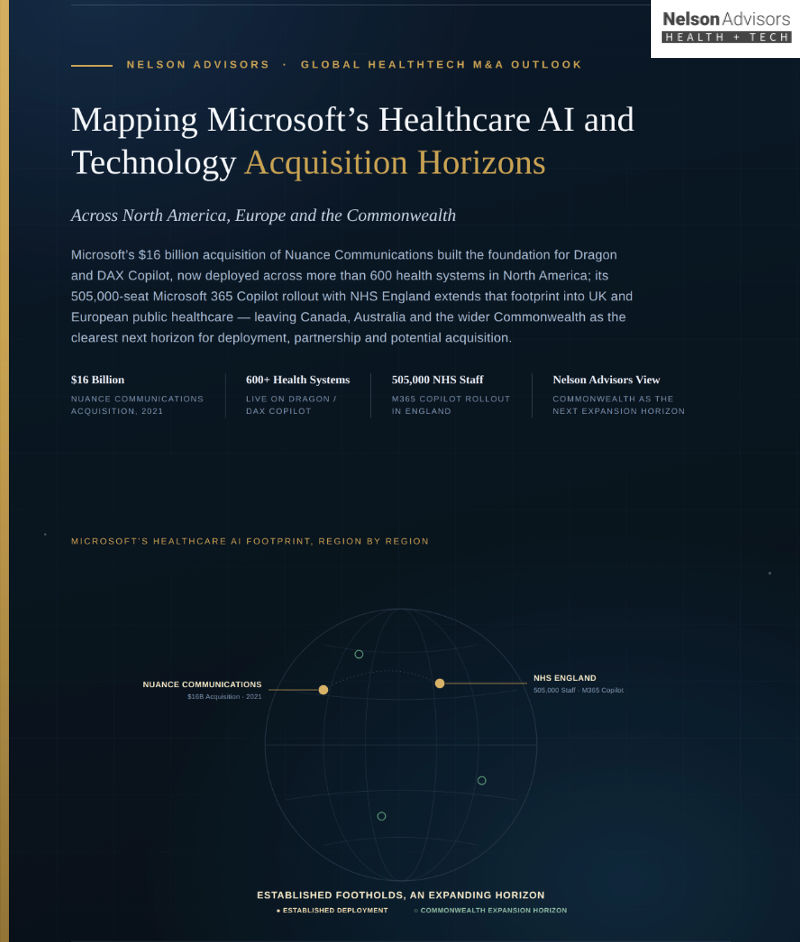
Strategic Architecture of Microsoft Cloud for Healthcare
The Neutrality Thesis: Horizontal Intelligence Layer vs. Vertical EHR Ownership
Microsoft’s corporate development strategy within the global healthcare technology sector is governed by a foundational structural imperative: preserving horizontal cloud infrastructure neutrality across competing healthcare application environments.
While historical industry speculation frequently identified dominant Electronic Health Record (EHR) market incumbents, such as Epic Systems, Cerner, Allscripts, or Athenahealth, as prospective enterprise takeover targets, rigorous transactional and competitive analysis demonstrates that vertical acquisition of a core EHR platform would undermine Microsoft’s foundational value proposition.
Direct ownership of an EHR vendor introduces immediate, systemic friction with major clinical software providers, most notably Epic Systems, with whom Microsoft maintains deep cloud-hosting, co-development, and generative artificial intelligence integration alliances across global health systems.
By operating strictly as an infrastructure agnostic intelligence and data integration layer, Microsoft positions Azure, Azure OpenAI Service, Microsoft Fabric, Dynamics 365 and Copilot Studio as the universal digital substrate across disparate health systems, payer environments, and biopharmaceutical enterprises.
In this architectural topology, Microsoft’s technology stack sits directly above specialised EHR platforms, including Epic Systems, Oracle Health (Cerner), MEDITECH and regional modular EMR providers, supplying advanced computational power, security frameworks and artificial intelligence models without competing for clinical workflow ownership.
Absorbing an EHR vendor would compromise this neutral posture, inevitably driving competing clinical software developers to migrate critical cloud workloads to rival hyperscalers such as Amazon Web Services (AWS) or Google Cloud Platform (GCP).
Consequently, Microsoft’s healthcare mergers and acquisitions (M&A) framework deliberately prioritises non conflicting, high margin capability layers, specifically ambient clinical documentation engines, agentic operational workflow tools, specialised revenue cycle analytics, federated biopharmaceutical data networks and precision medicine platforms.
** Nelson Advisors research is theoretical and does not constitute investment advice or recommendations in any way. **
The Post Nuance Landscape and Evolution of Build Buy Partner Dynamics
Microsoft’s landmark $19.7 billion acquisition of Nuance Communications established its primary posture in clinical voice recognition and conversational artificial intelligence. Integrating Nuance’s Dragon Ambient eXperience (DAX) Copilot natively into Azure and leading EHR environments created an enterprise clinical documentation footprint spanning more than 200 major health systems. This transaction highlights Microsoft’s structured "Build, Buy, Partner" decision model. Internal research and development (Build) concentrates on foundational cloud infrastructure, core large language models, enterprise security frameworks and multi-tenant data platform architectures.
Strategic alliances (Partner) expand software distribution across provider networks, consumer health operations, and biopharmaceutical enterprises. Targeted corporate acquisitions (Buy) are deployed selectively to absorb specialised domain expertise, proprietary clinical datasets and regulatory cleared software technologies that cannot be efficiently constructed internally.
This strategic framework experienced a notable structural shift when Microsoft transitioned its Cloud for Healthcare application templates toward partner managed and open source implementation frameworks. By delegating localised application customisation, specialised interface maintenance and front line workflow integration to experienced technology consulting and integration partners, Microsoft concentrated its internal engineering capital and corporate development balance sheet strictly on scalable cloud services, core AI platform infrastructure and high-margin micro services.
Strategic Vector | Operational Rationale | Primary Asset Profile & Structural Execution | Representative Ecosystem Examples |
Build | Expand foundational cloud compute capacity, security frameworks, and general purpose enterprise intelligence. | Core Azure infrastructure, Microsoft Fabric, Copilot Studio and foundational AI model architectures. | Azure OpenAI Service integration, Azure Health Data Services, Microsoft Cloud for Healthcare data models. |
Buy | Acquire defensible clinical workflows, domain specific intellectual property, and regulatory cleared software platforms. | Scale-stage vendors with proprietary clinical datasets, deep workflow integration, and established FDA/MDR clearances. | Acquisition of Nuance Communications ($19.7B); data center and analytics tuck-ins like Fungible and Minit. |
Partner | Secure global enterprise distribution, drive cloud consumption, and maintain horizontal market neutrality. | Co-development frameworks, cloud migration agreements, joint enterprise go-to-market initiatives. | Enterprise alliances with Epic Systems, Haleon, NHS England and Ensemble Health. |
Regulatory Constraints and Capital Allocation Thresholds
Microsoft's healthcare M&A strategy operates within tight regulatory parameters imposed by global antitrust authorities, including the United States Federal Trade Commission (FTC), the European Commission and the United Kingdom Competition and Markets Authority (CMA).
Large scale technology transactions face prolonged statutory reviews and heightened competitive scrutiny, as demonstrated by the extensive regulatory review required to clear the Nuance transaction across multiple jurisdictions. Furthermore, scrutiny surrounding Big Tech investments in foundational artificial intelligence entities forces Microsoft to structure industry expansion through targeted middle market acquisitions, bolt on technology purchases and venture stage equity alignments rather than mega cap consolidations.
Financially, Microsoft possesses extraordinary transaction capacity, supported by an aggregate common stock market value of $3.6 trillion and annual Microsoft Cloud revenues exceeding $214 billion. However, executive capital allocation discipline favours mid-market transactions falling within the $1 billion to $15 billion valuation range. Target companies must demonstrate clear revenue synergies through accelerated Azure consumption, strong operational gross margins, established regulatory clearances and immediate defensibility against competing hyper scale ecosystem offerings.
High Priority Acquisition Vectors in the United States Market
Clinical Workflow Automation and Next Generation Ambient AI
Although Nuance DAX Copilot maintains a strong position in clinical ambient documentation, the market for point-of-care clinical intelligence is experiencing rapid technological evolution and intensified competitive dynamics. Competitors such as Amazon, which introduced Amazon Connect Health to integrate ambient documentation, intelligent appointment scheduling, AWS HealthLake data processing and automated billing code generation, are directly challenging Microsoft’s clinical documentation footprint. Simultaneously, clinical documentation startups have captured significant mindshare by implementing advanced agentic architectures that automate post visit clinical summarisation, order entry and multi-specialty clinical workflow routing.
To defend and expand its point of care intelligence footprint, Microsoft is positioned to evaluate emerging leaders in ambient documentation that have established strong adoption outside legacy voice recognition channels. Abridge has emerged as a high-growth vendor in ambient clinical intelligence, validated by randomised clinical trials published in the New England Journal of Medicine AI demonstrating a 30-minute daily reduction in physician documentation time. Featuring native integrations across major EHR systems and rapid adoption among large academic medical centers, Abridge represents a compelling target.
Acquiring Abridge would consolidate Microsoft’s market share in clinical documentation, prevent competitive positioning by rival cloud platforms and absorb advanced structural machine learning models optimised for complex multi-specialty clinical notes.
Simultaneously, Ambience Healthcare presents an attractive target in point of care workflow automation. Valued at $1.25 billion following its Series C capital raise led by Oak HC/FT and Andreessen Horowitz, Ambience Healthcare provides a comprehensive suite of point of care tools tailored for health systems, including automated clinical documentation, coding compliance verification and care plan drafting. Given Ambience’s early architectural ties to OpenAI ecosystem investments, a formal acquisition by Microsoft would represent a logical vertical integration step, securing a native agentic platform operating directly within hospital point of care workflows.
Autonomous Revenue Cycle Management (RCM) and Financial Intelligence
The healthcare revenue cycle management sector represents a rapidly expanding global market projected to reach $275 billion by 2029, characterised by high administrative labour costs, complex insurance reimbursement environments and escalating claim denial rates.
Traditional RCM models relying on manual labour are being displaced by agentic artificial intelligence automation platforms capable of autonomous prior authorisation, predictive denial management, dynamic account routing and automated medical claim coding. Private equity capital deployment and strategic M&A in healthcare IT are heavily concentrated in RCM, driven by the structural convergence of clinical documentation, billing code generation and financial adjudication into unified software layers. Indeed, private equity deal flow in healthcare IT has surged toward record levels, with deal projections exceeding 442 transactions and $53.6 billion in value, driven primarily by agentic AI automation platforms.
Microsoft’s current strategy in RCM centres on hosting enterprise data workloads on Azure and supplying Azure OpenAI Service infrastructure to major third party RCM vendors. However, capturing the end to end financial transaction layer of healthcare delivery represents an exceptional strategic growth vector.
Ensemble Health Partners represents a premier platform in technology enabled revenue cycle management, managing over $32 billion in annual net patient revenue. Ensemble’s proprietary decisioning engine, EIQ®, is natively built on Microsoft Azure generative AI and machine learning infrastructure. Industry research highlights Ensemble as an asset positioned to either define the next generation agentic RCM market or serve as a takeover target for a scaled technology enterprise seeking complete ownership of the healthcare financial layer.
Acquiring Ensemble would allow Microsoft to embed financial intelligence directly into Microsoft Dynamics 365 and Azure Fabric, offering health systems an end-to-end operational software stack.
Beyond full service RCM providers, public platform vendors such as Waystar offer specialised capabilities in cloud-based payment software, claims management and patient financial engagement. Acquiring Waystar or a comparable enterprise clearinghouse platform would provide Microsoft with real time transactional data access across thousands of healthcare providers, enhancing its predictive analytics engines and enterprise cloud footprint.
Additionally, middle-market targets utilising agentic AI to automate prior authorisations, illustrated by Humata Health's acquisition by R1 RCM, demonstrate the demand for point-solution prior authorisation automation. Acquiring autonomous coding and prior authorisation engines would directly augment Nuance’s PowerScribe and DAX Copilot products, creating a continuous pipeline from spoken physician intent to adjudicated reimbursement submission.
Precision Medicine, Multimodal Diagnostics and Life Sciences Platforms
The integration of genomic sequencing, digital pathology, clinical diagnostics and real-world evidence into cloud data platforms represents a critical growth frontier for enterprise cloud providers. Microsoft’s prior investments in precision health, including its long-standing collaboration with Adaptive Biotechnologies to decode human immune system data, highlight its commitment to advanced bio-computation. To construct a unified multimodal clinical data ecosystem, Microsoft is incentivised to target scale stage life sciences and diagnostic technology platforms.
In this environment, Azure Health Data Services operates as a central multimodal data hub, ingesting clinical EHR streams from Epic or Cerner, multi-omics and genomic sequences and high-resolution digital pathology images.
Tempus AI (NASDAQ: TEM) represents a major target in this domain, having constructed one of the world’s largest libraries of multimodal clinical and genomic data to advance precision medicine, oncology diagnostics and therapeutic discovery. Having expanded its diagnostic footprint through acquisitions such as Paige, which developed the first FDA-cleared AI application in pathology and Personalis, Tempus generates substantial revenues ($382.5 million in Q2 2026) while maintaining deep relationships across oncology networks and biopharmaceutical developers.
A strategic transaction or majority equity investment would establish Microsoft as the primary host for multi-omics data storage, complex algorithmic diagnostic execution and biopharmaceutical R&D workflows.
Complementing clinical diagnostic targets, Benchling serves as a central platform for life sciences R&D, providing cloud-native software for biopharmaceutical research, lab management, and molecular design.
Acquiring Benchling would give Microsoft direct penetration into early-stage biotechnology research workflows, complementing its enterprise life sciences cloud strategy and positioning Azure as the primary platform for AI-assisted drug discovery and laboratory management.
Strategic Opportunities in European Markets (UK & EU)
Regulatory Enablers: EU AI Act and European Health Data Space (EHDS)
Healthcare technology M&A across Europe is heavily shaped by evolving regional regulatory frameworks. The enforcement of the EU AI Act imposes strict data governance, algorithmic transparency, post-market surveillance and clinical validation standards for medical artificial intelligence systems categorised as high-risk. Concurrently, the European Health Data Space (EHDS) framework mandates standardised access to electronic health records for secondary research, cross-border care delivery, and anonymised algorithmic training.
These regulatory mandates favour well capitalised cloud providers capable of delivering fully compliant, security hardened compute infrastructure. European healthtech platforms that have already achieved EU Medical Device Regulation (MDR) certifications, FDA clearances and EHDS compliance represent defensible acquisition targets for Microsoft. Acquiring pre-validated European platforms enables Microsoft to scale enterprise clinical services across member states without encountering regulatory integration delays or compliance friction.
Digital Health Infrastructure and Sovereign AI in the United Kingdom
The United Kingdom represents a strategic focal point for Microsoft due to the central role of National Health Service (NHS) trusts and the UK government's commitment to modernisation through cloud and artificial intelligence infrastructure. This strategy is anchored by Microsoft's landmark £774 million, five year enterprise partnership signed with NHS England to deploy Azure, Microsoft 365 and AI platforms across 1.5 million healthcare staff. Strategic M&A targets in this geography must align with NHS digital maturity goals, open-data standards and operational efficiency mandates.
Headquartered in London, Huma has raised over $300 million to construct a modular "hospital at home" and digital health platform. Positioned as an infrastructure provider for digital health application development, Huma holds FDA Class II and EU MDR Class IIb regulatory clearances. The company expanded its pharmaceutical integration by acquiring AstraZeneca’s AMAZE platform and building digital therapy companions across respiratory and metabolic disease areas.
Huma represents a logical target for Microsoft, providing an established remote patient monitoring layer that can be natively embedded into Microsoft Cloud for Healthcare and deployed seamlessly across NHS trusts and European health systems.
Additionally, Faculty AI presents a specialised target within the UK market. As a UK based artificial intelligence consultancy and deployment firm, Faculty AI maintains an established track record of developing predictive operational models for NHS England, including real time hospital resource forecasting engines deployed during national healthcare crises.
Operating as a trusted partner across the Azure AI portfolio, Faculty AI possesses domain specific operational optimisation algorithms. An acquisition would mirror Microsoft’s previous purchases of digital transformation consultancies, absorbing localised operational data science talent to support public-sector NHS implementations.
Federated AI and Enterprise Platforms in Continental Europe
In Continental Europe, strict data privacy regulations, localised healthcare financing frameworks and sovereign cloud initiatives necessitate acquisitions that respect decentralised data architectures. To address these privacy requirements, Microsoft can deploy Azure as a federated learning orchestrator across European health networks. In this architecture, encrypted AI model updates are transmitted between localised hospital data nodes in France, Germany, or Italy without raw patient records ever leaving local institutional firewalls, ensuring complete compliance with the EU AI Act and national sovereign cloud mandates.
Owkin, based in France and the United States, specialises in privacy preserving federated learning algorithms applied to medical imaging, digital pathology and clinical trial optimisation. Backed by significant strategic investments from biopharmaceutical firms such as Sanofi ($180 million strategic partnership), Owkin trains AI models on decentralised hospital databases without requiring central data aggregation, ensuring compliance with European data sovereignty mandates.
Acquiring Owkin would supply Microsoft with privacy preserving analytics infrastructure, facilitating multi-institutional medical research across Azure’s sovereign European cloud regions.
Furthermore, Doctolib represents Europe’s dominant digital booking, virtual care and clinical workflow platform, serving over 80 million patients and 900,000 healthcare professionals across France, Germany and Italy. Standardised cross border listing regulations under the European Common Prospectus initiative facilitate corporate transactions for scalable European platforms. While Doctolib's $6.4 billion private valuation positions it as an independent candidate, a strategic acquisition or deep equity integration by Microsoft would secure control over Europe’s largest digital patient engagement gateway, consolidating provider scheduling networks onto Azure infrastructure.
Expansion Vectors Across Commonwealth Markets (Canada & Australia)
Cloud Medical Imaging and Enterprise Diagnostics in Australia
Australia’s digital health sector features established software developers that have successfully commercialised cloud native platforms internationally, particularly within the United States and the United Kingdom. Enterprise medical imaging represents an active vector for cloud transformation, as legacy, on-premise Picture Archiving and Communication Systems (PACS) are systematically replaced by high-throughput cloud streaming architectures.
Pro Medicus (ASX: PME) is a leader in enterprise diagnostic imaging software. Its flagship Visage 7 platform allows radiologists to stream massive 3D medical imaging files rapidly over cloud networks without requiring local data downloading. The company has secured enterprise contracts across major US health systems, including a seven-year, $25 million cloud imaging contract with Valley Health and maintains diagnostic research collaborations with institutions like the Mayo Clinic.
Acquiring Pro Medicus would resolve a structural gap in Microsoft’s healthcare portfolio: high-performance diagnostic visualisation. Integrating Visage 7 into Azure Health Data Services would position Microsoft as the primary infrastructure host for high volume radiology data streams, capturing diagnostic imaging workloads from competing cloud vendors.
Modular Clinical Platforms and Out-of-Hospital Care Infrastructure
Commonwealth healthcare systems, characterised by single-payer operational frameworks, are prioritising out of hospital care management, home based care delivery and open-architecture Electronic Patient Records (EPR).
Alcidion (ASX: ALC) provides modular, cloud native EPR and clinical decision support software through its Miya Precision platform. Expanding rapidly across Australia, New Zealand and the UK NHS market through strategic acquisitions such as Silverlink PCS (Patient Administration Systems) and Telstra Health’s Kyra Patient Flow business, Alcidion offers a modular alternative to monolithic EHR systems. Its platform separates clinical data layers from application interfaces, aligning with NHS requirements for open, flexible digital health ecosystems.
An acquisition of Alcidion would provide Microsoft with a pre integrated, open architecture clinical workflow engine tailored for Commonwealth public health administration networks.
Concurrently, AlayaCare, headquartered in Montreal, Canada, provides cloud-based home health, disability, and community care software globally. The company has expanded its market footprint across Canada, the United States, and Australia through tuck in acquisitions, including Nightingale Software and Delta Health Technologies.
As healthcare systems transition aging populations out of acute hospital settings toward home-based care models, acquiring AlayaCare would supply Microsoft with an established software platform managing mobile workforce scheduling, remote patient monitoring, and post-acute care coordination across key Commonwealth territories.
Strategic Target Evaluation Matrix
** Nelson Advisors research is theoretical and does not constitute investment advice or recommendations in any way. **
Target Entity | Geographic HQ | Core Technology Domain | Alignment with Microsoft Architecture | Financial Scale & Valuation Context | Strategic Target Fit |
Abridge | United States | Point-of-care Ambient AI & Clinical Documentation | Consolidates leadership in conversational clinical documentation; defends against AWS Connect Health. | Series C Scale ($1B–$2B estimated valuation framework). | High (Tuck-in / Strategic Integration) |
Ambience Healthcare | United States | Agentic Clinical & Compliance AI | Provides comprehensive point-of-care workflow automation; leverages native OpenAI technology roots. | $1.25B Valuation (Series C funding round). | High (Tuck-in Platform) |
Ensemble Health Partners | United States | Autonomous Revenue Cycle Management | Secures enterprise healthcare financial transaction layer; deep native integration via Azure AI and EIQ®. | Multi-Billion Scale ($32B Managed Net Patient Revenue footprint). | Moderate-High (PE Buyout or Takeover) |
Tempus AI (NASDAQ: TEM) | United States | Multimodal Data, Precision Diagnostics & Pathology | Establishes premier cloud position for multi-omics data storage, digital pathology (Paige), and precision medicine R&D. | Public Platform ($382.5M Q2 2026 Quarterly Revenue; $4B–$8B Market Cap Tier). | Moderate (Strategic Buyout / Equity Position) |
Benchling | United States | Cloud Biopharmaceutical R&D Software | Expands enterprise life sciences footprint directly into biotechnology lab workflows and drug discovery pipelines. | Private Growth Tier ($3B+ estimated valuation framework). | Moderate (Tuck-in Software Asset) |
Huma | United Kingdom | Digital Health Infrastructure & Remote Patient Care | Delivers pre-approved (FDA Class II / EU MDR) remote patient care platform for NHS and European health networks. | Raised $300M+ ($1B+ pre-IPO candidate valuation). | High (International Platform Tuck-in) |
Owkin | France | Federated AI & Privacy-Preserving Analytics | Solves European data sovereignty mandates under EHDS via multi-institutional decentralized hospital model training. | Private Scale ($1B+ valuation tier backed by Sanofi). | Moderate-High (Capability Buyout) |
Pro Medicus (ASX: PME) | Australia | High-Performance Cloud Medical Imaging | Fills diagnostic radiology visualization gap; drives massive high-throughput medical image data consumption onto Azure. | Public Market Asset (A$10B+ Market Cap Scale on ASX). | Moderate (Public Strategic Buyout) |
Alcidion (ASX: ALC) | Australia | Modular Cloud EPR & Patient Flow Analytics | Provides open-architecture modular EMR/PAS alternative for public health networks across NHS and ANZ regions. | Micro-Cap Public ($100M–$300M Market Cap Tier). | High (Public Sector Cloud Tuck-in) |
AlayaCare | Canada | Home & Community Care Management Cloud | Captures global shift toward home-based healthcare, remote monitoring, and mobile caregiver fleet dispatching. | Private Mid-Cap Scale ($500M–$1B estimated valuation framework). | Moderate-High (Domain Infrastructure Buyout) |
Strategic Synthesis and Future Outlook
Microsoft's healthcare acquisition trajectory over the coming decade will be governed by disciplined capital deployment designed to maximise Azure cloud utilisation, expand foundational AI model penetration and secure mission critical healthcare workflows. Rather than pursuing mega-cap consolidations of legacy Electronic Health Record vendors, which would trigger severe antitrust challenges and destroy ecosystem neutrality, Microsoft will potentially deploy capital across four distinct, non-conflicting operational vectors.
First, Microsoft could potentially consolidate its leadership in point of care ambient documentation and clinical workflow routing by absorbing high growth ambient intelligence platforms such as Abridge or Ambience Healthcare. This posture directly counters competitive threats from Amazon Connect Health while embedding advanced agentic capabilities into the clinical documentation pipeline.
Second, Microsoft may expand into autonomous revenue cycle management and financial adjudication by acquiring technology-enabled RCM vendors like Ensemble Health Partners or Waystar. Uniting clinical ambient documentation with automated coding and claims processing allows Microsoft to capture high-margin administrative transactions across the healthcare economy.
Third, Microsoft could potentially expand Azure Health Data Services into multimodal precision medicine by targeting diagnostic platforms like Tempus AI and life sciences research environments like Benchling. Centralising multi-omics, digital pathology and biopharmaceutical R&D workloads on Azure solidifies Microsoft's position as an indispensable infrastructure partner for biopharmaceutical innovation.
Fourth, Microsoft may address regional regulatory and structural requirements across Europe and the Commonwealth by acquiring pre validated digital health platforms like Huma, federated AI learning providers like Owkin and modular public-sector care platforms like Alcidion and AlayaCare.
Through this targeted M&A framework, Microsoft has the potential to secure high yield clinical data streams, reinforce Azure's competitive moat against rival cloud providers and establish the primary horizontal intelligence platform across global healthcare markets.
Nelson Advisors > European HealthTech, MedTech, Digital Health Investment Banking
Nelson Advisors specialise in Mergers and Acquisitions, Partnerships and Investments for Digital Health, HealthTech, MedTech, Health IT, Consumer HealthTech, Healthcare Cybersecurity, Healthcare AI companies. www.nelsonadvisors.co.uk
Nelson Advisors regularly publish Thought Leadership articles covering market insights, industry trends, deal commentary, market analysis & predictions @ https://www.healthcare.digital
Nelson Advisors publish Europe's Leading Healthcare Technology Investment Banking Newsletter every week, join 5000+ HealthTech and MedTech subscribers today! https://lnkd.in/e5hTp_xb
Nelson Advisors pride ourselves on our DNA as ‘Founders advising Founders.’ We partner with entrepreneurs, boards, corporates, venture capital and private investors to maximise shareholder value and investment returns www.nelsonadvisors.co.uk
#NelsonAdvisors #HealthTech#MedTech#DigitalHealth #HealthIT #Cybersecurity #HealthcareAI #FemTech#ConsumerHealth #Mergers #Acquisitions #Partnerships #Growth #Strategy #NHS #UK #Europe #USA#Canada#Commonwealth#CorporateDivestitures #VentureCapital #PrivateEquity #Founders #SeriesA #SeriesB #Founders #SellSide #TechAssets #Fundraising #BuildBuyPartner #GoToMarket #PharmaTech #BioTech #Genomics
Nelson Advisors LLP
Hale House, 76-78 Portland Place, Marylebone, London, W1B 1NT
Meet Nelson Advisors @ 2026 Events
Digital Health Rewired > March 2026 > Birmingham, UK
NHS ConfedExpo > June 2026 > Manchester, UK
HLTH Europe > June 2026, Amsterdam, Netherlands
HIMSS AI in Healthcare > July 2026, New York, USA
Bits & Pretzels > September 2026, Munich, Germany
World Health Summit 2026 > October 2026, Berlin, Germany
HealthInvestor Healthcare Summit > October 2026, London, UK
HLTH USA 2026 > October 2026, USA
Barclays Health Elevate > October 2026, London, UK
Web Summit 2026 > November 2026, Lisbon, Portugal
MEDICA 2026 > November 2026, Düsseldorf, Germany
Venture Capital World Summit > December 2026 Toronto, Canada




Comments