Nelson Advisors: The Dalio Bubble Framework - Debt Financed Compute, Benchmark Yields and Liquidity Friction

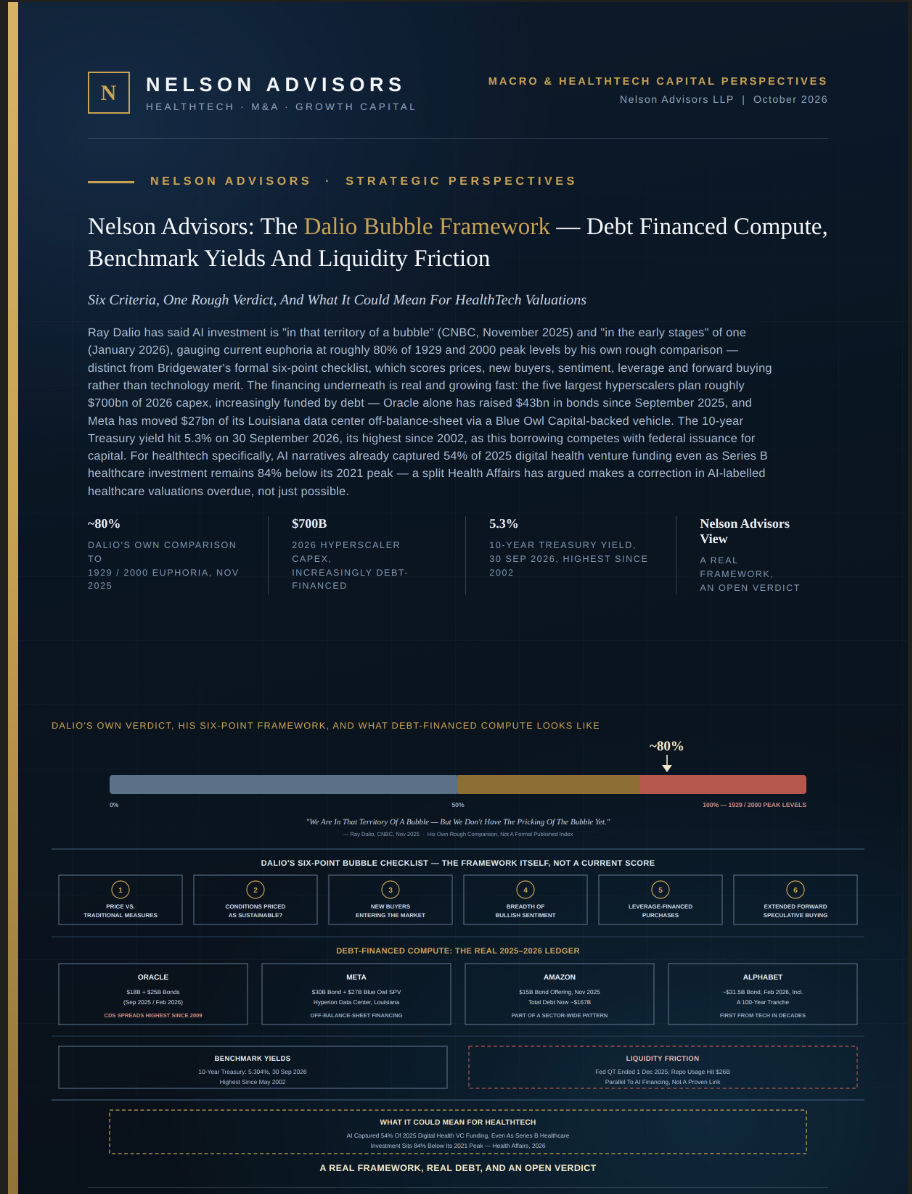
Macroeconomic analyses articulated by Bridgewater Associates founder Ray Dalio identify an impending structural inflection across the artificial intelligence landscape: the transition of capital allocation from equity-financed experimentation to debt fuelled physical infrastructure deployment. Industry projections indicate that global capital expenditures for artificial intelligence infrastructure will exceed $795 Billion in 2026 and cross $1 Trillion by 2027.
Historically, this buildout was underwritten by the liquid reserves and robust operational cash flows of mega-cap technology balance sheets. However, hyper scale cloud infrastructure operators and enterprise software conglomerates issued approximately $200 Billion in investment-grade debt during the first half of 2026 alone, effectively doubling their debt issuance relative to the entirety of 2025. Concurrently, capital expenditures across major hyper scalers are on track to consume nearly 100% of operating cash flows, departing sharply from the historical ten-year average of 40%.
Dalio’s classical market bubble indicator demonstrates that speculative cycles do not unravel simply because a technological architecture lacks long term utility, but because leveraged balance sheets collide with high borrowing costs and unavoidable liquidity constraints.
As benchmark 10 year US Treasury yields hover near multi decade highs of 5.3% and high grade corporate bond yields exceed 6%, the carrying cost of multi billion dollar data centre facilities, high performance computing clusters and specialised silicon procurement escalates. Financial distress emerges when paper asset valuations must be converted into physical cash flows to satisfy maturing obligations, cover debt service charges, adhere to bond covenants, or meet tax liabilities.
Because speculative expansions typically face retrenchment when interest rates remain elevated, the resulting repricing of capital inevitably propagates downstream into highly capitalised vertical industries. Healthcare and life sciences represent one of the most capital intensive ecosystems exposed to this dynamic. Having absorbed billions of dollars in speculative venture equity, enterprise software contracts and subsidised hyper scaler computing credits, the healthcare complex faces an immediate operational and valuation recalibration as tech sector leverage unwinds.
Macroeconomic Transmission and Asymmetric Healthcare Sub sector Exposure
The impact of rising debt burdens and an AI market contraction will not be distributed uniformly across the healthcare economy. Rather, the transmission mechanism operates across divergent sub sector balance sheets, regulatory regimes and reimbursement channels. In clinical medicine and biotechnology, capital dependency varies widely between speculative scientific discovery and core health system operations.
Healthcare Sub sector | Primary Capital Mechanism | Compute & Infrastructure Exposure | Benchmark Rate Sensitivity | Primary Structural Solvency & Operational Risk |
TechBio & AI Drug Discovery | Private venture capital, follow on public offerings, Big Pharma R&D milestone licensing | High (sustained GPU-intensive foundation biology model training, molecular dynamics simulation) | Severe | Extended pre-revenue operating runways; absence of commercialized, approved assets across ~175 clinical programs |
Health Systems & Hospital Networks | Tax exempt municipal debt, thin operating margins, philanthropic endowments | Low direct infrastructure spend; high third party SaaS operating expense | High | Operating margins compressed between 1.3% and 3.4%; low tolerance for IT investments lacking rapid operational payback |
Diagnostic Imaging & Computer Vision | MedTech corporate venture arms, growth equity, medical device balance sheets | Moderate (continuous imaging inference, high-density multimodal medical data storage) | Moderate | Regulatory and reimbursement lag; over 1,000 FDA cleared devices operating without dedicated Category I CPT reimbursement |
Workflow Automation & Ambient Systems | Private equity consolidation, late stage growth equity, enterprise software licensing | Moderate (ambient audio streaming, local and hosted LLM inference routing) | Moderate | Fast commoditisation of foundation model API wrappers; intense platform consolidation into dominant EHR environments |
The divergence illustrated across these sub sectors reflects their underlying cash flow stability.
Biotechnology platforms that lack near term commercial revenue depend continuously on low cost equity to fund laboratory and algorithmic overhead. Conversely, acute healthcare delivery organisations operate as capital constrained enterprises where persistent wage inflation and variable reimbursement dictate that every digital capital expenditure directly offsets operational overhead.
Life Sciences Under Capital Strain: TechBio De Risking and Pipeline Pruning
The biotechnology and algorithmic drug discovery sector, frequently designated as TechBio, faces severe exposure to the contraction outlined by Dalio. Computational biology platforms rely on massive graphics processing unit (GPU) clusters to power transformer models trained on genomic, proteomic and phenotypic datasets.
Compute allocations constitute approximately 40% to 60% of an artificial intelligence startup’s operating budget during its initial twenty four months. Startups previously masked these carrying costs by stacking promotional cloud compute credits from programs such as AWS Activate, Google Cloud for Startups, and Microsoft Founders Hub, which provided between $100,000 and $350,000 in non-dilutive computational subsidies. As debt burdens force cloud hyper scalers to defend their operating margins and preserve cash flows, these credit structures face tightening qualification parameters, forcing life sciences startups to transition to commercial on demand compute rates.
This infrastructural cost inflation coincides with a distinct venture capital pullback driven by elevated base interest rates. From 2019 through early 2026, cumulative venture and corporate capital deployments into AI enabled drug discovery totaled approximately $60 billion across roughly 175 clinical-stage programs. Despite this deployment of capital, the sector has not produced an FDA approved medicine whose discovery and optimisation were derived end to end via an artificial intelligence platform. In a zero interest-rate environment, institutional investors underwrote horizontal discovery platforms with speculative, multi-target pipelines. In an era of elevated yields and rising credit spreads, capital providers are demanding immediate clinical proof of concept, triggering significant pipeline rationalisation.
Publicly traded and late stage computational biotechs have reacted by divesting exploratory discovery assets to conserve liquid capital. Recursion Pharmaceuticals, following its structural combination with Exscientia, pruned three of its advanced internal clinical programs to suppress operational cash outlays and extend its liquidity runway into 2028. The company curbed its projected annual operating cash expenditures to less than $390 Million, insulating its balance sheet via upfront capital and milestone commitments exceeding $500 Million derived from partnerships with global pharmaceutical conglomerates.
Concurrently, institutional capital is aggregating almost entirely around platforms demonstrating definitive human clinical efficacy. Insilico Medicine advanced its small molecule TNIK inhibitor, rentosertib (ISM001-055), into Phase 3 trials for idiopathic pulmonary fibrosis following Phase 2a results that documented statistically significant forced vital capacity (FVC) improvements alongside measurable quality of life gains.
The broader consequence of Dalio's bubble deflation for the life sciences is a decisive shift from platform level multiple expansion to clinical milestone survival, where organisations unable to substantiate biological efficacy in human trials face distressed consolidation or asset liquidation.
Entity / Platform | Primary Clinical Asset | Targeted Therapeutic Indication | Clinical Phase Milestone | Liquid Capital Position | Defensive Corporate Action |
Recursion Pharma | REC-4881 (MEK1/2), REC-617, REC-7221 | Solid Tumors, Familial Adenomatous Polyposis | Phase 1 / Phase 2 Interventional | $743.3M–$753.9M cash reserves; runway into 2028 | Pruned 3 advanced programs; absorbed Exscientia; secured >$500M in partnership milestone commitments |
Insilico Medicine | Rentosertib / ISM001-055 (TNIK Inhibitor) | Idiopathic Pulmonary Fibrosis (IPF) | Initiated Phase 3 registrational trials; Phase 2a published | Backed by institutional venture equity & licensing | Concentrated platform resources on lead clinical validation rather than expanding unpartnered targets |
Early Stage Discovery Startups | Preclinical algorithmic screening libraries | Broad target portfolios (oncology, rare diseases) | Preclinical / IND-enabling | High GPU cash burn; runways frequently < 12 months | Pursuing acqui-hire exits, secondary royalty financings, or deep pipeline out-licensing to Big Pharma |
Health System Balance Sheets: The Transition from Algorithmic Experimentation to Hard Operational ROI
The macroeconomic friction outlined by Dalio intersects with health system operations at the level of municipal borrowing costs and operating margin compression. Hospital financial performance settled into an austere baseline, with national median hospital operating margins finishing 2025 at 1.3% before stabilising in early 2026 within a tenuous range of 2.5% to 3.4%.
Elevated operational expenses, driven by skilled clinical labor shortages, broad supply chain inflation, rising pharmacy acquisition costs and an expanding uninsured payer mix, leave health system CFOs with minimal budgetary flexibility for unproven digital technologies. Consequently, health system information technology leadership has ended speculative enterprise sandbox agreements.
Surveys of healthcare technology executives indicate that 71% of CIOs intend to freeze or defund artificial intelligence initiatives that fail to demonstrate audited financial returns within a twenty-four-month adoption window. While approximately 88% of health system executives historically acknowledged the long-term utility of artificial intelligence, nearly three quarters conceded that internal capital budget constraints prevent broad implementation across multiple categories. When rising sovereign bond yields raise the interest rates required on municipal bond issuances, hospital capital expenditure budgets are prioritised toward physical facilities, regulatory compliance and cybersecurity defences over experimental machine learning tools.
This capital discipline creates a pronounced divide in technology procurement. Enterprise solutions that address immediate operational overhead and generate measurable productivity gains continue to secure funding. Ambient clinical documentation systems represent the clearest manifestation of this defensible software tier.
Market leaders such as Microsoft Nuance DAX Copilot and Abridge have achieved high adoption rates by recording patient encounters and transcribing structured clinical notes directly into electronic health record workflows. These platforms consistently document administrative time savings of approximately 70% and reduce daily clinician documentation workloads by 13 minutes, allowing medical groups to mitigate provider burnout and recover investment capital within months.
Conversely, diagnostic algorithms, most prominently in medical imaging, face steep financial friction. Although the FDA has cleared over 1,000 artificial intelligence medical algorithms, of which approximately 78% are specialised for radiology, commercial deployment remains stalled behind a systemic reimbursement gap.
The Centers for Medicare & Medicaid Services and commercial payers have issued only a minimal volume of Category I Current Procedural Terminology (CPT) reimbursement codes for automated diagnostic interpretation. Consequently, hospitals must absorb the licensing and deployment costs of diagnostic imaging tools directly into their departmental overhead. In an operating environment shaped by 2% hospital margins and high corporate borrowing costs, health system acquisition committees are deprioritising imaging software lacking independent CPT fee schedule coverage.
Enterprise AI Operational Domain | Dominant Market Solutions | Quantified Clinical & Operational Return | Programmatic Reimbursement Status | Capital Allocation Viability Under Rate Pressures |
Ambient Clinical Documentation | Microsoft DAX Copilot, Abridge, Suki, Nabla | 70% reduction in documentation burden; 13 minutes saved daily; 82% physician satisfaction | Indirect (financed via operational overhead; funded by recaptured physician RVUs) | Highly resilient; rapid payback periods support direct enterprise purchasing |
Revenue Cycle Management (RCM) & Billing | Med Metrix, Vitalware, Commure, Innovaccer | Immediate automation of prior authorisation, claims scrubbing, and denial appeals | None required (ROI realised through decreased claims denials and accelerated cash flow) | High priority; directly shores up provider balance sheet liquidity and working capital |
Diagnostic Imaging & Computer Vision | Aidoc, Viz.ai, GE HealthCare, Siemens Healthineers | Proven speed in triage (e.g., 66-minute stroke workflow improvement); variable read efficiency | Severely limited; fewer than five Category I CPT reimbursement codes established | Highly constrained; unfunded software licensing faces deferral or budgetary cancellation |
Predictive Clinical Decision Support | Epic Native Models, Oracle Health Clinical Analytics | Sepsis detection, readmission prevention, patient deterioration monitoring ($1M–$2M hospital savings) | Indirect (tied to value based care quality bonuses and penalties avoidance) | Moderate; favors native EHR embedded tools over unintegrated third party point solutions |
Market Rationalisation: Vendor Consolidation, Compute Repricing and Structural Stabilisation
The bursting of an artificial intelligence bubble driven by debt financed infrastructure and elevated interest rates will induce a necessary market consolidation across healthcare technology. During earlier phases of the investment cycle, low capital costs fuelled excessive valuation multiples for undifferentiated platforms. In current conditions, the digital health investment environment is concentrating capital into scaled market leaders. While digital health venture investment in the United States reached $7.4 Billion across 244 transactions in the first half of 2026, roughly 45% of that aggregate capital was concentrated within mega-rounds exceeding $100 Million.
Concurrently, corporate mergers and acquisitions accelerated, recording 115 completed transactions in the first half of 2026 as well capitalised platforms acquired financially stressed point solution startups. Software ventures functioning primarily as user interface wrappers layered over third party foundational models are struggling to sustain previous valuation benchmarks. Enterprise healthcare systems are enforcing an "Epic-first" and native EHR purchasing strategy, with over 70% of health systems prioritising algorithms integrated directly into existing core clinical platforms to eliminate peripheral vendor integration costs.
Over the long term, a macroeconomic reset offers counter cyclical advantages for healthcare delivery and biomedical research. If massive capital investments in hyper scaler facilities culminate in an infrastructure overbuild relative to near term corporate software revenues, cloud hosting providers will face an oversupply of compute capacity. To service their elevated debt loads, hyperscale data centers will be forced to compete on pricing, triggering significant downward adjustments in inference and training costs. This cost deflation would lower the operating expenses of running compute heavy molecular dynamics models, cellular simulations and real time clinical voice processing.
Furthermore, an elevated cost of capital imposes market discipline by filtering out clinically unvalidated platforms. In recent years, healthcare technology procurement committees have navigated an environment saturated with exaggerated marketing and ambiguous safety declarations. The elimination of speculative capital forces market participants to focus on solutions with clear evidence of value: enterprise tools that lower health system labour expenditures, software that automates revenue cycle operations and computational biology platforms that validate drug candidates in prospective clinical trials.
Strategic Implications and Sector Outlook
The convergence of debt financed technology expansion and persistent interest rate pressures signals a structural transition for healthcare artificial intelligence. The era of loose exploratory capital is giving way to an operating environment governed by balance sheet discipline, workflow integration and verified clinical utility.
For pharmaceutical developers and TechBio enterprises, operational survival centers on liquidity preservation and clinical milestone execution. Organisations that burn capital on open ended computational screening without dedicated clinical development pipelines face severe refinancing challenges as equity markets demand higher risk premiums. Longevity requires establishing strategic co development alliances with cash rich pharmaceutical incumbents, securing milestone based non dilutive capital and focusing internal pipelines on biologically validated molecular targets that possess clear paths to human clinical validation.
For healthcare provider executives and technology vendors, enterprise strategy must center on defensible operational return on investment. Health systems will continue to implement technologies that address immediate operational bottlenecks, such as ambient medical documentation and automated claims processing, because these solutions offset provider burnout and generate near term cash savings.
Conversely, diagnostic algorithms and advanced predictive models will remain commercially constrained until regulatory agencies and public payers establish clear, reproducible reimbursement frameworks. As macro economic conditions deflate speculative valuation multiples, the healthcare industry will not abandon artificial intelligence. Instead, it will re anchor the technology to the rigorous, evidence driven standards that define traditional clinical medicine and sustainable financial management.
Nelson Advisors > European Healthcare Technology Investment Banking
Nelson Advisors specialise in Mergers and Acquisitions for European HealthTech, MedTech, Digital Health, Healthcare IT, Healthcare AI companies in the Lower to Mid Market ranging from $25M to $250M EV. www.nelsonadvisors.co.uk
Healthcare.Digital is the Google News approved HealthTech and MedTech Thought Leadership platform for Nelson Advisors, positioning them as a specialised authority on European Healthcare Technology M&A and strategic corporate development. https://www.healthcare.digital
Nelson Advisors publish Europe's Leading Healthcare Technology Investment Banking Newsletter every week, join 5000+ HealthTech and MedTech subscribers today! https://lnkd.in/e5hTp_xb
Healthcare.Digital serves as a research platform for Nelson Advisors’ perspectives on deals, valuations and structural shifts reshaping Global Digital Health, MedTech, Healthcare AI and Health IT. https://www.healthcare.digital
Nelson Advisors is one of Europe's leading mergers and acquisitions advisory firms, exclusively dedicated to the dynamic and rapidly evolving healthcare technology sector. With a deep understanding of market dynamics and technological advancements, they empower innovative HealthTech companies and strategic investors to navigate complex transactions and achieve their growth ambitions. www.nelsonadvisors.co.uk
#NelsonAdvisors #HealthTech#MedTech#DigitalHealth #HealthIT #Cybersecurity #HealthcareAI #FemTech#ConsumerHealth #Mergers #Acquisitions #Partnerships #Growth #Strategy #NHS #UK #Europe #USA #Canada #Commonwealth #CorporateDivestitures #VentureCapital #PrivateEquity #Founders #SeriesA #SeriesB #Founders #SellSide #TechAssets #Fundraising #BuildBuyPartner #GoToMarket #PharmaTech #Genomics
Nelson Advisors
Hale House, 76-78 Portland Place, Marylebone, London, W1B 1NT
Meet Nelson Advisors @ Events in 2026
Digital Health Rewired > March 2026 > Birmingham, UK
NHS ConfedExpo > June 2026 > Manchester, UK
HLTH Europe > June 2026, Amsterdam, Netherlands
HIMSS AI in Healthcare > July 2026, New York, USA
Bits & Pretzels > September 2026, Munich, Germany
HealthInvestor Healthcare Summit > September 2026, London, UK
World Health Summit 2026 > October 2026, Berlin, Germany
HLTH USA 2026 > October 2026, USA
Global Health Exhibition 2026 > October 2026, Riyadh, Saudi Arabia
Web Summit 2026 > November 2026, Lisbon, Portugal
MEDICA 2026 > November 2026, Düsseldorf, Germany
Leaders in Health Summit 2026 > November 2026, London, UK
Venture Capital World Summit > December 2026, Toronto, Canada
Meet Nelson Advisors @ Events in 2027
Digital Health Rewired > March 2027 > Birmingham, UK
Barclays Health Elevate > March 2027, London, UK
NHS ConfedExpo > June 2027 > Manchester, UK
HLTH Europe > June 2027, Amsterdam, Netherlands


Comments