Nelson Advisors European Healthcare Technology Predictions 2027: What can Founders, Investors and Providers expect in 2027?


If 2025 was the year European HealthTech discovered artificial intelligence, and 2026 the year the market learned to price it, then 2027 will be the year the sector is forced to prove it. The froth has gone. What remains is a market that is smaller in deal count, larger in deal size and far more discriminating about what it funds, buys and deploys. Q1 2026 told the story in miniature: European digital health venture funding fell 44% year-on-year to $1.2 billion across just 67 deals, yet average round sizes climbed 8% to over $21 million. Fewer bets, bigger cheques, higher expectations.
2027 arrives with three structural forces converging at once. The EU AI Act's high-risk obligations begin to bite in earnest, with enforcement for standalone high-risk AI systems landing in December 2027. The European Health Data Space (EHDS) reaches its first major milestone in March 2027, when the key implementing acts are published and the secondary-use framework starts taking concrete shape. A wall of private capital, private equity dry powder, strategics flush from the GLP-1 boom and a cautiously reopening IPO window, is looking for somewhere to land in a sector where the number of genuinely scaled, profitable European assets remains stubbornly small.
For founders, investors and providers, 2027 will not be a year of new narratives. It will be a year of execution against the narratives already in place. Below are our ten predictions for how that plays out.
1. AI becomes table stakes and the premium migrates to proof
For the past two years, attaching "AI-enabled" to a HealthTech proposition has been worth a valuation premium. In 2027, that premium disappears, not because AI matters less, but because it is now assumed. AI stops being a differentiator that attracts a premium and becomes a threshold requirement for institutional capital or acquisition interest. A company without a credible AI roadmap in 2027 will struggle to get a first meeting, let alone a term sheet.
What replaces the AI label as the source of premium is evidence. The bifurcation already visible in 2026, AI-native companies with clinical validation commanding 6x–8x revenue multiples against 4x–6x for the broader sector, will widen further. But the qualifying bar for the top bracket rises: peer-reviewed outcomes data, health-economic evidence accepted by a national payer and regulatory clearance in at least one major market. "Our model is more accurate" will no longer move valuations. "Our deployment reduced readmissions 18% across 40 hospitals and here is the payer contract to prove it" will.
Expect a painful middle. Companies that raised in 2024–2025 on AI positioning but cannot produce deployment-scale evidence by 2027 will face down rounds, structured deals, or sales at or below the last round's valuation. The evidence-rich minority, meanwhile, will find 2027 a seller's market.
2. The AI Act compliance crunch arrives and becomes an M&A catalyst
The EU AI Act's staggered timeline gave healthcare a grace period, with enforcement dates for standalone high-risk systems pushed to December 2027 and embedded AI in medical devices to August 2028. In 2027, that grace period ends. Every European clinical AI company will spend the year building quality-management systems, technical documentation, post-market monitoring and human-oversight frameworks. on top of existing MDR/IVDR obligations for those whose software is also a medical device.
The direct cost is significant; the indirect effect is bigger. Regulatory readiness becomes a due-diligence gating item in every M&A process and every growth round. Acquirers will pay up for companies with clean, audit-ready AI governance and discount or walk away from those without it. For under-capitalised SMEs facing a compliance bill they cannot fund, a sale to a larger platform becomes the rational path, and 2027 will see a wave of capability-driven consolidation dressed in regulatory clothing.
There is a contrarian upside. Europe's regulatory density, so often lamented as a brake on innovation, becomes a moat for those who clear it. A CE-marked, AI Act-compliant, EHDS-ready clinical AI product is a far more defensible asset in 2027 than an unregulated US equivalent and US strategics know it.
Expect American acquirers to buy European compliance infrastructure rather than build it.
3. EHDS moves from legal text to commercial opportunity
The European Health Data Space entered into force in March 2025 to widespread indifference from operators focused on nearer-term problems. That changes in 2027. On 26 March 2027, the key implementing acts arrive and the framework for secondary use, dataset descriptions, data quality labels, secure processing environments, begins applying, with the primary-use framework and first priority data categories (patient summaries, ePrescriptions) following in 2029.
2027 is therefore the year the EHDS picks-and-shovels market forms. Every EHR vendor selling into Europe faces mandatory interoperability, logging and patient-access requirements; every provider needs systems capable of cross-border data exchange; every pharma and research organisation wants a route into the secondary-use regime.
The winners will be the unglamorous middle layer: interoperability platforms, consent and opt-out management, data quality tooling, anonymisation and secure processing environment providers, and the systems integrators who stitch it together.
For founders, the message is that "EHDS-ready" becomes a sales line that opens doors in 2027 in the way "GDPR-compliant" did in 2018. For investors, health data infrastructure, long the least fashionable corner of the market, becomes one of its most strategically valuable, and we expect at least one significant European data-infrastructure acquisition at a premium multiple before year end.
4. Consolidation accelerates: fewer deals, bigger deals and the rise of the platform
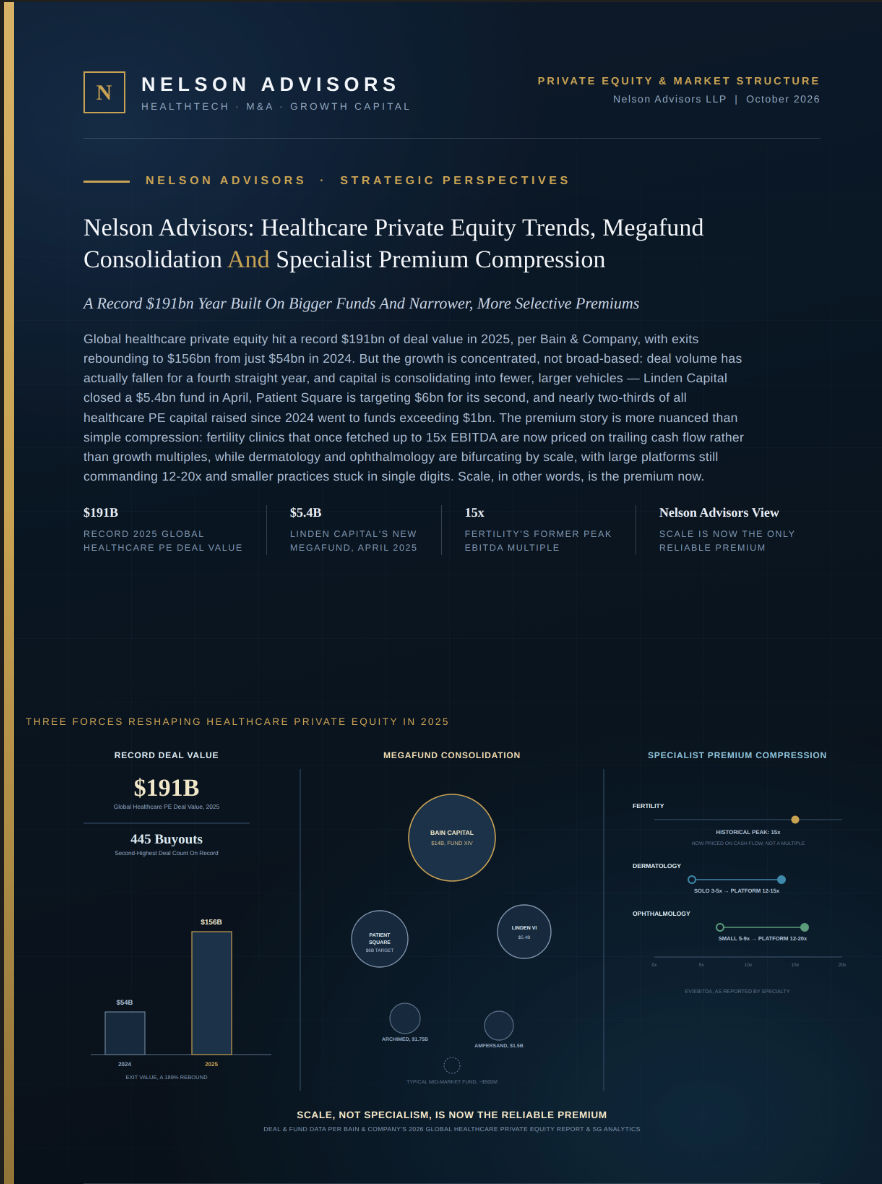
The M&A pattern established through 2026, depressed deal counts, rising deal values, extends into 2027, but with a change of character. The buy-and-build playbook that private equity ran across European healthcare services (dental, veterinary, fertility, imaging) is now being run across HealthTech. European healthcare PE activity surged 276% to €29.6 billion in 2025, and much of that capital is now sitting inside platforms with a mandate to acquire.
The sweet spot remains the €25M–€250M mid-market: companies large enough to have proven revenue and regulatory assets, small enough to be absorbed and too small to reach scale alone in a market where compliance costs are rising and procurement cycles remain brutal.
In 2027, expect the emergence of three to five recognisable pan-European digital health platforms, PE-backed roll-ups combining, say, an EHR base, an AI diagnostics layer, a remote-monitoring franchise and a payer-facing analytics arm, competing to be the continent's answer to the scaled US players.
Strategics will not sit still. The pharma patent cliff, with $180–400 billion of drug sales losing exclusivity between 2026 and 2030, keeps pharmaceutical acquirers hungry for digital assets in obesity, cardiometabolic and CNS. MedTech incumbents, their own growth slowing, will buy software margins. And the Sword Health–Kaia Health deal of early 2026 previewed a pattern we expect to recur: well-funded scale-ups acquiring European rivals to buy market access, consolidating categories from within.
5. The IPO window reopens, selectively and mostly not in Europe
The exit backlog is now the defining structural problem of the sector: a decade of venture funding has produced a cohort of European HealthTech companies with $100M+ revenue and no liquidity event. 2027 offers partial relief. We expect the IPO window that cracked open for US digital health in 2025–2026 to admit a small number of European champions in 2027, profitable or near-profitable, €100M+ revenue, category leaders with defensible AI assets.
Three caveats. First, selectivity: this is a window for the top decile, not a general reopening, and public investors burned by the 2021 cohort will demand profitability metrics private markets never did.
Second, venue: several of Europe's best candidates will list on Nasdaq rather than in London, Amsterdam or Stockholm, prolonging the debate about European capital-market competitiveness that no amount of listing reform has yet resolved.
Third, the paradox: a successful 2027 IPO or two will do more for the M&A market than for the IPO market, by giving acquirers and boards a public-market comparable to price deals against.
For most shareholders, exit in 2027 still means trade sale or sponsor to sponsor secondary. Plan accordingly.
6. Agentic AI moves from demo to deployment, narrowly
2026 was the year every vendor deck acquired an "agentic" slide. 2027 is the year a small number of agentic use cases become real, and the rest are quietly reframed. The use cases that scale will be administrative and bounded: prior authorisation and coding, referral triage, discharge coordination, revenue-cycle workflows, patient scheduling and follow-up. Autonomous clinical decision-making will not scale in Europe in 2027, the AI Act's human oversight requirements, liability uncertainty and provider risk-aversion see to that.
The commercial significance is nonetheless profound, because agentic workflow tools are bought on a different basis than clinical AI: they are sold on labour economics, procured by COOs and CFOs rather than CMIOs, and evaluated on payback periods measured in months.
In systems facing structural workforce shortages, which is to say, every system in Europe, that procurement logic cuts through.
Expect agentic back-office AI to be the fastest-growing procurement category of 2027, and expect the ambient documentation players to lead the charge, using the scribe as the wedge into a broader workflow platform.
7. Ambient AI becomes standard of care and a consolidation battleground
Ambient clinical documentation has achieved something rare in digital health: near-universal clinician enthusiasm. By 2027, AI scribes will be standard of care in a critical mass of European primary care and outpatient settings, with the Nordics and the Netherlands leading, the NHS scaling through framework procurement, and DACH following as data-protection assurances mature.
But the standalone scribe is not a company; it is a feature. As transcription accuracy commoditises, differentiation shifts to what sits on top: coding, clinical suggestion, order entry, registry submission, and the workflow automation described above.
2027 will therefore bring the great scribe consolidation, EHR vendors acquiring or crushing independents, US leaders buying European language capability and market access, European players merging to reach the scale their model economics demand. Founders in this category should be running dual-track processes by mid-year.
8. The NHS becomes Europe's most important HealthTech customer and its most demanding
The NHS 10 Year Health Plan's three shifts, hospital to community, analogue to digital, sickness to prevention, move from document to procurement reality in 2027, backed by a multi-billion-pound technology programme, the single patient record initiative and an app-first front door. For vendors, this is the largest single-payer digital health opportunity in Europe, with value-based procurement reshaping some £10 billion in annual spending.
It is also a filter. NHS procurement in 2027 will demand evidence, interoperability with the national record architecture, and pricing tied to outcomes. The era of the 12-month pilot that renews forever is ending; the replacement is fewer, larger, longer contracts awarded to vendors who can deploy at integrated-care-system scale.
Companies that win two or three ICS-scale NHS contracts in 2027 will become acquisition targets almost immediately, because an NHS reference at scale is the single most valuable sales asset in European HealthTech.
The corollary: the NHS's direction of travel, single record, national app, centralised procurement — will squeeze point solutions. If your product is a feature of the single patient record roadmap, 2027 is the year to find a platform partner or an acquirer.
9. Capital concentrates: obesity, cardiometabolic, mental health and women's health take the lion's share
The therapeutic concentration visible in 2026 funding data, cardiovascular, diabetes and nutrition, chronic disease management each attracting $250M+ in Q1 alone, hardens into 2027 orthodoxy. Obesity and metabolic care remain the sector's gravitational centre: the GLP-1 era has created a durable need for digital wraparound services (titration, adherence, nutrition, muscle-preservation, deprescribing), and pharma will keep funding and acquiring the category. Oviva's $235M Series D will not be the category's last mega-round.
Mental health returns to favour, but only the clinically validated end: measurement-based care, severe mental illness, and workforce-multiplying tools rather than wellness apps. Women's health graduates from "emerging category" to core allocation as menopause, fertility and cardiometabolic women's health converge with the prevention agenda. And a genuinely new 2027 theme: healthy longevity and prevention platforms, as EHDS-enabled data access and employer/insurer demand make preventive risk stratification commercially investable in Europe for the first time.
Early-stage funding overall stays tight. The barbell, pre-seed conviction bets on one side, $100M+ growth rounds for category leaders on the other, persists, and the Series B remains the valley of death for companies without payer revenue.
10. Sovereignty becomes a commercial force, not a talking point
European strategic autonomy in cloud, in data, in AI models, in supply chains, has been conference rhetoric for years. In 2027 it becomes procurement criteria. Expect member states and the EU institutions to push sovereign cloud requirements into health data hosting, EHDS secure processing environments to favour European infrastructure, and defence-adjacent health technology (trauma care, medical countermeasures, resilience logistics) to emerge as a funded category on the back of rearmament budgets.
For European founders this is a tailwind: "European-owned, European-hosted, EU-regulated" becomes a differentiator against US hyper scaler dependent competitors in public procurement.
For US and Asian strategics, it strengthens the case for acquiring European platforms rather than exporting into Europe. And for investors, it introduces a new exit constraint worth watching: expect at least one prominent European health data or AI transaction in 2027 to attract foreign-direct-investment screening, as governments begin treating health data assets as critical infrastructure.
What this means for founders
Fund the proof, not the promise. The single highest-return investment a European HealthTech founder can make in 2026–2027 is evidence generation: real-world outcomes, health-economic modelling and reference deployments at system scale. Treat AI Act and EHDS readiness as product features and sales assets, not compliance overhead, they are becoming the moat.
Extend runway into and through 2027, because the funding market will remain narrow even as it deepens, and the strongest negotiating position in a consolidating market is not needing the deal. And be honest about endgame: in a market of platforms, most companies are modules. Knowing which you are and running your company so that both paths stay open, is the difference between a premium exit and a distressed one.
What this means for investors
The 2027 playbook rewards concentration and patience. Back category leaders at fair prices rather than category hopefuls at cheap ones; the multiple bifurcation means the middle of the quality curve is where returns go to die. Underwrite regulation as alpha: portfolios that treat AI Act and EHDS compliance as value-creation workstreams will exit at premiums to those that treat them as cost centres.
Mine the mid-market: the €25M–€250M sweet spot remains the most attractive risk-return segment in European healthcare, and the buy-and-build window is open now, before platform scarcity reprices it.
And prepare portfolio companies for buyers' due diligence standards that now match public-market scrutiny — clean data rooms, audited outcomes claims, and defensible AI governance.
What this means for providers
Providers hold more negotiating power in 2027 than at any point in a decade, vendors need scaled European references more than providers need any individual vendor. Use it: demand outcome-linked pricing, contractual interoperability guarantees, and AI Act documentation as a condition of procurement.
Consolidate the pilot portfolio ruthlessly; the average European hospital's dozens of overlapping point solutions are an integration liability and a security risk and 2027's platform consolidation is the moment to rationalise.
Invest in data readiness ahead of EHDS obligations, because the providers with clean, structured, accessible data will be first to benefit from and first to monetise participation in, the European data economy. Above all, plan for AI as workforce strategy: the systems that deploy ambient and agentic tools at scale in 2027 will bank a productivity advantage that compounds annually.
Risks to this view
No forecast survives contact with the market intact, and three risks could reshape these predictions. The first is macro: a renewed rate shock or European growth scare would slam the IPO window shut, slow PE deployment, and push the exit backlog into 2028, deepening the discount at which mid-market companies trade.
The second is regulatory slippage: Brussels has already shown willingness to push AI Act deadlines once, and a further delay would postpone the compliance-driven consolidation we expect, keeping marginal companies alive longer and dampening 2027 deal volumes.
The third is an AI credibility event, a high-profile clinical AI failure, safety recall or liability judgment somewhere in Europe or the US, which would not stop adoption but would harden procurement caution, lengthen sales cycles and temporarily reprice the category.
Against these, one upside risk deserves equal weight: adoption could surprise. If ambient and agentic tools deliver visible productivity gains in flagship deployments, an ICS, a German university hospital group, a Nordic region, the demonstration effect across Europe's imitative procurement culture could compress five years of adoption into two. In that scenario, the constraint on the sector in 2027 is not demand or capital but deployment capacity, and the scarce assets become implementation and change-management
capability rather than algorithms.
The bottom line
2027 will not be a comfortable year for European healthcare technology, but it will be a clarifying one. The sector is exiting its adolescence: regulation is arriving on schedule, capital is concentrating around evidence, buyers are professionalising, and the gap between category leaders and everyone else is becoming a chasm.
For the companies on the right side of that chasm, clinically validated, regulatory ready, deployed at scale, 2027 offers the best exit and growth conditions Europe has ever produced. For everyone else, it offers a choice that gets starker every quarter: consolidate, or be consolidated.
The good news is that the underlying demand has never been more certain. Europe's health systems face demographic pressure, workforce shortage and fiscal constraint that only technology can reconcile.
The question was never whether European healthcare would digitise , only who would still be standing when it did. 2027 is the year that answer starts to become visible.
Nelson Advisors work with HealthTech founders, boards and investors on mergers, acquisitions, growth and strategy. This article represents our views on market direction and does not constitute investment advice.
Nelson Advisors > European HealthTech, MedTech, Digital Health Investment Banking
Nelson Advisors specialise in Mergers and Acquisitions, Partnerships and Investments for Digital Health, HealthTech, MedTech, Health IT, Consumer HealthTech, Healthcare Cybersecurity, Healthcare AI companies. www.nelsonadvisors.co.uk
Follow Nelson Advisors LinkedIn Page > https://www.linkedin.com/company/nelson-advisors/
Nelson Advisors regularly publish Thought Leadership articles covering market insights, industry trends, deal commentary, market analysis & predictions. https://www.healthcare.digital
Nelson Advisors publish Europe's Leading Healthcare Technology Investment Banking Newsletter every week, join 5000+ HealthTech and MedTech subscribers today! https://lnkd.in/e5hTp_xb
#VentureCapital #PrivateEquity #Founders #SeriesA #SeriesB #Founders #SellSide #TechAssets #Fundraising #BuildBuyPartner #GoToMarket #PharmaTech #BioTech #Genomics #NelsonAdvisors #HealthTech #MedTech #DigitalHealth #HealthIT #Cybersecurity #HealthcareAI #FemTech #Mergers #Acquisitions #Partnerships #Growth #Strategy #NHS #UK #Europe #USA #Canada
Nelson Advisors LLP
Hale House, 76-78 Portland Place, Marylebone, London, W1B 1NT
Meet Nelson Advisors @ 2026 Events
Digital Health Rewired > March 2026 > Birmingham, UK
NHS ConfedExpo > June 2026 > Manchester, UK
HLTH Europe > June 2026, Amsterdam, Netherlands
HIMSS AI in Healthcare > July 2026, New York, USA
Bits & Pretzels > September 2026, Munich, Germany
World Health Summit 2026 > October 2026, Berlin, Germany
HealthInvestor Healthcare Summit > October 2026, London, UK
HLTH USA 2026 > October 2026, USA
Barclays Health Elevate > October 2026, London, UK
Web Summit 2026 > November 2026, Lisbon, Portugal
MEDICA 2026 > November 2026, Düsseldorf, Germany
Venture Capital World Summit > December 2026 Toronto, Canada




Comments