Nelson Advisors: Healthcare Private Equity Trends, Megafund Consolidation and Specialist Premium Compression

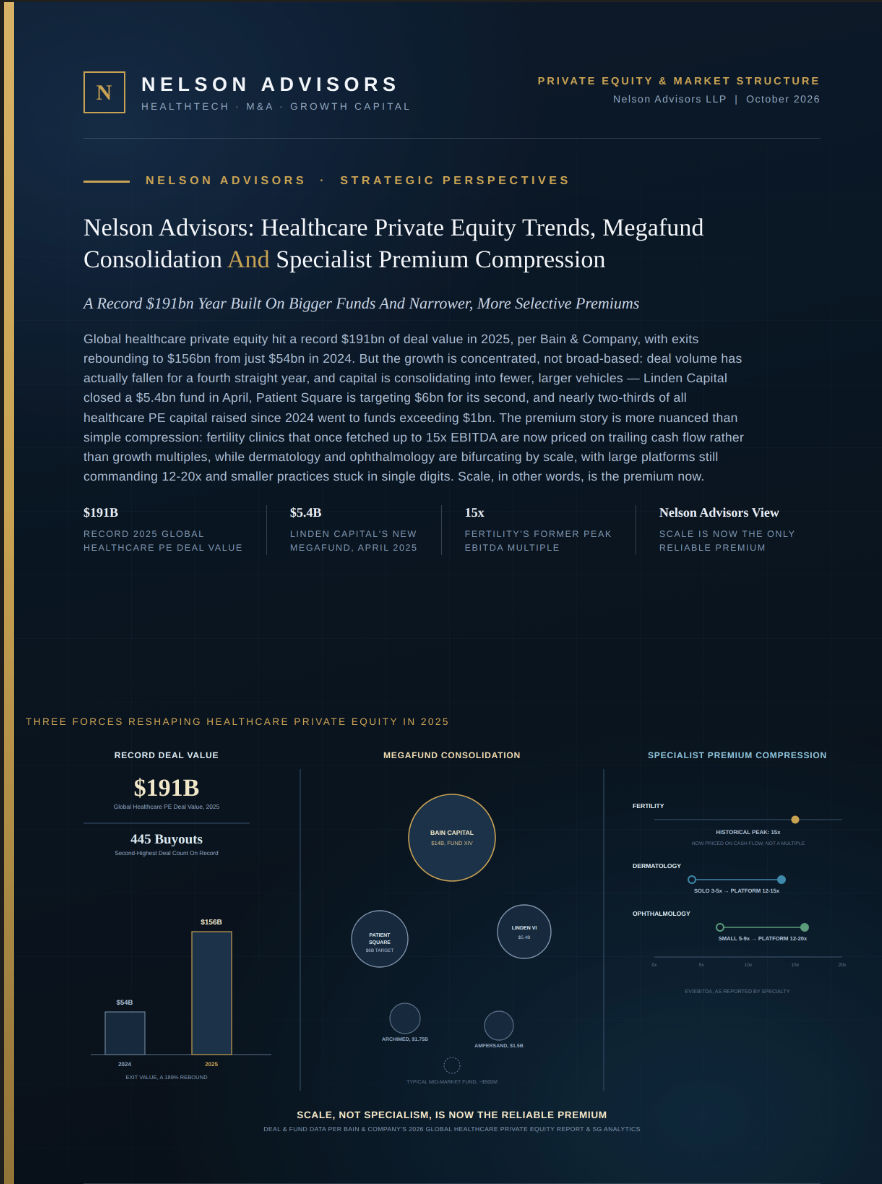
Executive Synthesis: Diverging Trajectories Across Private Equity and Venture Capital
Private capital allocation across the global healthcare and life sciences landscape reached an unprecedented structural inflection point during the first half of 2026. Driven by ongoing institutional portfolio rebalancing, prolonged liquidity constraints and shifting reimbursement fundamentals, the market has bifurcated into a high concentration fundraising environment alongside an acute divergence in sub-sector investment performance.
Healthcare private equity managers raised $16.2 billion in H1 2026, achieving more than 90% of the entire 2025 full-year total of $17.4 billion across just 11 fund closes. This fundraising pace is projected to cut the annual healthcare private equity fund count nearly in half, yet healthcare still captured 6.1% of all private equity capital raised globally in H1 2026, establishing an all-time high in historical benchmark data.
Concurrently, healthcare venture capital managers secured $4.7 billion in commitments over the same period, led by $3.6 billion allocated to life sciences specialists across 16 fund closes and $1.1 billion committed to healthtech vehicles, marking a measurable rebound for healthtech following a prolonged decade-long cyclical trough.
Underneath this robust top-line fundraising, performance metrics reveal an inverse decoupling between asset classes. In healthcare private equity, the specialist premium has compressed steadily since the 2012–2014 vintages, and the 2021–2023 pooled internal rate of return (IRR) now trails that of the broader private equity asset class at 10.2% against 12.0%. Conversely, healthtech venture strategies have moved in the opposite direction: their 2021–2023 vintages produced a total value to paid-in (TVPI) multiple of 1.24x, compared to 1.18x for the broader venture asset class.
These shifting dynamics are systematically captured in the H1 2026 Healthcare Funds Report, which profiles more than 500 healthcare and life sciences specialist managers, supported by interactive lists on the PitchBook Platform covering specialist investments, benchmarked returns, and key personnel. The empirical record underscores that scale, specialised execution and sub-sector operational realities are dramatically restructuring how institutional limited partners deploy capital and price risk across private healthcare markets.
Healthcare Private Equity: Megafund Consolidation and Specialist Premium Compression
Capital Concentration and the Flight to Flagship Platforms
The private equity healthcare fundraising environment in H1 2026 represents the most pronounced manifestation of LP capital concentration observed in over a decade. The accumulation of $16.2 billion across only 11 completed fund vehicles elevates the average fund size to approximately $1.47 billion, compared to an average vehicle size of $756.5 million across 23 closes in full-year 2025 and $904.3 million across 23 closes in 2024.
This trajectory reflects institutional allocators consolidating their commitments into proven, upper-middle-market and large-cap flagship managers that possess established sourcing networks, transatlantic footprints, and dedicated operational benches.
Vintage / Year | Capital Raised ($B) Closed Fund Count \ Average Fund Size ($M) |
2016 | 6.3 |
2017 | 6.4 |
2018 | 7.0 |
2019 | 14.5 |
2020 | 11.9 |
2021 | 16.8 |
2022 | 15.3 |
2023 | 27.0 |
2024 | 20.8 |
2025 | 17.4 |
H1 2026 | 16.2 |
Data source: PitchBook H1 2026 Healthcare Funds Report (Geography: North America and Europe, as of June 30, 2026).
The record 6.1% share of total private equity capital captured by healthcare in H1 2026 highlights the sustained institutional appetite for defensive market positioning. Faced with broader macroeconomic uncertainties, tariff adjustments, and technological disruption across general enterprise software, institutional investors have systematically reallocated toward healthcare assets supported by inelastic demand and demographic tailwinds.
However, this institutional support has been intensely selective, leaving emerging and lower-middle-market specialist GPs behind. The drop in vehicle count—from an annual baseline of 48 to 50 active closes between 2016 and 2020 down to an annualized pace of just 22 funds in 2026—confirms that mid-sized and first-time healthcare GPs face an arduous fundraising cycle, while top-tier flagship managers consistently meet or exceed their hard caps.
Structural Drivers of the Specialist Premium Compression
The performance trajectory of healthcare focused buyout strategies has fundamentally decoupled from historical patterns. Over prior cycles, healthcare specialization yielded an unambiguous alpha premium. Specialist GPs leveraged clinical knowledge, complex coding fluency and regulatory insights that generalist funds could not replicate, allowing them to underwrite complex corporate carve-outs and clinical platform consolidations at premium returns.
Strategy / Cohort | 2021–2023 Pooled Net IRR | Relative Benchmark Spread | Primary Performance Anchor |
Healthcare Specialist PE | 10.2% | -180 bps | Labor inflation, regulatory pushback, leverage costs |
Broader Private Equity | 12.0% | Baseline | Diversified sector rotation, broader industrial buyouts |
Data source: PitchBook H1 2026 Healthcare Funds Report.
The steady compression of this specialist premium, culminating in the 2021–2023 pooled IRR trailing broader PE by 180 basis points (10.2% versus 12.0%), stems from compounding structural factors.
Throughout the 2012–2020 cycles, specialist GPs generated substantial returns through fragmented physician practice management roll-ups across dental, dermatology, ophthalmology, and physical therapy. In those earlier periods, sponsors acquired small regional practices at 4x to 7x EBITDA and exited aggregated platforms to secondary sponsors at 12x to 15x EBITDA. By the 2021–2023 vintage window, entry multiples for platform assets had inflated substantially, eliminating standard multiple arbitrage.
Concurrently, post-pandemic clinical wage inflation, persistent nursing shortages, and reimbursement pushback from both commercial payers and public programs severely compressed clinic-level operating margins.
Furthermore, regulatory and legislative scrutiny intensified across outpatient and acute-care consolidation models. State-level healthcare policy reviews, federal antitrust probes into provider roll-ups, and scrutiny surrounding corporate practice of medicine doctrines constrained sponsors' ability to extract organic margin expansion through operational consolidation or out-of-network pricing strategies. Additionally, high-profile hospital bankruptcies and public pushback against aggressive sale-leaseback transactions with healthcare real estate investment trusts heightened financial and legal friction for traditional leveraged provider models.
Compounding these operational headwinds, debt capital structures established during the 2021–2023 market peak placed disproportionate strain on healthcare assets. Many healthcare buyouts were capitalized with floating-rate private debt packages. As global benchmark rates climbed, debt-servicing obligations consumed vital operational cash flows, directly impairing equity returns. While diversified buyout funds counterbalanced rate pressures by allocating toward sectors with dynamic pricing power or structural supply constraints, leveraged healthcare provider platforms remained encumbered by fixed reimbursement schedules, elevated interest burdens, and rigid clinical overhead.
Healthcare Venture Capital: Sub-Sector Realignment and the Healthtech Rebound
Life Sciences Fundraising Discipline Post-Euphoria
Healthcare venture capital closed H1 2026 with $4.7 billion raised, reflecting a continued flight toward scientific rigor and enterprise utility. Life sciences fundraising accounted for the clear majority of this capital, securing $3.6 billion across 16 closes. While this places annualised 2026 life sciences capital on pace to finish near $7.2 billion, a notable contraction from the peak speculative bubble of 2021 ($32.6 billion across 84 funds), it aligns with a disciplined, pre-pandemic run rate.
Vintage / Year | Capital Raised ($B) Closed Fund Count \ Average Fund Size ($M) |
2016 | 3.6 |
2017 | 13.7 |
2018 | 18.2 |
2019 | 17.7 |
2020 | 18.0 |
2021 | 32.6 |
2022 | 19.3 |
2023 | 11.1 |
2024 | 10.3 |
2025 | 12.6 |
H1 2026 | 3.6 |
Data source: PitchBook H1 2026 Healthcare Funds Report (Geography: North America and Europe, as of June 30, 2026).
The life sciences venture ecosystem has entered a mature rationalization phase following several volatile funding cycles. Following the public biopharma market correction of 2022–2024, initial public offerings ceased serving as an automatic liquidity mechanism for early-stage and preclinical assets. Consequently, venture managers adapted their capital allocation pace, eschewing wide portfolios of speculative discovery-stage assets in favour of concentrating capital into clinically de-risked platforms that display human proof-of-concept data.
This operational discipline is visible in vehicle sizing: the average life sciences fund size stabilised at $225.0 million in H1 2026, matching 2025 levels and remaining well above historical 2016–2020 averages, confirming that institutional LPs are primarily backing well-capitalised managers capable of supporting assets through Phase 2 trial milestones.
The Healthtech Recovery: Operational Value Driving Returns
Healthtech venture fundraising secured $1.1 billion during H1 2026, marking an inflection point after bottoming at a 10-year low. The preceding contraction resulted from the unwinding of pandemic-era direct-to-consumer digital health, tele-health aggregators, and unvetted virtual wellness platforms that exhibited unsustainable customer acquisition costs and negligible clinical differentiation.
Strategy / Benchmark | 2021–2023 TVPI Multiple | Outperformance Delta | Primary Performance Driver |
Healthtech Specialist VC | 1.24x | +600 bps | Cost restructuring, enterprise workflow AI integration |
Broader Venture Capital | 1.18x | Baseline | Prolonged tech valuation reset, late-stage liquidity delays |
Data source: PitchBook H1 2026 Healthcare Funds Report.
The performance of 2021–2023 healthtech vintages (1.24x TVPI) outperforming total venture capital (1.18x TVPI) reflects the accelerated restructuring the healthtech sector underwent relative to general technology. Because healthtech entered its valuation reset earlier in the cycle, startups in the space were forced to cut burn rates, rationalize operating footprints, and adjust cap tables ahead of other venture verticals. Consequently, capital deployed in the 2021–2023 vintage cohort entered at discounted entry multiples, providing downside protection and enhanced multiple upside.
Simultaneously, enterprise demand from hospital systems, clinical networks, and commercial payers pivoted toward quantifiable financial utility. Healthcare provider CFOs confronting clinical labor shortages and narrow operating margins prioritised procurement for enterprise software that delivered immediate, measurable return on investment.
Technologies addressing operational pain points, such as generative ambient clinical documentation, automated revenue cycle management, predictive nurse scheduling engines, and automated clinical trial workflows, experienced rapid commercial scaling. This enterprise adoption translated into stable recurring software as a service revenues, high customer retention rates, and enterprise multi-year contracts that insulated healthtech portfolios from broader venture tech valuation compressions.
Healthtech performance was further reinforced by robust M&A interest from private equity sponsors seeking technology-enabled platforms. Mid-market and large-cap buyout sponsors, seeking alternative growth vectors beyond traditional capital-intensive provider roll-ups, aggressively acquired mature, profitable healthcare IT platforms to streamline operations across their broader clinical portfolios.
This strategic and sponsor buyout demand established functional exit avenues and upward valuation marks for leading venture assets, supporting healthtech TVPI while general venture platforms remained encumbered by illiquid late-stage backlogs.
Comparative Assessment: Private Equity Versus Venture Capital Dynamics
The underlying forces governing healthcare private equity and healthcare venture capital during H1 2026 highlight contrasting cyclical pressures, valuation baselines, and execution profiles.
Structural Dimension | Healthcare Private Equity | Healthcare Venture Capital |
H1 2026 Fundraising Volume | $16.2 billion | $4.7 billion ($3.6B Life Sciences; $1.1B Healthtech) |
Capital Concentration Trend | Concentrated into 11 flagship mega-funds | Concentrated into 16 life sciences funds; selective healthtech |
Fundraising Velocity vs. 2025 | >90% of 2025 total raised in H1; fund count down ~50% | Stabilized pacing; life sciences rationalizing; healthtech rebounding |
Vintage Performance Benchmarks | 2021–2023 Pooled IRR: 10.2% (trails broader PE by 180 bps) | 2021–2023 TVPI: 1.24x for Healthtech (beats broader VC by 600 bps) |
Core Macro Headwinds | Leverage costs, labor inflation, regulatory/antitrust scrutiny | Extended clinical trials, selective IPO windows, milestone risk |
Primary Value Creation Mechanism | Operational EBITDA integration, digital upgrades, carve-outs | Clinical phase de-risking, enterprise ARR, administrative automation |
This divergence exposes an essential institutional paradox. Healthcare private equity captured a record-high 6.1% share of all global PE capital raised despite trailing broader PE performance benchmarks, driven by institutional allocators treating mature healthcare platforms as defensive capital-preservation vehicles.
Conversely, healthtech venture strategies delivered documented excess returns following an intensive market correction, yet continue to operate in a measured fundraising environment requiring extensive manager diligence and commercial validation.
Strategic Implications for Institutional Allocators and Fund Managers
Strategic Mandates for Private Equity Fund Managers
The continued compression of the specialist premium requires healthcare private equity general partners to overhaul legacy buyout and add-on underwriting practices. The historical reliance on financial engineering, excessive leverage, and multiple expansion via fragmented provider roll-ups is no longer viable in a high-rate, highly regulated environment. Sponsors must reorient their value-creation playbooks around direct operational productivity and technological modernisation. Rather than anticipating multiple expansion upon exit, fund managers must drive margin expansion by deploying automated clinical documentation, implementing centralised billing architecture, and modernising clinical scheduling to mitigate chronic wage inflation.
Furthermore, regulatory compliance must be integrated directly into platform underwriting. In response to heightened antitrust scrutiny surrounding regional market concentration and corporate hospital arrangements, managers must pivot away from aggressive physician roll-ups toward corporate carve-outs, non-controlled health system joint ventures, and specialised biopharma services. Sectors such as contract development and manufacturing organizations, specialized clinical research services, and medical device supply chains offer substantial scale while operating largely outside payer reimbursement disputes and provider regulatory crosshairs. Capital structures must also reflect modern financing constraints, leaning on structured equity solutions, minority growth investments, and equity-light operational alignments to minimise interest-rate vulnerabilities.
Deployment Playbook for Venture Capital and Life Sciences Sponsors
For life sciences and healthtech venture managers, the bifurcation of early-stage private markets demands rigorous capital discipline and milestone-focused investment structures. The outperformance demonstrated by 2021–2023 healthtech vintages shows that early-stage investors must maintain strict pricing discipline and resist speculative software valuations. Healthtech GPs must direct capital away from generic software wrappers and direct-to-consumer models, underwriting enterprise solutions with defensible clinical moats, direct electronic health record workflow integration, and validated customer returns on investment.
In parallel, life sciences venture managers must manage their syndicate dynamics and fund sizing around extended development cycles. With crossover IPO markets remaining highly selective, managers must structure investment rounds with sufficient internal capital reserves to fund lead therapeutics through definitive Phase 2 proof-of-concept endpoints. By structuring larger syndicate partnerships and aligning early with strategic pharmaceutical acquirers, life sciences managers can secure viable trade-sale liquidity pathways without depending on public equity markets for capital recycling.
Portfolio Pacing and Due Diligence Directives for Institutional Allocators
Institutional allocators navigating the private healthcare market must recalibrate their portfolio construction and fund evaluation frameworks. LPs can no longer assume that healthcare specialist buyout funds will automatically deliver an alpha premium over generalist strategies. Portfolio diligence must parse manager return attribution to distinguish between genuine operational EBITDA expansion and historical leverage-driven multiple expansion. Allocators must scrutinise whether a sponsor possesses the operating capabilities to navigate clinical labor inflation, state-level regulatory inquiries, and restrictive payer contracts.
Concurrently, allocators should recognise the defensive enterprise dynamics embedded within specialised healthtech venture portfolios. The 1.24x TVPI posted by 2021–2023 vintages demonstrates that disciplined enterprise healthtech provides an attractive blend of technological upside and defensive revenue visibility. Allocators should maintain targeted exposure to healthtech specialist managers who secured attractive entry valuations during the post-2022 market downturn and are deploying capital into enterprise automation platforms.
Finally, the concentration of private equity capital into mega-funds creates an attractive structural opening within the lower-middle market. As flagship managers scale beyond $2 billion per vehicle to execute larger transatlantic corporate carve-outs, sub-$500 million transaction environments face reduced competition. Institutional investors that selectively allocate toward disciplined lower-middle-market specialists capable of proprietary deal sourcing and hands-on operational improvements can capture the traditional specialist premium that has compressed within larger, debt-reliant buyout vehicles.
Conclusion: Structural Maturation and the New Paradigm of Healthcare Investing
The data through H1 2026 establishes that private healthcare markets have entered a mature, consolidated operational cycle. The era of unconstrained fundraising, straightforward multiple expansion via clinical practice roll-ups, and speculative consumer digital health ventures has passed. Healthcare private equity has transformed into an institutional, scale-driven market where flagship mega-funds absorb the overwhelming share of LP capital, while return compression across the asset class demonstrates that financial engineering cannot overcome structural operational headwinds.
Conversely, the rebound in healthtech venture performance proves that market dislocations create resilient, cash-efficient investment vintages. By rationalising burn rates and focusing on high-ROI hospital and payer enterprise software, healthtech venture funds have generated tangible outperformance relative to broader venture capital. For both general partners and institutional allocators, navigating this transformed private market landscape requires rigorous operational execution, regulatory awareness, and disciplined underwriting aligned with the long-term fundamentals of the global healthcare economy.
Nelson Advisors > European Healthcare Technology Investment Banking
Nelson Advisors specialise in Mergers and Acquisitions for European HealthTech, MedTech, Digital Health, Healthcare IT, Healthcare AI companies in the Lower to Mid Market ranging from $25M to $250M EV. www.nelsonadvisors.co.uk
Healthcare.Digital is the Google News approved HealthTech and MedTech Thought Leadership platform for Nelson Advisors, positioning them as a specialised authority on European Healthcare Technology M&A and strategic corporate development. https://www.healthcare.digital
Nelson Advisors publish Europe's Leading Healthcare Technology Investment Banking Newsletter every week, join 5000+ HealthTech and MedTech subscribers today! https://lnkd.in/e5hTp_xb
Healthcare.Digital serves as a research platform for Nelson Advisors’ perspectives on deals, valuations and structural shifts reshaping Global Digital Health, MedTech, Healthcare AI and Health IT. https://www.healthcare.digital
Nelson Advisors is one of Europe's leading mergers and acquisitions advisory firms, exclusively dedicated to the dynamic and rapidly evolving healthcare technology sector. With a deep understanding of market dynamics and technological advancements, they empower innovative HealthTech companies and strategic investors to navigate complex transactions and achieve their growth ambitions. www.nelsonadvisors.co.uk
#NelsonAdvisors #HealthTech#MedTech#DigitalHealth #HealthIT #Cybersecurity #HealthcareAI #FemTech#ConsumerHealth #Mergers #Acquisitions #Partnerships #Growth #Strategy #NHS #UK #Europe #USA #Canada#Commonwealth#CorporateDivestitures #VentureCapital #PrivateEquity #Founders #SeriesA #SeriesB #Founders #SellSide #TechAssets #Fundraising #BuildBuyPartner #GoToMarket #PharmaTech #Genomics
Nelson Advisors
Hale House, 76-78 Portland Place, Marylebone, London, W1B 1NT
Meet Nelson Advisors @ Events in 2026
Digital Health Rewired > March 2026 > Birmingham, UK
NHS ConfedExpo > June 2026 > Manchester, UK
HLTH Europe > June 2026, Amsterdam, Netherlands
HIMSS AI in Healthcare > July 2026, New York, USA
Bits & Pretzels > September 2026, Munich, Germany
HealthInvestor Healthcare Summit > September 2026, London, UK
World Health Summit 2026 > October 2026, Berlin, Germany
HLTH USA 2026 > October 2026, USA
Global Health Exhibition 2026 > October 2026, Riyadh, Saudi Arabia
Web Summit 2026 > November 2026, Lisbon, Portugal
MEDICA 2026 > November 2026, Düsseldorf, Germany
Leaders in Health Summit 2026 > November 2026, London, UK
Venture Capital World Summit > December 2026, Toronto, Canada
Meet Nelson Advisors @ Events in 2027
Digital Health Rewired > March 2027 > Birmingham, UK
Barclays Health Elevate > March 2027, London, UK
NHS ConfedExpo > June 2027 > Manchester, UK
HLTH Europe > June 2027, Amsterdam, Netherlands




Comments