Palantir, the NHS, Federated Data Platform: Past, Present and Future

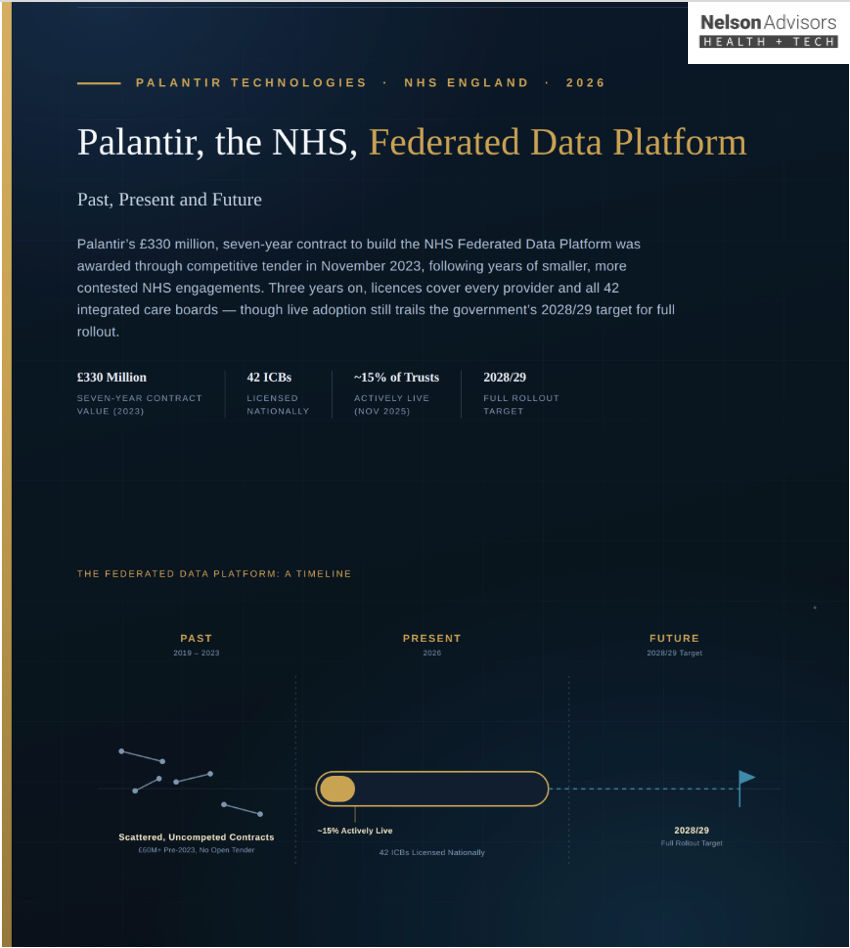
Few technology contracts in the history of the NHS have generated as much interest, scrutiny and hostility as the Federated Data Platform. Awarded to Palantir Technologies in November 2023 with a headline value of up to £330 Million over seven years, the FDP was billed as the digital backbone that would finally join up the NHS's notoriously fragmented data estate.
Nearly three years on, the platform is live in the majority of English acute trusts, NHS England is publishing quarterly benefits figures and yet the political temperature around the contract has never been higher. A cross-party committee of MPs has formally urged the government to walk away. The British Medical Association has instructed doctors to limit their engagement. And a break clause in spring 2027 has turned the second half of 2026 into a decision point that will shape NHS data infrastructure for a decade.
We look at how we got here, where the FDP actually stands today and what the next eighteen months are likely to bring.
Past: From Silicon Valley to Skipton House
To understand why a data platform procurement became a culture war, you have to start with the supplier. Palantir Technologies was founded in 2003 by Peter Thiel, Alex Karp and colleagues, with early backing that famously included In-Q-Tel, the venture arm of the CIA. The company built its reputation on Gotham, an intelligence and defence analytics product used by military, security and immigration enforcement agencies, before developing Foundry, the commercial data integration platform that now underpins its health sector work. Palantir was never a neutral utility vendor in the public imagination: its work with US Immigration and Customs Enforcement, its deep defence relationships and Thiel's own politics, he once suggested that British affection for the NHS was a form of "Stockholm syndrome", guaranteed that any NHS relationship would be contested from day one.
That relationship began quietly, in the most extreme circumstances imaginable. In March 2020, as COVID-19 overwhelmed planning assumptions across government, Palantir was brought in to help build the NHS COVID-19 Data Store, initially for a token fee of £1.
The emergency arrangement gave the company a foothold at the centre of NHS England's data operations, and it was extended and expanded repeatedly: a £23 Million deal in December 2020 continued the work, and further extensions kept Foundry embedded in NHS England through the pandemic recovery period. Campaigners at openDemocracy and Foxglove challenged the lack of transparency around these emergency contracts, forcing the government to commit to public consultation before any long-term expansion of the data store's scope.
Investigative reporting later revealed that Palantir had been courting NHS decision-makers well before the pandemic, the £1 contract was less an act of corporate altruism than a strategic land grab and a remarkably effective one.
The pandemic period also transformed Palantir itself. The company listed on the New York Stock Exchange in September 2020, and government health work, in the UK, the US and beyond, became a showcase for Foundry's commercial pivot beyond defence and intelligence. The NHS was not just another customer; it was arguably the most prestigious civilian healthcare reference in the world, and Palantir pursued it accordingly, recruiting a string of senior NHS figures. The traffic through that revolving door, including former NHS England deputy chief executive Matthew Swindells' advisory connections to the company while chairing north-west London acute trusts, became a controversy in its own right, feeding perceptions that the eventual procurement was a foregone conclusion.
By the time NHS England came to procure a permanent successor platform, Palantir was indeed the incumbent in all but name. The Federated Data Platform procurement was launched against the backdrop of two prior data initiatives that had collapsed under public distrust, care.data in 2016 and the General Practice Data for Planning and Research (GPDPR) programme in 2021, which prompted millions of opt-outs. The lesson NHS England drew was to focus the FDP on operational data for direct care and planning rather than research extracts. The lesson campaigners drew was that NHS data programmes fail when trust is treated as an afterthought.
In November 2023, NHS England confirmed what most observers expected: the FDP contract was awarded to a Palantir led consortium including Accenture, PwC, NECS and Carnall Farrar. Palantir's own share was approximately £182 Million within the £330 Million envelope, structured over an initial three year term with optional extensions, a 3+2+1+1 structure that would later become politically significant.
The award triggered immediate controversy: rival bidders and civil society groups questioned whether the incumbent's position had made the competition meaningful, the published contract was heavily redacted, and the Good Law Project and Foxglove began building legal and public campaigns that continue today.
Roughly 50,000 patients joined campaigns opposing the platform, and a judicial review challenge to the award was mounted in early 2024, though it did not stop the rollout.
Present: A Platform in Most Trusts and a Contract Under Siege
Two and a half years into the contract, the honest assessment is that the FDP is both more embedded and more embattled than either its champions or its critics predicted.
It is worth pausing on what the FDP actually is, because the branding invites misunderstanding. "Federated" is doing a lot of work in the name. The platform is not a single national database of patient records; it is a set of separate instances of Palantir's Foundry software, one for each participating trust and integrated care board, plus a national tenant, in which each organisation controls its own data and decides what to connect. Data flows between instances only under specific agreed arrangements, and the platform is restricted to operational purposes: managing waiting lists, scheduling theatres, co-ordinating discharge, tracking cancer pathways and supporting population health planning. It explicitly excludes GP records held at practice level and is not a research environment, a deliberate boundary drawn after the GPDPR debacle. In principle, this architecture is exactly what privacy advocates spent years asking for: local control, purpose limitation, no national honeypot. In practice, as we shall see, the assurances wrapped around that architecture have proved less watertight than the diagrams suggested.
Start with the deployment numbers, because they are genuinely substantial. According to NHS England's published uptake data (updated June 2026, covering the period to the end of May 2026), 139 NHS trusts are now live on the platform, 170 have signed up, and all 35 integrated care boards are live. The platform's national products cover the core operational pressure points of the post-pandemic NHS: the Inpatient Care Co-ordination Solution for waiting list and theatre management, an outpatient equivalent, the Referral to Treatment validation tool, OPTICA for discharge management, and Cancer 360 for cancer pathway tracking.
NHS England's claimed benefits are equally headline-friendly. It reports 111,589 additional theatre procedures attributable to the inpatient tool, over 300,000 patients safely removed from inpatient and outpatient waiting lists after validation, close to a million people removed from waiting lists through RTT validation of 4.7 million records, 348,084 patients discharged with the support of OPTICA, with double-digit percentage reductions in long-stay discharge delays and 93,691 cancer patients supported through Cancer 360, alongside measurable improvements in 28-day diagnosis and 62-day treatment standards. Individual trusts have reported real operational gains: University Hospitals Sussex, an early exemplar, saved around 90 staff hours a week on waiting list management, and a peer-reviewed Imperial College evaluation of the surgical scheduling tool found genuine improvements in theatre utilisation, albeit with the usual caveats about attribution.
If that were the whole story, the FDP would be an unambiguous, if expensive, success. It is not the whole story.
First, the adoption figures flatter the reality of usage. Freedom of Information research by Corporate Watch and the No Palantir campaign, published in 2025, found that while scores of trusts had signed memoranda of understanding, only a minority were actively using FDP products, 34 trusts, around 15% of those surveyed, at the time of the research. Several trusts declined to adopt on functionality grounds: Leeds concluded it would "lose functionality rather than gain it" by moving from existing systems, and Greater Manchester described the platform as potentially "retrograde" compared with what it already had. NHS analysts reported feeling "silently forced to adopt," and an £8.5 Million contract awarded to KPMG to drive adoption raised eyebrows about how organic the uptake really was.
A Financial Times analysis in June 2026 found the platform's benefits were strikingly uneven across trusts, and NHS England was forced to retract some of its earlier benefits claims, conceding that "we cannot draw conclusions about cause and effect as other variables have not been controlled for." When the flagship national figures depend on that caveat, the £330 Million question, is the FDP causing improvement, or merely present while improvement happens? remains genuinely open.
Second, the trust deficit has deepened rather than healed. In June 2025 the BMA formally voted to oppose the rollout and call for contract termination, and by February 2026 it had instructed doctors to limit engagement with the platform. Patients cannot individually opt out of the FDP for direct care purposes, a design decision that campaigners have made central to their case, though trusts retain discretion over adoption. Then, in the summer of 2026, came the most damaging episode yet: following pressure from the National Data Guardian, Dr Nicola Byrne, NHS England admitted that its Data Protection Impact Assessment had been wrong to state that only NHS staff could access identifiable patient data on the platform.
In fact, three Palantir engineers held administrative-level access to the national data integration environment where data sits before pseudonymisation, with a further 33 supplier engineers holding limited project-specific access. NHS England apologised and corrected the paperwork, but the damage was done. For a programme whose entire social licence rests on the claim that Palantir is a mere processor with no meaningful access to patient data, the correction of that "error" after years of categorical public assurances, was a gift to critics.
Third, the politics have shifted decisively. In April 2026, health minister Dr Zubir Ahmed told MPs the contract could be reconsidered if other firms "can do the job better." In June, technology secretary Liz Kendall confirmed the government was "reviewing every single aspect of that contract to make sure we get the right deal for Britain." Parliament's Science, Innovation and Technology Committee described Palantir's expanding footprint across UK public infrastructure as "an unacceptable point of weakness." And on 9th July 2026, the Health and Social Care Committee wrote formally to health innovation minister Preet Kaur Gill urging the government to prepare to drop the FDP altogether, with chair Layla Moran concluding: "Little by little, the government's arguments for sticking with the FDP has unravelled.
So in the interest of public confidence in the NHS and the security of their medical information, we believe it is time to crack on with preparations to find an alternative in time for spring 2027." Reports have also emerged of NHS England officials warning staff against public criticism of the platform, hardly the posture of a programme confident in its own evidence base.
It is worth being fair to Palantir here. The company's UK chief, Louis Mosley, has consistently argued that the criticism is reputational rather than performance-based, that the software can only process data in line with customer instructions, and that misuse would be both illegal and technically impossible given granular access controls.
Palantir did not create the NHS's data fragmentation, its waiting list crisis, or the failed data programmes that preceded the FDP. And some of the opposition is clearly about who Palantir is, its ICE contracts, its defence work, its founder's politics, rather than what the FDP does. But in public health infrastructure, who the supplier is matters, because patient trust is not a soft consideration: it is the operating condition. The lesson of care.data and GPDPR is that programmes which lose public confidence lose their data, as patients opt out and clinicians disengage.
Future: The Break Clause and the Battle for NHS Data Infrastructure
Everything now converges on a single contractual mechanism. The FDP's initial three year term ends in spring 2027, and the government must actively decide whether to trigger the first extension. Ministers have said a decision will come "later this year", that is, in the second half of 2026.
The Health and Social Care Committee wants the break clause exercised in February 2027 and has asked the Department of Health and Social Care to assess whether a replacement contractor could be onboarded by March 2027.
Foxglove, 38 Degrees, Amnesty International and allied campaigns are running coordinated public pressure for exactly that outcome, with tens of thousands of signatories.
Three scenarios are plausible.
The first is continuation. Ripping out a platform that is live in 139 trusts, mid-way through an elective recovery programme the government has staked its health credibility on, is operationally daunting and politically risky in its own way. The NHS has a £24.9 Million Foundry transition and exit contract on the books, but an actual migration would consume management bandwidth the service does not have. If NHS England can stabilise the evidence base, the independent Imperial College Projects evaluation, a £700,000 contract running from March 2026 to 2029, is meant to do exactly that, ministers may conclude that the least bad option is to extend, extract better terms, and tighten governance around supplier access. The awkward wrinkle is timing: the break clause decision will land before the evaluation reports, meaning the government will decide the FDP's future without the independent evidence it commissioned to judge it.
The second scenario is managed exit. The committee's letter matters because it reframes exit as responsible planning rather than ideological rupture, and it noted evidence that some trusts already run alternative systems that match or exceed FDP functionality. The Procurement Act 2023, live since February 2025, gives contracting authorities stronger KPI and transparency tools and is generally friendlier to challenger suppliers. An estimated 150 NHS data, intelligence and AI contracts worth around £400 Million expire within two years, creating a genuine market moment for UK-headquartered analytics vendors, systems integrators and interoperability specialists. A government keen to signal digital sovereignty, a theme gathering force across Europe as dependence on US technology firms becomes a strategic anxiety , might find an exit both substantively defensible and politically useful. Advocacy groups have moved beyond pure opposition into constructive territory: Medact's 2026 paper "Beyond Palantir's FDP" sketches what NHS-controlled, standards-based data infrastructure could look like, drawing on precedents such as OpenSAFELY, the secure analytics environment built on GP data during the pandemic that never moved patient records out of their existing systems. The existence of credible, publicly-articulated alternatives changes the political calculus: ministers can no longer claim there is no other way.
For the health technology market, the stakes extend well beyond one contract. The FDP decision will set the tone for how the NHS buys strategic data infrastructure for years. An exit, or even a contested renewal, would validate the challenger ecosystem: UK and European analytics vendors, federated-learning and secure data environment specialists, and the systems integrators who would carry any migration. Investors have noticed, data infrastructure, interoperability and waiting-list optimisation have been among the more resilient corners of UK healthtech dealmaking through 2025 and 2026, precisely because demand is policy driven and durable regardless of which logo sits on the platform. Conversely, a clean extension would confirm the gravitational advantage of incumbency at national scale and likely accelerate consolidation among smaller vendors who conclude they cannot compete head-on for national infrastructure and must instead position as acquirable point solutions within someone else's stack.
The third scenario, and perhaps most likely, is a fudge: a short extension paired with a re-procurement process, tougher contractual conditions on supplier access and IP, and a commitment to modular, standards-based architecture that reduces lock-in over time. The critique that the NHS is spending £330 Million on a subscription that leaves it with "no lasting software, intellectual property or internal capability" has cut through with MPs across parties and any continuation will likely have to answer it.
Whatever happens to this contract, three lessons should outlast it.
First, emergency procurement creates incumbents: the £1 COVID deal of March 2020 shaped the competitive landscape for a decade, and future crises will tempt governments down the same path.
Second, benefits claims must be built for scrutiny from day one: the retraction of causal claims did more damage to the FDP's standing than any campaign group managed.
Third and most fundamentally, the NHS's underlying data problem is real and is not going away. The service still runs on fragmented systems that cannot see a patient's journey across organisational boundaries, and that fragmentation costs lives, money and staff goodwill daily.
The case for a joined-up operational data layer is as strong as it was in 2023. The question was never whether the NHS needs one. It is whether this platform, from this supplier, on these terms, with this level of public consent, is the way to get it.
The second half of 2026 will give us the answer. For Palantir, the NHS remains both a flagship international healthcare reference and its most politically exposed contract anywhere in the world. For the NHS, the decision is a test of whether it can be a sophisticated customer for strategic technology, capable of holding a powerful supplier to account, evidencing benefits honestly, and carrying its patients and workforce with it.
However the break clause falls, the era in which NHS data infrastructure could be procured quietly, evaluated generously and governed loosely is over. That, at least, is progress.
Nelson Advisors > European HealthTech, MedTech, Digital Health Investment Banking
Nelson Advisors specialise in Mergers and Acquisitions, Partnerships and Investments for Digital Health, HealthTech, MedTech, Health IT, Consumer HealthTech, Healthcare Cybersecurity, Healthcare AI companies. www.nelsonadvisors.co.uk
Follow Nelson Advisors LinkedIn Page > https://www.linkedin.com/company/nelson-advisors/
Nelson Advisors regularly publish Thought Leadership articles covering market insights, industry trends, deal commentary, market analysis & predictions. https://www.healthcare.digital
Nelson Advisors publish Europe's Leading Healthcare Technology Investment Banking Newsletter every week, join 5000+ HealthTech and MedTech subscribers today! https://lnkd.in/e5hTp_xb
#VentureCapital #PrivateEquity #Founders #SeriesA #SeriesB #Founders #SellSide #TechAssets #Fundraising #BuildBuyPartner #GoToMarket #PharmaTech #BioTech #Genomics #NelsonAdvisors #HealthTech #MedTech #DigitalHealth #HealthIT #Cybersecurity #HealthcareAI #FemTech #Mergers #Acquisitions #Partnerships #Growth #Strategy #NHS #UK #Europe #USA #Canada
Nelson Advisors LLP
Hale House, 76-78 Portland Place, Marylebone, London, W1B 1NT
Meet Nelson Advisors @ 2026 Events
Digital Health Rewired > March 2026 > Birmingham, UK
NHS ConfedExpo > June 2026 > Manchester, UK
HLTH Europe > June 2026, Amsterdam, Netherlands
HIMSS AI in Healthcare > July 2026, New York, USA
Bits & Pretzels > September 2026, Munich, Germany
World Health Summit 2026 > October 2026, Berlin, Germany
HealthInvestor Healthcare Summit > October 2026, London, UK
HLTH USA 2026 > October 2026, USA
Barclays Health Elevate > October 2026, London, UK
Web Summit 2026 > November 2026, Lisbon, Portugal
MEDICA 2026 > November 2026, Düsseldorf, Germany
Venture Capital World Summit > December 2026 Toronto, Canada




Comments