The First Single EPR for Primary and Secondary Care: Assessment of Nervecentre’s Expansion into Regional Cross Continuum EPR Platforms

Updated: Jul 30

Exec Summary
The Health and Social Care landscape in the United Kingdom is undergoing a structural transition toward regional integration, driven by the operational mandates of Integrated Care Systems and national policy ambitions focused on shifting care from acute hospitals into community settings.
Within this environment, Nervecentre Software has established itself as one of the fastest-growing Electronic Patient Record (EPR) vendors in the acute sector. Having evolved from a specialised mobile platform for clinical workflows, task management and electronic physiological observations into a full-suite acute EPR, Nervecentre holds multi-year contracts that position it as the second-largest EPR provider by acute bed footprint in England.
Nervecentre's strategic ambitions extend beyond acute hospital walls. The vendor seeks to leverage its cloud-native, multi-tenant platform to deliver a regional EPR capable of orchestrating workflows across primary, community, and acute care settings. Evaluating the probability of success for this cross-continuum expansion requires examining Nervecentre’s market momentum, technical architecture and regional alignment against the structural, commercial and technical realities of the primary and community care IT markets in England.

Market Trajectory and Geographic Consolidation
Nervecentre’s strategy centers on establishing contiguous regional clusters of acute NHS trusts, which then serve as operational anchors for broader cross-provider digitisation. The primary example of this model is the East Midlands Acute Providers (EMAP) network. Across the East Midlands, seven acute NHS trusts independently selected Nervecentre’s cloud EPR platform: University Hospitals of Leicester, Nottingham University Hospitals, University Hospitals of Derby and Burton, Chesterfield Royal Hospital, Northampton General Hospital, United Lincolnshire Teaching Hospitals, and Sherwood Forest Hospitals.
Together, the EMAP collaboration represents a joined-up footprint encompassing 17 acute hospitals, 8,549 beds, 82,600 staff, and a catchment population of up to 5.48 Million patients. This regional concentration allows Nervecentre to demonstrate multi-tenant cloud operations across distinct legal entities.
Rather than operating isolated deployments, clinical leaders and digital teams collaborate through the EMAP Digital Design Collaborative to share clinical content, standardise pathways, and coordinate system enhancements.
NHS Trust or Health Board | Region and ICS Alignment | Delivery Scope and Functional Modules | Operational Scale and Population Impact |
University Hospitals of Derby and Burton & Chesterfield Royal Hospital | Joined Up Care Derbyshire ICS | Joint multi-year cloud EPR contract covering Patient Administration System (PAS), emergency care, clinical noting, ePMA, and nursing observations. | 6 hospital sites across Derbyshire and Staffordshire; single multi-tenant record across acute trusts. |
Nottingham University Hospitals NHS Trust | Nottinghamshire ICS | Multi-year cloud EPR incorporating real-time bed management, clinical documentation, and discharge workflows. | Major regional teaching trust; focus on reducing discharge delays and operational bottlenecks. |
University Hospitals of Leicester & Northampton General Hospital | Leicestershire & Northamptonshire ICSs | Preferred acute EPR platform; joint provider collaboration model under University Hospitals of Northamptonshire. | Combined group executive structure serving over 2 million residents across two ICS footprints. |
York and Scarborough Teaching Hospitals NHS Foundation Trust | Humber and North Yorkshire ICS | Enterprise cloud EPR deployment active across acute inpatient wards and community healthcare sites. | Dual-coverage footprint bridging acute hospitals and geographically dispersed community services. |
East Sussex Healthcare NHS Trust | Sussex ICS | Single acute and community provider EPR platform; integrated nursing assessments, weight tracking, and MUST screening. | Integrated acute and community provider for 500,000 residents across East Sussex. |
Liverpool University Hospitals NHS Foundation Trust | Cheshire and Merseyside ICS | Selected Nervecentre as enterprise EPR supplier; established regional operations office to support local delivery. | Large urban acute teaching trust footprint anchor in the North West. |
The concentration of deployments within contiguous regional corridors provides Nervecentre with a structural advantage. By establishing a dominant presence among acute providers in regions such as the East Midlands and North Yorkshire, Nervecentre creates a strong pull factor for surrounding community providers and local health systems seeking to streamline emergency access and hospital discharge.
Architectural Foundations for Cross-Boundary Workflows
Nervecentre’s competitive position relies on its technical architecture, which differs from legacy acute suite suppliers and hosted community databases. Designed as a cloud-native, multi-tenant Software-as-a-Service (SaaS) platform, Nervecentre separates the core data layer from user-facing clinical applications while operating natively within modern web browsers and mobile environments.
The multi-tenant architecture enables separate NHS trusts within an Integrated Care System to operate on a shared infrastructure while maintaining distinct governance boundaries. This capability is demonstrated in the joint implementation by University Hospitals of Derby and Burton and Chesterfield Royal Hospital.
Rather than configuring complex, point-to-point interface engines between disparate instances, both trusts utilise a single multi-tenanted platform that provides real-time access to patient records across acute sites. In the initial deployment phase across six hospital sites in early 2025, the system logged over 435,000 clinical notes, 100,000 physical observations, and 137,000 clinical tasks in its first week.
Nervecentre was engineered specifically for mobile devices at the point of care. Rather than serving primarily as a retrospective documentation repository or billing tool, the software functions as a real-time clinical workflow engine. It continuously processes physiological observations, risk assessments and diagnostic results to automatically trigger alerts, escalate deteriorating patients, and assign tasks to mobile multidisciplinary teams.
This real-time tasking capability is central to cross-setting care, such as managing virtual wards, intermediate care step-down teams, and urgent community response pathways.
To support external integration, Nervecentre aligns with national technical standards, including internet-first networking, public cloud hosting, and open application programming interfaces (APIs) built on Fast Healthcare Interoperability Resources (FHIR). This enables the system to interact with regional data platforms—such as the Northamptonshire Care Record and the Yorkshire and Humber Care Record—and connect with national primary care interoperability frameworks, including GP Connect, the Booking and Referral Standard (BaRS), and the Electronic Prescription Service (EPS).
Structural Friction and Competitive Realities Across Care Settings
Despite its rapid expansion in acute care, Nervecentre faces structural, commercial, and workflow barriers when expanding across primary and community care settings.
The primary care electronic health record market in England is highly consolidated, functioning as an established duopoly. TPP (SystmOne) and EMIS Web together account for more than 95% of general practice deployments in England. This concentration is maintained by deep integration into general practice operational workflows, national Quality and Outcomes Framework (QOF) reporting, complex capitation payment algorithms, and decade-old GP IT contracting mechanisms.
Attempts by national commercial bodies to open the primary care market, including the GP IT Futures Framework, which expired in 2023 with minimal impact on market share, have struggled to introduce new core primary care EPR entrants at scale. General practitioners are hesitant to replace established core software due to the risks of data migration, loss of historical clinical coding structures, and disruption to daily practice operations. Consequently, displacing EMIS Web or TPP SystmOne as the primary clinical system inside GP practices presents a formidable hurdle.
In community care, the market is structurally fragmented. Where community services are managed directly by integrated acute and community trusts—such as East Sussex Healthcare NHS Trust or York and Scarborough Teaching Hospitals NHS Foundation Trust, Nervecentre can be deployed across both hospital wards and community nursing teams. However, stand-alone community and mental health trusts frequently rely on established platforms such as TPP SystmOne, Access Rio, or Advanced CareNotes.
In these organisations, community clinicians often favour systems that integrate directly with local GP practices over systems tied to acute hospitals.
For example, Leicestershire Partnership NHS Trust evaluated replacing point solutions like Nervecentre with native TPP mobile applications to maintain a single continuous record across community nursing, mental health, and TPP-equipped primary care practices, while eliminating multi-vendor software licensing costs.
Operational Domain | Dominant Market Incumbents | Primary Workflow Focus | Architectural Paradigms | Key Barriers to Vendor Displacement |
Acute Care | Epic, Oracle Health (Cerner), Nervecentre, System C | High-concurrency bed management, emergency medicine, inpatient charting, order entry, ePMA | Multi-tenant SaaS or enterprise client-server; real-time operational tasking | High capital investment cycles, long-term procurement commitments, extensive clinical change management. |
Community Care | TPP (SystmOne), Access Rio, Advanced CareNotes, Nervecentre | Mobile caseload management, rehabilitation, health visiting, multidisciplinary reablement, virtual wards | Distributed mobile offline capabilities, pathway management, caseload allocation | Historical alignment with GP databases (SystmOne); split organizational boundaries between acute and community trusts. |
Primary Care (GP) | EMIS Web, TPP (SystmOne) | High-volume consultation charting, structured disease registries, QOF reporting, repeat prescribing | Practice-centric databases, structured clinical coding engines, national framework integration | >95% market duopoly; practice autonomy in system selection; strict national GP IT compliance requirements. |
Furthermore, financial and governance structures across Integrated Care Systems create procurement friction. Although ICBs are tasked with fostering cross-sector integration, capital allocations and operational budgets remain legally distinct across acute trusts, community trusts, and Primary Care Networks. Reaching a multi-organisational consensus to adopt a single vendor across autonomous boards requires navigating conflicting digital priorities, legacy contract expiration dates, and multi-year procurement timelines.
Probability Analysis of Success Across Care Settings
Nervecentre’s likelihood of successfully establishing a regional cross-continuum EPR varies depending on how cross-continuum integration is defined and executed across different care settings.
Care Continuum Integration Layer | Strategic Objective | Probability of Success | Primary Enabling Drivers and Execution Risks |
Acute-to-Community Convergence | Single platform deployment across combined acute and community NHS trusts | Very High | Strong track record in integrated trusts (e.g., East Sussex, York); high SaaS agility; shared multidisciplinary care plans. |
Cross-Provider Regional Workflow Orchestration | Interoperable workflow engine linking acute Nervecentre instances to primary and community systems | High | Critical mass in regional clusters (EMAP network); mobile tasking engine; adoption of open APIs (GP Connect, BaRS, FHIR). |
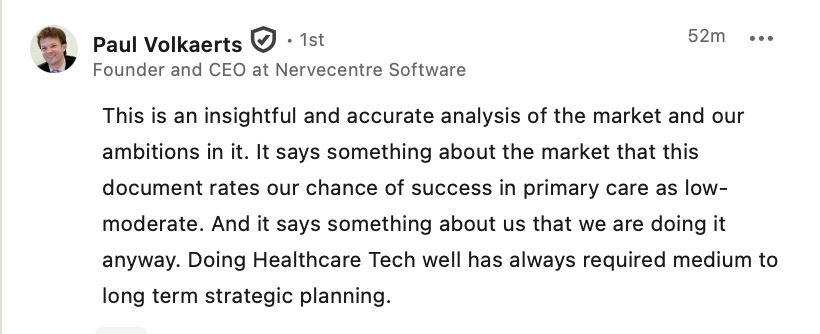
Direct Primary Care Core System Displacement | Wholesale replacement of EMIS Web and TPP SystmOne in general practice clinics | Moderate-to-Low | Entrenched >95% GP market duopoly; practice-level purchasing autonomy; high commercial acquisition and migration friction. |
Acute-to-Community Integration
Nervecentre’s chances of delivering a unified acute and community EPR platform within integrated provider trusts or regional acute-community alliances are high. The platform’s live deployments in organisations managing both acute facilities and community services, such as York and Scarborough Teaching Hospitals NHS Foundation Trust and East Sussex Healthcare NHS Trust, demonstrate that its SaaS architecture scales effectively across inpatient wards and mobile community teams.
Operational imperatives to reduce discharge delays, manage virtual wards, and coordinate urgent community response teams favour a real-time, mobile-first workflow system over legacy primary care databases operating in community settings. As acute trusts assume greater operational responsibility for community step-down services, Nervecentre’s footprint in community care will expand alongside its acute growth.
Cross-Provider Regional Workflow Orchestration
Rather than requiring every general practice to replace EMIS Web or TPP SystmOne, Nervecentre is well-positioned to succeed as the regional operational orchestration layer across Integrated Care Boards. By deploying its platform across the majority of acute and community providers within a geographic area, as seen in the East Midlands, Nervecentre creates a consolidated operational environment.
Using national interoperability standards, such as GP Connect, BaRS, and FHIR APIs, primary care clinicians can view, launch, and interact with Nervecentre clinical workflows, such as direct bookings, single point of access intermediate care referrals, and electronic discharge summaries, from within their existing GP software. This interoperable approach achieves tightly integrated cross-boundary workflows without requiring the costly replacement of core primary care systems.
Direct Primary Care System Displacement
Nervecentre’s chances of directly displacing EMIS Web or TPP SystmOne to become the core installed record system inside general practice surgeries remain low to moderate in the medium term. The structural complexities of primary care contracting, independent practice autonomy, and specialised GP consultation workflows present substantial barriers to new entrants.
While Nervecentre’s cloud architecture can technically support primary care documentation, the commercial acquisition costs and change management effort required to convince thousands of independent GP partners to switch primary systems make total market displacement unlikely. Instead, Nervecentre’s path into primary care rests on the NHS Digital Care Services Catalogue and open API frameworks, positioning its software as modular solutions for urgent access, neighbourhood care teams, and primary-secondary interface management.

Strategic Trajectory and Market Outlook
Nervecentre is positioned to achieve its objective of delivering a regionally integrated cross-continuum EPR, provided regional integration is pursued through a combination of unified single-platform deployments across acute and community care, and standards-based API orchestration into primary care.
By establishing dense acute and community footprints across contiguous regions, Nervecentre creates an operational center of gravity within Integrated Care Systems. When neighbouring acute and community providers operate on a shared multi-tenant SaaS platform, surrounding healthcare organisations are incentivised to align their digital care pathways with that system to streamline discharge processes, manage urgent care demands, and improve patient safety.
This bottom-up regional strategy aligns with national policy priorities emphasizing digital integration, data sharing, and out-of-hospital care delivery.
Nervecentre’s SaaS architecture, mobile usability, and rapid implementation speed provide clear operational advantages over legacy acute systems. While total displacement of core primary care systems remains improbable due to market structures, Nervecentre’s open-API framework enables it to serve as the overarching workflow engine across regional health systems, linking acute, community, and primary care into a cohesive operational network.
Nelson Advisors > European MedTech and HealthTech Investment Banking
Nelson Advisors specialise in Mergers and Acquisitions, Partnerships and Investments for Digital Health, HealthTech, MedTech, Health IT, Consumer HealthTech, Healthcare Cybersecurity, Healthcare AI companies.www.nelsonadvisors.co.uk
Nelson Advisors regularly publish Thought Leadership articles covering market insights, industry trends, deal commentary, market analysis & predictions @ https://www.healthcare.digital
Nelson Advisors publish Europe's Leading Healthcare Technology Investment Banking Newsletter every week, join 5000+ HealthTech and MedTech subscribers today! https://lnkd.in/e5hTp_xb
Nelson Advisors pride ourselves on our DNA as ‘Founders advising Founders.’ We partner with entrepreneurs, boards, corporates, venture capital and private investors to maximise shareholder value and investment returns.www.nelsonadvisors.co.uk
#NelsonAdvisors #HealthTech #MedTech #DigitalHealth #HealthIT #Cybersecurity #HealthcareAI #FemTech#ConsumerHealth #Mergers #Acquisitions #Partnerships #Growth #Strategy #NHS #UK #Europe #USA #Canada#Commonwealth#CorporateDivestitures #VentureCapital #PrivateEquity #Founders #SeriesA #SeriesB #Founders #SellSide #TechAssets #Fundraising #BuildBuyPartner #GoToMarket #PharmaTech #BioTech #Genomics
Nelson Advisors LLP
Hale House, 76-78 Portland Place, Marylebone, London, W1B 1NT
Nelson Advisors LLP
Hale House, 76-78 Portland Place, Marylebone, London, W1B 1NT
Meet Nelson Advisors @ 2026 Events
Digital Health Rewired > March 2026 > Birmingham, UK
NHS ConfedExpo > June 2026 > Manchester, UK
HLTH Europe > June 2026, Amsterdam, Netherlands
HIMSS AI in Healthcare > July 2026, New York, USA
Bits & Pretzels > September 2026, Munich, Germany
World Health Summit 2026 > October 2026, Berlin, Germany
HealthInvestor Healthcare Summit > October 2026, London, UK
HLTH USA 2026 > October 2026, USA
Barclays Health Elevate > October 2026, London, UK
Web Summit 2026 > November 2026, Lisbon, Portugal
MEDICA 2026 > November 2026, Düsseldorf, Germany
Venture Capital World Summit > December 2026 Toronto, Canada



Comments