Workflow Automation over Diagnostics: Where European Healthcare PE Capital is Flowing


The European healthcare private equity (PE) landscape is undergoing a structural reallocation of capital. Private equity sponsors, growth equity funds and institutional investors are shifting capital away from early-stage, speculative diagnostic tools and high-risk Software as a Medical Device (SaMD) platforms toward mission-critical operational workflow software.
Historically, diagnostic artificial intelligence and novel MedTech tools commanded premium valuations based on transformative clinical promises. However, prolonged clinical validation cycles, stringent regulatory hurdles under the European Union Medical Device Regulation (EU MDR) and the EU AI Act, and extended hospital procurement timelines have severely degraded the internal rates of return (IRR) for clinical diagnostic assets.
Concurrently, European healthcare systems, both public single-payer models such as the UK National Health Service (NHS) and dual/social-insurance models across the DACH region and France, are confronting acute operational strain. Squeezed by structural labour shortages, widespread clinician burnout, escalating agency staff costs and persistent wage inflation, hospital operating margins have compressed to historic lows.
In response, PE deal teams are re-underwriting sector thesis maps to target software platforms that deliver immediate, quantifiable cost mitigation and operational throughput. Operational workflow tools, spanning ambient clinical documentation, workforce management and rostering, clinical pathway automation and bed management, offer shorter sales cycles, lower regulatory risk, higher capital efficiency and rapid return on investment (ROI) validation for hospital procurement boards.
Macroeconomic and Structural Imperatives Driving Capital Reallocation
Structural Workforce Deficits and Clinician Burnout
European healthcare delivery is constrained by a severe human capital deficit. Data from the World Health Organization (WHO) indicates that Western Europe faced a shortfall of approximately 1.2 Million physicians in 2022, a structural deficit further compounded by an aging demographic that drives up clinical demand while simultaneously contracting the active medical workforce. The global shortage of nurses is projected to reach 4.5 Million by 2030, leaving European health systems unable to maintain baseline operational staffing without aggressive intervention.
Multi-country European physician surveys, such as the METEOR study, highlight a systemic retention crisis: 16.5% of hospital physicians express an explicit intention to leave their current hospital, with turnover intention peaking at nearly 20% in countries like Belgium (19.6%) and Italy (19.0%). In primary care settings, the outlook is equally constrained; in the United Kingdom, approximately 40% of general practitioners report plans to leave the profession within five years.
This turnover dynamic follows a direct operational escalation. Excessive administrative overhead, which currently consumes roughly half of an average clinician's shift, acts as the primary catalyst for severe emotional exhaustion and burnout. In turn, high burnout rates elevate the proportion of physicians actively intending to leave their hospital or the profession entirely, directly aggravating shift vacancy rates and forcing health systems into expensive stopgap solutions.
Hospital Margin Compression and Agency Labour Escalation
The human capital shortage has created direct financial pressure for hospital operating budgets. To maintain mandatory operational capacity, bed numbers, and emergency care availability, hospital administrators across Europe have relied heavily on temporary agency workers and locum personnel. Agency staff costs carry a substantial premium, often adding 30% to over 50% to standard full-time equivalent (FTE) hourly compensation rates.
In the UK NHS, overall spending on non-permanent staff (combining internal bank staff and external agency personnel) exceeded £10 Billion in 2022/23. Agency spending alone rose to £3.46 Billion, despite regulatory price caps and central targets designed to curb off-framework locum usage. High-cost agency doctors and specialised Locum consultants can command single-shift fees exceeding £5,000, creating unsustainable cost structures for NHS Trusts.
This reliance on non-permanent labour functions as a self-reinforcing financial drain: persistent core vacancies force reliance on external agency staffing, which carries a 30% to 50%+ cost premium over standard hourly pay bills. The resulting operating margin compression restricts the health system's ability to fund substantive pay increases or capital improvements, thereby worsening core retention and perpetuating the shift vacancy cycle. Consequently, private equity sponsors view workflow software as an intervention that breaks this financial loop at its root.
Across Germany and France, statutory price freezes, inflation on consumable supplies and fixed reimbursement rates under Diagnosis-Related Group (DRG) frameworks prevent health systems from passing labor cost increases directly to payers. As a consequence, provider operating margins have eroded, turning workforce optimisation and labor expense governance into a primary financial priority for hospital C-suites and private hospital operators.
Country / Region | Primary Labor Metric / Shortage Indicator | Financial Impact on Health Systems | Strategic Vendor Response |
United Kingdom (NHS) | >100,000 system vacancies; 40% GP 5-year exit expectation. | >£10B total non-permanent staff spend (£3.46B pure agency). | Adoption of surgical list scheduling, bank staff optimization platforms. |
DACH (Germany, Austria, Switzerland) | KHZG mandatory digital transformation; acute nursing vacancies. | Rising labour costs compounded by DRG reimbursement caps. | Modernization via KHZG funds; deployment of intensive care PDMS & rostering software. |
France | Regional nurse/doctor deficits; strike action over shift structures. | High reliance on temporary sector placements; growing public hospital deficits. | Regional workforce scheduling integration; adoption of care-coordination OS platforms. |
Benelux & Nordics | 16.5%–19.6% physician hospital turnover intention (BE/NL/IT). | Escalating sick leave costs; administrative overhead consuming ~50% shift hours. | Ambient AI deployment; vendor-neutral critical communication platforms. |
Underwriting Dynamics: Operational Software vs. Diagnostic SaMD
To understand where private equity funds are directing capital, deal teams must compare the investment profile of operational software against diagnostic Software as a Medical Device (SaMD). The underwriting path for diagnostic tools is burdened by early-stage model training, multi-year certification phases and complex integration pathways. Conversely, operational software bypasses high-risk medical device designations, enabling rapid procurement and immediate margin expansion.
The Regulatory Friction of Diagnostic SaMD
Under EU MDR 2017/745 (specifically Rule 11), any software intended to provide information used to take decisions with diagnosis or therapeutic purposes is classified as a Class IIa, Class IIb, or Class III medical device. Achieving CE mark certification for diagnostic AI applications requires engagement with notified bodies, clinical evaluation reports, post-market clinical follow-up (PMCF) studies, and rigorous quality management system (QMS) compliance under ISO 13485 and IEC 62304.
This regulatory pathway introduces structural headwinds for venture and growth capital return models:
Extended Timelines: Securing EU MDR certification typically requires 18 to 36 months of validation and notified body review, delaying commercial scale-up.
Capital Intensity: Initial regulatory clearance costs for software-based diagnostic devices range from €200,000 to over €1,000,000 per product iteration, creating recurring capital drag whenever core models undergo major software updates.
EU AI Act Drag: The implementation of the EU AI Act imposes additional compliance layers on "high-risk" medical AI systems, including auditable training sets, strict demographic bias controls, and formal risk management frameworks. Unclear compliance obligations have led some diagnostic AI providers to suspend or withdraw European commercial operations, as demonstrated by US-based OpenEvidence exiting the UK and EU markets due to regulatory uncertainty surrounding high-risk clinical decision engines.
The Operational Software Advantage: Accelerated ROI and Minimal Regulatory Barriers
In contrast, operational workflow software, such as ambient clinical documentation scribes, staff rostering systems, surgical list planners, and bed management tools, generally operates as administrative or non-clinical enterprise software. Because these systems do not directly output automated diagnostic or treatment mandates without human intervention, they fall outside the scope of EU MDR Class IIa/b requirements, avoiding multi-year notified body queues.
The value realisation timeline for operational software is significantly condensed compared to regulated clinical tools. Following initial implementation and FHIR/EHR integration during the first quarter of deployment, ambient documentation tools typically deliver 2 to 3 hours of daily savings per clinician by month three.
By month six, health systems realise measurable reductions in agency staff reliance and overtime expenses, culminating in full software payback and EBITDA margin expansion within twelve months.
This structural separation translates directly into underwritten cash flow advantages:
Short Sales Cycles: Operational tools can be procured by hospital IT, HR, or operational leaders under standard enterprise software budgets within 6 to 12 months, avoiding the 12 to 36-month multi-departmental clinical trial evaluations required for SaMD.
Immediate, Quantifiable ROI: Operational software targets explicit line items on hospital income statements. For example, optimising surgical theatre schedules reduces unused capacity billed at over £20 per minute (£1,200 per hour), directly unlocking surgical throughput without adding physical infrastructure.
High Capital Efficiency: Operational software companies show superior recurring revenue metrics per head. While traditional healthcare services generate $100,000–$200,000 in Annual Recurring Revenue (ARR) per FTE, and legacy healthcare SaaS achieves $200,000–$400,000, AI-native operational platforms achieve $500,000 to over $1,000,000 in ARR per FTE due to low human-in-the-loop servicing requirements.
Feature / Metric | Diagnostic / Clinical SaMD Platforms | Operational Workflow Software Platforms |
Regulatory Classification | EU MDR Class IIa, IIb, or III; EU AI Act High-Risk. | Non-medical administrative enterprise SaaS. |
Time-to-Market / Regulatory Clearance | 18 to 36 months via Notified Bodies. | Immediate deployment; standard QMS / ISO 27001. |
Hospital Procurement Sales Cycle | 12 to 36 months (requires clinical trial validation). | 6 to 12 months (procured by COO, CIO, or CFO). |
Target Hospital Value Driver | Long-term diagnostic accuracy & outcomes. | Direct cost reduction, agency avoidance, labor capacity. |
EBITDA Margin Target at Scale | 15% – 25% (diluted by clinical support/R&D). | 30% – 40%+ (scalable pure-play SaaS architecture). |
Typical Valuation Multiples (EV/ARR) | 3.0x – 5.5x ARR (compressed by regulatory drag). | 6.0x – 8.0x+ ARR (for high-growth AI workflow platforms). |
Sector Mapping: Mid-Market Operational Sub-Sectors and Platform Opportunities
Private equity capital deployment is concentrating across three key operational software sub-sectors. Each sub-sector addresses a specific structural bottleneck within European healthcare delivery and offers actionable buy-and-build roll-up opportunities for middle-market sponsors.
Sub-Sector 1: Ambient Clinical AI and Documentation Automation
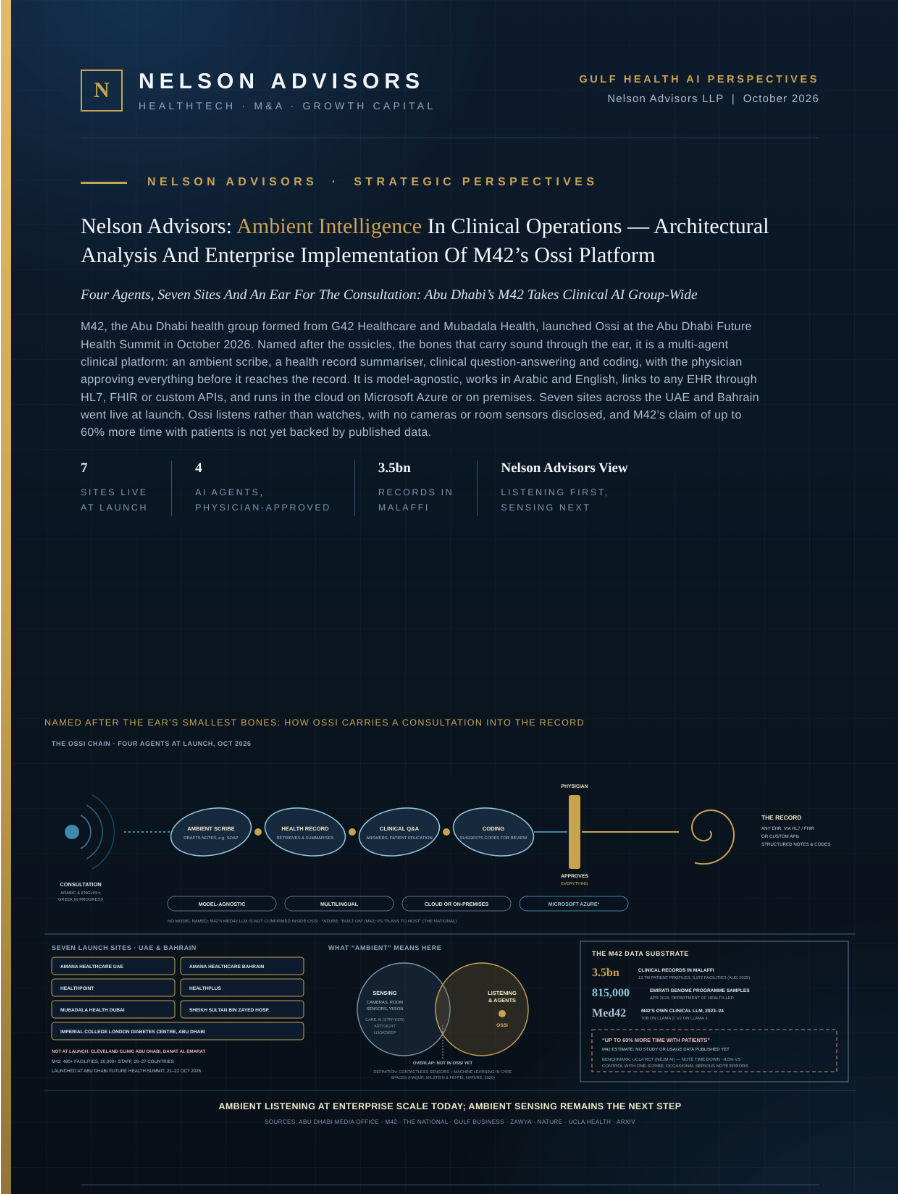
Ambient clinical voice technology utilises passive generative AI audio monitoring during patient consultations to auto-generate structured, compliant medical notes, EHR entries, and billing codes.
Operational Impact: Reduces clinician documentation time by 2 to 3 hours per daily shift, mitigating clerical fatigue and increasing daily patient throughput without adding clinical headcount.
PE Underwriting Dynamics: Standalone dictation tools are rapidly becoming commoditized by major incumbents (e.g., Epic, Microsoft/Nuance, Oracle). Winning PE platforms are those that position ambient tools as "clinical co-pilots" deeply embedded into core regional EHR systems (e.g., Dedalus ORBIS, Cambio COSMIC, CompuGroup Medical) via Fast Healthcare Interoperability Resources (FHIR) APIs.
Regulatory Differentiation: High-performing ambient platforms deploy "glass box" explainable architectures where clinicians review, edit, and sign off on structured data before EHR commit, maintaining human-in-the-loop oversight and bypassing high-risk EU AI Act classification.
Representative Assets & Capital Flows: European growth-stage vendors such as Nabla ($120M total raise), Tandem Health (building NHS-embedded enterprise tools), and OurMind (€2.1M seed round led by 4impact capital) demonstrate strong institutional backer interest.
Sub-Sector 2: Workforce Management, Rostering and Critical Communication
Workforce software platforms optimise hospital labour deployment through automated shift scheduling, internal bank staff recruitment, and vendor-neutral critical communication infrastructure.
Operational Impact: Solves the locum reliance spiral by allowing health systems to mobilize internal staff banks before resorting to high-cost external staffing agencies. Automated rostering ensures strict compliance with complex European labor regulations, such as the European Working Time Directive and statutory regional rest period mandates.
PE Underwriting Dynamics: These assets feature predictable recurring revenue (ARR), net revenue retention (NRR) exceeding 120%, and clear buy-and-build consolidation potential across fragmented European borders.
Representative Assets & Capital Flows:
Hublo: French workforce management platform serving the healthcare sector; Revaia raised a dedicated €40 Million reinvestment vehicle to accelerate its pan-European expansion.
IQ Messenger: Netherlands-based vendor-neutral critical alarm and workflow communication platform acquired by Main Capital Partners to execute a European buy-and-build strategy across DACH, France, and the Nordics.
Orbio AI: AI workforce management and HR automation platform that raised $21 million in Series A funding led by Dawn Capital, cutting operational hiring cycles for frontline healthcare staff from 20 days to less than a week.
Sub-Sector 3: Clinical Pathway Automation and Capacity Optimisation
Sub-sector platforms focus on optimising physical hospital infrastructure, surgical suite scheduling, patient throughput, and regional outpatient coordination.
Operational Impact: Address waiting list backlogs (such as the >7.3 million elective care backlog in England) by dynamically modelling operating room duration variances, staffing availability, and cancellation risks.
Tailwinds from Government Subsidies: Structural funding mandates act as demand accelerators. In Germany, the Krankenhauszukunftsgesetz (KHZG) program allocated over €3 Billion in targeted hospital modernization and digitalisation subsidies, legally mandating expenditures on digital discharge management, workflow automation, and care coordination software.
Representative Assets & Capital Flows:
Semble: Care management operating platform that raised €35 Million in a Series B round led by Revaia, with Partech, Mercia and Octopus, targeting the integration of fragmented clinical pathways across the UK and France.
Tetra AI: Pre-seed stage UK healthtech platform optimising NHS surgical theatre scheduling to capture capacity in operating rooms running at £1,200+ per hour in operating costs.
LOWTeq: German specialised Patient Data Management System (PDMS) for intensive care, anesthesia and emergency department workflow automation, benefiting directly from KHZG digital infrastructure funding.
Sub-Sector | Core Market Pain Point | Target ROI Metric | European Regional Density | Representative Transactions / Companies |
Ambient Clinical Documentation | 2–3 hours/day spent on clerical EHR entry; physician burnout. | 100% documentation completion rate; +15% patient volume capacity. | Pan-European (UK, DACH, Nordics, France). | Nabla, Tandem Health, OurMind (€2.1M raise). |
Workforce Management & Rostering | Unsustainable locum agency bills; Working Time Directive compliance. | 20%–30% reduction in external agency spend via internal bank optimization. | France, Benelux, DACH, UK. | Hublo (Revaia €40M vehicle), IQ Messenger (Main Capital). |
Frontline HR & Recruitment AI | High staff turnover; 20+ day hiring cycles for healthcare workers. | 60% reduction in recruitment time-to-hire (under 7 days). | Pan-European footprint. | Orbio AI ($21M Series A led by Dawn Capital). |
Care Coordination & Pathway OS | Outdated legacy EHRs; fragmented primary/secondary care links. | Interoperable FHIR care pathways; administrative overhead reduction. | UK, France, DACH. | Semble (€35M raise), mps public solutions (Main Capital). |
Surgical & Bed Capacity Systems | Elective backlog spikes; surgical suite downtime at £1,200/hr. | +8%–12% increase in operating theatre utilization rate. | UK NHS, DACH KHZG mandate markets. | Tetra AI (£450k pre-seed), LOWTeq. |
Private Equity Deal Mechanics, Valuation Multiples, and Buy-and-Build Playbooks
Valuation Multiples and Historical Returns
Private equity activity in European Healthcare IT (HCIT) has outperformed broader healthcare services and MedTech sub-sectors. Sector benchmarking data indicates that HCIT investments have delivered a median Internal Rate of Return (IRR) of approximately 26%, compared to 22% for biopharma services, 20% for brick-and-mortar provider services, and 17% for physical MedTech.
Valuation multiples for European healthcare software have recalibrated following the post-2021 valuation reset, stabilising around execution-driven parameters:
EBITDA Multiples: Middle-market PE transactions for mature, cash-generative HCIT assets typically trade between 12.0x and 18.0x EBITDA for quality platforms, with premium assets featuring market leadership commanding higher multiples.
ARR Revenue Multiples: Growth-stage European healthcare software assets command 4.0x to 6.0x Enterprise Value to ARR (EV/ARR) for standard B2B SaaS platforms, while AI-native workflow platforms demonstrating Rule of 40 performance (e.g., >30% growth with high margins) and strong Net Revenue Retention (>120%) reach 6.0x to 8.0x+ EV/ARR.
Public/Private Multiple Variance: Buyout sponsors are capturing arbitrage by acquiring fragmented local vendors at single-digit EBITDA multiples (5.0x–8.0x) and rolling them into consolidated regional platforms valued at 14.0x–18.0x EBITDA upon exit.
Healthcare Software Category | Typical EV / Revenue Multiple | Typical EV / EBITDA Multiple | Key Valuation Drivers & Moats |
AI-Native Operational Platforms | 6.0x – 8.0x+ ARR | 15.0x – 18.0x+ | ARR/FTE >$500k; Rule of 40 score >65%; deep FHIR integration. |
Core Healthcare B2B SaaS | 4.0x – 6.0x ARR | 10.0x – 13.0x | High NRR (>115%); low churn (<5%); stable recurring cash flows. |
Diagnostic SaMD / AI Tools | 3.0x – 5.5x ARR | N/A (Often Unprofitable) | Compressed by EU MDR timeline risk; long hospital sales cycles. |
Niche Provider Services / Billing IT | 1.5x – 2.5x Revenue | 7.0x – 11.0x | Prime roll-up candidates; margin expansion via Generative AI integration. |
The Buy-and-Build Expansion Playbook
Due to the fragmented nature of the European healthcare landscape, where language barriers, country-specific labor laws and localised EHR architectures impede direct organic scaling, sponsors are leveraging "Buy and Build" frameworks.
Sponsors execute this strategy by acquiring fragmented local vendors at lower entry multiples (typically 5.0x to 8.0x EBITDA). Once acquired, the platform layers centralised AI-native operational software and automated revenue cycle management tools, expanding portfolio EBITDA margins from historical levels of ~15% toward ~30%. The combined platform can then cross-sell software modules across EU national borders before exiting to strategic buyers or sponsor-to-sponsor transactions at expanded multiples of 14.0x to 18.0x EBITDA.
Capitalising on funds dedicated to enterprise software buyouts—such as Main Capital Partners closing its dual funds (Main Capital IX and Main Foundation III) at €5.25 billion—sponsors acquire market leaders in one jurisdiction (e.g., IQ Messenger in the Benelux) and execute add-on acquisitions to capture distribution channels across the DACH region, France, and the Nordics.
Exits in the European HCIT space flow primarily through sponsor-to-sponsor buyouts or acquisitions by global industrial/life-sciences software strategics.
A notable example is Nordic Capital’s agreement to sell ArisGlobal, a life sciences clinical and regulatory workflow software provider, to Dassault Systèmes for approximately $2 Billion, demonstrating strategic buyer appetite for workflow software platforms integrated into regulated end markets.
Strategic Portfolio Guidance and Target Selection Framework
To capitalise on this macro thesis, PE deal teams evaluating European healthcare software assets should apply a structured framework during initial screening and due diligence.
Screening Logic for Investment Committees
Investment committees should evaluate targets through a clear sequence of operational criteria:
EU MDR Exemption Status: Determine whether the platform is classified as SaMD under EU MDR Rule 11. If the tool directly drives diagnosis or automated clinical intervention without human oversight, it introduces multi-year notified body risk and should face valuation discounting.
EHR Ecosystem Integration: Assess whether the software connects natively via FHIR/HL7 endpoints to incumbent hospital databases (such as Dedalus ORBIS, Cambio COSMIC, or Epic). Standalone point solutions lacking native integration carry high customer churn risk.
Quantifiable ROI & Cost Mitigation: Validate that the platform yields measurable savings within six months of deployment—specifically through reduced agency staff spend, reduced recruitment cycles, or higher operating room throughput.
Localised Regulatory Defensibility: Prioritise assets that possess defensive channel moats, such as NHS DTAC compliance in the UK or eligibility under Germany's KHZG funding frameworks.
Target Screening Matrix for Private Equity Buyouts
The target screening framework categorises potential software acquisitions based on their regulatory risk exposure and direct financial ROI delivery to health system buyers:
Target Category | Quadrant Focus | Target Asset Profile | Investment Strategy & Action |
Quadrant I | Prime PE Targets | Ambient clinical AI co-pilots, automated shift rostering, surgical suite optimization, hospital bed management. | Prioritise Deployment: Deploy growth capital; execute aggressive buy-and-build strategies across European borders. |
Quadrant II | Caution / Valuation Discount | Standalone diagnostic AI tools, image classifiers, SaMD decision engines under EU MDR Class IIb. | Discount Valuation: Underwrite extended regulatory clearance timelines; demand proven clinical trial traction. |
Quadrant III | Selective Buy-and-Build | Regional medical billing IT, legacy paper-to-digital software, specialized communication hardware. | Margin Expansion: Acquire at low single-digit EBITDA multiples; layer modern AI workflows to expand margins. |
Quadrant IV | Avoid / Uninvestable | Non-interoperable dictation wrappers, unregulated wellness apps, black-box diagnostic models. | Reject Opportunity: Avoid capital deployment due to high commoditization risk and EU AI Act compliance liabilities. |
Conclusion
The reallocation of European healthcare private equity capital from speculative diagnostics toward operational workflow software reflects a shift toward operational predictability. Driven by systemic doctor and nurse shortages, escalating temporary agency labor expenses, and hospital margin pressures across European healthcare systems, sponsors are prioritising assets that deliver immediate financial ROI and capacity expansion.
By targeting platforms in ambient documentation, workforce management and clinical pathway automation, private equity deal teams can achieve predictable recurring revenue growth, insulate portfolios from EU MDR regulatory delays and execute value creation strategies that generate strong risk-adjusted returns.
Nelson Advisors > European MedTech and HealthTech Investment Banking
Nelson Advisors specialise in Mergers and Acquisitions, Partnerships and Investments for Digital Health, HealthTech, Health IT, Consumer HealthTech, Healthcare Cybersecurity, Healthcare AI companies. www.nelsonadvisors.co.uk
Nelson Advisors regularly publish Thought Leadership articles covering market insights, trends, analysis & predictions @ https://www.healthcare.digital
Nelson Advisors publish Europe’s leading HealthTech and MedTech M&A Newsletter every week, subscribe today! https://lnkd.in/e5hTp_xb
Nelson Advisors pride ourselves on our DNA as ‘Founders advising Founders.’ We partner with entrepreneurs, boards and investors to maximise shareholder value and investment returns. www.nelsonadvisors.co.uk
#NelsonAdvisors #HealthTech #DigitalHealth #HealthIT #Cybersecurity #HealthcareAI #ConsumerHealthTech #Mergers #Acquisitions #Partnerships #Growth #Strategy #NHS #UK #Europe #USA #VentureCapital #PrivateEquity #Founders #SeriesA #SeriesB #Founders #SellSide #TechAssets #Fundraising #BuildBuyPartner #GoToMarket #PharmaTech #BioTech #Genomics #MedTech
Nelson Advisors LLP
Hale House, 76-78 Portland Place, Marylebone, London, W1B 1NT
Meet Nelson Advisors @ 2026 Events
Digital Health Rewired > March 2026 > Birmingham, UK
NHS ConfedExpo > June 2026 > Manchester, UK
HLTH Europe > June 2026, Amsterdam, Netherlands
HIMSS AI in Healthcare > July 2026, New York, USA
Bits & Pretzels > September 2026, Munich, Germany
World Health Summit 2026 > October 2026, Berlin, Germany
HealthInvestor Healthcare Summit > October 2026, London, UK
HLTH USA 2026 > October 2026, USA
Barclays Health Elevate > October 2026, London, UK
Web Summit 2026 > November 2026, Lisbon, Portugal
MEDICA 2026 > November 2026, Düsseldorf, Germany
Venture Capital World Summit > December 2026 Toronto, Canada





Comments