Analysis of Accenture’s $162 Million Australian My Health Record Contract

Executive Summary
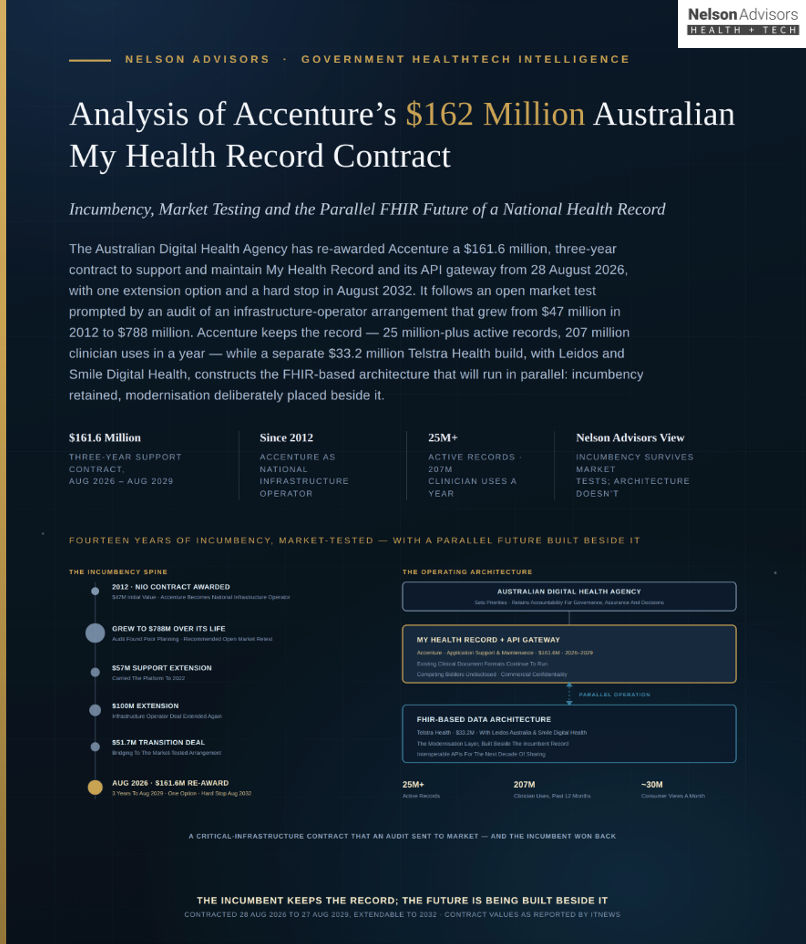
The Australian Digital Health Agency (ADHA) has finalised an open market procurement awarding Accenture Australia Pty Ltd a $161.6 million contract to deliver Application Support and Maintenance (ASM) services for the national My Health Record (MHR) infrastructure and associated API gateway. This procurement decision follows scrutiny from the Australian National Audit Office (ANAO), which published a performance audit detailing historical governance failures, uncompeted contract extensions, and risk management deficiencies during Accenture’s previous tenure as the National Infrastructure Operator (NIO).
The MHR platform remains a key piece of Australia’s digital health architecture, managing over 25 million active health records and representing a cumulative public investment exceeding $2 billion. System utilisation has grown significantly, recording approximately 207 million clinician interactions over the past 12 months and roughly 30 million consumer views per month.
To balance operational continuity with mandated procurement reforms, the ADHA has restructured its vendor engagement model. Rather than outsourcing total infrastructure management under a monolithic contract, the Agency has implemented an Agency led multi supplier framework. Under this re engineered architecture, the ADHA retains direct responsibility for governance, system assurance and priority setting, while delegating application maintenance to Accenture and data architecture modernisation to specialised external vendors.
Historical Trajectory of the National Infrastructure Operator Contract
Accenture’s involvement with the My Health Record platform, initially launched as the Personally Controlled Electronic Health Record (PCEHR), began in June 2012 when the original National Infrastructure Operator (NIO) contract was executed by the Department of Health for a two-year term valued at $47 million. Governance responsibility for the platform transferred to the newly formed ADHA in 2016, which subsequently initiated a series of contract modifications.
Between 2018 and 2023, the ADHA executed eight major contract variations with Accenture without conducting a competitive open market re tender. These modifications repeatedly expanded the scope and duration of the agreement, driving the total cumulative value of the NIO arrangement from $47 million to $746 million by February 2024 and ultimately reaching $788 million.
Financial analysis reveals that between the 2018–19 and 2022–23 fiscal years, total MHR national infrastructure outlays totalled $408.2 million, of which $295.6 million, representing 72 percent of total infrastructure spending, was disbursed directly to Accenture.
Contract Framework / Milestone | Effective Period | Financial Value | Primary Governance and Operational Context |
Initial NIO Execution | June 2012 – June 2014 | $47.0 Million | Baseline establishment of core platform infrastructure and system operations. |
Cumulative Contract Variations | 2018 – 2023 (8 Variations) | Escalated to $746M – $788M | Scope extensions executed without open-market re-testing. |
Infrastructure Outlay Concentration | FY 2018–19 – FY 2022–23 | $295.6 Million | Accenture captured 72% of total ADHA infrastructure expenditure ($408.2M total). |
Interim Transition Arrangements | Late 2024 – Mid-2026 | Tens of Millions (Interim) | Short-term extension payments while ADHA conducted market testing. |
Restructured ASM Contract | Aug 28, 2026 – Aug 27, 2029 | $161.6 Million | Awarded under an Agency-led multi-supplier model (Hard end-date: Aug 31, 2032). |
The rapid expansion of contract values was driven in part by policy shifts, such as the transition from an opt-in model to a universal opt out structure for Australian residents, alongside continuous technical updates. However, the administrative reliance on sole source variations and limited tenders insulated the contract from market competition and limited comprehensive value for money evaluations
.
Audit Scrutiny and Governance Deficiencies
The institutional reliance on contract variations prompted a performance audit by the Australian National Audit Office, published as Auditor General Report No. 36 of 2023–24 (and cataloged under Report No. 4 of 2024–25). The audit delivered a critical assessment of the ADHA’s procurement oversight and contract management practices regarding the NIO arrangement.
The audit highlighted systemic governance deficiencies across several operational domains. A key finding was the Agency’s repeated failure to reassess commercial and operational risks, neglecting risk re evaluations on five of the six occasions when the Accenture contract was varied during existing terms between 2018 and 2024. Furthermore, formal contract management plans lacked objective criteria to justify assigned risk ratings, omitted specific risk appetite thresholds and provided inadequate guidance on managing risk mitigations.
The ANAO also identified deficiencies in contract administration, showing that the ADHA regularly approved payments without maintaining verifiable records to confirm that contractor deliverables and monthly reports had undergone thorough technical reviews. Controls surrounding system architecture documentation were similarly weak, creating operational risks regarding asset ownership, intellectual property clarity and system auditability. Delegate approvals for contract variations frequently lacked documented assessments proving that scope changes constituted minor modifications or delivered value for money.
In total, the ANAO issued 13 formal recommendations to the ADHA, alongside six secondary improvement opportunities. The recommendations required a complete overhaul of risk management frameworks, mandatory annual reviews of contract management plans, formal value-for-money justifications for variations, enhanced AusTender reporting and advance planning for open tenders.
The ADHA agreed to 12 recommendations and agreed in principle to one, initiating a broad internal remediation program under the oversight of the Parliamentary Joint Committee of Public Accounts and Audit (JCPAA Inquiry / Report 511). In response, the ADHA updated its Risk Management Framework, established centralised procurement controls, updated its Contract Management Plan and scheduled internal audits for high value contracts across the 2025–26 fiscal year.
The 2026 Procurement and Operating Model Restructuring
To address audit mandates and evaluate market competitiveness, the ADHA initiated an open tender process for Application Support and Maintenance (ASM) services. The market testing phase began with a Request for Information in November 2024, followed by a formal Request for Tender that closed in October 2025. During the procurement evaluation, the ADHA executed interim transition arrangements with Accenture worth tens of millions of dollars to maintain continuous system operations.
Following the evaluation of technical capabilities, commercial terms, value for money and security standards, the ADHA selected Accenture Australia Pty Ltd for the newly structured ASM contract. Valued at approximately $161.6 million, the contract spans a fixed three-year term running from August 28th, 2026, to August 27th, 2029. The contract includes a single extension option that sets a hard end-date of August 31st, 2032. The operational scope covers maintenance and application support for both the My Health Record core system and the ADHA's API gateway infrastructure
.
Although the contract was awarded to the incumbent, the structural framework of the engagement was fundamentally changed. Under the former NIO contract, Accenture operated as a single prime integrator with broad control over infrastructure management and operational execution. Under the 2026 agreement, the ADHA dismantled the monolithic NIO structure, replacing it with an Agency led multi supplier delivery model.
Under this re engineered operating model, the ADHA assumes direct, end to end control over national digital health priorities, coordinates cross supplier service delivery and retains sole accountability for governance, system assurance and operational decision making. Conversely, Accenture’s operational role is restricted to technical application support, system maintenance and platform stability under the direct oversight of the Agency. Despite public audit mandates demanding transparency, the ADHA declined to state how many competing organisations tendered for the contract or whether any rival bidders reached the final evaluation stage, citing commercial in confidence restrictions and procurement confidentiality obligations.
Architectural Modernisation and Multi Supplier Division of Labour
The ASM contract awarded to Accenture forms one component of a broader architectural transformation pursued under the ADHA's Digital Health Infrastructure Program. A core objective of this strategy is transitioning the national health record infrastructure from legacy clinical document storage formats to an interoperable Fast Healthcare Interoperability Resources (FHIR) data architecture.
To execute this technical transition while mitigating system disruption risks, the ADHA unbundled application support from data architecture modernisation. In a separate, parallel procurement, the Agency awarded a $33.2 million contract to Telstra Health to design and deploy a modernised FHIR based data platform. Telstra Health is delivering this capability in consortium with Leidos Australia and Canada-based Smile Digital Health.
Vendor / Partner Ecosystem | Contract Value | Core Primary Responsibilities | Technical & Architecture Focus |
Accenture Australia | ~$161.6 Million | Application Support and Maintenance (ASM) Services. | Core MHR infrastructure maintenance, platform stability, and API gateway support. |
Telstra Health Consortium (with Leidos Australia & Smile Digital Health) | $33.2 Million | Data Architecture Modernisation & Transformation. | Implementation of FHIR-based data platform running parallel to legacy clinical formats. |
Australian Digital Health Agency (ADHA) | System Operator | End to End Governance, Delivery Coordination, Assurance. | Strategy setting, multi-supplier management, policy oversight, delegate approvals. |
This multi supplier approach operates as a parallel ecosystem. The legacy clinical document infrastructure maintained by Accenture will run alongside the FHIR data architecture implemented by Telstra Health. This dual-track model allows the ADHA to support existing operational volumes, exceeding 207 million clinician accesses and 30 million consumer views monthly, while gradually transitioning the underlying infrastructure toward real time interoperability across primary care, acute care and community health software platforms.
Strategic Implications and Analytical Insights
The Incumbent Lock-in Paradox in Public Sector Procurement
The re-selection of Accenture following an open tender illustrates the structural challenge of incumbent lock in within large scale public sector IT procurements. When digital infrastructure reaches national ubiquity, encompassing 25 million records and deeply embedded system integrations across public and private health networks, the operational risk and switching costs of replacing the primary infrastructure operator become exceptionally high.
Even when procurement processes are opened to competitive market testing, an incumbent provider retains deep domain knowledge, platform familiarity, and institutional integration that competing bidders find difficult to match on price and risk. The multi-million dollar transition payments remitted to Accenture while the market was being tested highlight how operational reliance can constrain true market contestability. In practice, open tenders for complex legacy systems often serve to re-anchor pricing and restructure contract terms with the incumbent rather than replace them.
Governance Restructuring as Organisational Risk Hedging
The structural transition from the legacy National Infrastructure Operator framework to an Agency led multi supplier model represents an organisational risk hedging strategy. Under the initial NIO structure, the ADHA delegated broad operational authority to Accenture, leading over time to scope creep, cost escalation and audit criticism regarding agency oversight.
By reclaiming direct end to end service management and authority over system governance, the ADHA addresses key audit criticisms without risking the operational disruption of switching primary maintainers. Under the new model, Accenture functions as a specialised software maintenance provider operating under strict Agency oversight. This administrative restructuring allows the ADHA to satisfy ANAO recommendations while preserving operational continuity.
Modular Decoupling as an Exit and Modernisation Strategy
The decision to award data architecture modernization ($33.2 million) to Telstra Health while keeping application maintenance ($161.6 million) with Accenture represents an intentional modular disaggregation strategy. By separating application maintenance from modern data standard developments, the ADHA prevents a single supplier from controlling both legacy operations and future technical standards.
This technical decoupling serves as a long-term strategy for future procurement cycles. By transitioning system data persistence to an open, FHIR-compliant repository managed independently of the legacy application layer, the ADHA reduces vendor lock-in tied to Accenture’s historical code base. Consequently, when the current ASM contract reaches its final termination option in August 2032, the Agency will have built a more standardised environment, lowering switching costs and enabling greater market contestability in future procurements.
Institutional Opacity and Public Trust Considerations
A ongoing challenge in public sector contract management is balancing commercial confidentiality against audit mandates for transparency. The ANAO audit censured the ADHA for inadequate procurement documentation and uncompetitive contract extensions.
While the ADHA updated its internal procurement policies, its decision to withhold basic tender metrics, such as total bidder participation numbers, leaves public visibility into the competitive process incomplete. Maintaining public confidence in high-value digital health procurements requires establishing that open competition was genuinely achieved, rather than relying strictly on commercial-in-confidence protections.
Conclusions
The award of the $161.6 million Application Support and Maintenance contract to Accenture demonstrates the interplay between operational continuity and governance reform within Australia’s digital health system. While the retention of the incumbent provider reflects the inherent switching costs of large-scale public IT infrastructure, the revised contract terms reflect meaningful administrative adjustments made in response to oversight audits.
By replacing the single vendor National Infrastructure Operator arrangement with an Agency led multi supplier framework, the ADHA has reasserted institutional control over strategy, governance and system assurance. Additionally, by pairing application maintenance with an independent, FHIR based modernisation program led by Telstra Health, the Agency has established a dual-track strategy.
This structure maintains platform stability for millions of daily clinical and consumer transactions while building an open, interoperable digital health ecosystem for the future. The long-term success of this framework will depend on the ADHA’s ability to maintain strict contract management oversight, enforce clear supplier boundaries, and ensure multi vendor projects are delivered on time and within budget.
Nelson Advisors > European HealthTech, MedTech, Digital Health Investment Banking
Nelson Advisors specialise in Mergers and Acquisitions, Partnerships and Investments for Digital Health, HealthTech, MedTech, Health IT, Consumer HealthTech, Healthcare Cybersecurity, Healthcare AI companies.www.nelsonadvisors.co.uk
Nelson Advisors regularly publish Thought Leadership articles covering market insights, industry trends, deal commentary, market analysis & predictions @ https://www.healthcare.digital
Nelson Advisors publish Europe's Leading Healthcare Technology Investment Banking Newsletter every week, join 5000+ HealthTech and MedTech subscribers today! https://lnkd.in/e5hTp_xb
Nelson Advisors pride ourselves on our DNA as ‘Founders advising Founders.’ We partner with entrepreneurs, boards, corporates, venture capital and private investors to maximise shareholder value and investment returns.www.nelsonadvisors.co.uk
#NelsonAdvisors #HealthTech#MedTech#DigitalHealth #HealthIT #Cybersecurity #HealthcareAI #FemTech#ConsumerHealth #Mergers #Acquisitions #Partnerships #Growth #Strategy #NHS #UK #Europe #USA#Canada#Commonwealth#CorporateDivestitures #VentureCapital #PrivateEquity #Founders #SeriesA #SeriesB #Founders #SellSide #TechAssets #Fundraising #BuildBuyPartner #GoToMarket #PharmaTech #BioTech #Genomics
Nelson Advisors LLP
Hale House, 76-78 Portland Place, Marylebone, London, W1B 1NT
Meet Nelson Advisors @ 2026 Events
Digital Health Rewired > March 2026 > Birmingham, UK
NHS ConfedExpo > June 2026 > Manchester, UK
HLTH Europe > June 2026, Amsterdam, Netherlands
HIMSS AI in Healthcare > July 2026, New York, USA
Bits & Pretzels > September 2026, Munich, Germany
World Health Summit 2026 > October 2026, Berlin, Germany
HealthInvestor Healthcare Summit > October 2026, London, UK
HLTH USA 2026 > October 2026, USA
Barclays Health Elevate > October 2026, London, UK
Web Summit 2026 > November 2026, Lisbon, Portugal
MEDICA 2026 > November 2026, Düsseldorf, Germany
Venture Capital World Summit > December 2026 Toronto, Canada


Comments