Digital Health IPO Pipeline: Candidate Profiles, Market Mechanics and Valuation Realities


Executive Summary
The digital health sector enters late 2026 at a pivotal financial transition point. Following a multi-year liquidity drought, public capital markets briefly reopened in mid-2025, enabling a cohort of scaled healthtech companies, most notably Hinge Health, which raised $437 Million at a $2.6 Billion valuation on the NYSE and Omada Health, which raised $150 Million at a $1.1 Billion valuation on NASDAQ, alongside HeartFlow, Carlsmed and Profusa, to execute initial public offerings.
Despite this breakthrough, the first half of 2026 experienced an operational freeze for core digital health listings, creating an acute exit backlog paradox where dozens of late-stage venture-backed unicorns face limited M&A avenues and must prepare for public listing scrutiny.
Within this landscape, Oura Health stands as the definitive immediate frontrunner to become the next core digital health company to list publicly. In May 2026, Oura confidentially submitted a draft registration statement on Form S-1 to the U.S. Securities and Exchange Commission. Backed by an $11.0 Billion valuation from its October 2025 Series E round, a projected 2026 revenue run rate between $1.5 Billion and $2.0 Billion and strong underlying profitability, Oura possesses the revenue scale, growth rate and financial discipline required by modern public equity markets.
Directly behind Oura, a distinct pipeline of institutional candidates is executing structured pre-IPO maneuvers. Companies such as Spring Health, Zelis Healthcare, Virta Health, Abridge and Innovaccer are actively signalling public market readiness through confidential filings, senior public-market executive appointments, secondary liquidity tenders and large-scale strategic consolidations.
Follow Nelson Advisors on LinkedIn https://www.linkedin.com/company/nelson-advisors
Primary IPO Contender Profile: Oura Health
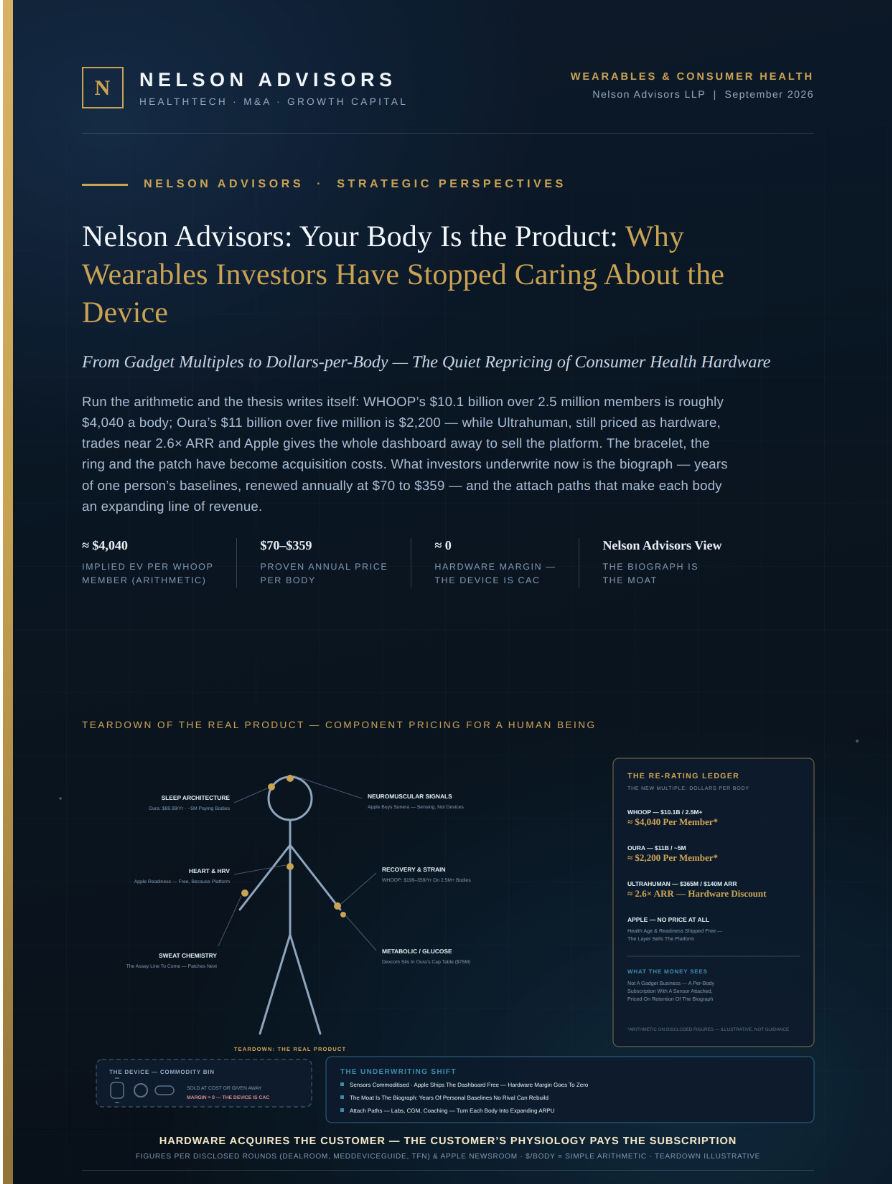
Oura Health has transitioned from a consumer wellness wearable manufacturer into a clinical-grade diagnostic platform, positioning itself at the head of the digital health IPO pipeline. Its confidential Form S-1 submission in May 2026 followed a $900 Million Series E funding round in October 2025 led by Fidelity Management & Research Company, with participation from ICONIQ, Whale Rock Capital and Atreides Management. This transaction established Oura's private market valuation at $11.0 Billion, making it the highest-valued independent wearable technology platform globally.
The company's operational trajectory displays rapid top-line growth coupled with improving unit economics. Oura generated over $500 Million in revenue in 2024 and doubled its top line to reach approximately $1.0 Billion in 2025. Executive guidance projects full-year 2026 revenue between $1.5 Billion and $2.0 Billion. At an $11.0 Billion private valuation, Oura trades at approximately 5.5 times projected 2026 sales, a reasonable forward multiple for a fast growing, profitable technology asset relative to historic bubble-era multiples. To lead its public debut, Oura assembled an underwriting syndicate composed of Goldman Sachs, Morgan Stanley, JPMorgan, Allen & Co and Jefferies.
Oura's investment narrative centres on converting high volume consumer hardware distribution into high margin recurring software subscriptions and integrated clinical care workflows. Beyond tracking continuous baseline biometrics, Oura has expanded into enterprise clinical care ecosystems. Strategic integrations with continuous glucose monitoring leader Dexcom, alongside clinical partnerships with virtual care providers such as Midi Health, Evernow, Maven Clinic, and Progyny, position Oura as a foundational data layer within women's health, metabolic tracking, and cardiovascular care.
Furthermore, specialised product features designed to monitor GLP-1 medication adherence, nighttime breathing, and cardiovascular load, supported by a proprietary population-specific AI model, provide a defensible data moat against competing hardware efforts from major consumer technology conglomerates.
Near Term Pipeline: Institutional Contenders and S-1 Filings
Beyond Oura, several institutional healthtech platforms have executed deliberate balance-sheet restructuring, executive hiring and corporate acquisition strategies to establish public listing readiness.
Spring Health
Spring Health has emerged as an advanced candidate within the employer and payer focused mental health market, currently covering more than 20 Million lives globally. Following a $100 Million Series E round that established its private valuation between $3.3 Billion and $4.0 Billion (bringing total capital raised to over $500 Million), leadership explicitly signalled that the capital was secured to fortify the company's balance sheet for a public listing. In a key operational step toward public governance, Spring Health appointed a Head of Investor Relations with extensive public company experience.
Furthermore, Spring Health completed the strategic acquisition of clinician platform Alma in January 2026, creating a combined mental health enterprise targeting $1.0 Billion in total revenue in the year following merger completion. Backed by institutional investors including Kinnevik and Generation Investment Management, Spring Health possesses both the revenue scale and organisational structure necessary to execute an IPO.
Zelis Healthcare
Zelis Healthcare operates as a defensive healthcare FinTech and claims-payment clearinghouse platform, offering public equity markets exposure to healthcare IT infrastructure. Sponsored by Bain Capital and Parthenon Capital, Zelis is targeting an initial public offering with an anticipated valuation of approximately $17.0 Billion, supported by recent minority stake sales to sovereign wealth funds such as Mubadala.
The company executed a confidential Form S-1 draft registration filing targeted for early 2026, engaging Goldman Sachs and JPMorgan as lead underwriters. Zelis enters the market with a robust balance sheet generating nearly $1.0 Billion in annual EBITDA, presenting a low-volatility cash-flow profile designed to appeal to institutional value and growth investors alike.
Virta Health
Virta Health specialises in Type 2 diabetes reversal and GLP-1 clinical medication management. CEO Sami Inkinen publicly stated that the company expects to be operationally IPO-ready in 2026. Virta surpassed $160 Million in annualised revenue in late 2025, maintaining a year-over-year top-line growth rate exceeding 80%. Last valued privately at $2.0 Billion following a $133 Million Series E funding round in 2021, Virta has repositioned its core technology to capture enterprise demand from self-insured employers and health plans seeking to control GLP-1 drug spending through structured clinical tapering protocols.
Abridge
Abridge has established itself as the leading generative AI clinical documentation platform in healthcare. Deployed across more than 150 health systems, including Johns Hopkins, Kaiser Permanente, Duke Health and the Mayo Clinic, Abridge processes over 50 Million medical conversations annually. A $300 Million Series E round in mid-2025 boosted the company's private valuation to $5.3 Billion. With high software gross margins, clear clinical ROI in reducing provider administrative burnout and rapid SaaS expansion, Abridge represents a prime candidate for an AI-native public stock listing.
Innovaccer
Innovaccer provides an enterprise data integration layer, known as the Healthcare Intelligence Cloud, for major health systems and managed care organisations. The company has sustained a 50% year-over-year revenue growth rate over five consecutive fiscal years while maintaining cash-flow positive operations. Valued at $3.45 Billion following a $275 Million Series F round, Innovaccer completed a $75 Million secondary ESOP buyback in January 2026. This secondary liquidity event enabled early employees and equity holders to monetise holdings while optimising the cap table, a standard operational milestone prior to filing a formal S-1 prospectus.
Candidate Company | Market Category Focus | Private Valuation Benchmark | Revenue Run-Rate / Scale | Strategic Pre-IPO Status |
Zelis Healthcare | Healthcare FinTech & Payments | ~$17.0 Billion | ~$1.0 Billion EBITDA | Confidential S-1 Target Q1 2026; Underwriters Assigned |
Spring Health | Workforce Mental Health | $3.3B – $4.0B | $1.0B Combined Run-Rate Target | Public IR Executive Hired; Alma Acquisition Completed |
Abridge | Clinical Generative AI | $5.3 Billion | 50M+ Annual Conversations | Series E ($300M) Closed; Premier AI Listing Profile |
Innovaccer | Healthcare Data Cloud | $3.45 Billion | Cash-Flow Positive; 50% YoY Growth | Executed $75M Secondary ESOP Buyback (Jan 2026) |
Virta Health | Metabolic Reversal & GLP-1 | $2.0 Billion | >$160M ARR late 2025 (80% YoY) | Public CEO Statement for 2026 IPO Readiness |
Secondary Wave, Telehealth Transitions and Specialised Exits
Behind the primary frontrunners, a second wave of private digital health platforms maintains the underlying revenue scale and market distribution required to enter the public market as liquidity conditions normalise.
Direct to Consumer Telehealth Evolution
Ro has evolved from a direct-to-consumer digital men's health provider into a vertically integrated telehealth infrastructure powerhouse. Financial data indicates Ro's revenue run rate grew from $185.3 Million in 2023 to $598 Million in 2024, with top-line momentum accelerating into 2026. This acceleration is anchored by direct-to-consumer partnerships with pharmaceutical manufacturers, including Novo Nordisk for branded oral Wegovy distribution, signaling a transition toward high-intent medical commerce. Last valued privately at $7.0 Billion in 2022, Ro offers a public peer comparison to Hims & Hers, though public investors will demand persistent revenue durability and expanding operating margins before supporting a listing.
Similarly, Noom has restructured its business model ahead of a potential public debut. After shelving previous 2022 IPO plans led by Goldman Sachs, Noom achieved positive EBITDA, positive free cash flow, and a cash-rich balance sheet with zero debt. Driven by its GLP-1 Microdose clinical offering, which pairs low-dose compounded semaglutide with behavioral coaching and now accounts for 60% of top-line revenue—and enterprise partnerships with payers like Highmark Health, Noom has successfully diversified into recurring B2B payer revenue streams.
Enterprise AI and Virtual Specialty Providers
Commure has scaled rapidly within the clinical artificial intelligence and administrative automation space. Backed by a $70 Million Series D-3 funding round in May 2026 led by General Catalyst and Sequoia Capital, Commure achieved a private valuation of $7.0 Billion. The company generates $200 Million in annual recurring revenue while doubling its top-line sales year-over-year, targeting an initial public offering window between late 2026 and 2027.
Sword Health operates as a cash-flow positive digital physical therapy provider and a direct competitor to Hinge Health. Generating a revenue run rate of $240 Million, Sword Health utilises its Phoenix AI agent to deliver autonomous clinical care. Although executive guidance points to a longer-term public timeline, secondary liquidity pressures from early venture holders could accelerate its public market debut.
Maven Clinic continues to build its position as the largest virtual clinic dedicated to women's and family health, serving more than 23 Million covered lives across 2,000 corporate employers and health plans. Last valued at $1.7 Billion following a $125 Million Series F round led by StepStone Group, Maven appointed public-market executive leadership in 2025 to structure its internal operations for a public listing.
Devoted Health combines a tech-enabled Medicare Advantage insurance plan with a virtual-first primary care delivery system. Having raised $2.3 Billion in venture capital with a private valuation reaching $12.6 Billion, Devoted Health represents a scaled, value-based care listing candidate.
Lyra Health maintains a strong market presence in workforce mental health, covering 17 Million lives and generating an annualised revenue run rate of $235 Million. Valued between $5.5 Billion and $5.9 Billion, Lyra completed a $57 Million Series G funding round in June 2026 to accelerate clinical AI automation across its network of over 10,000 providers.
Corporate Carve Outs, Mergers and Global Listings
In addition to venture-backed primary listings, the public healthtech market is absorbing carved-out corporate entities, SPAC business combinations, and international offerings:
Medtronic MiniMed, the automated insulin delivery and diabetes management spin-off of Medtronic, filed a Form S-1 registration statement in December 2025 under the ticker NASDAQ: MMED. The standalone pure-play entity generated ~$2.7 Billion in revenue for FY2025 and reported $128 Million in Adjusted EBITDA for the six months ended October 2025, with underwriting managed by Goldman Sachs, BofA Securities, Citigroup, and Morgan Stanley.
Freenome, a developer of liquid biopsy multi-cancer early detection diagnostics, bypassed traditional draft filings by entering into a definitive business combination agreement with Perceptive Capital Solutions Corp under NASDAQ ticker FRNM. The transaction yields $330 Million in gross proceeds, establishing a post-merger enterprise value of ~$1.1 Billion.
Molbio Diagnostics, an India-based molecular diagnostics developer known for its portable PCR Truenat platform, launched its public IPO in August 2026 on the NSE and BSE to raise Rs 939.70 crore. The company reported total income of Rs 1,455 crore (+42% YoY) and Profit After Tax of Rs 164 crore for FY26.
Manipal Health Enterprises, one of India's largest healthcare network operators, completed a Rs 9,275.22 crore initial public offering in mid-2026, listing at an 11% premium on the BSE and NSE.
Market Dynamics and Second Order Exit Mechanisms
The structural environment surrounding the 2026 digital health IPO pipeline is shaped by capital allocation shifts, revised public market valuation frameworks, and operational leverage benchmarks.
Venture Capital Concentration and Exit Backlog
U.S. digital health venture capital funding rebounded to $14.2 Billion in 2025, representing a 35% increase over 2024's $10.5 Billion total. However, this headline growth concealed significant capital concentration. Mega-deals of $100 Million or more accounted for 42% to 45% of total capital deployed, while overall deal count dropped to 482. Removing the top nine capital raises from the 2025 data set drops total annual investment below 2024 levels, highlighting a funding environment focused heavily on proven late-stage platforms.
This high concentration has created a structural exit bottleneck. Dozens of late-stage digital health platforms that raised capital at high valuations during the 2021 market peak cannot easily be acquired, as high capital costs and antitrust oversight limit corporate M&A transactions. Consequently, public equity markets represent the primary viable exit path for institutional investors seeking liquidity.
Public Market Valuation Reset
Public markets have recalibrated valuation models for digital health companies, moving away from speculative pandemic-era forward revenue multiples. Current public market pricing follows realistic operational tiers:
Standard digital health platforms with non-differentiated virtual delivery models trade within a normalised multiple range of 4x to 6x forward revenue. Premium platforms featuring proprietary artificial intelligence engines, deep clinical workflow integrations, and validated health system data moats command valuation multiples of 6x to 8x+ revenue. Conversely, sub-scale or unprofitable platforms without demonstrated clinical outcomes face multiple compression down to 3x to 4x revenue, accelerating secondary corporate consolidation.
Structural Efficiency and Revenue per Employee
A defining operational benchmark for 2026 IPO candidates is productivity measured by revenue per Full-Time Equivalent employee. Traditional physical health service providers generate between $100,000 and $200,000 in revenue per FTE, while legacy healthcare SaaS vendors yield $200,000 to $400,000 per FTE.
In contrast, AI-native infrastructure platforms such as Abridge and Commure generate between $500,000 and over $1,000,000 in revenue per FTE. By deploying AI to automate clinical documentation, prior authorisation and patient triage, these platforms decouple revenue scaling from linear head-count growth, unlocking structural operating leverage.
Secondary Tenders and Private Crossover Strategies
Because the primary IPO window remained selective through early 2026, late-stage crossover investors, including Fidelity, T. Rowe Price, Coatue and Wellington Management, are using secondary liquidity mechanisms. Rather than forcing premature public listings at discounted valuations, these institutions fund selective bridge rounds and execute structured tender offers, such as Innovaccer's $75 Million ESOP buyback and Oura's investor liquidity tenders. These transactions provide early liquidity while giving
companies the time needed to optimise governance structures prior to formal public offerings.
Comprehensive Candidate Landscape Analysis
Primary Company Name | Primary Sub-Sector Focus | Private Valuation Benchmark | Financial Scale & Key Metrics | Form S-1 / Strategic Readiness Status |
Oura Health | Wearable Diagnostic Platform | $11.0 Billion | $1.0B (2025 Rev); $1.5B–$2.0B (2026 Outlook) | Form S-1 Confidential Draft Filed (May 2026) |
Zelis Healthcare | Healthcare FinTech & Payments | ~$17.0 Billion | ~$1.0 Billion EBITDA | Confidential S-1 Target Q1 2026 |
Medtronic MiniMed | MedTech / Diabetes Spin-Off | Multi-Billion | ~$2.7B Rev; $128M Adj EBITDA | Form S-1 Filed (Dec 2025); Ticker NASDAQ: MMED |
Spring Health | Enterprise Mental Health | $3.3B – $4.0B | $1.0B Combined Run-Rate Target (Alma) | Public IR Executive Hired; Explicit Balance Sheet Prep |
Commure | Healthcare OS & AI Automation | $7.0 Billion | $200M ARR (Doubling YoY) | Series D-3 Closed May 2026 ($70M); 2026/2027 Target |
Abridge | Generative AI Clinical Notes | $5.3 Billion | 50M+ Conversations across 150 Systems | Series E Closed ($300M); High-Margin SaaS Profile |
Innovaccer | Data Integration Cloud | $3.45 Billion | Cash-Flow Positive; 50% YoY Growth | $75M Secondary Buyback Completed (Jan 2026) |
Virta Health | Metabolic Reversal & GLP-1 | $2.0 Billion | >$160M ARR late 2025 (80% YoY) | Public CEO Target for 2026 IPO Readiness |
Ro | Telehealth & GLP-1 Commerce | $7.0 Billion | $598M Revenue Run-Rate | Active Partner Integration (Novo Nordisk); Target 2026/2027 |
Noom | Behavioral Weight Management | $3.7 Billion | EBITDA / FCF Positive; Zero Debt | Enterprise Shift Complete; GLP-1 Microdose Wedge |
Sword Health | Digital Musculoskeletal Care | Unspecified Growth | $240M Revenue Run-Rate; Cash-Flow Positive | Autonomous AI Care Delivery; Target Horizon 2026–2028 |
Maven Clinic | Women's & Family Virtual Care | $1.7 Billion | 23M Covered Lives; 2,000+ Clients | Senior Public Market Executive Appointments |
Devoted Health | Medicare Advantage Tech | $12.6 Billion | $2.3B Total Venture Capital Raised | Scaled Value-Based Care Listing Candidate |
Lyra Health | Workforce Mental Health | $5.5B – $5.9B | $235M ARR; 17M Covered Lives | $57M Series G Raised June 2026 |
Freenome | Early Cancer Diagnostics | $1.1 Billion (EV) | $330M Expected Gross Proceeds | Definitive SPAC Merger (NASDAQ: FRNM) |
Molbio Diagnostics | Point-of-Care Molecular Dx | ~$1.1 Billion Equivalent | Rs 1,455 Cr FY26 Income; Rs 164 Cr PAT | Public IPO Opening August 2026 (BSE / NSE) |
Conclusions and Strategic Outlook
The analysis of regulatory filings, financial performance, and institutional capital flows confirms that Oura Health is positioned as the next core digital health platform to enter the public markets. Its confidential SEC Form S-1 submission, annual revenue scale approaching $2.0 Billion, high-margin subscription model, and expanding clinical footprint fulfil the rigorous criteria currently demanded by public equity underwriters.
Directly following Oura, an established secondary cohort composed of Zelis Healthcare, Spring Health, Virta Health, Abridge, and Innovaccer forms a strong IPO candidate pipeline. Public market institutional investors evaluating this next wave of healthtech offerings will strictly enforce three core operational mandates:
First, candidates must demonstrate clear near-term profitability, evidenced by positive EBITDA or sustainable free cash flow generation, as public markets no longer support growth-at-all-costs models.
Second, platforms featuring AI-native workflow infrastructure, capable of achieving operational leverage exceeding $500,000 in revenue per full-time employee, will command premium valuation multiples relative to legacy virtual care providers.
Third, companies with diversified B2B enterprise payer and employer contracts will be favoured over pure direct-to-consumer models due to lower customer acquisition costs and higher net revenue retention. As these financial standards take hold across private markets, the post-pandemic digital health backlog will transition into a durable, institutional public asset class.
Nelson Advisors > European HealthTech, MedTech, Digital Health Investment Banking
Nelson Advisors specialise in Mergers and Acquisitions, Partnerships and Investments for Digital Health, HealthTech, MedTech, Health IT, Consumer HealthTech, Healthcare Cybersecurity, Healthcare AI companies.www.nelsonadvisors.co.uk
Nelson Advisors regularly publish Thought Leadership articles covering market insights, industry trends, deal commentary, market analysis & predictions @ https://www.healthcare.digital
Nelson Advisors publish Europe's Leading Healthcare Technology Investment Banking Newsletter every week, join 5000+ HealthTech and MedTech subscribers today! https://lnkd.in/e5hTp_xb
Nelson Advisors pride ourselves on our DNA as ‘Founders advising Founders.’ We partner with entrepreneurs, boards, corporates, venture capital and private investors to maximise shareholder value and investment returns.www.nelsonadvisors.co.uk
#NelsonAdvisors #HealthTech#MedTech#DigitalHealth #HealthIT #Cybersecurity #HealthcareAI #FemTech#ConsumerHealth #Mergers #Acquisitions #Partnerships #Growth #Strategy #NHS #UK #Europe #USA#Canada#Commonwealth#CorporateDivestitures #VentureCapital #PrivateEquity #Founders #SeriesA #SeriesB #Founders #SellSide #TechAssets #Fundraising #BuildBuyPartner #GoToMarket #PharmaTech #BioTech #Genomics
Nelson Advisors LLP
Hale House, 76-78 Portland Place, Marylebone, London, W1B 1NT
Meet Nelson Advisors @ 2026 Events
Digital Health Rewired > March 2026 > Birmingham, UK
NHS ConfedExpo > June 2026 > Manchester, UK
HLTH Europe > June 2026, Amsterdam, Netherlands
HIMSS AI in Healthcare > July 2026, New York, USA
Bits & Pretzels > September 2026, Munich, Germany
World Health Summit 2026 > October 2026, Berlin, Germany
HealthInvestor Healthcare Summit > October 2026, London, UK
HLTH USA 2026 > October 2026, USA
Barclays Health Elevate > October 2026, London, UK
Web Summit 2026 > November 2026, Lisbon, Portugal
MEDICA 2026 > November 2026, Düsseldorf, Germany
Venture Capital World Summit > December 2026 Toronto, Canada





Comments