Nelson Advisors: The Nordic HealthTech Paradox - Anatomy of Scandinavia’s Global Healthcare Breakthrough profiling Neko Health, Oura Health, Tandem Health


The international prominence of Scandinavian healthtech enterprises, highlighted by Oura Health’s multi-billion-dollar valuation and public filing, Neko Health’s rapid deployment of preventive diagnostic clinics, and Tandem Health’s enterprise rollout of ambient clinical artificial intelligence, is frequently interpreted as a sudden regional phenomenon.
In reality, the emergence of Sweden, Finland and Denmark as major exporters of biomedical hardware, consumer health platforms and clinical artificial intelligence represents the commercial maturation of a decades-long industrial convergence.
This ecosystem links microelectronics and bio-sensor engineering inherited from telecommunications pioneers with the world’s most unified single payer longitudinal health data architectures. Bolstered by a mature venture class recycling liquidity from consumer-technology unicorns and sustained by high civic trust and a cultural emphasis on preventive wellness, the Nordic region has created a repeatable pipeline for healthcare innovation. Far from an overnight anomaly, the Scandinavian healthtech surge reflects the deliberate translation of domestic institutional advantages into globally defensible commercial platforms.
Deconstructing Scandinavia’s Global Breakouts
The current expansion of Nordic healthtech is characterised by three core archetypes: consumer to enterprise biometric hardware, capital intensive preventive diagnostic infrastructure and ambient clinical workflow software.
Metric / Dimension | Oura Health | Neko Health | Tandem Health |
Origin & Inception | Oulu, Finland (2013) | Stockholm, Sweden (2018) | Stockholm, Sweden (2023) |
Founders | Petteri Lahtela, Kari Kivelä, Markku Koskela | Daniel Ek, Hjalmar Nilsonne | Lukas Saari, Oliver Åstrand, Oscar Boldt-Christmas |
Product Core | Biometric smart ring, companion mobile application, and subscription software | Multi-sensor 3D full-body diagnostic scanning cabins and consumer clinics | Ambient AI scribe and EHR-integrated clinical workflow operating system |
Valuation History | $5.2B (Series D, Dec 2024); $11.0B (Series E, Oct 2025); targeting >$16B at IPO | $1.8B (Series B, Jan 2025); $7.0B (Series C, July 2026) | ~$1.0B (Series B, Sept 2026) |
Capital Raised | ~$1.5B to $1.6B | ~$960M to $1.02B | $160M |
Scale & Financial Traction | $1.4B+ TTM revenue; 5.5M lifetime rings shipped; 5.0M paying subscribers | Rapidly expanding European waitlists; clinics operating in Stockholm and London; US launch | 10,000 care organizations across 14 markets; 200k+ NHS clinicians reached via Accurx |
Regulatory & Moat Strategy | Sensor miniaturization IP, algorithms, Dexcom integration, US military contracts | Vertically integrated physical clinics, proprietary optical/laser scanning arrays | EU MDR Class IIa medical device certification, localized multilingual models, sovereign data processing |
Oura Health: Biometric Miniaturisation and the Hardware to SaaS Model
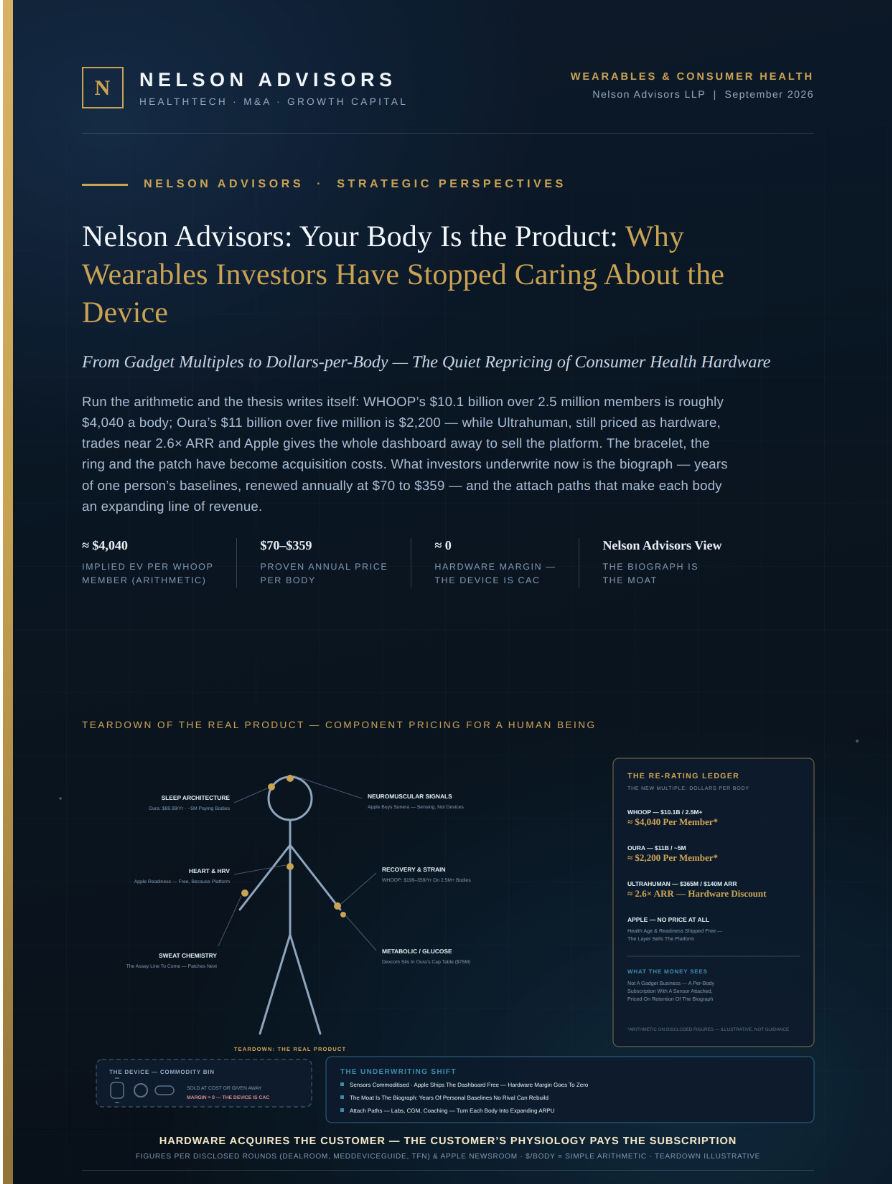
Oura Health was founded in Oulu, Finland, in 2013 by Petteri Lahtela, Kari Kivelä, and Markku Koskela, targeting an unaddressed gap in the wearable market: continuous physiological monitoring focused on sleep architecture, heart rate variability and recovery, housed in a comfortable ring form factor. The company’s trajectory illustrates the transition from a niche quantified self wearable to a profitable clinical-grade consumer hardware and enterprise software platform.
Financially, Oura moved through a series of increasingly large funding rounds, including a $200 million Series D at a $5.2 billion valuation in late 2024, followed by an $875 million to $900 million Series E in October 2025 led by Fidelity Management & Research, which brought its private market valuation to $11 billion. In September 2026, Oura filed a public Form S-1 with the U.S. Securities and Exchange Commission to list on the Nasdaq under the ticker OURA, with reports pointing to an offering targeting a valuation above $16 billion.
Oura’s underlying economics rely on an efficient hardware-to-SaaS conversion model. Trailing twelve-month revenue reached approximately $1.4 billion to $1.42 billion by mid-2026, marking a 74% year-over-year increase from fiscal 2025 revenues of $908 million and fiscal 2024 revenues of $500 million. The company has shipped more than 5.5 million rings, with over 3.6 million units sold in the preceding twelve months alone.
The revenue mix consists of roughly 80% hardware and 20% recurring software subscriptions ($70 annually per user, delivered at an 89% gross margin). With 5.0 million active paid subscribers and an 85% twelve-month subscription retention rate, Oura leverages hardware sales—yielding an average realized price of $311 per unit at a roughly 46% gross margin—to fully offset customer acquisition costs on day one. The software subscription layer drives long-term customer lifetime value and operating profits, generating $60.8 million in net income in the nine months prior to its public filing.
To protect against commoditisation, Oura has expanded into regulated clinical applications and business-to-business partnerships. Strategic acquisitions, including metabolic health platform Veri and enterprise analytics firm Sparta Science, combined with continuous glucose monitoring integration with Dexcom and a $96 million biometric monitoring contract with the United States Department of Defense, have expanded Oura's footprint well beyond discretionary fitness tracking.
Neko Health: Automated Preventive Imaging Infrastructure
Founded in 2018 in Stockholm by Spotify co-founder Daniel Ek and serial entrepreneur Hjalmar Nilsonne, Neko Health was built on the premise that reactive healthcare allocation is economically unsustainable. With public health budgets overwhelmingly directed toward downstream acute disease management, Neko spent more than four years in stealth engineering dedicated to developing a non-invasive, automated preventive diagnostic scanning system.
Neko’s scanning cabins utilise custom optical arrays, multi-spectral laser sensors and computer vision models to capture millions of biological data points in a single fifteen minute session. The scan maps cardiovascular risks, micro-dermatological changes, full-body mole distributions, and arterial stiffness to identify early markers of metabolic syndrome, vascular dysfunction and malignant melanomas before symptoms manifest clinically.
Positioned as an accessible direct to consumer medical diagnostic service, Neko launched its flagship clinic in Stockholm, followed by an expansion into London priced at £299 per scan, which generated waiting lists numbering in the tens of thousands.
The company's rapid capitalisation reflects its capital intensive infrastructure model. Backed initially by Ek’s investment firm Prima Materia, Neko closed a Series B round valuing the business at $1.8 billion in early 2025, and subsequently completed a $700 million Series C round in July 2026 at a $7 billion valuation.
The Series C financing is allocated toward building brick-and-mortar scanning facilities across prime metropolitan centres in Europe and North America, establishing an international preventive imaging footprint.
Tandem Health: Sovereign Clinical Intelligence
Founded in 2023 in Stockholm by Lukas Saari, Oliver Åstrand, and Oscar Boldt-Christmas, Tandem Health addresses the administrative crisis confronting modern healthcare systems, where clinicians spend up to 40% of their working hours completing clinical documentation. Tandem develops an ambient clinical scribe and co-pilot that listens to doctor-patient consultations and automatically synthesizes medical records, referral letters, and coding documentation directly into electronic health record (EHR) systems in real time.
Tandem built its strategic moat by prioritising European regulatory and architectural compliance. Rather than deploying a generic large language model wrapper, Tandem obtained Class IIa medical device certifications under the European Union Medical Device Regulation (EU MDR) for its documentation, clinical coding, and decision-support engines. It paired these certifications with data sovereignty frameworks, including ISO 27001, ISO 13485, ISO 42001, German C5, and Spanish ENS High security attestations.
By partnering with existing clinical software provider Accurx, Tandem secured deployment across more than 200,000 to 230,000 National Health Service (NHS) professionals, establishing coverage across 98% of primary care practices in the United Kingdom.
In September 2026, Tandem closed a $100 million (€86.5 million) Series B funding round led by the Scaleup Europe Fund, a €5 billion institutional vehicle managed by EQT Group and backed by the European Commission, Novo Holdings, and CriteriaCaixa, taking its total funding to $160 million at an estimated $1 billion valuation.
Operating across 14 European markets and serving over 10,000 care organisations, Tandem is transitioning from an ambient documentation tool into an AI-native operating system managing clinical workflows, patient scheduling, and point of care clinical decisions.
Industrial Lineage: Sensor Heritage and Precursor Platforms
The sudden visibility of these platforms obscures a decades-long industrial foundation. The engineering, clinical, and commercial components driving modern Nordic healthtech firms were cultivated across historical corporate expansions, technology transitions, and early digital health ventures.
The Nokia-Polar Hardware Heritage
The hardware and algorithmic foundations of Oura Health are rooted in the telecommunications and microelectronics cluster of Oulu, Finland. In 1977, Polar Electro was established in nearby Kempele, inventing the world’s first wireless, portable heart rate monitor and pioneering commercial heart rate variability analysis. Over the next four decades, Polar, together with research institutes at the University of Oulu, turned northern Finland into a centre for physiological telemetry, wireless biomedical instrumentation, and sports science algorithms.
Parallel to Polar’s growth, Nokia transformed Oulu into an engineering hub for radio-frequency hardware, miniaturized embedded printed circuit boards, and low-power mobile architectures. When Nokia contracted its mobile phone operations in the early 2010s, it left a high concentration of optical engineers, embedded firmware developers and materials scientists in the local startup ecosystem.
Oura’s founding team drew directly from this talent pool: Kari Kivelä contributed over a decade of Nokia firmware development, while early algorithmic teams were staffed by veterans from Polar’s physiological research divisions. The engineering challenge of integrating dual infrared photoplethysmography sensors, negative temperature coefficient thermistors, a 3D accelerometer, and a lithium-polymer battery into a wearable titanium ring was uniquely feasible in Oulu because the necessary bio-sensor and radio-frequency capabilities had been systematically developed there for forty years.
The First Wave of Digi-Physical Care Delivery
Before ambient AI or automated body scanning emerged, Nordic pioneers established the commercial, operational and regulatory pathways for digital care delivery. Founded in Stockholm in 2015, Kry (operating as Livi in the United Kingdom and France) became Europe’s largest digital primary care provider. Backed by European venture capital firms including Index Ventures, Accel, and Creandum, Kry reached a $2 billion valuation during its $300 million Series D round in 2021.
Kry reshaped European healthcare delivery across two key areas. First, it challenged and reformed Nordic and Western European reimbursement frameworks, establishing legal mechanisms for public funds to compensate digital consultations on equal footing with in-person visits. Second, Kry demonstrated that pure telemedicine had structural clinical limitations; by acquiring and operating more than thirty physical primary care clinics, it pioneered a hybrid "digi-physical" care model.
This hybrid operational framework established the regulatory and logistical blueprint that later enabled capital-intensive clinical deployments like Neko Health.
Specialised Biomedical and Clinical Intelligence Systems
The broader Nordic digital health landscape exhibits similar clinical rigor and specialization. Copenhagen-based Corti, established in 2016, engineered specialised speech-processing machine learning models for emergency medical dispatch and triage. By analysing acoustic signatures, verbal patterns, and respiratory cues in real time, Corti's AI detects out-of-hospital cardiac arrests and acute clinical events across more than 250,000 daily interactions, raising a $60 million Series B in 2023.
In Sweden, Flow Neuroscience developed a non-invasive, at-home transcranial direct current stimulation (tDCS) headset paired with behavioral therapy software for treating Major Depressive Disorder. Flow secured FDA Breakthrough Device designation and completed NHS clinical trials, establishing a non-pharmacological treatment alternative. These platforms demonstrate that Nordic healthtech enterprises consistently emphasise rigorous clinical trials, physical medical hardware, and public health integration over lightweight, unvalidated consumer apps.
Structural Moats: The Scandinavian Health Data Architecture
The international competitiveness of Nordic healthtech is directly enabled by the region's public health data infrastructure. The single-payer systems of Sweden, Finland, Denmark and Norway provide an advantageous environment for validating diagnostic models, running clinical trials and building interoperable medical software.
At the foundation of this ecosystem are universal civic identifiers. Every citizen in Sweden, Finland, Denmark, and Norway is assigned a unique personal identification number at birth, such as the Swedish personnummer, the Danish CPR, or the Finnish henkilötunnus. This identifier links all medical encounters across primary care clinics, acute hospital trusts, specialised diagnostic laboratories and retail pharmacies throughout an individual's lifetime.
Unlike the fragmented United States healthcare system, where patient records are distributed across disconnected hospital systems, insurance claims databases and varied billing clearinghouses, the Nordic countries maintain unified, high-integrity longitudinal health records extending back decades. For clinical AI developers and medical device manufacturers, this infrastructure provides an ideal setting for epidemiological baselining, retrospective outcome correlation and algorithmic verification against verified health outcomes.
Complementing these universal registries is complete clinical digitalization. The Nordic nations achieved near-complete adoption of electronic health records, diagnostic digitization, and electronic prescribing well ahead of other Western economies. National patient access portals—such as Sweden’s 1177.se, Finland’s Kanta, and Denmark’s Sundhed.dk—provide authenticated citizen access to health records, diagnostic results, and communication tools within a single interface. This environment acts as a clinical testbed; companies like Tandem Health can integrate directly with standardised EHR formats and existing workflows, avoiding paper-to-digital translation challenges and allowing rapid product validation before entering fragmented markets like the UK or the US.
Finally, European regulatory frameworks serve as a competitive moat for Nordic healthtech companies once mastered. Meeting strict GDPR data sovereignty standards, patient privacy protections, and the European Union Medical Device Regulation requires substantial upfront engineering and legal investment. Securing Class IIa MDR certification requires exhaustive clinical evaluations, risk analyses, and rigorous auditing, which often take twelve to eighteen months and require significant capital. When Nordic companies expand internationally, their adherence to stringent European data-residency and medical device compliance allows them to clear enterprise security and clinical procurement audits faster than foreign competitors attempting to adapt after the fact.
Venture Recycling and Institutional Capital Formation
The scaling of Nordic healthtech is sustained by a mature venture capital ecosystem that reinvests tech returns and institutional assets into deep technology and life science companies.
Venture Ecosystem Tier | Key Institutional Entities | Strategic Function in Scaling Healthtech |
Founder Capital & Private Offices | Daniel Ek, Prima Materia, Norrsken Foundation, Lifeline Ventures | Provides long-horizon capital for multi-year deeptech R&D, insulating early-stage companies from premature software metric demands. |
Regional & Global Venture Syndicates | Creandum, Northzone, Kinnevik, Index Ventures, Accel | Supplies Series A and B growth rounds, international playbooks, and connections to foreign healthcare procurement networks. |
Sovereign Scale-Up Funds | Scaleup Europe Fund (managed by EQT Group; funded by EC, Novo Holdings, CriteriaCaixa) | Provides late-stage growth rounds ($50M to $100M+) to support multi-country expansion and prevent early foreign acquisitions. |
Cross-Border Research Clusters | Medicon Valley Alliance (Copenhagen-Malmö), Karolinska Institutet, KTH, University of Oulu | Connects basic biomedical science, engineering faculties, and university hospital trial networks across Denmark and Sweden. |
Stockholm has generated more technology unicorns per capita than any other European hub, producing companies such as Spotify, Klarna, King, and Skype. Capital and experienced leadership from these earlier successes have flowed directly into healthcare and deep engineering. Daniel Ek’s launch of Neko Health alongside Hjalmar Nilsonne represents a prime example of this capital recycling. By committing long-term private capital through Prima Materia, Ek gave Neko the financial runway to spend four years developing proprietary hardware and algorithms in stealth, insulating it from short-term software return metrics.
Similarly, early venture firms such as Lifeline Ventures in Helsinki supported Oura during early financing rounds when hardware ventures were out of favor with mainstream investors. This network provides Nordic founders with playbooks for brand building, software design, and global market expansion.
Historically, European startups faced a structural funding gap: early-stage capital was readily available, but late-stage growth rounds of $50 million to $200 million often required selling to American incumbents or relocating to the United States. The introduction of growth vehicles like the €5 billion Scaleup Europe Fund managed by EQT Group has altered this dynamic.
Tandem Health’s $100 million Series B illustrates the institutional commitment to developing regional champions. Supported by sovereign institutions and life-science investors like Novo Holdings, these funds provide Nordic healthtech companies with the capital necessary to build enterprise commercial teams, conduct multi-country clinical trials, and establish independent footprints across Europe and North America.
This venture infrastructure is linked to regional academic research institutions. The Medicon Valley cluster—spanning the Øresund region between Greater Copenhagen and Skåne in southern Sweden—contains twelve universities, thirty-two hospitals, and hundreds of life-science and medtech enterprises.
Institutions including the Karolinska Institutet, KTH Royal Institute of Technology, and the University of Oulu provide a steady stream of clinical research and technical talent. Karolinska conducts complex clinical trials, KTH supplies software and biomedical engineering specialists, and Oulu contributes signal-processing and microelectronics graduates. This integration between technical universities and teaching hospitals ensures that Nordic healthtech ventures are built on solid clinical foundations rather than unverified consumer trends.
Cultural and Demographic Vectors: The Preventive Paradigm
Beyond technology and capital, Scandinavian healthtech companies are shaped by the social norms and health attitudes of their domestic markets.
The Nordic countries consistently demonstrate high levels of interpersonal and institutional trust. Citizens show a strong willingness to share personal and health data with public agencies and research institutions, provided the data governance is transparent, secure, and oriented toward the collective good. This social contract creates an ideal domestic setting for adopting health-tracking platforms.
When Oura or Neko asks users to monitor biometric indicators, share sleep trends, or undergo comprehensive body scans, they encounter minimal consumer skepticism regarding improper data exploitation. This cultural acceptance enables Nordic companies to gather large biometric datasets early, refining their algorithms before launching into more cautious international markets.
At the same time, Nordic culture places high value on preventive wellness, outdoor life (friluftsliv), restorative rest, and long-term health balance. When Oura introduced its first smart rings, it diverged from the dominant Silicon Valley model of high-intensity athletic performance and active calorie-burn gamification typified by early iterations of Fitbit and Apple Watch. Instead, Oura centred its platform on sleep quality, heart rate recovery, skin temperature shifts, and daily "Readiness" scores.
By aligning its product design with a holistic philosophy of rest and recovery, Oura reached an under-served consumer segment, notably women tracking menstrual cycles and individuals focused on metabolic longevity. What began as a reflection of Nordic wellness attitudes ultimately anticipated global shifts in health behavior, establishing Oura's international market position. Neko Health is leveraging a similar cultural dynamic: shifting physical health away from episodic annual blood tests and toward continuous, proactive, and data-driven preventive maintenance.
Strategic Trajectory and the Global Horizon
The international growth of Oura, Neko, and Tandem signals that the Nordic healthtech ecosystem has moved from early exploration into large-scale commercial expansion. However, sustaining this trajectory across varying international environments introduces several distinct operational and competitive challenges.
A central hurdle for Nordic innovators expanding into the United States is navigating fragmented payer environments. In the Nordics and the United Kingdom, platforms integrate into unified, single-payer health delivery frameworks. Conversely, the United States market requires dealing with thousands of independent commercial insurers, self-insured employers, and specialized reimbursement codes. While Oura has addressed this through direct-to-consumer sales, corporate wellness offerings, and military contracts, Neko Health and Tandem Health must navigate complex payer incentives to achieve broad integration within private insurance networks.
In clinical artificial intelligence, companies like Tandem Health and Corti face competition from well-funded American technology giants. Microsoft’s integration of Nuance Dragon Copilot into Epic electronic health record systems represents a major institutional competitor in clinical documentation. To protect long-term margins, Tandem must avoid remaining solely an ambient transcription tool—a capability that risks commoditisation by general-purpose foundation models.
Tandem's decision to deploy its Series B capital toward building an integrated, AI-native clinical operating system is aimed at controlling scheduling, diagnostic workflows, and automated billing. By obtaining EU MDR Class IIa medical device clearances and deploying localized systems across Europe, Tandem aims to integrate deeply into public healthcare infrastructure before foreign competitors can adapt to local languages, procurement laws, and European medical device regulations.
The global expansion of Oura, Neko, and Tandem reflects a broader structural change in medicine: the transition from reactive, episodic hospital care to continuous, ambient, and preventive health management.
Scandinavia’s engineering legacy, comprehensive health data infrastructure, institutional trust and mature venture environment have formed a reliable ecosystem for healthcare technology. As Oura completes its public listing and Neko and Tandem expand into international markets, the Nordic model illustrates how high regulatory standards, user-focused hardware, and societal trust can serve as foundational assets for building globally dominant healthcare companies
Nelson Advisors > European HealthTech, MedTech, Digital Health Investment Banking
Nelson Advisors specialise in Mergers and Acquisitions, Partnerships and Investments for Digital Health, HealthTech, MedTech, Health IT, Consumer HealthTech, Healthcare Cybersecurity, Healthcare AI companies.www.nelsonadvisors.co.uk
Nelson Advisors regularly publish Thought Leadership articles covering market insights, industry trends, deal commentary, market analysis & predictions @ https://www.healthcare.digital
Nelson Advisors publish Europe's Leading Healthcare Technology Investment Banking Newsletter every week, join 5000+ HealthTech and MedTech subscribers today! https://lnkd.in/e5hTp_xb
Nelson Advisors pride ourselves on our DNA as ‘Founders advising Founders.’ We partner with entrepreneurs, boards, corporates, venture capital and private investors to maximise shareholder value and investment returns.www.nelsonadvisors.co.uk
#NelsonAdvisors #HealthTech#MedTech#DigitalHealth #HealthIT #Cybersecurity #HealthcareAI #FemTech#ConsumerHealth #Mergers #Acquisitions #Partnerships #Growth #Strategy #NHS #UK #Europe #USA#Canada#Commonwealth#CorporateDivestitures #VentureCapital #PrivateEquity #Founders #SeriesA #SeriesB #Founders #SellSide #TechAssets #Fundraising #BuildBuyPartner #GoToMarket #PharmaTech #BioTech #Genomics
Nelson Advisors LLP
Hale House, 76-78 Portland Place, Marylebone, London, W1B 1NT
Meet Nelson Advisors @ 2026 Events
Digital Health Rewired > March 2026 > Birmingham, UK
NHS ConfedExpo > June 2026 > Manchester, UK
HLTH Europe > June 2026, Amsterdam, Netherlands
HIMSS AI in Healthcare > July 2026, New York, USA
Bits & Pretzels > September 2026, Munich, Germany
World Health Summit 2026 > October 2026, Berlin, Germany
HealthInvestor Healthcare Summit > October 2026, London, UK
HLTH USA 2026 > October 2026, USA
Barclays Health Elevate > October 2026, London, UK
Web Summit 2026 > November 2026, Lisbon, Portugal
MEDICA 2026 > November 2026, Düsseldorf, Germany
Venture Capital World Summit > December 2026 Toronto, Canada




Comments