Nelson Advisors: Your Body Is the Product - Why Wearables Investors Have Stopped Caring About the Device

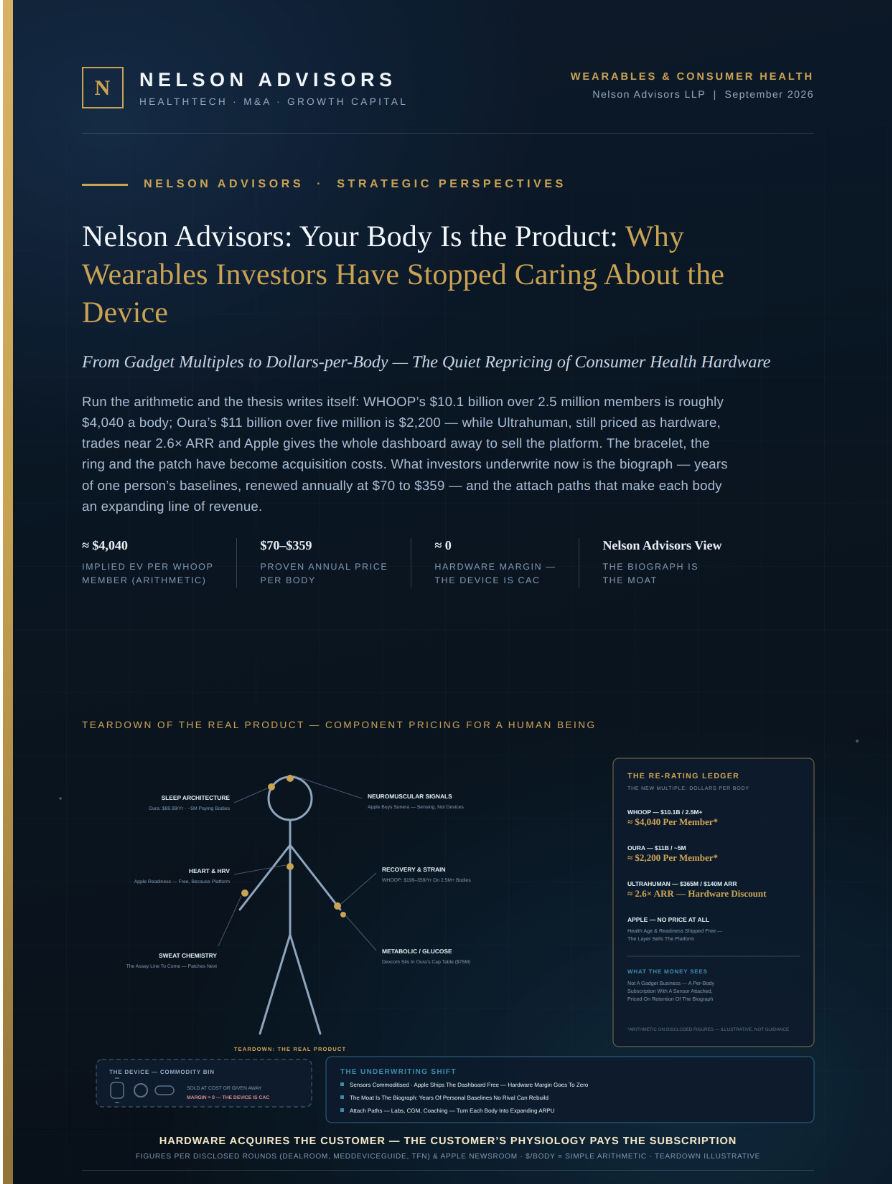
Exec Summary
During the initial growth cycle of consumer wearable technology, venture capital allocations and equity valuations were tethered directly to consumer electronics benchmarks: industrial design, miniaturisation of components, unit shipment volume, and hardware gross margins. The contemporary investment thesis has decisively broken with this framework.
Institutional capital, private equity sponsors, and Big Tech acquirers now regard consumer hardware as a low-margin, commoditised conduit. Physical rings, wristbands, and sensor-laden patches are structured as loss-leading access points whose principal commercial function is to capture, ingest, and monetize an uninterrupted stream of longitudinal biometric data.
This strategic pivot reflects a broader economic transformation: human biological processes have been operationalised as a high margin, recurring asset class. Once raw physiological signals, photoplethysmography waveforms, heart rate variability, continuous interstitial glucose, peripheral skin temperature, and sleep architecture, are integrated into proprietary algorithmic pipelines, they unlock recurring software revenues, enable dynamic underwriting transformations in life and health insurance, and compress discovery timelines in pharmaceutical development. The consumer may purchase a personal wellness tracker, but in institutional capital markets, the human body itself has become the underlying product.
The Commoditisation of the Form Factor: From Hardware Margins to Software Multiples
The flight of institutional capital away from hardware stems from the rapid commoditization of sensor technology and physical components. Across the preceding decade, tri-axial accelerometers, photoplethysmography (PPG) optical arrays, skin temperature thermistors, and Bluetooth Low Energy (BLE) microcontrollers evolved into off-the-shelf commodities. Original design manufacturers and contract assembly partners in Asia can replicate consumer tracking form factors with minimal capital expenditure, eroding any long-term technological defensibility inherent to hardware engineering alone.
Standalone hardware businesses face persistent operational head-winds, including substantial working capital requirements, supply chain volatility, inventory obsolescence, and cyclical 18-to-24-month replacement intervals. Because customer acquisition costs (CAC) recur with each discrete unit sale, standalone hardware makers experience acute margin compression when market categories mature, an economic dynamic that previously undermined pioneers like Jawbone and led to the acquisition of Fitbit by Alphabet.
To overcome these structural constraints, venture investors shifted to valuing wearable enterprises through the lens of Software-as-a-Service (SaaS) and digital health metrics. This valuation arbitrage relies on the stark economic divergence between physical products and recurring software layers.
Operating Metric | Standalone Hardware Business Model | Biometric Platform and Data Model |
Primary Revenue Driver | Transactional, one-time device sales | Annual/Monthly subscription fees and enterprise data licensing |
Gross Margin Range | 30% to 40% | 65% to 80%+ |
Revenue Predictability | Volatile, seasonal, cyclical upgrade dependent | High annual recurring revenue (ARR) visibility |
Defensibility and Moat | Industrial styling and branding (vulnerable to erosion) | Longitudinal physiological baselines and algorithmic network effects |
Public/Private Multiples | 1.0x – 2.5x Enterprise Value / Revenue; 15x – 20x P/E | 6.0x – 10.0x+ Enterprise Value / Revenue; 25x – 35x+ P/E |
Engagement Lifecycle | Concludes at product delivery; dormant until upgrade | Daily interactive logging, biological nudging, and habituation |
As detailed in the structural comparison above, companies that monetise ongoing data interpretation escape the compressed margins of consumer electronics. Venture capital returns depend heavily on valuation multiple expansion; investors favor businesses commanding revenue multiples of 6x to 10x over pure hardware manufacturers trading near 1x to 2x sales. This multiple expansion reflects the economic reality that algorithmic software layers generate superior gross margins while creating durable switching costs that deepen with every day of user data capture.
The Architectural Pivot: Hardware as a Service and Algorithmic Moats
The institutional push toward software driven valuation multiples prompted the emergence of the Hardware-as-a-Service (HaaS) delivery structure. Under this configuration, the physical tracker is repositioned not as a durable possession owned by the consumer, but as an active terminal through which proprietary analytical software is dispensed.
WHOOP engineered one of the earliest full executions of this strategy in 2018 by discarding its $500 upfront device purchase model in favor of a subscription-only architecture. Members pay an ongoing fee of $20 to $30 per month or $199 to $359 annually to retain access to platform analytics, while the physical wristband is provided at no independent retail charge. Backed by institutional funding rounds, most notably a $200 million Series F financing round led by the SoftBank Vision Fund that lifted the enterprise to a $3.6 billion valuation, WHOOP proved that eliminating hardware-driven consumer pricing friction accelerates data asset accumulation.
The primary operational imperative in this pure-subscription format shifts entirely to member retention. Because the manufacturer absorbs hardware production costs, component logistics, and upfront marketing expenses, financial unit-economic models indicate that a member must typically remain active for at least 24 consecutive months before lifetime value eclipses acquisition and subsidization overhead. To mitigate churn, the platform builds an algorithmic switching barrier: because recovery, daily cardiovascular strain, and sleep scores require months of continuous tracking to calibrate accurate physiological baselines, a departing subscriber must abandon their accumulated biological history, rendering substitution across competing platforms friction-heavy.
Oura pursued a related hybrid architecture. Having initially established scale via direct-to-consumer hardware sales, Oura introduced a recurring monthly membership fee with its third-generation ring, effectively placing detailed sleep architecture, readiness analytics, and biometric tracking behind an ongoing paywall. Although Oura still derives approximately 80% of its top-line revenue from hardware unit sales and 20% from recurring software subscriptions, the continuous software layer radically upgraded the enterprise's long-term financial quality.
To build institutional defensibility beyond consumer discretionary spending, Oura launched Oura for Business, licensing pooled biometric telemetry to commercial enterprises, elite athletic organizations, and medical researchers. In late 2024, Oura deepened this ecosystem strategy by securing a $75 million strategic investment from medical device leader Dexcom, establishing an integrated commercial bridge between smart rings and real-time metabolic telemetry.
Within these operating models, physical hardware functions purely as the collection layer of a multi-tiered monetisation architecture. At the sensor tier, the physical apparatus captures continuous autonomic and metabolic telemetry, including photoplethysmography pulses, accelerometry, and interstitial fluid shifts. These signals flow immediately into the core analytics engine, which converts raw data into validated biometric indices such as sleep stage distributions, baseline deviations, and cardiovascular strain.
This interpreted data powers two parallel revenue streams: a consumer-facing SaaS subscription that monetises personalised health optimisation and an enterprise pipeline that syndicates longitudinal data to commercial payers, clinical research organisations and institutional employers.
Somatic Monetisation: Actuarial Underwriting, Digital Biomarkers and Biosensing Consumables
While consumer app subscriptions provide baseline operating cash flow, the largest institutional capital inflows into wearable platforms target institutional data monetisation across life insurance, clinical research, and metabolic consumable markets.
Dynamic Actuarial Underwriting and Behavioural Insurance
Historically, health and life insurance underwriting has relied on static, retrospective actuarial calculations: applicant age, family medical history, smoking status, and episodic laboratory screenings. Wearable telemetry transitions this legacy framework into continuous, real-time behavioural risk assessment.
Pioneered globally by Discovery Limited through its syndicated Vitality program and commercialised in partnership with major carriers including John Hancock and UnitedHealthcare, behavioural insurance programs subsidise consumer smartwatches and rings in exchange for access to live biometric streams.
This framework creates dual advantages for underwriters. First, it mitigates adverse selection by attracting a demographic cohort that skews younger, more affluent, and fundamentally proactive regarding wellness behaviours. Second, continuous algorithmic feedback loops actively nudge policyholders toward lifestyle interventions that suppress aggregate claims incidence. By monitoring cardiovascular activity, step counts, and sleep regularity, insurance actuaries dynamically optimise reserve capital allocations, replacing static demographic risk pools with real-time risk ratings.
Digital Biomarkers and Pharmaceutical Clinical Trials
The institutional biopharmaceutical sector has integrated wearable biometric streams to address rising clinical drug trial development costs. The global digital biomarkers market was valued between $5.0 billion and $6.3 billion in 2024 to 2025 and is projected to expand to between $35.8 billion and $41.0 billion by 2034 to 2035, growing at a compound annual growth rate exceeding 20%. Wearable based digital biomarkers represent between 41% and 61% of this total market capitalisation.
Pharmaceutical sponsors use continuous sensor streams to support decentralized clinical trials and generate Real-World Evidence (RWE). High-frequency physiological tracking detects micro-changes in baseline autonomic function, gait velocity, nocturnal scratch frequency, and tremor characteristics in neurodegenerative diseases like Parkinson’s. By deploying wearables as continuous clinical endpoint monitors, trial sponsors bypass the noise and attrition associated with infrequent, on site hospital assessments, dramatically accelerating trial completion times and reducing drug development overhead.
Consumable Biosensors and the Metabolic Ingestion Engine
The most commercially lucrative manifestation of the somatic asset model combines wearable technology with consumable medical chemistry. Historically, continuous glucose monitors (CGMs) developed by Dexcom and Abbott were restricted to prescription bound, insurance reimbursed populations managing Type 1 or insulin dependent Type 2 diabetes. During 2024, both companies unlocked the broader consumer wellness landscape by securing clearance from the US Food and Drug Administration (FDA) for over the counter (OTC) biosensors.
Biosensor System | Regulatory Classification | Primary Target Demographic | Commercial Distribution Strategy | Sensor Mechanical Lifecycle |
Dexcom Stelo | FDA 510(k) Clearance (March 2024) | Adults with Type 2 diabetes not on insulin; pre-diabetes; wellness cohorts | Direct-to-consumer online ordering and e-commerce platforms | 15-day single-use biosensor expiration |
Abbott Lingo | FDA 510(k) Clearance (May 2024) | Healthy consumers pursuing metabolic coaching and lifestyle tracking | Direct-to-consumer retail, consumer subscription, Amazon store | 14-day single-use biosensor expiration |
Abbott Libre Rio | FDA 510(k) Clearance (May 2024) | Non-insulin Type 2 diabetes adult patients (18+) | Direct retail pharmacy competition targeting non-insulin metabolic care | 14-to-15-day single-use biosensor expiration |
These continuous metabolic monitors represent a structurally distinct hardware model. Unlike smart rings or wristbands, which remain functional for years, enzymatic biosensors physically expire every 14 to 15 days due to the biological exhaustion of the glucose oxidase catalyst on the subcutaneous filament.
This built-in chemical expiration creates a recurring subscription loop: users pay between $49 and $90 per month out of pocket to replenish hardware components. The physical patch functions as a consumable cartridge, while the underlying value driver remains the longitudinal metabolic software feedback loop that guides dietary and lifestyle modifications.
Platform Power and Regulatory Scrutiny: Big Tech Moats and the Erosion of HIPAA Arbitrage
For hyperscale technology platforms like Apple, Google, and Samsung, wearable hardware operates as an ecosystem retention anchor. These conglomerates do not require wearable product divisions to optimize standalone profit margins. For Apple, an Apple Watch serves primarily to secure iPhone retention, defending high-margin Services revenue segments that deliver gross margins between 65% and 75%, compared to hardware product margins of roughly 35%.
Wearables also serve as intake portals for personal health records, establishing deep ecosystem lock-in. When an individual amasses several years of continuous cardiovascular, sleep, and activity baselines within a proprietary operating system, the transaction friction of migrating to an alternative platform becomes prohibitive.
The regulatory importance of this biometric concentration was highlighted during the European Commission’s antitrust review of Google’s $2.1 billion acquisition of Fitbit. Antitrust authorities raised acute market-distortion concerns, concluding that merging Fitbit’s deep physiological database into Google’s programmatic advertising machinery would reinforce insurmountable barriers to entry across online search and ad display markets.
To secure merger clearance within the European Economic Area, Google committed to a binding ten-year regulatory framework overseen by an independent technical trustee. These conditions required Google to maintain a strict internal data silo separating Fitbit biometric records from ad platforms, preventing European user health telemetry from influencing ad targeting.
Google was further required to maintain open and non-discriminatory access to core Android application programming interfaces (APIs) for rival third-party wearable manufacturers, ensuring that competitive hardware could connect and interoperate with Android smartphones without artificial latency or degraded utility. This landmark antitrust intervention established that regulatory authorities no longer view wearables as simple consumer gadgets, but as systemic data aggregation platforms capable of consolidating anti-competitive power.
Simultaneously, the foundational legal architecture underlying the consumer health economy is undergoing structural reform. Historically, commercial wearable makers exploited a substantial regulatory loophole: the provisions of the US Health Insurance Portability and Accountability Act of 1996 (HIPAA) apply strictly to covered entities such as hospitals, physicians, healthcare clearinghouses, and formal health maintenance organizations. Commercial wellness trackers fall outside this statutory perimeter. Operating within this non-HIPAA zone, wearable platforms gathered, aggregated, and transferred consumer biometric records to marketing entities, ad platforms, and analytical data brokers with minimal direct healthcare compliance liability.
This regulatory environment is tightening rapidly. The US Federal Trade Commission (FTC) has stepped into the enforcement void by interpreting its Health Breach Notification Rule (HBNR) to govern direct to consumer health applications and connected digital devices. Through repeated enforcement actions, the FTC has established that transmitting sensitive consumer physiological or reproductive telemetry to third party data brokers or programmatic advertising tracking pixels without affirmative, explicit consent constitutes an actionable breach of federal trade law. Concurrently, state level regulations, exemplified by Washington State's My Health My Data Act, have established strict opt-in consent mandates specifically targeting non-HIPAA health data and commercial biometric profiling.
Beyond statutory frameworks, advancements in analytical computing are undermining standard anonymisation claims. Modern data science demonstrates that continuous, high-frequency biological waveforms are virtually unique to the individual. When an anonymised telemetry stream containing granular heart rate accelerations, sleep wake cycles, and peripheral motion is cross-referenced with public geolocation metadata, individuals can be re-identified with high mathematical precision.
These analytical realities have led academic observers and economic theorists to categorize consumer wearables as instruments of biological surveillance and "somatic capitalism". In this framework, human biological rhythms, historically insulated from financial markets, are systematically extracted, algorithmicised and monetised to support corporate risk governance, creating an asymmetrical exchange where consumers fund the acquisition of devices that harvest their biological data for institutional exploitation.
Strategic Horizon: The Post-Device Era
The commercial evolution of wearable technology is rapidly entering a post-device phase. Sensor arrays are becoming increasingly ambient, disappearing directly into smart fabrics, continuous transdermal patches, audio hearing devices and consumer eyewear. As component miniaturisation renders the physical housing effectively invisible, the mechanical product will carry zero standalone consumer surplus.
Venture capital allocation confirms that enduring equity value resides entirely within the machine learning models trained on these continuous somatic streams. Large scale physiological foundation models are being built to recognise early autonomic anomalies, metabolic dysregulation and neurodegenerative decline months before clinical symptoms manifest.
The primary competitive battleground across the digital health industry will not be contested over industrial hardware design or wristband aesthetics. Market leadership and sustained capital returns will belong to the platforms that control the analytical interpretation layer, the digital infrastructure that ingests continuous bodily outputs, synthesises them into actionable behavioural insight and integrates them across clinical health systems, dynamic actuarial underwriters and automated AI health coaches. The wearable device has fulfilled its purpose as an initial distribution vehicle; the continuous biometric stream of the human body is the permanent asset.
Nelson Advisors > European HealthTech, MedTech, Digital Health Investment Banking
Nelson Advisors specialise in Mergers and Acquisitions, Partnerships and Investments for Digital Health, HealthTech, MedTech, Health IT, Consumer HealthTech, Healthcare Cybersecurity, Healthcare AI companies. www.nelsonadvisors.co.uk
Nelson Advisors regularly publish Thought Leadership articles covering market insights, industry trends, deal commentary, market analysis & predictions @ https://www.healthcare.digital
Nelson Advisors publish Europe's Leading Healthcare Technology Investment Banking Newsletter every week, join 5000+ HealthTech and MedTech subscribers today! https://lnkd.in/e5hTp_xb
Nelson Advisors pride ourselves on our DNA as ‘Founders advising Founders.’ We partner with entrepreneurs, boards, corporates, venture capital and private investors to maximise shareholder value and investment returns.www.nelsonadvisors.co.uk
#NelsonAdvisors #HealthTech#MedTech#DigitalHealth #HealthIT #Cybersecurity #HealthcareAI #FemTech#ConsumerHealth #Mergers #Acquisitions #Partnerships #Growth #Strategy #NHS #UK #Europe #USA#Canada#Commonwealth#CorporateDivestitures #VentureCapital #PrivateEquity #Founders #SeriesA #SeriesB #Founders #SellSide #TechAssets #Fundraising #BuildBuyPartner #GoToMarket #PharmaTech #BioTech #Genomics
Nelson Advisors LLP
Hale House, 76-78 Portland Place, Marylebone, London, W1B 1NT
Meet Nelson Advisors @ 2026 Events
Digital Health Rewired > March 2026 > Birmingham, UK
NHS ConfedExpo > June 2026 > Manchester, UK
HLTH Europe > June 2026, Amsterdam, Netherlands
HIMSS AI in Healthcare > July 2026, New York, USA
Bits & Pretzels > September 2026, Munich, Germany
World Health Summit 2026 > October 2026, Berlin, Germany
HealthInvestor Healthcare Summit > October 2026, London, UK
HLTH USA 2026 > October 2026, USA
Web Summit 2026 > November 2026, Lisbon, Portugal
MEDICA 2026 > November 2026, Düsseldorf, Germany
Venture Capital World Summit > December 2026 Toronto, Canada



Comments