European MedTech and HealthTech valuation landscape in February 2026


The 2026 European MedTech and HealthTech Valuation Landscape: A Strategic Assessment of Industrial Maturity and Regulatory Darwinism
The European healthcare technology and medical technology sectors have transitioned into a definitive era of disciplined industrial maturity as of February 2026. This phase, widely characterised by market analysts as the Great Rationalisation, marks the final pivot away from the venture subsidised experimentation of the early 2020s toward a rigorous "flight to quality".
In this environment, the fundamental determinants of asset value have shifted; revenue growth is no longer a standalone metric for success. Instead, valuation is increasingly predicated on a company’s integration into clinical pathways, its regulatory fortitude under a maturing EU framework, and its capacity to deliver measurable, sustainable return on investment to health systems facing unprecedented fiscal constraints.
The Macroeconomic Framework and the Dry Powder Paradox
The valuation environment in early 2026 is shaped by a persistent pressure cooker of macroeconomic forces that have redefined deal mechanics. While the peak volatility of the post-pandemic recalibration has largely subsided, the lingering effects of elevated interest rates have sustained a significant "bid-ask" spread between buyers and sellers. This gap has necessitated the adoption of creative and increasingly complex deal structures, including earn-outs often representing 20-30% of total deal value seller notes and performance-linked consideration.
Despite the cautious pace of deployment, the capital markets are defined by what is known as the Dry Powder Paradox. Private equity and venture capital funds are estimated to hold nearly $2.5 trillion in unallocated capital. However, deployment is characterised by extreme selectivity, favouring "vertical operators" that demonstrate clear industrial logic and a path to profitability over those with purely theoretical scaling potential.
The Transition to Profitable Efficiency and the Rule of 40
In the zero-interest-rate policy (ZIRP) era of 2019–2021, valuations were frequently detached from unit economics, driven primarily by user acquisition metrics and top-line expansion. By February 2026, the metric of choice for both public and private investors has definitively shifted to EBITDA or a highly credible, near-term trajectory toward it. The "Rule of 40," once a balanced metric for SaaS-based healthcare platforms, has seen its internal weighting shift heavily toward the profit component.
In previous market cycles, a venture could satisfy investor demands with 50% growth despite -10% margins; in the current landscape, high-growth, high-burn companies are seeing their revenue multiples compressed to the 3x–4x range.Conversely, moderate-growth platforms that demonstrate consistent profitability and industrial-scale operational efficiency are commanding premium multiples of 10x–14x EBITDA. This structural transformation reflects a broader realisation that the cost of capital remains structurally higher than the pre-2022 era, forcing a prioritisation of "profitable efficiency".
Private Equity Liquidity Cycles and the M&A Resurgence
Private equity activity in 2026 is primarily fueled by the maturation of assets from the 2019–2021 vintage. PE firms are under immense pressure to return capital to Limited Partners (LPs), creating a "use it or lose it" dynamic as funds approach the end of their investment periods. Because the IPO market remains highly selective, favouring only those assets with proven scale and significant profitability, sponsors are increasingly turning to secondary buyouts and continuation funds to drive consolidation.
This liquidity cycle coincides with an expected surge in M&A activity throughout 2026. Large-cap healthcare companies, which have largely avoided transformational deals in 2024 and 2025, are now re-entering the market to optimize their portfolios. These strategics are focusing on capability-building acquisitions that strengthen their positions in high-growth procedural segments like cardiovascular care, neuro-stimulation, and sports medicine.
Sub-sector | EV / Revenue Multiple | EV / EBITDA Multiple | Core Strategic Rationale |
Premium AI & Data Platforms | 6.0x – 8.0x+ | 15x – 18x+ | Proprietary clinical datasets; validated algorithms; Rule of 40 performance. |
Value-Based Care (VBC) | 5.5x – 7.0x | 12x – 15x | Demonstrable ROI for payers; high population health impact. |
General HealthTech SaaS | 4.0x – 6.0x | 10x – 13x | Predictable unit economics; stable retention; standard digital health. |
MedTech Hardware (MDR-ready) | 3.5x – 5.5x | 11x – 14x | Highly regulated; strategic "compliance moats"; high barrier to entry. |
Regulatory Darwinism: The New Valuation Benchmark
One of the most profound shifts in the 2026 valuation landscape is the emergence of "Regulatory Darwinism". Regulatory status has surpassed traditional metrics such as Annual Recurring Revenue (ARR) growth to become the single most critical filter for investment and acquisition. This phenomenon is driven by the convergence of several major regulatory timelines that have created a binary environment for healthcare technology ventures.
The Triple Convergence of 2026
Entering February 2026, the European market is grappling with a "perfect storm" of regulatory deadlines that are effectively strangling unprepared firms while propelling compliant enterprises to leadership positions.
MDR and IVDR Full Enforcement: The implementation of the EU Medical Device Regulation (MDR) and In Vitro Diagnostic Regulation (IVDR) has reached a critical bottleneck. Class III custom-made devices are required to reach full compliance by May 26, 2026. The scarcity of Notified Bodies has led to an 18-24 month regulatory risk profile for non-certified devices, making those with existing certifications highly sought after by US strategics seeking immediate market entry.
The EU AI Act: Full enforcement for "high-risk" medical AI systems begins in March 2026. This legislation requires stringent data governance, human oversight, and absolute transparency. Investors are rigorously avoiding "black box" models, favouring ventures that have engineered "glass box" interpretability to satisfy Articles 13 and 14 of the Act.
Mandatory EUDAMED Usage: The European database on medical devices (EUDAMED) becomes fully functional and mandatory as of May 28, 2026, for actor and device registration. This transition requires significant internal resources for data preparation and system integration, serving as another operational filter for startups.
The Rise of the "Compliance Moat"
In 2026, a valid MDR/IVDR certificate is no longer merely a permit to sell; it is a significant financial asset. Large strategic acquirers like Roche, Siemens Healthineers and Abbott are increasingly engaging in "compliance-driven M&A". They target smaller competitors not necessarily for their novel technology, which may be similar to their own R&D, but to acquire a "compliance moat" that de-risks the asset and secures immediate data sovereignty.
Consequently, ventures that have navigated the regulatory bottleneck command valuation premiums because they offer a shortcut through the time and cost barriers of the European system.
The AI Inflection: From Speculative Hype to Vertical Intelligence
Artificial Intelligence has transitioned from an experimental "concept" phase in 2024–2025 to a core operational capability in 2026. The valuation narrative has matured beyond generalist large language models (LLMs) toward "Vertical AI", specialised clinical co-pilots and drug discovery platforms that leverage proprietary, regulatory-cleared datasets.
Performance Metrics of AI-Native Healthcare
The efficiency gains provided by AI-native platforms are fundamentally altering the unit economics of the sector. Traditional healthcare services typically generate $100,000 to $200,000 in ARR per full-time employee (FTE), whereas AI-native platforms are achieving ARR per FTE metrics between $500,000 and over $1 million. This productivity allows for software-like margins even at scale, justifying higher valuations compared to first-generation digital health companies.
By 2025, AI-enabled ventures captured 55% of all healthtech funding, a trend that has intensified in early 2026 as biopharma and medtech leaders prioritize capability multipliers. The healthcare AI market is projected to reach between $18 billion and $61 billion in 2026, with the generative AI segment specifically showing a staggering 35.1% compound annual growth rate.
AI Market Segment | EV / Revenue Multiple | Primary Valuation Drivers |
AI-First Drug Discovery | 8.0x – 15.0x | "Bio-bucks" potential; upfront payments; reduced R&D costs. |
AI-Powered Medical Imaging | 5.0x – 9.0x | FDA/EMA clearance; measurable workflow efficiency in radiology. |
AI Remote Monitoring | 4.0x – 8.0x | Scale (>100k lives); reduction in nurse staffing ratios (1:50 to 1:200). |
Operational & RCM AI | 3.0x – 6.0x | Concrete ROI via denial rate reduction and coding automation. |
The "Trust Gap" and Market Re-Rating
Despite these strong metrics, where new healthtech stocks often demonstrate twice the revenue growth and FCF margins of standard cloud software, public healthtech stocks in 2026 still trade at a 10–20% discount to their cloud counterparts.
This "trust gap" is the result of lingering skepticism among public investors following the 2020–2021 bubble and the inherent complexity of healthcare regulatory risks. Analysts expect that as these businesses continue to show sustainable growth metrics over multiple quarters, the sentiment will re-rate, narrowing this gap over the next 12–24 months.
Unicorns, "Soonicorns," and the Industrialisation of Care
The European "unicorn" class—private companies valued at over $1 billion—has undergone a structural transformation by February 2026. The list is no longer dominated by consumer-facing fitness apps but by deep-tech enterprises that bridge the gap between hospital and home through advanced platforms and robotics.
Case Studies in Valuation Resilience
Several companies have emerged as bellwethers for the 2026 landscape, demonstrating how to maintain or expand valuations in a disciplined market:
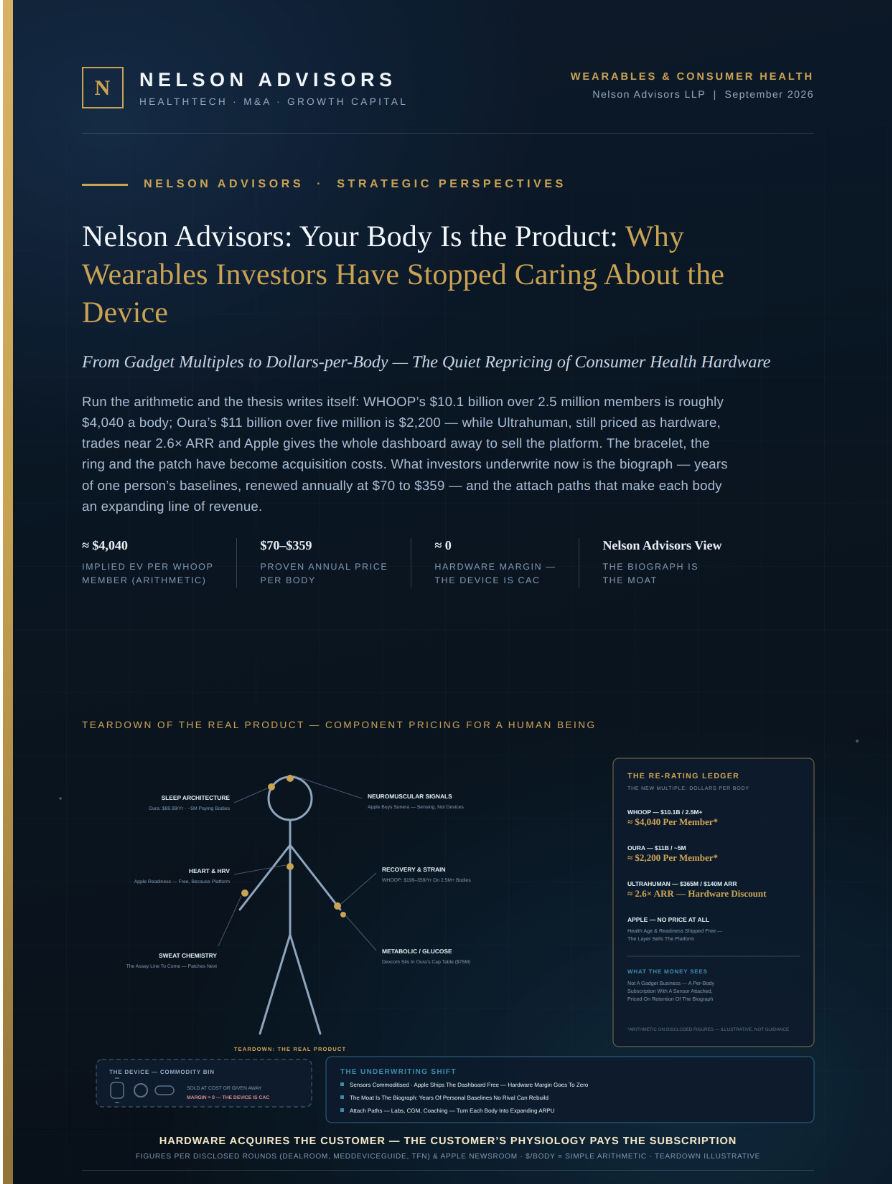
Oura (Finland): Following a $900 million Series E round, Oura achieved an $11 billion valuation. It has successfully pivoted from a niche sleep tracker to a holistic preventative health platform, leveraging strong B2B corporate wellness channels and enterprise research relevance.
Sword Health (Portugal/UK/US): Valued at $4 billion, Sword Health’s "AI Care" model has become a leader in digital MSK (musculoskeletal) care. By utilising AI to replace human physical therapy components, it has achieved high margins and expanded into pelvic and mental health.
CMR Surgical (UK): Valued at approximately $3 billion to $4 billion, CMR is the primary European challenger to Da Vinci in the surgical robotics space. In 2026, it is exploring a "dual-track" strategy—weighing an IPO against a potential $4 billion acquisition by a US medtech giant like Medtronic or J&J.
Flo Health (UK): The first FemTech unicorn, Flo Health has broken the $1 billion barrier by monetising the menopause market and expanding its employer benefits channel.
The "Soonicorn" Pipeline: The Infrastructure of Care
The next wave of high-value ventures is concentrated in the "unsexy" backend infrastructure of healthcare, the plumbing that allows for interoperability and data fluidity.
| HQ | Valuation Status | Core Strategic Focus |
Neko Health | Sweden | $1.8B | Consumer preventative care clinics; medical diagnostics. |
Distalmotion | Switzerland | Soonicorn | Hybrid robotics targeting the US Ambulatory Surgery Center market. |
Corti | Denmark | Soonicorn | AI co-pilot for consultations; addressing the workforce crisis. |
Lifen | France | Soonicorn | Interoperability layer for hospitals; EHDS "picks and shovels". |
Huma | UK | Soonicorn | Hospital-at-home infrastructure; growth through acquisition. |
The Geographic Shift: The "American Accent" and Regional Disparities
By early 2026, the European digital health and medtech ecosystem has seen its funding dynamics reshaped by the aggressive entry of US capital. US investors now account for 61% of participants in European late-stage deals, a staggering increase of twenty percentage points from just two years ago.
Valuation Arbitrage and the "IPO Test"
This influx of US capital has introduced valuation benchmarks shaped by the North American market, characterized by larger deal sizes and faster scaling assumptions. This has driven a 4.1x increase in average late-stage deal sizes for European ventures in 2025, setting a high bar for liquidity events in 2026.
Consequently, 2026 is described as a "put up or shut up" moment; success is no longer measured by the ability to raise capital but by the capacity to deliver exits that justify these "American-style" prices.
Regional Powerhouses and Declines
The distribution of capital across Europe remained highly concentrated in 2025 and early 2026:
United Kingdom: Remained the regional leader, attracting $2.11 billion in funding. Its ecosystem is supported by a favourable policy environment and AI-enabled pathways that have reduced clinical trial approval timelines.
Finland: Surged into second place with $1.16 billion, though this was heavily skewed by the Oura mega-round.
France and Germany: Both experienced funding declines in 2025, falling to $731 million and $612 million, respectively. This suggests investor concentration around specific high-growth assets rather than broad ecosystem exposure in these traditional markets.
Southern Europe (Spain, Italy): Emerging as the "growth frontier" for private equity. Fragmented markets in dental, veterinary, and ophthalmology clinics are attracting significant "buy-and-build" capital seeking multiple arbitrage.
The Convergence of Value-Based Care and Home Diagnostics
A critical theme in 2026 is the movement toward "decentralized care," driven by strained public health budgets and the maturation of remote monitoring technology. M&A activity is increasingly favouring assets that enable this transition, such as tech-enabled home care providers and outpatient surgery centres (ASCs).
Payer Alignment and Reimbursement
Investors in 2026 are prioritising startups that show early signals of adoption and willingness to pay from clinicians and payers. The expansion of remote monitoring and home-based testing reimbursement, both in the US via CMS and in Europe via national fast-tracks like Germany’s DiGA and France’s PECAN, has created a sustainable pathway for these models. The at-home diagnostic market, in particular, is expected to experience significant growth throughout 2026, supported by pharmacies partnering directly with diagnostic startups.
Addressing the Workforce Crisis
The European healthcare workforce is currently short 1.2 million doctors, nurses, and midwives. This chronic shortage has turned workforce optimization and AI-enabled efficiency from "experimental tools" into "clinical priorities".Solutions that can reduce nurse staffing ratios or automate manual documentation are seeing the most immediate ROI and, consequently, the highest valuation premiums.
Public Market Comparables and Strategic Acquirer Dynamics
The public MedTech market in early 2026 has stabilised following a landmark year in 2025, where deal value hit $97.6 billion, the highest in a decade.
Public Company Valuation Multiples (Feb 2026 Consensus)
Publicly traded European MedTech giants continue to prioritise portfolio optimisation and divestitures of non-core assets to concentrate capital on high-growth procedural segments.
Public Company | Country | Market Cap (USD B) | EV / Revenue (NTM) | EV / EBITDA (NTM) |
Siemens Healthineers | Germany | $75.0 | 3.6x | 13.0x |
Philips | Netherlands | $16.1* | 1.0x* | 9.0x* |
Smith & Nephew | UK | $12.5 | 2.8x | 11.5x |
Straumann | Switzerland | $18.0 | 5.5x | 19.5x |
Coloplast | Denmark | $22.0 | 6.5x | 21.0x |
Large-cap strategics are no longer acquiring for growth alone; they are acquiring for "clinical relevance". Acquirers are focusing on:
Vertical Integration: Securing data sovereignty and "compliance moats" to navigate the EU regulatory stack.
Platform Consolidation: Eliminating "vendor sprawl" by acquiring point solutions that can be bundled into a single clinical layer.
ASCs and Specialised Clinics: Targeting the US Ambulatory Surgery Center market with flexible, modular robotics and precision diagnostics.
Emerging Themes: TechBio and Longevity
In 2026, the market is increasingly favouring "TechBio" and longevity sectors, now often referred to as "Healthspan tech".These sectors are characterised by dense science and high capital requirements, often drawing investment from specialised VCs and sovereign wealth funds.
The Pharma Patent Cliff
The "Pharma Patent Cliff" is driving renewed engagement from corporate venture arms like Medtronic Ventures, JJDC, and Philips Ventures. Large pharmaceutical companies are turning to TechBio ventures for generative biology and AI-enabled drug discovery to rebuild their pipelines. This has led to a shift from pure SaaS metrics to "bio-bucks" potential, where valuation is driven by upfront payments and asset-based milestones.
The Maturation of Longevity
Healthspan tech saw a 2.3x increase in investment in 2025, though the market remains concentrated in a few massive deals. The focus in 2026 is on moving longevity from "bio-hacking" toward clinical validation, where wearables and preventative diagnostics provide longitudinal data to manage chronic, age-related diseases.
Conclusion: A Blueprint for Shareholder Value in 2026
The European MedTech and HealthTech valuation landscape in February 2026 is defined by a transition from speculative fragmentation to disciplined "Industrial Maturity". For ventures and investors to succeed in this "clearing event" driven by Regulatory Darwinism, several imperatives must be mastered:
Fortify the Compliance Moat: Regulatory status is now the primary metric of value. A valid MDR/IVDR certificate and a compliant AI stack are essential assets for an exit.
Operationalise Profitable Efficiency: Margin consistency and EBITDA visibility have replaced top-line growth at all costs. The "Rule of 40" is now a profit-weighted metric.
Master the Data Plumbing: Interoperability via the European Health Data Space (EHDS) and clean data models are the new gold standard. "Vendor sprawl fatigue" means only integrated platforms will survive procurement scrutiny.
Evidence-Based Outcomes: The era of selling on vision has ended. Liquidity in 2026 belongs to those who can demonstrate measurable clinical and operational ROI to strained health systems.
Ultimately, 2026 represents a "rationalized" market where capital is abundant but highly selective. The companies that thrive are those that pair technical defensibility and regulatory readiness with a clear, demonstrable impact on the industrialisation of care.
Nelson Advisors > European MedTech and HealthTech Investment Banking
Nelson Advisors specialise in Mergers and Acquisitions, Partnerships and Investments for Digital Health, HealthTech, Health IT, Consumer HealthTech, Healthcare Cybersecurity, Healthcare AI companies. www.nelsonadvisors.co.uk
Nelson Advisors regularly publish Thought Leadership articles covering market insights, trends, analysis & predictions @ https://www.healthcare.digital
Nelson Advisors publish Europe’s leading HealthTech and MedTech M&A Newsletter every week, subscribe today! https://lnkd.in/e5hTp_xb
Nelson Advisors pride ourselves on our DNA as ‘Founders advising Founders.’ We partner with entrepreneurs, boards and investors to maximise shareholder value and investment returns. www.nelsonadvisors.co.uk
#NelsonAdvisors #HealthTech #DigitalHealth #HealthIT #Cybersecurity #HealthcareAI #ConsumerHealthTech #Mergers #Acquisitions #Partnerships #Growth #Strategy #NHS #UK #Europe #USA #VentureCapital #PrivateEquity #Founders #SeriesA #SeriesB #Founders #SellSide #TechAssets #Fundraising #BuildBuyPartner #GoToMarket #PharmaTech #BioTech #Genomics #MedTech
Nelson Advisors LLP
Hale House, 76-78 Portland Place, Marylebone, London, W1B 1NT





Comments