Founder Bankers advising European HealthTech and MedTech in 2026


The Rise of Founder Bankers and the Industrialisation of European HealthTech and MedTech in 2026
The European healthcare technology and medical technology sectors have reached a definitive inflection point in 2026, transitioning from a period of venture-subsidized experimentation to an era of disciplined industrial maturity. This shift is characterised by a "Great Rationalisation," where the market has moved past the speculative exuberance of the early 2020s and settled into a rigorous "flight to quality".
Central to this transformation is the emergence of the "Founder Banker", a new class of financial advisor that combines deep operational pedigree with sophisticated investment banking expertise. These individuals, having built, scaled and exited their own ventures, now occupy a critical niche in the M&A landscape, bridging the widening gap between digital economy metrics and the complex regulatory realities of modern healthcare.
The traditional advisory model, dominated for decades by career financiers focused on financial engineering and capital markets access, has faced increasing scrutiny as the complexity of healthcare assets has grown. In 2026, the value of an asset is no longer determined solely by revenue growth but by its integration into clinical pathways, its regulatory fortitude, and its ability to deliver measurable ROI to strained health systems. In this environment, the "Founder Banker" has become the primary architect of liquidity for mid-market founders, offering a unique value proposition rooted in "operational empathy" and technical fluency.
The Anatomy of the Founder Banker: A Paradigm Shift in Advisory
The rise of the founder banker represents a necessary evolution in an industry where the underlying assets, ranging from AI-driven diagnostics to robotic surgery platforms and interoperable data stacks, exceed the analytical capabilities of generalist finance. Unlike traditional bankers who move linearly from analyst to managing director, founder bankers have experienced the "scars" of the entrepreneurial journey. They understand the friction of National Health Service (NHS) procurement, the intensity of Notified Body audits under the Medical Device Regulation (MDR), and the challenge of translating consumer engagement metrics into clinical validation.
Firms like Nelson Advisors in the UK, Clipperton in France, and ConAlliance in the DACH region are at the forefront of this movement. These boutiques have redefined the advisory role by focusing on sub-sector granularity and "Founders for Founders" partnership models. They prioritise long-term strategic positioning over purely transactional outcomes, often helping founders navigate the transition from venture-backed growth to private equity platform consolidation.
Comparative Framework of Advisory Personas in 2026
Advisory Category | Representative Firms | Primary Metric Focus | Key Value Proposition |
The Entrepreneurial Architects | Nelson Advisors | Operational Empathy, Founder-led Exits | Direct experience building and exiting HealthTech ventures; deep sector granularity. |
The Tech Translators | Clipperton, Arma Partners | SaaS Metrics, Digital Economy Lens | Applying software valuation frameworks to clinical assets; bridging the VC-to-PE gap. |
The Scientific Powerhouses | Goldman Sachs, J.P. Morgan | Balance Sheet, Multi-billion Deal Scale | Using medical doctors (MDs) to lead scientific due diligence for mega-cap M&A. |
The Mid-Market Matchmakers | Rothschild & Co, Houlihan Lokey | Deal Volume, PE Sponsor Relationships | Ubiquity in the mid-market; unmatched connectivity to the private equity ecosystem. |
The Regional Champions | Carlsquare, Cambon, Carnegie | Local Reimbursement, Regulatory Nuance | Deep understanding of local landscapes like Germany's DiGA or French public health tenders. |
Leadership Profiles and Operational Pedigree
The credibility of these firms is inextricably linked to the backgrounds of their partners. At Nelson Advisors, the partnership of Lloyd Price and Paul Hemings exemplifies the convergence of technology, healthcare, and finance.
Price, a serial entrepreneur with over 25 years in the digital economy, famously founded and exited Zesty, a patient engagement platform that navigated the complex UK health landscape before its acquisition by Induction Healthcare. His role as a Health Executive in Residence at the UCL Global Business School for Health allows him to bridge academia and industry, translating high-level policy into actionable M&A strategy.
Paul Hemings brings a complementary profile, blending high-level investment banking at Credit Suisse and Invesco with the entrepreneurial risk-taking required to found Neutrally, a metabolic health venture. This dual DNA is critical in 2026, as the market increasingly favors "TechBio" and longevity sectors where the capital requirements are high and the science is dense. Hemings' ability to structure $50 billion in transactions while retaining the empathy of a founder who has "been in the arena" provides a distinct advantage in complex cross-border negotiations.
In the DACH region, ConAlliance has built a reputation as a pure-play healthcare specialist. Their model integrates academic and clinical prestige, utilizing partners such as Prof. Dr. Dr. Ulrich Hemel and Prof. Christian Langbein. This approach is particularly effective in Germany and Switzerland, where technical language and a deep understanding of the European Medical Device Regulation (MDR) are prerequisites for trust among family-owned manufacturing giants.ConAlliance does not dilute its focus across other sectors, allowing it to maintain an unrivalled network within specialised private equity firms and family offices.
Clipperton, led by Paul-Noël Guély and Antoine Ganancia, has established itself as the premier advisor for the European "Digital Economy". Guély, a titan of European tech advisory, views healthcare through a lens of digital transformation and big data. Their HealthTech practice has grown rapidly by advising leaders in digital HR (Hublo) and SaaS-based health solutions (DentalMonitoring), focusing on the intersection of scalability and clinical utility.
Macroeconomic Catalysts and the Regulatory Darwinism of 2026
The market dynamics of 2026 are shaped by a unique "pressure cooker" of macroeconomic and regulatory forces. High interest rates and a persistent "bid-ask" spread between buyers and sellers have necessitated more creative deal structures, including earn-outs, seller notes, and performance-linked considerations. However, the most significant driver of activity is what analysts call "Regulatory Darwinism".
The full enforcement of the EU Medical Device Regulation (MDR) and In Vitro Diagnostic Regulation (IVDR) has created a capital-intensive barrier to entry that is increasingly untenable for stand-alone SMEs. The costs associated with Notified Body certification, clinical data generation, and ongoing vigilance have become a "guillotine" for undercapitalised firms. This has sparked a wave of "compliance-driven M&A," where large strategic acquirers like Medtronic, Siemens Healthineers, and Philips acquire smaller players specifically to secure MDR-ready infrastructure and regulatory approvals that act as financial assets in their own right.
Simultaneously, the EU AI Act, which began full enforcement for "High-Risk" systems in March 2026, has introduced a binary filter for HealthTech investment. Medical AI tools must now meet stringent requirements for data governance, human oversight, and transparency. Advisors like Nelson Advisors are leveraging this regulatory stack as a valuation driver, arguing that a fully compliant AI stack commands a premium because it de-risks the asset for the acquirer.
The Private Equity Liquidity Cycle
Private equity (PE) activity in 2026 is driven by the maturation of the 2019-2021 vintage of assets. With approximately $2.5 trillion in global dry powder, PE firms are under immense pressure to return capital to Limited Partners (LPs).However, with the IPO market remaining selective and focused only on assets with proven profitability and scale, sponsors are increasingly utilising secondary buyouts and continuation funds to drive consolidation.
The "flight to quality" means that PE sponsors are seeking "safe assets" with resilient, recurring cash flows to hedge against reimbursement uncertainty and geopolitical risk. This has led to a rotation toward generics, hospital clusters, post-acute care platforms, and occupational health services. A notable example is the proposed acquisition of STADA by a group led by CapVest Partners, highlighting the appetite for defensible assets with stable demand profiles.
HealthTech M&A Multiples (January 2026 Outlook)
Sub-sector | EV / Revenue Multiple | EV / EBITDA Multiple | Strategic Rationale |
Premium AI & Data Platforms | 6.0x – 8.0x+ | 15x – 18x+ | Proprietary algorithms; clean, validated datasets; "Rule of 40" performance. |
Value-Based Care (VBC) | 5.5x – 7.0x | 12x – 15x | Demonstrable ROI for payers; population health impact. |
General HealthTech SaaS | 4.0x – 6.0x | 10x – 13x | Stable retention; predictable unit economics; "standard" digital health range. |
MedTech Hardware (MDR-ready) | 3.5x – 5.5x | 11x – 14x | Highly regulated; high barriers to entry; strategic "compliance moats". |
Consumer Health & Wellness | 2.0x – 4.0x | 8x – 11x | Lower barriers; higher churn; sensitive to consumer discretionary spending. |
The Rise of Clinical Operating Systems and Data Plumbing
A critical theme in 2026 is the consolidation of "point solutions" into comprehensive platforms. Hospital Chief Information Officers (CIOs) are reporting "vendor sprawl fatigue," leading to a massive push for acquisitions that bundle services into a single clinical layer. This is giving rise to enterprise-scale AI "operating systems" like Ambience or Commure, which integrate scribing, coding, and clinical documentation into a unified workflow.
Furthermore, capital is flowing into the "unsexy" backend infrastructure of healthcare—the "plumbing" that enables data to flow between fragmented systems. As the European Health Data Space (EHDS) matures, the interoperability layer has become critical national infrastructure.
Key Infrastructure and Interoperability Players
Lifen (France): Acting as the "App Store" infrastructure for hospitals, connecting legacy hospital information systems (HIS) to modern digital health applications using FHIR standards.
Tuva Health (UK/US): Pioneering open-source data transformation to normalize messy healthcare data into analytics-ready formats, serving as a "Red Hat for Healthcare".
Better (Slovenia): Utilizing the openEHR standard to provide clinical data repositories that separate data from specific applications, allowing for vendor-neutral data lakes.
Tuvi (Spain): Scaling voice-AI platforms like LOLA that automate up to 80% of nursing follow-up for chronic care, proving the ROI of workflow automation.
The investment thesis for these infrastructure players is rooted in the "picks and shovels" model. By providing the translation layer for legacy systems, these companies enable the entire digital health ecosystem to scale without requiring hospitals to undertake massive "rip and replace" projects.
The Unicorn Class of 2026 and the Future of Venture Exits
The European venture ecosystem in 2026 has reached a state of "industrial maturity," where speculative bets have been replaced by disciplined capital allocation. Total global digital health funding reached $28.8 billion in 2025, with Europe seeing the fastest growth at 15%. US capital has played a significant role in this resurgence, participating in over 60% of late-stage European deals and driving valuations toward transatlantic convergence.
Profile of 2026 European Healthcare Unicorns
Company | Sector | Valuation | Key Investment Thesis |
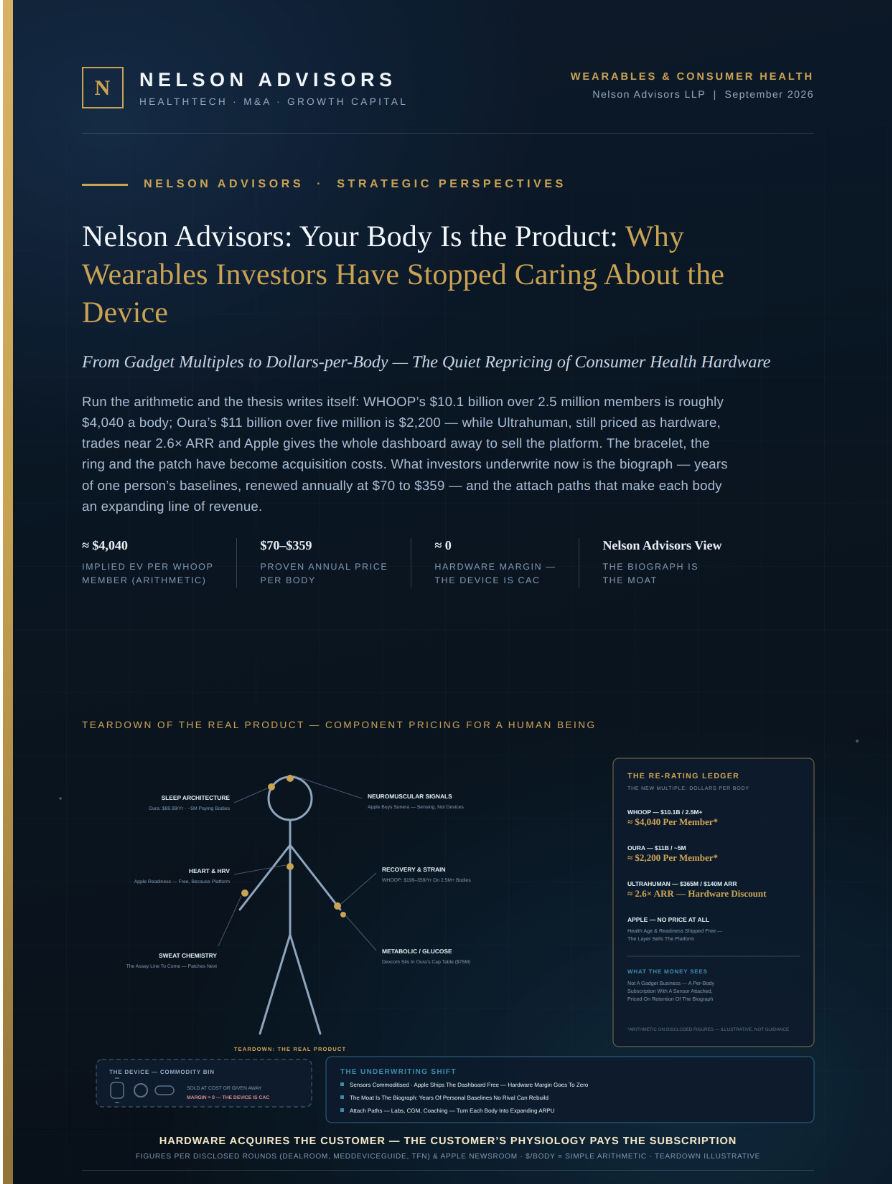
Oura (Finland) | Wearables | $11B | Transition from consumer device to holistic B2B preventative health platform. |
Sword Health (Portugal) | Digital MSK | $4B | "AI Care" model delivering high-margin alternatives to traditional physical therapy. |
CMR Surgical (UK) | Robotics | $3B+ | Sole viable European competitor to Da Vinci; scaling manufacturing for global markets. |
Flo Health (UK) | FemTech | $1B+ | Dominating the "menopause" and B2B employee benefits sector; $200M round from General Atlantic. |
Owkin (France) | AI/Bio | $1B+ | Utilising federated learning for GDPR-compliant pharmaceutical research. |
The emergence of these unicorns confirms that the IPO window is reopening for "data-rich" and de-risked assets. The massive $7.26 billion IPO of Medline in December 2025 has provided a much-needed benchmark for late-stage investors.However, earlier-stage companies remain constrained, and the 2026 exit landscape is defined by "selective recovery," where the primary engines of liquidity are strategic M&A and secondary PE buyouts.
Regional Hotspots and the Dynamics of Local Champions
The advisory landscape in 2026 remains fragmented by geography, with local champions playing a vital role in navigating specific reimbursement and regulatory environments.
DACH: The German Industrial Engine
The German market is characterised by a "deep technical" culture where M&A is often driven by manufacturing excellence and MDR compliance. ConAlliance is the undisputed leader here, leveraging its ties to family offices and specialized PE firms. German investors are particularly focused on "agentic AI" and RCM automation to combat severe labor shortages in the provider sector. The rise of Parloa, which tripled its valuation to $3 billion in early 2026, exemplifies the strength of the German AI-led HealthTech scene.
France: The Hub of Innovation and Sovereignty
France has become a central architect of European digital health, supported by progressive policies and a vibrant startup ecosystem. Clipperton and Cambon dominate the advisory landscape, facilitating landmark deals like Five Arrows' investment in Hublo. The French market is also a leader in "sovereign tech," with companies like Lifen and Owkin building infrastructure that aligns with the EHDS and GDPR requirements.
UK: The Strategic Hub for Transatlantic Capital
The UK continues to serve as the primary gateway for US capital entering Europe. Nelson Advisors and Arma Partners are the dominant forces here, with a heavy focus on HealthTech SaaS, AI, and robotics. The UK ecosystem is particularly strong in "TechBio", where Lloyd Price and Paul Hemings help bridge the gap between consumer digital health and clinical drug discovery.
The Convergence of Life Sciences and Technology: Dual-Advisory Models
As the traditional silos between "Healthcare" (providers, payers, pharma) and "Technology" (software, data, AI) collapse, 2026 has seen the rise of the "dual-advisory" model. This involves pairing a technical specialist (like Arma Partners or Clipperton) with a scientific specialist (like WG Partners or Kempen & Co) to provide a comprehensive evaluation of an asset's value.
Firms like Jefferies, led by Tommy Erdei, have become "Market Makers" in this convergence space. By hosting Europe's premier healthcare conferences, Jefferies facilitates the high-volume sponsor exits that characterise the mid-market.Similarly, Kempen & Co acts as a "Life Science Powerhouse" in the Benelux region, serving as the go-to bank for IPOs on Euronext Amsterdam and Brussels for biotech and diagnostics firms like Hansa Biopharma and Curevac.
For venture capital funds, the choice of advisor is increasingly segmented by asset class. Life science specialists like Sofinnova or Forbion typically prefer advisors with deep scientific and ECM capabilities (Jefferies, Goldman Sachs), while tech-focused generalists like Atomico or Index Ventures favor advisors who view healthcare through a "Digital Economy" lens (Arma Partners, GP Bullhound, Clipperton).
Strategic Implications and Future Outlook
The "Founder Banker" model has proven to be more than a niche trend; it is a necessary evolution for a sector where complexity is the primary risk factor. As European HealthTech and MedTech move into the second half of 2026, several strategic imperatives will define the landscape:
The Pre-eminence of "Industrial Proof": Growth without a clear path to profitability (EBITDA) is no longer a viable strategy for exits. The "Great Rationalisation" has firmly established capital efficiency as a primary determinant of value.
Compliance as a Competitive Moat: Proactive alignment with the EU AI Act, MDR, and EHDS is no longer a cost centre but a strategic advantage that supports premium valuation multiples.
The Consolidation of Point Solutions: The market will continue to favor "platform" assets that integrate disparate services into a unified layer, addressing the "vendor fatigue" of hospital CIOs.
The Pivot to Outpatient and Home Settings: Capital will continue to rotate toward technologies that decentralise care, as health systems seek to manage aging populations and chronic diseases outside of high-cost hospital environments.
In conclusion, the 2026 advisory market is defined by a shift from financial generalism to operational depth. The founder banker, exemplified by leaders at Nelson Advisors, Clipperton, and ConAlliance, has emerged as the essential conduit for value realisation in an increasingly complex and regulated world. Their "operational DNA" allows them to navigate the nuances of clinical utility and regulatory fortitude, ensuring that the European HealthTech and MedTech ecosystem continues its journey toward industrial maturity.
Nelson Advisors > European MedTech and HealthTech Investment Banking
Nelson Advisors specialise in Mergers and Acquisitions, Partnerships and Investments for Digital Health, HealthTech, Health IT, Consumer HealthTech, Healthcare Cybersecurity, Healthcare AI companies. www.nelsonadvisors.co.uk
Nelson Advisors regularly publish Thought Leadership articles covering market insights, trends, analysis & predictions @ https://www.healthcare.digital
Nelson Advisors publish Europe’s leading HealthTech and MedTech M&A Newsletter every week, subscribe today! https://lnkd.in/e5hTp_xb
Nelson Advisors pride ourselves on our DNA as ‘Founders advising Founders.’ We partner with entrepreneurs, boards and investors to maximise shareholder value and investment returns. www.nelsonadvisors.co.uk
#NelsonAdvisors #HealthTech #DigitalHealth #HealthIT #Cybersecurity #HealthcareAI #ConsumerHealthTech #Mergers #Acquisitions #Partnerships #Growth #Strategy #NHS #UK #Europe #USA #VentureCapital #PrivateEquity #Founders #SeriesA #SeriesB #Founders #SellSide #TechAssets #Fundraising #BuildBuyPartner #GoToMarket #PharmaTech #BioTech #Genomics #MedTech
Nelson Advisors LLP
Hale House, 76-78 Portland Place, Marylebone, London, W1B 1NT





Comments