Nelson Advisors Big Questions in HealthTech Series: Are GLP-1 drugs an existential threat or a Growth Catalyst for Digital Health?

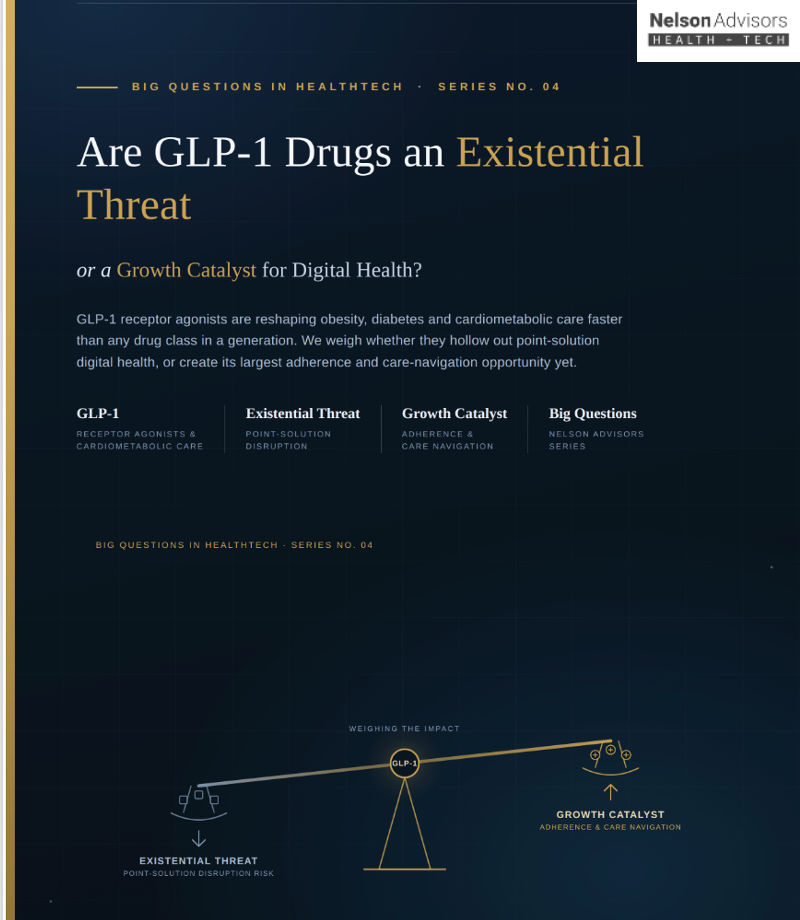
The GLP-1 Paradigm Shift: Existential Threat or Growth Catalyst for Digital Health
The rapid proliferation of glucagon-like peptide-1 (GLP-1) receptor agonists and multi-target incretin mimetics represents the most disruptive structural force in modern healthcare since the emergence of digital health itself. Originally developed for type 2 diabetes management, these pharmacological interventions, including semaglutide and dual GLP-1/GIP agonists like tirzepatide, have expanded into chronic weight management, cardiovascular risk reduction, and metabolic dysfunction.
With market projections estimating that the global GLP-1 sector will expand from $53.46 Billion in 2024 to over $150 Billion by 2030, the technology and digital health landscape faces a pivotal inflection point.
Whether GLP-1 drugs pose an existential threat or serve as a growth catalyst for digital health is not a binary proposition; rather, it depends on a digital health platform's core operating model, clinical integration, and strategic alignment with enterprise payers. For point-solution platforms reliant on legacy diet culture, calorie tracking, or unassisted behavioral modification, the scaling of GLP-1s has proven existential. Conversely, for digital health entities that provide enterprise wrap-around care, prescribing navigation, muscle preservation protocols, and structured medication off-ramping (de-prescribing), GLP-1s have ignited unprecedented capital inflows, strategic partnerships, and valuation expansion.
Macro Market Signals: Capital Concentration and Regulatory Re-Architecting
The financial architecture of digital health underscores this market bifurcation. Total venture capital funding reached $7.4 Billion across 244 deals in the first half of 2026, marking a distinct rebound driven by clinical AI and metabolic infrastructure. Rather than diluting investment in digital tools, the GLP-1 phenomenon has concentrated capital into specialised clinical platforms, making weight management and obesity the second-highest funded clinical indication behind mental health.
This capital influx is heavily weighted toward enterprise wrap-around platforms and clinical enablement networks. High-profile mega-deals ($100 Million or greater) accounted for 45% of total capital deployed, including major allocations to platforms like eMed ($200 Million), Nourish ($100 Million), and Midi ($100 Million). Simultaneously, public market liquidity signals have re-emerged, highlighted by wearable ring maker Oura’s S-1 filing at an $11 Billion valuation and Whoop’s $575 Million financing check.
The macroeconomic environment is further complexified by regulatory changes and drug shortage adjustments. While early direct-to-consumer (DTC) telehealth providers capitalised on compounding exemptions under the Federal Food, Drug, and Cosmetic Act during official drug shortages, the FDA's removal of tirzepatide in December 2024 and semaglutide in February 2025 from the Drug Shortage List closed the statutory window for commercial-scale GLP-1 compounding. Concurrently, federal price negotiations under the TrumpRx platform and the Medicare Bridge pilot lowered out-of-pocket costs to $245 per month (with $50 copay pathways for eligible Medicare beneficiaries). These pricing adjustments have shifted the competitive baseline from basic drug access toward long-term treatment adherence, lifestyle support, and cost containment for commercial employers.
Market Metric / Indicator | Baseline Realised Data | Current Market Projections | Strategic Market Implication |
Total Digital Health VC Funding | $6.4 Bn (H1 2025) | $7.4 Bn (H1 2026) | Capital rebound focused on high-conviction clinical indications. |
Top Clinical Indications by Capital | Mental Health (#1) | Mental Health (#1), Weight/Obesity (#2) | Weight management solidified as a core institutional asset class. |
Megadeal Capital Concentration | Distributed across sectors | 45% of capital in 20 megadeals | Winner-take-most dynamics favoring enterprise-integrated platforms. |
Projected Global GLP-1 Market Size | $53.46 Bn (2024) | $150B–$156.7 Bn (By 2030) | Massive total addressable market expanding into adjacent indications. |
Branded GLP-1 Cash Pricing (TrumpRx) | $1,000–$1,350 / month | $245 / month ($50 Medicare copay pilot) | Price reduction accelerates adoption while shifting margin to software care layers. |
Category Breakdown: Winners, Losers and Strategic Pivots
The scaling of high-efficacy weight loss therapeutics (~15–22% total body weight reduction in clinical trials) has fundamentally reordered digital health categories based on their ability to complement or substitute biological mechanisms.
Disrupted Categories: Legacy Unassisted Behavioural Care & Diet Culture Apps
Commercial models built strictly on points-based systems, manual calorie logging, and weekly weigh-ins have experienced severe customer attrition and revenue degradation as consumers substitute manual willpower with biological appetite suppression. This structural shift is reflected in legacy weight-loss brand disruptions, such as Jenny Craig liquidating its operations and WeightWatchers filing for Chapter 11 bankruptcy in 2025 after its traditional subscription model failed to retain members seeking pharmaceutical options.
To survive, legacy entities executed radical strategic pivots toward medicalisation. WeightWatchers acquired telehealth platform Sequence to launch prescription capabilities, subsequently entering strategic international partnerships (such as CheqUp in the UK) to market app interfaces engineered specifically for patients on GLP-1 injections. Similarly, Noom pivoted from psychological food-logging to a hybrid medical model by launching Noom Med for branded prescribing, introducing Noom GLP-1Rx with a "GLP-1 Companion," and offering a "Taper-Off Guarantee" to assist patients transitioning off therapy. Pure calorie tracking apps without medical infrastructure have seen citation and market share shift toward clinical platforms, forcing apps like MyFitnessPal and Lose It! to re-orient feature sets around macronutrient tracking optimised specifically for protein retention during rapid weight loss.
Winner Category: Enterprise Wrap-Around Care and Clinical Enablement Platforms
As commercial employers and health plans struggle with soaring pharmacy benefit costs—where fewer than half of large employers currently cover GLP-1s for non-diabetic obesity due to net budget impact—the digital health platforms capturing market share are those offering comprehensive care management, adherence tracking, and de-prescribing pathways.
Real-world evidence indicates that approximately 85% of non-diabetic patients discontinue GLP-1 therapy within two years, driven by gastrointestinal side effects, out-of-pocket costs, and therapeutic plateaus. Upon abrupt discontinuation without structured intervention, patients typically experience a rebound in ghrelin signaling, a decrease in resting metabolic rate, and a rapid recovery of two-thirds of lost weight. This persistence gap has positioned specialised digital health providers as essential operational partners for pharmacy benefit managers (PBMs) and enterprise buyers.
Platforms such as Omada Health have evolved from traditional diabetes prevention programs into multi-condition metabolic control centers. Omada’s Enhanced GLP-1 Care Track integrates medical prescribing protocols with behavioural coaching, continuous glucose monitoring (CGM) assets and musculoskeletal (MSK) programming aimed at preventing lean muscle loss. By establishing distribution relationships across all three major PBMs, including Optum Rx’s Weight Engage portfolio and Eli Lilly’s Employer Connect, Omada gains direct access to over 80% of U.S. prescription claims. Real-world clinical data from Omada's GLP-1 Care Track demonstrates a 67% medication persistence rate at 12 months (compared to a 47–49% real-world baseline) and an average weight regain of just 0.8% at 12 months post-titration, compared to an 11–12% regain typical in standard clinical trials.
Concurrently, Virta Health has established a distinct clinical model centered on medical deprescribing—the deliberate, clinically supervised tapering or discontinuation of GLP-1 therapies. Virta utilizes Carbohydrate-Restricted Nutrition Therapy (CRNT) and continuous biometric monitoring to transition patients off expensive weight-loss medications without triggering weight regain or glycemic spikes. Published peer-reviewed research on Virta’s protocol evaluated patients who discontinued GLP-1 receptor agonists while maintaining nutritional ketosis.
Over 70% of participants maintained a total body weight loss of 5% at 12 months post-discontinuation, achieving glycemic metrics comparable to patients remaining on active drug therapy. By commercialising a Proactive Deprescribing Program and offering enterprise performance guarantees, Virta aligns its fee structure with pharmacy savings for payers, directly monetising the off-ramping process.
Winner Category: Biometric Hardware and Continuous Monitoring Infrastructure
The widespread adoption of GLP-1s has altered the functional role of wearable technology and remote patient monitoring (RPM) hardware. Historically utilised for consumer step-counting and recreational calorie estimation, advanced wearables are now integrated into clinical weight management protocols to monitor muscle loss, autonomic nervous system modulation, and metabolic status.
A primary clinical concern associated with rapid GLP-1-induced weight loss is sarcopenia, the involuntary loss of lean muscle mass, which can account for up to 25–40% of total weight reduced if unmanaged. This physiological reality has expanded the addressable market for continuous biometric hardware. Continuous Glucose Monitors (CGMs) integrated by platforms like Signos, Omada and Virta provide real-world glucose and ketone telemetry to deliver instant feedback on metabolic flexibility and nutritional status. Monitoring nutritional ketosis via blood or sensor-derived biomarkers provides actionable data during GLP-1 tapering phases.
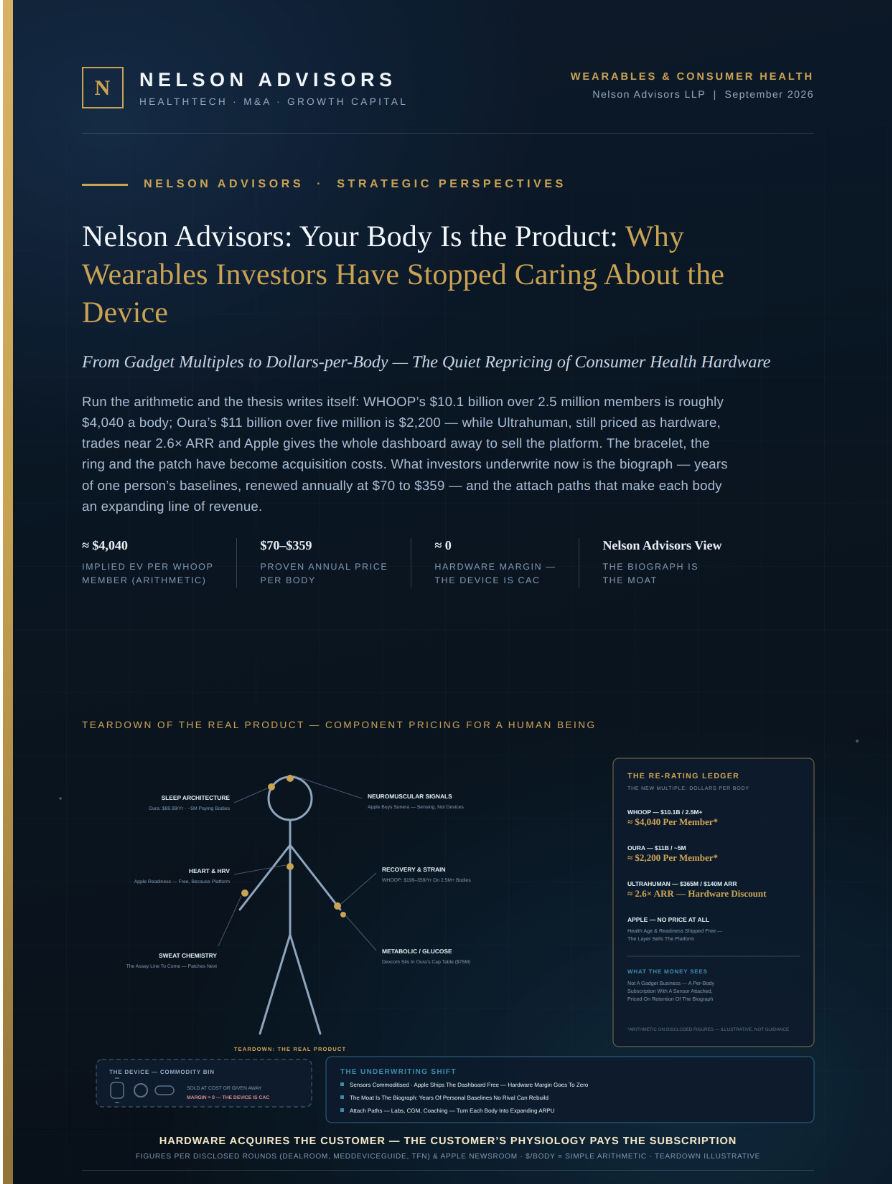
Simultaneously, smart rings and high-fidelity wearables from makers like Oura and Whoop leverage multi-sensor suites to track heart rate variability, resting heart rate, sleep staging, and physiological adaptation during dose escalation. Oura’s progression toward an $11 Billion public market valuation and Whoop’s $575 Million funding round highlight investor confidence in hardware serving as a continuous diagnostic layer for drug therapy. Furthermore, digital physical therapy platforms integrate connected motion-tracking equipment and guided resistance training to ensure that weight loss reflects fat mass reduction rather than muscle atrophy.
Category | Primary Strategic Focus | Representative Players | Impact of Scaling GLP-1s | Enterprise Value Driver |
Standalone Diet / Calorie Tracking | Manual logging, calorie deficits, points algorithms | WeightWatchers (Pre-pivot), Jenny Craig, MyFitnessPal | Disrupted: High churn, loss of core subscription value proposition. | Forced pivot toward telehealth or nutrition sub-tracking for muscle defense. |
Direct-to-Consumer Telehealth | Fast prescribing, cash-pay drug access, direct delivery | Ro, PlushCare, Form Health, 9amHealth | Pivoting: Early volume surge, now constrained by shortage end. | Shift from cash-pay compounded drugs to branded employer/PBM integration. |
Enterprise Wrap-Around Care | Adherence, side-effect triage, MSK support, lifestyle integration | Omada Health, Nourish, eMed | Growth Catalyst: High capital inflows, institutional adoption. | Extended medication persistence, lower total cost of care, PBM distribution. |
Metabolic Reversal & Deprescribing | Supervised tapering, CRNT, nutritional ketosis, drug avoidance | Virta Health | Growth Catalyst: Differentiated value proposition addressing employer costs. | Shared-savings models based on pharmacy cost reduction and weight maintenance. |
Biometric Wearables & Hardware | Lean muscle monitoring, sleep tracking, metabolic biomarkers | Oura, Whoop, Dexcom, Signos | Growth Catalyst: Transition from fitness gadgets to clinical tracking tools. | Tracking body composition shifts, nutritional status, and cardiovascular health. |
Deeper Second and Third-Order Insights: Structural Re-Architecting of Digital Health
Beyond immediate category winners and losers, the scaling of GLP-1s generates profound second and third order ripple effects that re-architect healthcare delivery, enterprise SaaS pricing, and competitive moats.
The Persistence Moat and Total Cost of Care Optimisation
The primary financial risk for enterprise buyers covering GLP-1s is the "sunk cost" of incomplete therapy. When a member discontinues medication at six months due to unmanaged nausea or cost constraints, the employer incurs significant pharmaceutical expense without achieving sustained long-term health improvements or downstream cost avoidance.
As a result, digital health platforms are no longer evaluated on software user engagement or app downloads, but on medication persistence and long-term weight maintenance metrics. Software platforms that increase 12-month persistence rates from ~48% to 67% significantly improve the return on investment (ROI) of the underlying pharmaceutical expenditure, creating a powerful "persistence moat" for platforms embedded in enterprise benefit stacks.
Commoditisation of Prescribing versus Defensibility of Workflow Integration
As oral small-molecule GLP-1 formulations enter the market and drug pricing falls via federal interventions, pure prescribing platforms face rapid margin compression. Simply offering a virtual doctor's visit to write a prescription is a commoditised service with diminishing pricing power.
The defensible moat in digital health has shifted decisively toward embedding deep within backend enterprise workflows and benefit channels. Digital health platforms that integrate directly into PBM infrastructures (such as Optum Rx Weight Engage), deploy forward-deployed engineers into health system architectures, or manage multi-condition workflows (combining diabetes, hypertension and MSK) possess structural moats that isolated direct-to-consumer prescribers cannot replicate.
AI-Driven Personalisation at the Metabolic Layer
The sheer volume of longitudinal data generated by GLP-1 companion programs spanning drug dosage, side effect logs, continuous glucose trends, meal composition, and muscle mass readings, creates a rich training dataset for clinical AI engines. Platforms like Omada leverage tens of millions of care interactions to power proprietary behavioural engines (e.g., OmadaSpark), which predict patient drop-off risks, dynamically adjust nutrition guidance and signal clinicians when a patient is a candidate for dose tapering or maintenance transition. This integration of real-world metabolic data transforms software from a static monitoring tool into an active clinical co-pilot.
Conclusions and Strategic Imperatives
The scaling of GLP-1 drugs is neither a uniform existential threat nor an unqualified growth catalyst; it is a powerful catalyst for integrated clinical care platforms and an existential threat for disconnected consumer diet apps. The digital health industry has moved past the initial rush of basic drug prescribing into an era defined by longitudinal care management, muscle defence and pharmacy cost containment.
For digital health founders and executive teams, survival requires abandoning standalone unassisted behavioural models and pivoting toward specialised clinical companion programs that directly address protein target fulfilment, side-effect management, and resistance training. Furthermore, developing structured off-ramping protocols, such as carbohydrate-restricted nutrition therapy or gradual dosage tapering, will be critical to addressing employer demands for sustainable weight loss without permanent drug dependency. Establishing distribution relationships across PBM channels and employer defined-contribution models remains paramount to securing long-term enterprise volume.
For enterprise payors and strategic investors, capital allocation should prioritize multi-condition platforms that manage metabolic health holistically across diabetes, hypertension, and MSK indications. Enterprise buyers should demand at-risk performance guarantees that tie vendor fees directly to medication persistence, weight maintenance and verified de-prescribing outcomes. Finally, integrating continuous biometric hardware and remote patient monitoring into weight management benefit designs ensures that pharmacological weight loss translates to genuine, long-term health improvements and structural cost savings.
Nelson Advisors > European HealthTech, MedTech, Digital Health Investment Banking
Nelson Advisors specialise in Mergers and Acquisitions, Partnerships and Investments for Digital Health, HealthTech, MedTech, Health IT, Consumer HealthTech, Healthcare Cybersecurity, Healthcare AI companies. www.nelsonadvisors.co.uk
Nelson Advisors regularly publish Thought Leadership articles covering market insights, industry trends, deal commentary, market analysis & predictions @ https://www.healthcare.digital
Nelson Advisors publish Europe's Leading Healthcare Technology Investment Banking Newsletter every week, join 5000+ HealthTech and MedTech subscribers today! https://lnkd.in/e5hTp_xb
Nelson Advisors pride ourselves on our DNA as ‘Founders advising Founders.’ We partner with entrepreneurs, boards, corporates, venture capital and private investors to maximise shareholder value and investment returns www.nelsonadvisors.co.uk
#NelsonAdvisors #HealthTech#MedTech#DigitalHealth #HealthIT #Cybersecurity #HealthcareAI #FemTech#ConsumerHealth #Mergers #Acquisitions #Partnerships #Growth #Strategy #NHS #UK #Europe #USA#Canada#Commonwealth#CorporateDivestitures #VentureCapital #PrivateEquity #Founders #SeriesA #SeriesB #Founders #SellSide #TechAssets #Fundraising #BuildBuyPartner #GoToMarket #PharmaTech #BioTech #Genomics
Nelson Advisors LLP
Hale House, 76-78 Portland Place, Marylebone, London, W1B 1NT
Meet Nelson Advisors @ 2026 Events
Digital Health Rewired > March 2026 > Birmingham, UK
NHS ConfedExpo > June 2026 > Manchester, UK
HLTH Europe > June 2026, Amsterdam, Netherlands
HIMSS AI in Healthcare > July 2026, New York, USA
Bits & Pretzels > September 2026, Munich, Germany
World Health Summit 2026 > October 2026, Berlin, Germany
HealthInvestor Healthcare Summit > October 2026, London, UK
HLTH USA 2026 > October 2026, USA
Barclays Health Elevate > October 2026, London, UK
Web Summit 2026 > November 2026, Lisbon, Portugal
MEDICA 2026 > November 2026, Düsseldorf, Germany
Venture Capital World Summit > December 2026 Toronto, Canada




Comments