Nelson Advisors Big Questions in HealthTech Series: Is Longevity and Healthy Ageing the next Trillion dollar HealthTech category, or overhyped Consumer Wellness?


The Longevity and Healthy Ageing Market: Macroeconomic Trajectory, Deep Biotech Reality and Consumer HealthTech Valuations
The global longevity and healthy ageing sector sits at an unprecedented inflection point between fundamental biological innovation and consumer health commercialisation. Driven by demographic shifts that will see the population aged 80 and older reach 265 million by the mid-2030s, alongside a widening healthspan-lifespan gap currently estimated at ten years in developed markets, the sector has attracted intense institutional, corporate and private equity interest.
Whether longevity represents the next multi trillion dollar HealthTech category or an overhyped consumer wellness bubble depends entirely on the sub-category under evaluation. The market has bifurcated into two distinct vectors operating on fundamentally different capital cycles, regulatory pathways, and valuation multiples:
Geroscience and Deep Biotech: High-risk, long-horizon therapeutics seeking to target the fundamental hallmarks of biological aging, such as cellular senescence, epigenetic drift, and metabolic dysfunction.
Consumer HealthTech and Preventive Diagnostics: High-margin, rapid-ARR platforms that commercialize biomarker tracking, full-body imaging, and proactive risk profiling directly to consumers and self-insured employers.
While broader market projections estimate the global wellness and longevity landscape to exceed $8.5 trillion by 2027and pure-play anti-aging therapies to scale beyond $300 Billion by 2030, institutional capital deployment reveals a more nuanced, highly concentrated, and milestone-gated reality.
Macro Capital Deployment and Venture Dynamics (2024–2026)
Capital flows into the longevity sector between 2024 and mid-2026 demonstrate a definitive transition from early-stage, broad-basket speculation to execution-phase capital concentration. Following a broader venture rebound in 2024, where global geroscience and longevity investments doubled to approximately $8.5 Billion across roughly 325 deals, pure play venture capital deployment matured into a small number of winners market.
Headline funding surges in 2025, where total capital in pure-play longevity reached $1.92 Billion, were driven by mega-platform financings rather than widespread portfolio expansion. Retro Biosciences’ $1 Billion Series A accounted for over 52% of all capital deployed in pure-play longevity in 2025. Excluding rounds greater than $50 Million, underlying capital allocation actually contracted from $328 million in 2024 to $196 million in 2025.
Metric | 2024 | 2025 | 2026 YTD (thru July 2026) | Strategic Context |
Global Financing (Broad Geroscience) | ~$8.5B | N/A | N/A | Rebound from 2023 correction (~$3.8B). |
Pure-Play Longevity Capital | ~$837M | ~$1.92B | ~$689M | Headline surge in 2025 distorted by mega-rounds. |
Longevity Biotech Sub-segment | $665M | $1.45B | $662M | Down ~50% YTD 2026 vs comparable early-2025 period ($1.35B). |
Pure-Play Deal Count | 23 deals | 21 deals | 7 deals | Steady contraction in deal volume; flight to quality. |
Average Round Size (Pure-Play) | ~$36M | ~$92M | ~$110M | Pulled upward by outlier platforms (Retro, Function). |
Median Round Size (Pure-Play) | ~$17M | ~$20M | ~$50M | Reflects modest growth for typical, non-mega startups. |
Top 3 Deals Capital Share | 47% | 74% | 93% (Biotech) | Extreme capital concentration in perceived platform winners. |
First Financings Share of Capital | 13% | 4% | ~5% | Follow-on financings capture >95% of institutional dollars. |
This structural concentration of capital reveals three fundamental shifts in institutional underwriting behaviour across the healthspan landscape:
The lengthening time between successive funding rounds represents a primary operational bottleneck. Median Seed-to-Series A timelines in healthcare and biotech surpassed 750 days (~2.1 years) by late 2024.
This environment mandates that startups reach verifiable clinical milestones, secure Phase 2 human data, or establish big-pharma business development partnerships before accessing follow-on growth capital.
Concurrently, early-stage allocations have shifted away from single-molecule discovery bets toward multi-modal data platforms. Discovery platforms attracted over $2.6 billion in 2024 alone, as institutional allocators prioritised proprietary data systems capable of generating continuous drug leads over binary single-asset risks.
Geographically, North America continues to control the financing landscape for longevity biotech, capturing 95% of capital in 2024, 89% in 2025, and 97% YTD in 2026. European and Asia-Pacific ecosystems continue to produce foundational scientific research, but struggle to replicate the late-stage capital availability present in the North American market.
Deep Biotech and Geroscience: Modality Evolution and Clinical Realities
Longevity therapeutics developers represent the primary capital spine of the market, capturing 57% of total category investment in 2024, 71% in 2025, and over 91% YTD in 2026. However, the scientific pathways being financed have shifted dramatically over this timeframe.
Therapeutic Modality | Market Share / Capital Velocity | Dominant Players | Key Mechanisms & Clinical Status |
Epigenetic Reprogramming | Jumped from 2% of biotech capital in 2024 to 78% YTD 2026. | Altos Labs, NewLimit, Life Biosciences, Retro Biosciences. | Expression of Yamanaka factors ($Oct4, Sox2, Klf4$) to reset cellular age; first cellular reprogramming IND cleared by FDA in Jan 2026. |
Senolytics & Senomorphics | Held 36.52% of market revenue in 2025; projected 8.18% overall CAGR. | Unity Biotechnology, Calico, Rapalogix Health. | Targeted clearance of senescent cells or attenuation of the Senescence-Associated Secretory Phenotype (SASP). |
Gene Therapies & Viral Vectors | Projected 11.63% CAGR (2026–2031). | Rejuvenate Bio, Cyclarity Therapeutics. | AAV vector refinements enabling repeat-dosing protocols for chronic degenerative conditions. |
Metabolic Modulators & Geroprotectors | High historical volume; transitioning to strict clinical trials. | Academic Consortiums (AFAR), MetroBiotech. | Targeting nutrient-sensing networks, AMPK activation, mTOR inhibition, and mitochondrial function. |
Epigenetic Reprogramming as the Primary Vector
Epigenetic reprogramming has rapidly consolidated venture capital within deep longevity biotech. By utilising controlled, partial cellular reprogramming via regulated expression of specific transcription factors, these platforms aim to reverse biological age and restore tissue resilience without inducing full pluripotency or teratoma risk. The landmark FDA clearance of the first cellular reprogramming therapeutic drug for human testing in January 2026 marked a pivotal transition from preclinical animal models to regulated human clinical translation.
Senolytics and the Senomorphic Pivot
While first-generation senolytic small molecules established early commercial validation, accounting for over 36% of longevity therapeutic revenue in 2025, clinical translation has encountered difficulties regarding off-target toxicity and tissue-specific clearance efficacy. Consequently, institutional capital is shifting toward senomorphic compounds that suppress SASP secretion without forcing cell death, alongside targeted antibody-drug conjugates (ADCs) designed for selective senescent-cell clearance.
The Regulatory Bottleneck and the TAME Precedent
The primary structural barrier facing geroscience is the regulatory reality that the FDA does not recognise aging itself as a disease indication. As a result, biotech developers must adopt a disease-first regulatory strategy—targeting established clinical endpoints such as Idiopathic Pulmonary Fibrosis (IPF), Metabolic Dysfunction-Associated Steatohepatitis (MASH), or Osteoarthritis—while designing molecules that act on underlying aging hallmarks.
The landmark Targeting Aging with Metformin (TAME) trial, led by the American Federation for Aging Research (AFAR) and Dr. Nir Barzilai, was designed to address this regulatory precedent. By evaluating 3,000 non-diabetic individuals aged 65–79 across 14 research sites over a six-year period to test whether metformin delays the composite onset of multi-morbidities (cardiovascular disease, cancer, and cognitive decline), TAME seeks to establish an FDA-accepted proof-of-concept that targeting aging biology can treat multiple chronic diseases simultaneously.
However, clinical trial readouts from 2025 and 2026 underscore the complexity of repurposing established metabolic drugs in non-diabetic populations:
The MET-PREVENT trial, published in The Lancet Healthy Longevity, evaluated a 4-month metformin protocol in older adults with sarcopenia and frailty. The study demonstrated no statistically significant improvement in walking speed or physical performance, while showing worse GI tolerability, indicating that metformin cannot be used as a standalone treatment for muscle frailty.
Similarly, the 21-year Diabetes Prevention Program Outcomes Study (DPPOS) follow-up published in JAMA in June 2026 tracked 1,173 adults with prediabetes. While intensive lifestyle intervention significantly reduced long-term multi-morbidity risk, metformin showed no statistically significant difference compared to placebo for that specific multi-morbidity endpoint. These results emphasise that repurposing generic metabolic agents may yield limited benefits in healthy cohorts, reinforcing the necessity of advanced platforms like epigenetic reprogramming and targeted senomorphics.
Veterinary Longevity: The Regulatory Playbook for Lifespan Extension
Because human lifespan trials require decades and immense financial resources, companion animal longevity has emerged as both a lucrative commercial category and a regulatory testing ground for human applications.
Biotech startup Loyal (Cellular Longevity, Inc.) has built a regulatory advantage through the FDA Center for Veterinary Medicine’s (CVM) Expanded Conditional Approval (XCA) pathway. By securing formal acceptance for both the Reasonable Expectation of Effectiveness (RXE) and Target Animal Safety (TAS) technical packages for its lead program, LOY-002, Loyal has cleared two of the three technical hurdles required for commercial launch, leaving manufacturing validation as the final requirement.
Pet Longevity Startup | Primary Program | Modality / Target | Scientific & Regulatory Status | Capital Raised |
Loyal (Cellular Longevity) | LOY-002 (Senior Dogs) LOY-001/003 (Large Breeds) | Metabolic dysfunction reversal; IGF-1 axis modulation. | FDA RXE & TAS sections accepted for LOY-002 under XCA pathway; 1,300-dog STAY pivotal trial fully enrolled across 70 clinics. | $250M+ ($100M Series C in early 2026 led by age1). |
Rejuvenate Bio | Canine Gene Therapy | AAV gene therapy for age-related cardiac disease & metabolic failure. | Demonstrated preclinical proof-of-concept and durable biological activity in small canine cohorts; corporate partnerships with Merck Animal Health and Phibro. | Venture & strategic corporate backing. |
Animal Bioscience | Leap Years | NAD+ precursor combined with a senolytic agent. | Commercialized as a supplement; completed a randomized, double-blind trial demonstrating cognitive improvement in senior dogs over 3 months. | Privately funded / Commercial cash flows. |
The veterinary longevity playbook provides critical strategic insights for human geroscience translation. Proving that regulatory agencies will accept biological age biomarkers and functional gains as interim endpoints prior to final survival data validates surrogate pathways for human drug development. Furthermore, enrolling 1,300 senior dogs across 70 independent veterinary clinics in Loyal's STAY trial establishes an operational model for executing large-scale, decentralised longitudinal aging studies.
Consumer HealthTech and Preventive Diagnostics: Valuations and Economics
While deep biotech operates on long regulatory timelines, Consumer Longevity HealthTech has unlocked commercial traction. Driven by consumer demand for proactive care, where 84% of U.S. consumers prioritise wellness in purchasing decisions, platforms providing blood biomarker profiling, full-body imaging, and continuous health tracking have scaled rapidly.
Companies operating in the consumer diagnostic space command technology platform multiples rather than standard clinical laboratory valuation metrics.
Company | Latest Valuation | Total Capital Raised | Scale & Operational Metrics | Business Model & Core Offering |
Function Health | $2.5B (Series B, Nov 2025) | >$800M ($350M Equity + $450M GC CVF growth capital) | 500,000+ members; >100 million lab tests completed; $100M+ ARR run rate. | $365/year membership covering 160+ longitudinal biomarkers, integrated Ezra full-body MRI/CT, and AI Medical Intelligence Lab. |
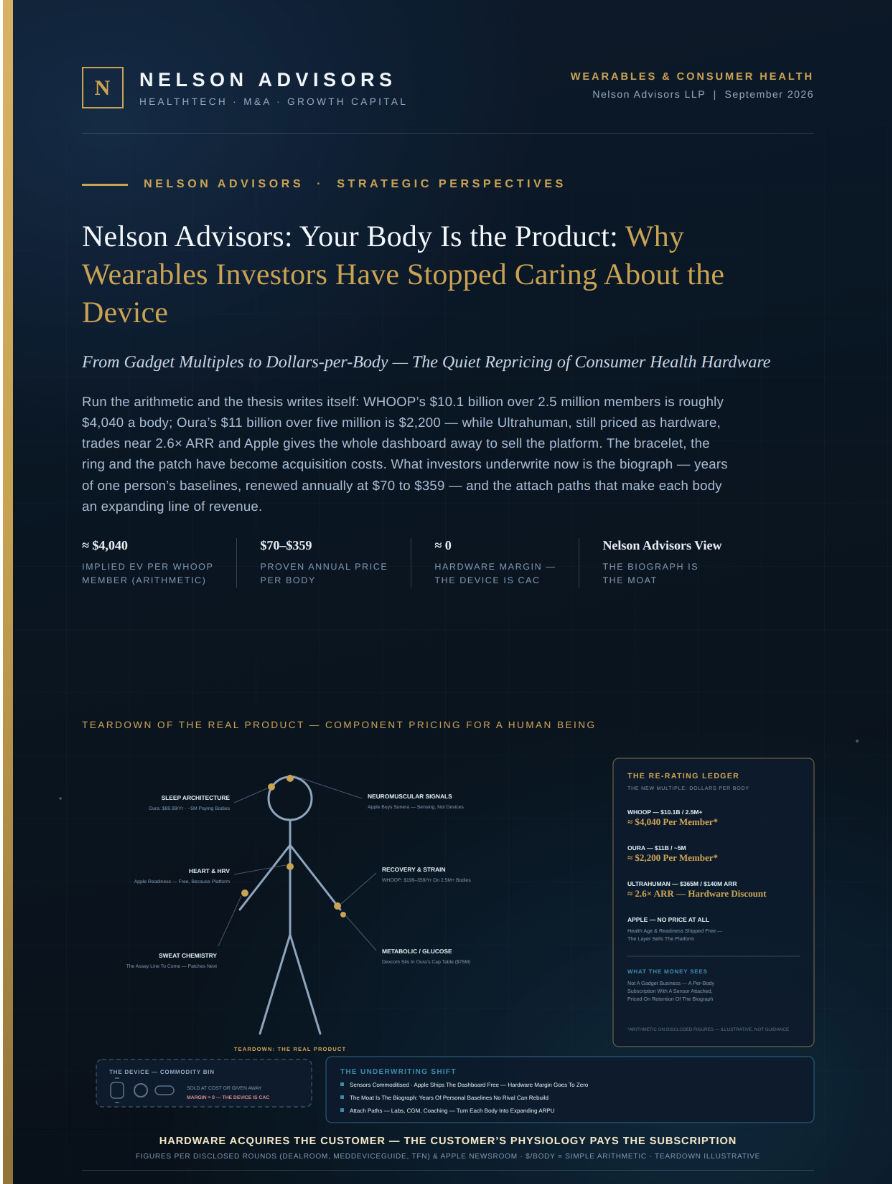
Oura | $11B (Series E, Oct 2025) | ~$1.5B | >5.5 million smart rings sold; approaching $1B in annual revenue with expanding profitability. | Wearable hardware + recurring subscription software layer for continuous physiological monitoring. |
Neko Health | $1.8B (Series B, Jan 2025) | ~$300M | Rapid expansion of physical preventative scanning centers across Europe and North America. | Consumer preventive healthcare featuring full-body 3D optical scanning, cardiovascular checks, and targeted diagnostics. |
The Data Flywheel and the 23andMe Trap
The valuation premium assigned to platforms like Function Health, valued at 15x to 23x membership revenue, rests on the premise that they are building proprietary, longitudinal biomarker engines rather than acting as lab resellers. By tracking 160+ biomarkers twice annually across hundreds of thousands of members, these platforms aggregate multi-modal datasets combining blood chemistry, imaging, genomic profiles, and wearable inputs. These aggregated assets hold value for health systems, biopharma R&D, and predictive AI model development.
However, this business model faces structural challenges when scaling beyond early adopters:
Selling consumer longevity diagnostics into self-insured employer wellness plans encounters an economic disconnect. The median private-sector employee tenure in the United States is 3.5 years. A self-insured employer funding a $365 annual diagnostic membership bears the upfront operational cost, but any long-term cost avoidance from mitigating a cardiovascular or oncological event 15 years later accrues to a future insurer. Consequently, corporate adoption remains largely restricted to high-end employee wellness perks rather than risk-bearing clinical management.
Simultaneously, consumer diagnostic brands rely on direct-to-consumer trust centered on individual data ownership. Transitioning to monetising de-identified member data via biopharma research partnerships requires careful bioethical management to prevent churn and loss of consumer confidence.
Regulatory Interventions in Consumer Longevity
The consumer longevity industry also faces regulatory scrutiny regarding un targeted direct-to-consumer supplements and unvalidated longevity products.
A prime illustration is the regulatory enforcement surrounding Nicotinamide Mononucleotide (NMN), an NAD+ precursor supplement. The FDA determined that NMN could not be lawfully sold as a dietary supplement because Metro International Biotech had previously initiated an Investigational New Drug (IND) application for its proprietary NMN formulation, MIB-626. Under the Federal Food, Drug, and Cosmetic Act's drug preclusion clause, an ingredient actively investigated as a drug cannot be commercialised as a dietary supplement unless prior market presence is established. The supplement industry challenged this enforcement, highlighting how regulatory shifts can alter consumer wellness landscapes.
Market Divergence: Trillion-Dollar HealthTech Category vs. Overhyped Consumer Wellness
Evaluating whether longevity and healthy ageing constitutes a trillion-dollar HealthTech category or an overhyped consumer wellness trend requires separating commercial timelines from scientific capabilities.
Metric / Dimension | Consumer Preventive HealthTech Layer | Deep Geroscience Biotech Layer |
Primary Offerings | Biomarker panels, full-body MRIs, continuous wearables, supplements. | Epigenetic reprogramming, senolytics, AAV gene therapies, small molecules. |
Monetisation Model | D2C annual subscriptions, cash-pay health clinics, enterprise wellness perks. | Prescription specialty therapeutics, FDA-approved disease treatments. |
Valuation Drivers | Rapid ARR expansion, low customer acquisition cost, data flywheel scale. | Milestone-gated clinical trials, Phase 2 readouts, big-pharma M&A. |
Primary Failure Risks | Subscriber churn, cash-pay saturation, employer ROI misalignment. | High clinical trial failure rates, off-target toxicity, regulatory barriers. |
Addressable Market Potential | Premium consumer wellness segment ($100B+ TAM across developed markets). | Systemic disease prevention replacing acute care ($1T+ systemic value). |
The Overhyped Consumer Wellness Risks
Short-term market risk is concentrated in consumer offerings that market cellular rejuvenation without robust clinical trial evidence. Direct-to-consumer diagnostic platforms, longevity clinics, and boutique supplement regimens face structural headwinds:
Out-of-pocket cash-pay diagnostic subscriptions ($365–$499/year for services like Function Health, up to $40,000/year for ultra-premium tiers like Equinox Optimise) primarily penetrate affluent, health-conscious demographics. Scaling beyond these cohorts requires third-party payer reimbursement, which demands proof of clinical efficacy and health system cost reduction.
Furthermore, public skepticism toward unverified anti-aging claims, combined with clinical trial failures in repurposed compounds, risks creating a negative perception that could affect consumer trust across the sector.
The Trillion-Dollar HealthTech Fundamentals
Conversely, the long-term economic foundation for geroscience rests on the magnitude of potential healthcare savings. Economic modelling of the "Longevity Dividend", developed by economist Andrew Scott, demonstrates that targeting biological aging to compress late-life morbidity generates significantly more value than treating individual diseases sequentially.
While curing a single disease like cancer eliminates one cause of mortality, individuals remain vulnerable to Alzheimer's, stroke, and cardiovascular conditions. In contrast, extending healthy lifespan by just one year yields an estimated global economic value of $38 trillion by delaying the onset of systemic multi-morbidity.
If cellular reprogramming platforms, senolytics, or metabolic modulators secure regulatory approval for disease indications while delaying underlying biological aging, the category will capture enterprise value across pharmaceutical, diagnostic, and preventative healthcare markets.
Macro Outlook and Strategic Recommendations
The longevity and healthy ageing market is neither purely an overhyped wellness fad nor an immediately realisable trillion-dollar category. Instead, it represents an evolving healthcare infrastructure undergoing a transition from speculative consumer experimentation to institutional, platform-based execution.
For institutional venture capital, private equity allocators and biopharma strategists, navigating this sector requires category-specific execution strategies:
Institutional allocators should prioritise platform-level longevity biotech companies that control proprietary discovery flywheels, maintain cash runways exceeding 24 months, and possess the resources required to advance cellular reprogramming candidates through FDA clinical channels. Broad-basket seed investments in single-molecule startups face headwinds due to extended 750+ day Series A funding cycles.
When evaluating consumer diagnostic platforms, underwrite valuations based on long-term data monetisability, longitudinal retention, and AI integration rather than simple lab reseller margins. Sustainable enterprise value will accrue to platforms that successfully convert consumer diagnostic datasets into strategic R&D infrastructure for biopharma partners.
Developments in companion animal health, notably Loyal’s LOY-002 progress under the FDA CVM Expanded Conditional Approval pathway, should be monitored as leading indicators for human regulatory frameworks. The acceptance of functional biological age biomarkers in canine models provides a framework for structuring surrogate endpoints in human geroscience trials.
Finally, therapeutic investments must maintain a dual-thesis architecture: a primary clinical indication targeting an established disease endpoint (such as IPF, MASH, or sarcopenia) alongside a secondary, platform-level mechanism addressing fundamental hallmarks of biological aging. This dual approach mitigates clinical trial risk through standard pharmaceutical commercialisation pathways while maintaining strategic exposure to human healthspan extension.
Nelson Advisors > European HealthTech, MedTech, Digital Health Investment Banking
Nelson Advisors specialise in Mergers and Acquisitions, Partnerships and Investments for Digital Health, HealthTech, MedTech, Health IT, Consumer HealthTech, Healthcare Cybersecurity, Healthcare AI companies. www.nelsonadvisors.co.uk
Nelson Advisors regularly publish Thought Leadership articles covering market insights, industry trends, deal commentary, market analysis & predictions @ https://www.healthcare.digital
Nelson Advisors publish Europe's Leading Healthcare Technology Investment Banking Newsletter every week, join 5000+ HealthTech and MedTech subscribers today! https://lnkd.in/e5hTp_xb
Nelson Advisors pride ourselves on our DNA as ‘Founders advising Founders.’ We partner with entrepreneurs, boards, corporates, venture capital and private investors to maximise shareholder value and investment returns www.nelsonadvisors.co.uk
#NelsonAdvisors #HealthTech#MedTech#DigitalHealth #HealthIT #Cybersecurity #HealthcareAI #FemTech#ConsumerHealth #Mergers #Acquisitions #Partnerships #Growth #Strategy #NHS #UK #Europe #USA#Canada#Commonwealth#CorporateDivestitures #VentureCapital #PrivateEquity #Founders #SeriesA #SeriesB #Founders #SellSide #TechAssets #Fundraising #BuildBuyPartner #GoToMarket #PharmaTech #BioTech #Genomics
Nelson Advisors LLP
Hale House, 76-78 Portland Place, Marylebone, London, W1B 1NT
Meet Nelson Advisors @ 2026 Events
Digital Health Rewired > March 2026 > Birmingham, UK
NHS ConfedExpo > June 2026 > Manchester, UK
HLTH Europe > June 2026, Amsterdam, Netherlands
HIMSS AI in Healthcare > July 2026, New York, USA
Bits & Pretzels > September 2026, Munich, Germany
World Health Summit 2026 > October 2026, Berlin, Germany
HealthInvestor Healthcare Summit > October 2026, London, UK
HLTH USA 2026 > October 2026, USA
Barclays Health Elevate > October 2026, London, UK
Web Summit 2026 > November 2026, Lisbon, Portugal
MEDICA 2026 > November 2026, Düsseldorf, Germany
Venture Capital World Summit > December 2026 Toronto, Canada




Comments