Nelson Advisors: Strategic Consolidation in CareTech - Analysis of Lottie’s Acquisition of CareMaster

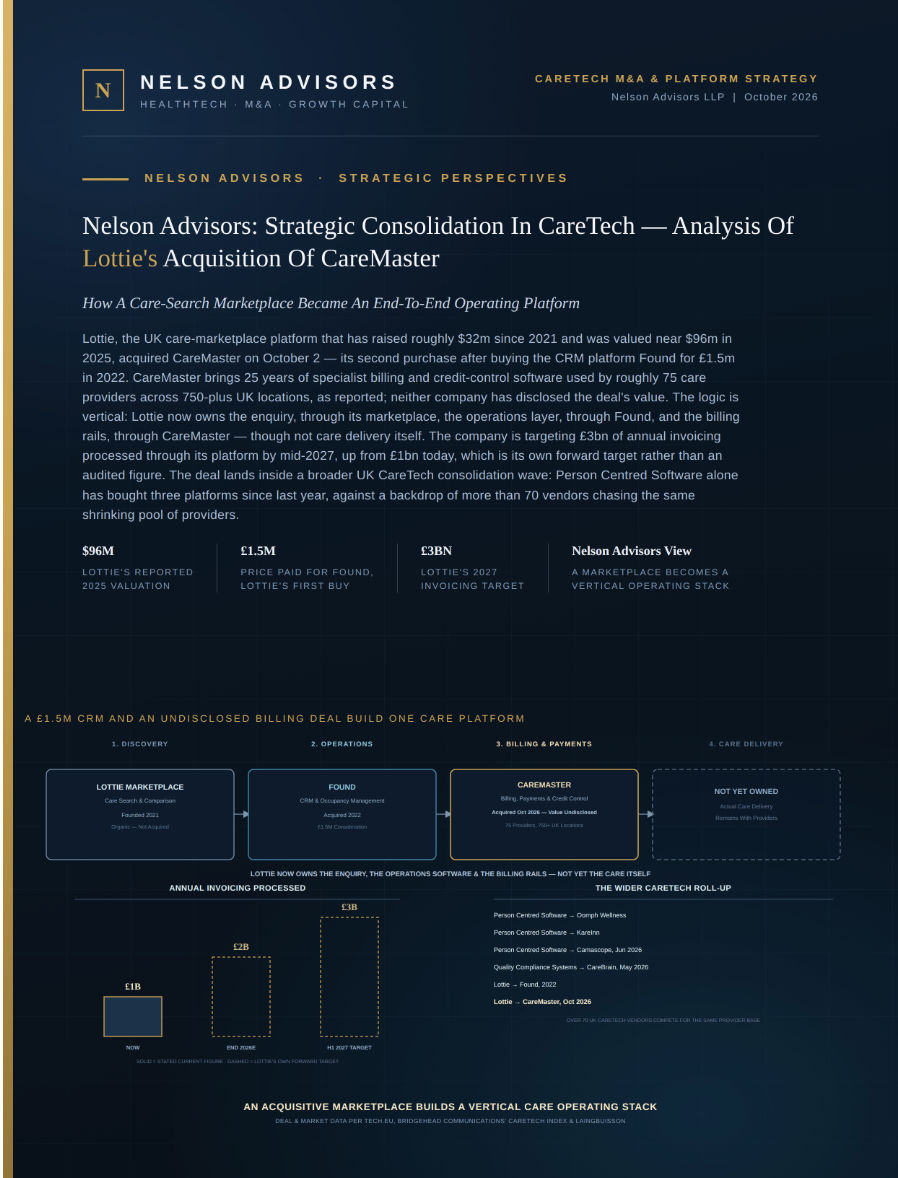
Strategic Consolidation in CareTech: Analysis of Lottie’s Acquisition of CareMaster
The United Kingdom’s adult social care ecosystem is undergoing a structural realignment driven by demographic aging, severe workforce attrition, and escalating regulatory mandates for digital adoption. In response to these operational pressures, London based healthtech company Lottie completed the acquisition of CareMaster, an established care billing software provider with a 25-year operating history.
The transaction represents Lottie’s second major enterprise software acquisition, following its September 2022 takeover of the care customer relationship management (CRM) platform Found.
By incorporating CareMaster’s specialized domain expertise in resident ledgers, split-funder billing and credit control into its AI-native Found operating layer, Lottie is transitioning from a consumer discovery marketplace into a vertically integrated enterprise operating system.
This strategic manoeuvre positions the company to expand its managed annual invoicing volume from over £1 billion to £3 billion by the first half of 2027, creating an automated back-office architecture capable of addressing the chronic administrative strain characteristic of the UK care economy.
Transaction Overview and Corporate Trajectory
The acquisition of CareMaster unites one of the UK’s fastest growing venture backed healthtech startups with a deeply entrenched provider of legacy care accounting infrastructure. Founded by Bob Grimshaw and Colin Rooke, CareMaster was developed under C A Solutions as an on premise and client server billing engine designed specifically for residential and nursing homes, integrating with enterprise platforms such as Sage 50 Accounts. CareMaster brings a customer base of nearly 75 care provider organisations encompassing more than 750 care home locations across the UK. Although specific transaction terms were not publicly disclosed, the acquisition follows a collaborative 24-month engagement period structured to ensure the phased migration of CareMaster’s enterprise client base onto Lottie’s cloud infrastructure.
Lottie was launched in 2021 by Will Donnelly, a former commercial real estate healthcare specialist at CBRE, and Chris Donnelly. The venture originated as a digital marketplace to address acute market inefficiencies, opaque pricing, and consumer distress in identifying eldercare facilities.
Capitalised by top-tier venture investors, Lottie has raised $33 million to date, anchored by a $21 million (£16.35 million) Series A round led by Accel with participation from General Catalyst and Kindred Capital. The CareMaster transaction marks the continued execution of Lottie’s platform strategy: pairing top of funnel marketplace traffic with back office workflow software to establish defensible, multi sided software as a service (SaaS) moats.
Dimension | Lottie (Marketplace Layer) | Found by Lottie (B2B Operating System) | CareMaster (Acquired Billing Engine) | Combined Enterprise Platform |
Year Established | 2021 | 2019 (Acquired by Lottie 2022) | ~2001 (~25-year market presence) | 2026 Consolidated Operations |
Core Value Drivers | Consumer discovery, fee transparency, NHS bed-matching | AI inquiry capture, CRM pipelines, occupancy tracking | Multi-payer billing, resident ledgers, Sage 50 links | End-to-end commercial operations from enquiry to cash |
Facility Footprint | >4,000 care and retirement listings | Scaling to ~2,500 services by end-2026 | ~75 provider groups; >750 care homes | Comprehensive national presence across residential and home care |
Annual Billing Scale | Referral transaction layer | >£1.0B (Current) / £2.0B (Projected end-2026) | Historical private billing software | Projected £3.0B run-rate by H1 2027 |
Primary Revenue Model | Commission and listing subscriptions | Monthly per-location SaaS (£75–£150+) | Legacy software licenses, support agreements | Tiered recurring SaaS and transaction orchestration |
Architectural Evolution: Integrating Found and CareMaster
The integration of CareMaster builds upon Lottie’s corporate expansion roadmap initiated in September 2022 with the £1.5 million (€1.7 million) acquisition of Found CRM. At the time of its acquisition, Found operated as an early-stage occupancy and enquiry management tool deployed across fewer than 100 care locations. Over the subsequent four years, Lottie rebuilt the platform from the ground up as a native cloud and artificial intelligence infrastructure, expanding its operational remit beyond residential care into domiciliary home care and supported living. Found is projected to scale to nearly 2,500 UK care services by the end of 2026, representing a twenty-five-fold network expansion since its initial acquisition.
Social care accounting features operational complexities that are rarely accommodated by standard horizontal enterprise resource planning (ERP) systems. A primary barrier to software consolidation in this space is split-payer funding structures, where an individual resident’s weekly fees are routinely divided across local authority adult social services, NHS Continuing Healthcare (CHC) awards, third-party familial top-ups, and private direct payments. Accounting engines must calculate dynamic variations, including residents' personal allowances, retrospective local council fee uplifts, and ad-hoc incidentals such as chiropody, hairdressing, or specialized therapies. Furthermore, care providers must manage backdated funding changes when public bodies alter reimbursement eligibility months after admission, which requires complex retrospective adjustments across multiple debtor accounts.
CareMaster addressed these edge cases by building specialised data schemas and bidirectional synchronisations with Sage 50 Accounts, directly mapping customer codes, nominal ledgers, and tax classifications into general accounting records. By moving CareMaster’s client base onto Found, Lottie secures these accounting models while replacing legacy desktop workflows with modern, browser-based cloud infrastructure.
Machine learning and artificial intelligence are applied directly across operational friction points in this combined architecture. At the front-of-house intake stage, the platform utilizes conversational models, including its proprietary "Eliza" virtual assistant, to execute 24/7 telephony and live-chat inquiry management, transcribe interactions, capture admission intent, and maintain bed occupancy tracking. In the back office, Lottie is directing machine learning models toward credit control and accounts receivable administration.
These models parse disparate remittance documentation from local authorities, balance split-payer allocations, track aged-debt risk profiles, and automate collection outreach based on debtor payment histories. By automating these manual reconciliation tasks, providers can mitigate operational overhead and recover missing revenue while preserving delicate interpersonal relationships with resident families.
Financial Throughput and Scaled Operational Milestones
Consolidating CareMaster into Found provides Lottie with significant transaction throughput, transforming the startup into an essential financial clearinghouse for UK social care providers. Given that average residential care fees in England frequently run between £800 and £1,400 per resident per week, mid-sized care home groups bill tens of millions of pounds annually. Processing these financial flows gives Lottie deep insights into payment health across both private payers and public sector commissioners.
Milestone Phase | Implementation Horizon | Primary Technological Focus | Commercial Footprint | Invoicing Throughput Run-Rate |
Found Baseline | September 2022 | Cloud inquiry logging and initial lead management | <100 care home locations | Early commercial throughput |
AI-Native Platform Rebuild | 2023 – Mid-2026 | "Eliza" automated call handling; domiciliary care expansion | ~1,700 to 2,000 active services | >£1.0 Billion annualized |
CareMaster Integration | End of 2026 | Unified resident ledgers; automated billing cycles | Nearly 2,500 care services | £2.0 Billion projected run-rate |
Scale Back-Office Deployment | First Half of 2027 | Autonomous credit control; global market localization | >3,250 consolidated care operations | £3.0 Billion targeted run-rate |
Managing £3 billion in annual invoicing volume unlocks higher-margin business models beyond baseline SaaS subscription fees, which currently range between £75 and £150 or more per location monthly. As transaction volume concentrates on the Found platform, Lottie can introduce embedded financial services, including integrated payment gateway processing, automated Direct Debit collections, and invoice factoring or working capital loans designed to smooth cash flows disrupted by local authority payment delays.
Macroeconomic Drivers and Industry Backdrop
Lottie’s expansion into care home back-office operations addresses acute macroeconomic and structural pressures across the UK care economy. Adult social care contributes £77.8 billion annually to the English economy, yet operating margins among independent and charitable providers remain compressed. The sector faces an estimated £2.3 billion local authority funding deficit, while cumulative increases in the National Living Wage (NLW) alongside rising employer National Insurance contributions have introduced £2.2 billion in additional operating costs for local authority adult care budgets. Because statutory fee uplifts often lag wage inflation, care providers must extract operational efficiencies from internal workflows to remain commercially viable.
Workforce instability further compounds these financial constraints. Data from the Skills for Care Adult Social Care Workforce Data Set (ASC-WDS) indicates that although total vacancies have dropped from peak post-pandemic highs of 10.7%, the aggregate vacancy rate remains elevated at 7.0%, representing approximately 111,000 open posts. Staff turnover across the independent sector persists at 24.8%, with 56.6% of providers reporting acute retention challenges due to non-care industries offering higher baseline wages.
Labor shortages are particularly severe in domiciliary care services, where vacancy rates sit at 9.7% and nearly one in three operators report an inability to meet existing community care demand. Because facilities struggle to recruit and retain administrative personnel and registered managers, care staff are frequently pulled away from patient support to handle paperwork, manual billing reconciliations, and overdue payment collection. Automating these administrative tasks directly relieves operational bottlenecks.
Technology adoption across UK care services is shifting from an operational option to a regulatory necessity. Under NHS England’s "Digitising Social Care" program, central authorities established mandates for 80% or more of Care Quality Commission (CQC) registered providers to deploy an Assured Digital Social Care Record (DSCR). The Care Quality Commission increasingly evaluates providers' digital governance capabilities during audits, accelerating the replacement of paper binders and manual spreadsheets with integrated software ecosystems. Providers implementing digital care plans now demand that back-office financial systems integrate seamlessly with clinical records, driving software consolidation across the market.
Vendor / Platform | Core Market Focus | Clinical Record (DSCR) Capability | Billing & Ledger Integration | CRM, Inquiry & Lead Intake | Strategic Alignment & Differentiation |
Found by Lottie (Combined with CareMaster) | Residential homes, domiciliary agencies, supported living | Integrated partner ecosystem (e.g., Person Centred Software) | Native engine; split-payer support; direct Sage 50 integration | AI-native conversational capture ("Eliza"), marketplace link | Bridges consumer demand generation directly with enterprise financial reconciliation |
CareHQ | Independent and group residential care homes | External partner integration focus | Basic billing, modular reporting, Xero two-way sync | Dedicated enquiry and occupancy CRM pipeline | Independent, CRM-first workflow tool tailored to care operators |
CoolCare | Medium-to-large care home operators | Back-office operational focus | Invoicing, fee management, financial reporting | Inbuilt care home enquiry tracking | Established administrative platform covering rostering, time-and-attendance, and billing |
CareLineLive | Domiciliary care, homecare agencies | NHS England Assured DSCR platform | Client invoicing, payroll export, gross margin tracking | Client management and family portal access | Field workforce management platform covering eMAR, compliance, and rostering |
Person Centred Software | Comprehensive residential and nursing homes | Market-leading Assured DSCR clinical system | Broad third-party accounting software integrations | Connects with Found CRM via open API partnerships | Clinical care management specialist linking medical records to operational software |
End to End Vertical Integration and Global Expansion
The CareMaster acquisition enables Lottie to unify the customer life cycle into a single digital process. This pipeline begins when a family initiates an inquiry on the Lottie marketplace, where they can evaluate facilities using transparent pricing schedules, availability metrics, and regulatory audit ratings. The inquiry flows directly into Found CRM, where the AI virtual agent "Eliza" captures intake criteria, schedules facility walk-throughs, and updates occupancy records without manual intervention.
Upon admission, the resident's profile transitions into the CareMaster billing engine, which configures multi-party funding splits across local authority allocations, NHS continuing care entitlements, and private top-ups. Invoices are produced across custom billing cycles, synchronised with general ledgers such as Sage 50, and continuously monitored by algorithmic credit control workflows that handle debt collection and backdated funding adjustments.
By connecting front of house acquisition tools with back-office accounting engines, Lottie addresses the operational fragmentation that often complicates care management. Capturing this end-to-end workflow provides the company with defensible data visibility across provider capacity, fee structures, and cash collection timelines.
Looking ahead to 2027, Lottie is preparing for international market expansion, targeting countries such as the United States, Australia, and India. These target geographies face similar demographic aging trends, strained healthcare budgets, and fragmented long-term care systems reliant on manual administration.
Although varying regulatory environments and healthcare payer models will require localised compliance adjustments, the core administrative challenges, matching residents to available beds, orchestrating split-payer billing, and automating debt collection, remain consistent across mature healthcare markets. Deploying this integrated operating model internationally will allow Lottie to export its UK-tested software platform to global care operators.
Conclusion
Lottie’s acquisition of CareMaster marks an important maturation in the CareTech sector, showing how healthtech ventures are expanding beyond consumer portals to build full-stack enterprise operating infrastructure.
By absorbing CareMaster’s quarter-century of specialist domain expertise in resident ledgers, split-funder billing, and Sage accounting integrations, Lottie removes an administrative bottleneck that historically hindered software modernisation across care networks.
Deploying artificial intelligence across credit control, intake communications, and debt reconciliation provides direct relief to care homes operating under tight fiscal and staffing constraints.
Backed by leading venture capital firms and projecting £3 billion in managed annual invoicing by early 2027, Lottie has established a defensible foothold in the UK care market while building an exportable software architecture for international long-term care providers.
Nelson Advisors > European Healthcare Technology Investment Banking
Nelson Advisors specialise in Mergers and Acquisitions for European HealthTech, MedTech, Digital Health, Healthcare IT, Healthcare AI companies in the Lower to Mid Market ranging from $25M to $250M EV. www.nelsonadvisors.co.uk
Healthcare.Digital is the Google News approved HealthTech and MedTech Thought Leadership platform for Nelson Advisors, positioning them as a specialised authority on European Healthcare Technology M&A and strategic corporate development. https://www.healthcare.digital
Nelson Advisors publish Europe's Leading Healthcare Technology Investment Banking Newsletter every week, join 5000+ HealthTech and MedTech subscribers today! https://lnkd.in/e5hTp_xb
Healthcare.Digital serves as a research platform for Nelson Advisors’ perspectives on deals, valuations and structural shifts reshaping Global Digital Health, MedTech, Healthcare AI and Health IT. https://www.healthcare.digital
Nelson Advisors is one of Europe's leading mergers and acquisitions advisory firms, exclusively dedicated to the dynamic and rapidly evolving healthcare technology sector. With a deep understanding of market dynamics and technological advancements, they empower innovative HealthTech companies and strategic investors to navigate complex transactions and achieve their growth ambitions. www.nelsonadvisors.co.uk
#NelsonAdvisors #HealthTech#MedTech#DigitalHealth #HealthIT #Cybersecurity #HealthcareAI #FemTech#ConsumerHealth #Mergers #Acquisitions #Partnerships #Growth #Strategy #NHS #UK #Europe #USA #Canada#Commonwealth#CorporateDivestitures #VentureCapital #PrivateEquity #Founders #SeriesA #SeriesB #Founders #SellSide #TechAssets #Fundraising #BuildBuyPartner #GoToMarket #PharmaTech #Genomics
Nelson Advisors
Hale House, 76-78 Portland Place, Marylebone, London, W1B 1NT
Meet Nelson Advisors @ Events in 2026
Digital Health Rewired > March 2026 > Birmingham, UK
NHS ConfedExpo > June 2026 > Manchester, UK
HLTH Europe > June 2026, Amsterdam, Netherlands
HIMSS AI in Healthcare > July 2026, New York, USA
Bits & Pretzels > September 2026, Munich, Germany
HealthInvestor Healthcare Summit > September 2026, London, UK
World Health Summit 2026 > October 2026, Berlin, Germany
HLTH USA 2026 > October 2026, USA
Global Health Exhibition 2026 > October 2026, Riyadh, Saudi Arabia
Web Summit 2026 > November 2026, Lisbon, Portugal
MEDICA 2026 > November 2026, Düsseldorf, Germany
Leaders in Health Summit 2026 > November 2026, London, UK
Venture Capital World Summit > December 2026, Toronto, Canada
Meet Nelson Advisors @ Events in 2027
Digital Health Rewired > March 2027 > Birmingham, UK
Barclays Health Elevate > March 2027, London, UK
NHS ConfedExpo > June 2027 > Manchester, UK
HLTH Europe > June 2027, Amsterdam, Netherlands




Comments