Nelson Advisors: Apple, AirPods Pro, Hearing Health and the Future of Electroacoustic Technology

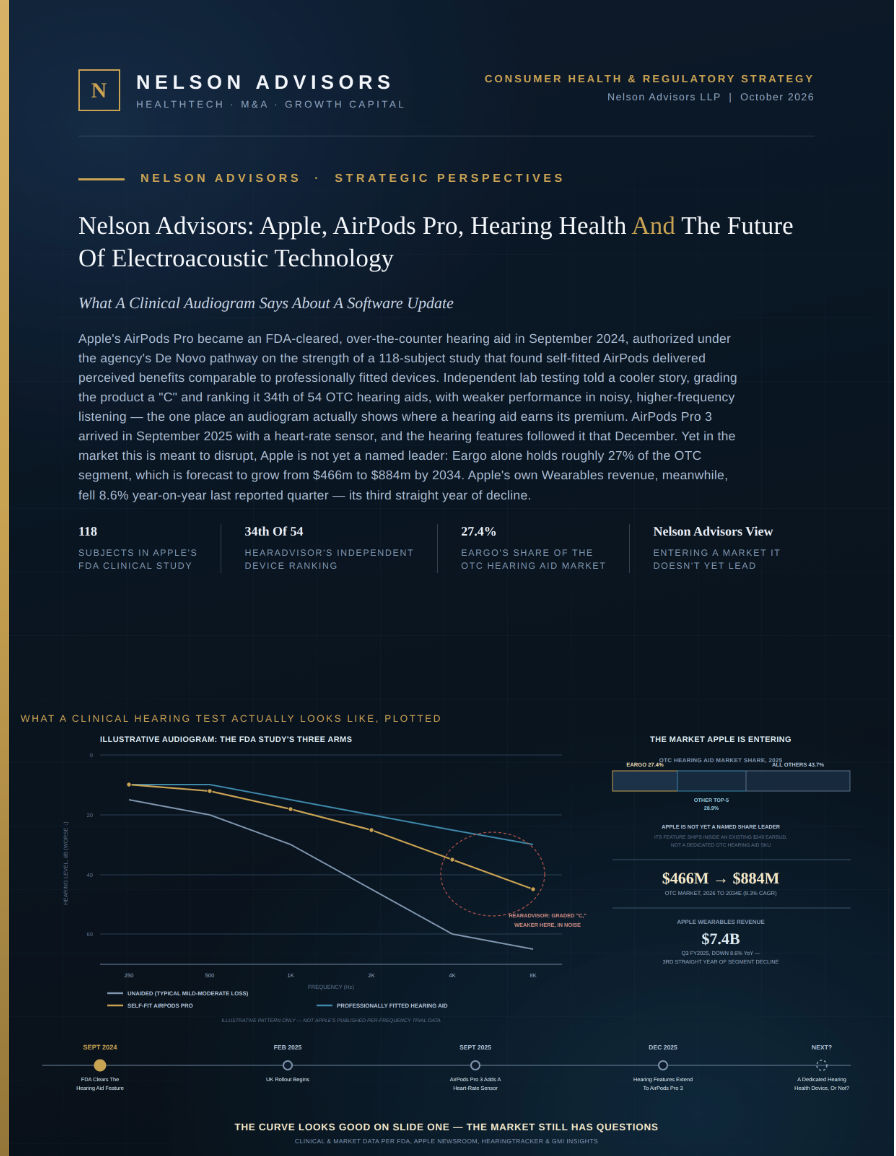
Clinical and Electroacoustic Evaluation of Apple AirPods Pro Hearing Health Technologies
The integration of medical grade amplification into consumer audio hardware reached a regulatory turning point with the clearance of Apple’s Hearing Aid Feature (HAF). On September 12th, 2024, the United States Food and Drug Administration (FDA) granted marketing authorisation for HAF as the first over the counter (OTC) hearing aid software device. The regulatory determination was executed under the FDA’s De Novo premarket review pathway, establishing a classification for software driven OTC hearing systems intended for individuals aged 18 and older with perceived mild to moderate hearing impairment.
The FDA authorisation was predicated on a multi-centre clinical validation trial encompassing 118 adult subjects with perceived mild to moderate hearing loss. The clinical protocol evaluated perceived functional benefit, speech intelligibility in background noise and electro-acoustic amplification within the ear canal, comparing self fitting outcomes directly against professional audiologic fittings of the identical hardware.
The clinical data demonstrated that participants utilising the autonomous self-fitting interface achieved subjective benefit and speech in noise improvements statistically equivalent to those achieved via professional audiologist fittings, with no device related adverse events recorded during the trial.
Regulatory Jurisdiction | Governing Body | Classification / Pathway | Target Indication | Initial Rollout Timeline |
United States | U.S. FDA | De Novo Marketing Authorisation (OTC Software-Only Device) | Perceived mild to moderate hearing loss | September 2024 |
United Kingdom | MHRA | Registered Medical Device (OTC Hearing Aid category) | Perceived mild to moderate hearing loss | Early 2025 |
European Union | European Notified Bodies / Competent Authorities | CE Marking (Medical Device Regulation / HAF v2 conformity) | Perceived mild to moderate hearing loss | 2024–2025 |
In the United Kingdom, deployment followed a distinct administrative timeline. While consumer audio capabilities were distributed internationally, the medical software configuration remained subject to statutory registration under the Medicines and Healthcare products Regulatory Agency (MHRA). Early iterations of iOS 18.1 restricted the clinical HAF configuration within the UK pending formal regulatory submission and documentation alignment.
Following completion of the registration pathway and technical compliance under medical device directives, the capability launched officially across the UK in early 2025.
Professional reaction within the UK audiological community, led by the British Academy of Audiology (BAA), reflected both recognition of public health utility and clinical caution. BAA leadership observed that integrating calibrated audiometric screening and OTC amplification into ubiquitous consumer electronics lowers barriers to early intervention and reduces societal stigma.
However, professional guidance underscored that an autonomous self fitting system cannot substitute for comprehensive clinical assessments capable of identifying middle ear pathology, retrocochlear lesions, or otological red flags such as unilateral decline or sudden sensorineural hearing loss, which necessitate urgent specialist care.
Architecture of the Hearing Aid Feature and Assessment Workflow
The operational pipeline of the Hearing Aid Feature comprises an integrated diagnostic and digital signal processing sequence, executing pure tone threshold evaluation on the mobile host device and delegating live acoustic filtering directly to the earbud hardware.
The diagnostic foundation relies on the integrated Hearing Test Feature (HTF). Prior to stimulus delivery, the system evaluates testing conditions: external microphones monitor ambient sound levels to ensure low background noise, while internal feedback microphones emit a calibrated tone to verify an airtight physical seal within the ear canal. Once conditions are confirmed, the system administers an automated pure-tone air-conduction test across octaves and inter-octaves spanning 250 Hz to 8 kHz. Tones are delivered in pulsed triplets, requiring interactive touch confirmation on the paired host device. In clinical validation studies comparing HTF to standard sound-treated booth audiometry, 84.1% of evaluated thresholds agreed within 5 dB HL and 96.6% fell within 10 dB HL, achieving a median completion duration of 5.5 minutes compared to approximately 10.0 minutes for traditional manual assessments.
For users with pre-existing clinical evaluations, the system accommodates digital entry or optical scanning of audiograms via the device camera, transcribing physical paper charts into HealthKit records. Independent validation studies show that the optical import mechanism matches 71% to 73% of clinical threshold points within 5 dB of the original paper record, though typographic variance requires manual user review to avoid transcription errors.
Following test completion or data ingestion, the derived hearing threshold configuration is compiled directly into the firmware of the Apple H2 system on chip located within the earbuds. Storing the compensation tables locally on the earbuds decouples runtime amplification from the paired mobile device, allowing continuous hearing aid function even when disconnected from the host hardware.
The live amplification profile operates under defined electroacoustic boundaries. Environmental amplification operates exclusively when the hardware is set to Transparency mode, suspending ambient compensation if the user engages Active Noise Cancellation (ANC) or Adaptive Audio. User customisation is executed via parametric controls:
The broadband Amplification control modulates total acoustic gain uniformly across the spectrum, providing an adjustment range of approximately 10 dB relative to baseline fitting targets. Spectral balance is governed by the Tone control, which introduces a 5 to 10 dB high-frequency shelf tilt to alter perceived vocal brilliance or warmth without shifting lower-frequency energy. Environmental distractions are addressed by the Ambient Noise Reduction algorithm, which applies real-time spectral subtraction to suppress steady-state background disturbances such as HVAC fans or traffic roar.
For conversational dynamics, the Conversation Boost feature engages directional beamforming arrays across the outward-facing microphones, prioritising acoustic energy within a narrow forward cone while attenuating off-axis reverberation.
Finally, in territories operating under HAF v2 clearance, the system provides Own Voice Amplification, which selectively amplifies the user's phonation to mitigate the occlusion effect and restore vocal naturalness during speech.
Media Assist Architecture and Streaming Audio Compensation
Unlike conventional prescription hearing aids that stream external audio via auxiliary Bluetooth Low Energy protocols or remote accessories, consumer wireless earbuds feature high-fidelity audio reproduction as their native mode of operation. The Media Assist feature bridges consumer media delivery and audiologic compensation by applying personalised hearing correction directly to streamed content.
A primary functional distinction of Media Assist is its independence from external acoustic modes. While ambient HAF requires Transparency mode, Media Assist functions continuously across all noise control configurations, including Active Noise Cancellation, Adaptive Audio, Transparency and passive physical isolation. The digital signal processing pipeline queries the user's pure-tone threshold configuration in HealthKit and dynamically recalibrates the digital media output across phone calls, video streams and audio playback.
For telecommunications and conferencing platforms, Media Assist applies targeted dynamic range compression and frequency shaping across the critical speech-recognition band. Frequencies between 1.5 kHz and 4 kHz receive proportional expansion, sharpening speech intelligibility across low-bandwidth cellular codecs and teleconferencing applications. When applied to video streaming and music playback, Media Assist restores high-frequency transient details that are routinely lost to individuals experiencing sensorineural decline.
Laboratory assessments utilising the standardised International Speech Test Signal (ISTS) confirm that speech-dominant audio, such as podcasts and spoken dialogue, demonstrates marked clarity improvements under Media Assist, whereas multi-layered musical arrangements produce more variable subjective responses based on the individual configuration of hearing loss.
Furthermore, the firmware executes a dual-stream mixing architecture: when a user streams media while simultaneously engaging ambient Transparency HAF, the system allows the physical hardware volume controls to govern the media stream while the Control Centre amplification slider independently regulates environmental awareness, preserving ambient speech comprehension without drowning out playback audio.
Hardware Capabilities and Electroacoustic Differentiation: AirPods Pro 2 Versus AirPods Pro 3
Apple’s clinical hearing features operate across two hardware generations: AirPods Pro 2 and AirPods Pro 3. Both models utilise the Apple H2 system on chip, which processes real-time audio at 48,000 cycles per second to execute low-latency filtering, feedback cancellation and active acoustic protection. Nevertheless, physical design modifications and internal acoustic component revisions distinguish the physical performance of the two generations.
Technical Parameter | AirPods Pro 2 (2nd Generation) | AirPods Pro 3 (3rd Generation) | Audiological and Functional Impact |
Chipset Architecture | Apple H2 System in Package | Apple H2 System in Package | Identical processing throughput for low-latency filtering and DSP execution. |
Acoustic Driver & Venting | High-excursion driver; standard venting architecture | Multiport acoustic architecture; updated low-distortion driver | Improved low-frequency reproduction and cleaner transient response in complex acoustic environments. |
Acoustic Coupling Materials | Silicone ear tips (4 sizes: XS, S, M, L) | Foam infused silicone hybrid (5 sizes: XXS, XS, S, M, L) | Enhanced seal retention, mitigation of slit-leak feedback, and broader canal anatomical compatibility. |
Ingress Protection Rating | IP54 (Dust and splash resistance) | IP57 (Dust and immersion resistance) | Increased resilience against cerumen accumulation, perspiration, and environmental moisture. |
Battery Life: Ambient HAF | Up to 10 hours continuous operation | Up to 10 hours continuous operation | Identical run-time for environmental amplification within Transparency mode. |
Battery Life: Streamed Media | Up to 6 hours continuous playback | Up to 8 hours continuous playback | Extended operational headroom during media streaming and active phone calls. |
Conversation Boost Activation | Manual or context-dependent toggle | Automated dynamic engagement | Seamless transition to directional beamforming when ambient noise thresholds rise. |
Integrated Physiological Sensors | Capacitive skin-detect sensors | Photoplethysmography (PPG) heart-rate sensor | Additional biometric tracking without degrading low-latency digital signal processing. |
Acoustic coupling represents the most clinically relevant physical change between the two iterations. Over the counter amplification systems frequently suffer from acoustic leakage, where generic silicone tips allow unamplified low-frequency energy to escape while promoting high-frequency acoustic feedback oscillation. The foam-infused hybrid tips introduced on AirPods Pro 3 conform dynamically to the contours of the cartilaginous canal. This physical design limits slit leaks, improves passive isolation, and provides a stable acoustic seal necessary for reliable insertion gain and high-frequency feedback suppression.
While both generations provide up to 10 hours of active amplification under continuous Transparency Hearing Aid operation, AirPods Pro 3 expands media streaming autonomy to 8 hours, representing a significant improvement over the 6-hour limit of AirPods Pro 2. Furthermore, the introduction of automated Conversation Boost on AirPods Pro 3 eliminates the need for manual parameter switching within the operating system, engaging directional microphone arrays automatically when environmental ambient noise impedes front-facing speech perception.
Clinical Verification and Target Matching Against Prescriptive Formulas
Independent clinical and electroacoustic investigations have evaluated the real-world performance of Apple’s HAF against traditional audiological fitting benchmarks. A primary standard in rehabilitative audiology is the National Acoustic Laboratories Non-Linear Version 2 (NAL-NL2) prescription formula, which optimises speech intelligibility while preserving physiological loudness comfort across varying input levels.
Research by Huang, Dalzell, and Picou (published in the International Journal of Audiology, 2026) evaluated the real-ear aided response (REAR) produced by the AirPods Pro 2 HAF across standardised audiometric profiles, specifically the BISGAARD N-2 (mild sloping) and N-3 (moderate sloping) configurations. The empirical measurements demonstrated systematic deviations between the default automated HAF gain output and prescriptive NAL-NL2 targets.
Audiometric Profile | Input Presentation Level | Frequency Range of Observed Under-Amplification | Default Deviation vs NAL-NL2 Targets | Audiologist Fine-Tuned Target Match (≤±5 dB) |
Mild Sloping (N-2) | Soft Speech (55 dB SPL) | 1.5 kHz – 4.0 kHz | Peak under-amplification of 8–12 dB | Target match achieved via Tone and Amplification |
Mild Sloping (N-2) | Average Speech (65 dB SPL) | 2.0 kHz – 4.0 kHz | Moderate under-amplification | Target match achieved via Tone and Amplification |
Mild Sloping (N-2) | Loud Speech (75 dB SPL) | 4.0 kHz | Mild under-amplification | Target match achieved via Tone and Amplification |
Moderate Sloping (N-3) | Soft Speech (55 dB SPL) | 1.0 kHz – 6.0 kHz | Severe under-amplification up to 15 dB | Target match achieved via Tone and Amplification |
Moderate Sloping (N-3) | Average Speech (65 dB SPL) | 1.0 kHz – 4.0 kHz | Marked under-amplification | Target match achieved via Tone and Amplification |
Moderate Sloping (N-3) | Loud Speech (75 dB SPL) | 1.0 kHz – 4.0 kHz | Marked under-amplification | Target match achieved via Tone and Amplification |
The clinical findings indicate that the default automated fitting curve of Apple HAF under amplifies high-frequency speech cues, particularly between 1.5 kHz and 4 kHz. This conservative gain implementation is common in commercial first-fit algorithms, engineered to minimise user rejection caused by sudden high-frequency brightness, loud environmental transients, or physical feedback oscillation. However, persistent under-amplification in the 2 kHz to 4 kHz spectrum diminishes consonant contrast, directly impeding speech discrimination in complex or reverberant noise environments.
Significantly, Huang et al. established that prescriptive NAL-NL2 targets could be achieved within accepted clinical tolerance 5 dB when an audiologist manually adjusted the onboard user controls. Adjusting the Amplification slider introduces approximately 10 dB of uniform broadband gain across frequencies, while altering the Tone slider from "Dark" to "Bright" introduces a 5 to 10 dB high-frequency shelf tilt without destabilising lower-mid frequencies at 1.0 kHz to 1.5 kHz. Through systematic manipulation of these parameters, clinical researchers successfully brought real-ear aided responses within formal NAL-NL2 tolerances for both mild and moderate hearing loss profiles.
In an independent cross-sectional evaluation published in the American Journal of Audiology (2025), investigators documented high overall usability metrics (mean mHealth App Usability Questionnaire score of 6.7/7) among adult iPhone users. Nevertheless, objective speech in noise evaluations via the Quick Speech-in-Noise (QuickSIN) metric revealed a nonsignificant baseline improvement of only 0.1 dB signal to noise ratio (SNR) under default factory configurations. These observations demonstrate that while the underlying hardware and digital signal processing architecture possess sufficient acoustic capability to match prescriptive standards, default consumer self-fitting routines sacrifice high-frequency gain for acoustic comfort, falling short of the performance achieved through verified professional fittings.
Comparative Analysis: Over the Counter Hearables Versus Dedicated Prescription Audiology Systems
The expansion of clinical amplification into high volume consumer hearables represents a structural disruption to conventional audiological practice. However, key distinctions remain across electroacoustic, ergonomic and clinical domains when comparing AirPods Pro to dedicated prescription hearing instruments.
Evaluation Domain | Apple AirPods Pro (OTC Hearable Platform) | Dedicated Prescription Hearing Instruments |
Audiologic Fitting Range | Perceived mild to moderate hearing impairment only | Mild, moderate, severe and profound hearing impairment |
Clinical Verification Protocol | Consumer self-fitting interface; lacks probe tube real ear measurement (REM) | Real ear measurement (REM) verification matching NAL-NL2 or DSL v5 prescriptive targets |
Continuous Operating Run-Time | Up to 10 hours in Transparency HAF mode | 18–30+ hours (lithium-ion rechargeable) or 5–14 days (zinc-air cells) |
Acoustic Coupling Architecture | Universal silicone or hybrid foam-silicone tips (4–5 generic sizes) | Custom canal molds, micro-shells, or calibrated open-fit acoustic domes |
Environmental Beamforming | Multi-microphone array with forward-facing Conversation Boost | Binaural beamforming, dynamic sound scene classifiers, deep neural network noise suppression |
Occlusion and Autophony | Noticeable occlusion; mitigated via acoustic vents and software voice compensation | Open-fit venting or deep canal placement minimised to natural ear resonance |
Sociological Perception | Mainstream consumer aesthetic; removes medical stigma but may imply conversational disengagement | Discreet, skin-matched receiver-in-canal (RIC) or completely-in-canal (CIC) form factors |
Service and Healthcare Model | Self-directed consumer onboarding; direct to consumer purchase | Regulated medical device; requires diagnostic workup, otoscopy and ongoing provider care |
Operating battery life remains a notable operational limitation for continuous, full-day use. Traditional prescription hearing aids operate between 18 and 30 hours per charge, easily accommodating a full waking day. By contrast, the 10-hour limit of AirPods Pro in continuous Transparency HAF mode necessitates a midday charging pause if intended for all-day wear. Consequently, AirPods Pro are clinically positioned as situational hearing devices, ideal for discrete demanding environments such as restaurants, business conferences, classroom lectures, or media consumption, rather than uninterrupted morning to night prostheses.
Acoustic coupling and physical fit also highlight significant design differences. While the foam-infused hybrid ear tips of AirPods Pro 3 improve physical retention over standard silicone tips, they cannot duplicate the anatomical precision of a custom molded acrylic shell or the ear ventilation of open-fit receiver in canal (RIC) instruments. The occlusion effect, the amplification of bone conducted vocal energy in an acoustically sealed canal, remains prominent during vocal exchanges, even with integrated pressure equalisation vents and digital Own Voice Amplification.
From a sociological perspective, the consumer aesthetic of AirPods Pro fundamentally alters the historical stigma associated with hearing aids. Wearing consumer earbuds is normalised in modern public spaces, allowing users to obtain amplification without signalling physical impairment. However, this consumer aesthetic introduces a behavioural trade-off: in face to face social and professional settings, visible earbuds can be perceived as active media listening or conversational disengagement, occasionally creating conversational friction that clinical hearing aids avoid.
Strategic Outlook for Over the Counter Auditory Rehabilitation
The combination of validated pure-tone audiometry, FDA-cleared and MHRA-registered self-fitting amplification, and streaming equalisation establishes commercial earbuds as an effective channel for early auditory intervention. By integrating hearing health tools into hardware already owned by millions of consumers, the barrier to initial diagnosis is lowered, directly addressing the multi-year latency typical of individuals entering the audiological rehabilitation pipeline.
Independent electroacoustic analyses confirm that the acoustic drivers and processors inside AirPods Pro 2 and AirPods Pro 3 possess the physical capability to match established NAL-NL2 prescriptive targets within clinical tolerances. However, the automated consumer self-fitting interface prioritises initial listening comfort over aggressive speech recognition targets, resulting in consistent under-amplification of mid to high frequencies unless manually adjusted. Furthermore, physical limitations, such as a 10-hour maximum continuous run-time in transparency mode, ear-canal occlusion and the absence of real ear probe tube verification, reinforce their role as situational hearing devices rather than full replacements for custom prescription prosthetics.
The broader clinical value of these systems lies in public health triage and media consumption support. The Media Assist feature delivers measurable improvements in clarity for streaming media and phone calls across all listening modes, resolving a persistent difficulty for individuals with mild-to-moderate hearing decline. Simultaneously, the on-board Hearing Test Feature provides accessible, calibrated screening that flags severe or asymmetric losses requiring medical evaluation. While consumer hearables will not eliminate the need for licensed audiological management in complex or severe pathologies, their electroacoustic capabilities establish consumer TWS hardware as an effective, scalable entry point for hearing rehabilitation.
Nelson Advisors > European Healthcare Technology Investment Banking
Nelson Advisors specialise in Mergers and Acquisitions for European HealthTech, MedTech, Digital Health, Healthcare IT, Healthcare AI companies in the Lower to Mid Market ranging from $25M to $250M EV. www.nelsonadvisors.co.uk
Healthcare.Digital is the Google News approved HealthTech and MedTech Thought Leadership platform for Nelson Advisors, positioning them as a specialised authority on European Healthcare Technology M&A and strategic corporate development. https://www.healthcare.digital
Nelson Advisors publish Europe's Leading Healthcare Technology Investment Banking Newsletter every week, join 5000+ HealthTech and MedTech subscribers today! https://lnkd.in/e5hTp_xb
Healthcare.Digital serves as a research platform for Nelson Advisors’ perspectives on deals, valuations and structural shifts reshaping Global Digital Health, MedTech, Healthcare AI and Health IT. https://www.healthcare.digital
Nelson Advisors is one of Europe's leading mergers and acquisitions advisory firms, exclusively dedicated to the dynamic and rapidly evolving healthcare technology sector. With a deep understanding of market dynamics and technological advancements, they empower innovative HealthTech companies and strategic investors to navigate complex transactions and achieve their growth ambitions. www.nelsonadvisors.co.uk
#NelsonAdvisors #HealthTech#MedTech#DigitalHealth #HealthIT #Cybersecurity #HealthcareAI #FemTech#ConsumerHealth #Mergers #Acquisitions #Partnerships #Growth #Strategy #NHS #UK #Europe #USA #Canada#Commonwealth#CorporateDivestitures #VentureCapital #PrivateEquity #Founders #SeriesA #SeriesB #Founders #SellSide #TechAssets #Fundraising #BuildBuyPartner #GoToMarket #PharmaTech #Genomics
Nelson Advisors
Hale House, 76-78 Portland Place, Marylebone, London, W1B 1NT
Meet Nelson Advisors @ Events in 2026
Digital Health Rewired > March 2026 > Birmingham, UK
NHS ConfedExpo > June 2026 > Manchester, UK
HLTH Europe > June 2026, Amsterdam, Netherlands
HIMSS AI in Healthcare > July 2026, New York, USA
Bits & Pretzels > September 2026, Munich, Germany
HealthInvestor Healthcare Summit > September 2026, London, UK
World Health Summit 2026 > October 2026, Berlin, Germany
HLTH USA 2026 > October 2026, USA
Global Health Exhibition 2026 > October 2026, Riyadh, Saudi Arabia
Web Summit 2026 > November 2026, Lisbon, Portugal
MEDICA 2026 > November 2026, Düsseldorf, Germany
Leaders in Health Summit 2026 > November 2026, London, UK
Venture Capital World Summit > December 2026, Toronto, Canada
Meet Nelson Advisors @ Events in 2027
Digital Health Rewired > March 2027 > Birmingham, UK
Barclays Health Elevate > March 2027, London, UK
NHS ConfedExpo > June 2027 > Manchester, UK
HLTH Europe > June 2027, Amsterdam, Netherlands




Comments