Strategic Analysis of the ResMed and Oura Partnership: Bridging Consumer Wearables and Clinical Sleep Medicine


On May 19th, 2026, ResMed (NYSE: RMD, ASX: RMD), a prominent global health technology company specialising in sleep, breathing and home-delivered respiratory care and ŌURA, the manufacturer of the leading smart ring, announced a strategic partnership.
This cross-industry collaboration represents a structured initiative to connect daily consumer wellness tracking with professional medical diagnostic and treatment networks. By linking Oura's passive biometric telemetry with ResMed's established clinical software and device ecosystem, the partnership seeks to systematically address the persistent diagnostic gap in Obstructive Sleep Apnea (OSA).
In the United States alone, approximately 80% of individuals with OSA remain undiagnosed and untreated, posing a massive clinical challenge and creating a significant commercial opportunity for out-of-hospital care systems.
This partnership emerges at a time of rapid transformation in the consumer health technology sector, where sleep monitoring has moved from a novel trend to an essential component of clinical preventive medicine. This shift is supported by epidemiological data indicating a rise in sleep disorders, driven by an aging global population and climbing obesity rates.
Furthermore, legislative momentum, such as the Supplemental Oxygen Access Reform (SOAR) bill, which seeks to improve patient access to respiratory therapists and liquid oxygen, highlights a broader regulatory focus on optimising home-based respiratory support. Simultaneously, initiatives like the Main Street Competition Coalition, established by the National Community Pharmacists Association (NCPA) and the National Grocers Association (NGA), underscore the shifting dynamics of community-level healthcare distribution, where accessible health screening is increasingly decentralised.
Technical Architecture and Wearable Biometrics
The core of the partnership relies on translating passive, consumer-grade biometric tracking into clinically actionable events. The Oura Ring Gen3 and Oura Ring 4 collect near-continuous physiological data using advanced photoplethysmography (PPG) sensors, skin temperature sensors, and multi-axial accelerometers.
The Oura Ring 4, utilising its proprietary Smart Sensing platform, increases the number of available signal pathways from eight to eighteen compared to previous generations, dynamically adapting to the user’s finger to optimise signal capture and battery efficiency. This architecture delivers a 120% improvement in blood oxygen saturation signal quality, resulting in a 30% increase in overnight average measurement accuracy and a 15% more accurate estimation of the Breathing Disturbance Index (BDI).
Unlike standard smartwatches worn on the wrist, the finger-worn ring form factor benefits from closer arterial proximity, reducing motion artifacts and light pollution. In clinical validation studies comparing consumer sleep trackers (CSTs) with the gold standard of in-lab polysomnography (PSG) which simultaneously records electroencephalography (EEG), electrooculography (EOG), electromyography (EMG), respiratory effort, nasal airflow, snoring, heart rate and body movement, wearables have demonstrated variable performance.
For instance, a multi centre study assessing 11 commercially available CSTs, including the Google Pixel Watch, Galaxy Watch 5, Fitbit Sense 2, Apple Watch 8, Oura Ring 3, and nearable devices like the Withings Sleep Tracking Mat, revealed significant differences in sleep stage classification. Wearable devices often show a proportional bias in sleep efficiency metrics, while nearables exhibit higher bias in sleep latency measurements. Specifically, the Oura Ring's four-stage sleep classification algorithm has demonstrated a 79% accuracy rate when validated against polysomnography, establishing it as one of the most reliable consumer-grade trackers tested.
The monitoring framework deployed under this partnership operates on a graduated notification scale. Within the Oura app, users can view their overnight breathing disturbances visualised as a timeline indicating "Optimal," "Fair," or "Pay Attention" states. Occasional minor disturbances are common and typically represent movement or positional changes, characterised by sparse blue lines on the app’s graphic interface alongside a normal average range of 95% to 100%.
However, frequent, dense clusters of breathing disturbances paired with overnight oxygen desaturation drops below 90% trigger critical notifications, signalling potential sleep-disordered breathing and prompting the user to explore clinical evaluations.
Monitoring Modality | Primary Biometrics Tracked | Clinical/Regulatory Status | Typical Use Profile |
Oura Ring Gen3 & 4 | Heart rate, HRV, breathing disturbances, sleep stages, skin temperature, respiratory rate | Wellness tracking; continuous monitoring, not intended for direct diagnosis | Continuous 24/7 wear; 5 to 8 days of battery life |
Apple Watch (Series 9 & newer) | Heart rate, ECG, limb movement, sleep apnea notifications | FDA-cleared sleep apnea notifications based on breathing disturbances | Daily wear; 18 to 48 hours of battery life requiring regular charging |
ResMed NightOwl | Peripheral arterial tone, heart rate, oxygen saturation, accelerometer-based motion | FDA-cleared Home Sleep Apnea Test (HSAT) | Single-use/short-term diagnostic application; finger-worn sensor with adhesive tape |
Polysomnography (PSG) | EEG, EOG, EMG, ECG, nasal airflow, abdominal/thoracic effort, snoring, body position | Gold standard clinical diagnostic method | Single-night evaluation conducted in a specialized sleep laboratory |
The Integrated Referral Pathway and Care Funnel
The operationalisation of the partnership commenced with a gradual rollout on April 28th, 2026, followed by the formal public announcement on May 19th, 2026. The integration is currently active for users of the Oura Ring Gen3 and Oura Ring 4 with active Oura memberships within the United States. The mechanism relies on a direct-to-consumer digital referral tunnel. When the Oura application flags a persistent pattern of elevated nighttime breathing disturbances, a dedicated home card is presented to the user. Tapping this card redirects the user to a co-branded, secure digital portal hosted by ResMed.
Upon entering the ResMed environment, the user is guided through a comprehensive sleep assessment questionnaire. This assessment is derived from established clinical screening protocols designed to quantify risk factors such as daytime hypersomnolence, loud snoring, and witnessed apneas. To support the subsequent clinical encounter, the portal generates a downloadable, co-branded PDF guide that summarises the user's longitudinal breathing disturbances, sleep efficiency trends and assessment results.
This document is structured to bridge the typical communication gap between patient experience and professional medical evaluation, enabling primary care physicians or sleep specialists to rapidly interpret home-recorded sleep metrics.
The clinical navigation pathways are supported by ResMed’s digital search tools, including the Sleep Lab Locator and the Dealer Locator, which allow users to locate local sleep diagnostic centers or durable medical equipment (DME) suppliers.
Additionally, patients have the option to connect virtually with independent sleep specialists for remote diagnostic evaluation and prescription management. This virtual pathway is designed to lower geographic barriers and expedite the time to therapy, helping to bypass the traditional bottleneck of physical sleep laboratories.
Pathway Phase | User Action & Biometric Trigger | Backend System / Provider Integration | Regulatory & Compliance Controls |
1. Triage | Ring detects frequent breathing disturbances; overnight oxygen drops below 90% | Oura App processes biometric data locally; displays co-branded sleep-care card | FTC/HIPAA-compliant; no automatic data transfer without explicit user opt-in |
2. Assessment | User taps app card; completes online screening; downloads discussion guide | ResMed host portal runs clinical algorithms; compiles longitudinal trend PDF | Structured screening using clinically validated sleep assessment templates |
3. Clinical Engagement | User matches with telemedicine provider or searches local sleep centers | Integration with ResMed Sleep Lab Locator & independent clinical partner platforms | State-specific medical licensing compliance; independent clinical decision-making |
4. Therapy Initiation | Patient undergoes Home Sleep Apnea Test (HSAT); receives CPAP or alternative therapy | Integration with DME networks; listings updated via onlinestore.resmed.com | FDA-cleared medical diagnostics and therapy prescription compliance |
Macro Market Synergies: GLP-1 Medications and Comorbidity Management
A primary driver for ResMed's consumer-facing strategies is the shifting landscape of obesity management, particularly the widespread adoption of GLP-1 receptor agonists like tirzepatide (Zepbound) and semaglutide. Although initial market assumptions suggested that effective weight loss therapies could diminish the long-term demand for sleep apnea treatments by resolving anatomical airway obstructions, longitudinal market surveillance indicates the opposite effect.
Data collected over a two-year surveillance period demonstrates that patients prescribed a GLP-1 medication are 11% more likely to initiate CPAP therapy than those who are not on these weight loss drugs. This acceleration is primarily a funnel effect: the high profile of modern weight loss therapies has drawn historically disengaged populations into primary care settings. When these patients seek medical assistance for weight management, clinicians systematically evaluate their overall health, identifying untreated co-morbidities such as hypertension, type 2 diabetes and obstructive sleep apnea. While weight loss occurs over a prolonged period, treating active sleep apnea is medically urgent due to the immediate risk of stroke or cardiovascular events, leading to high rates of concurrent CPAP prescriptions.
Furthermore, ResMed’s tracking of patient compliance indicates that GLP-1 users demonstrate superior long-term adherence. At one year of therapy, GLP-1 patients are 3% more likely to reorder replacement masks from ResMed, and this metric rises to 5% at the two-year mark. This persistent demand is particularly significant given that real-world discontinuation rates for GLP-1 medications typically exceed 50% at one year and continue to climb at two years. As patients discontinue their weight loss medications and potentially regain weight, their reliance on mechanical airway support is reinforced, driving continued utilisation of ResMed's core technologies.
This patient flow aligns with ResMed’s broader out-of-hospital care ecosystem, which features cloud-connected therapeutic devices monitored via the myAir and AirView software platforms. These platforms are designed to enhance patient adherence using AI-enabled digital coaching assistants such as Comfort Match, which acts as an automated sleep coach to optimise comfort settings and long-term compliance.
Additionally, ResMed’s joint venture with Verily, known as Primasun, and its collaboration with digital platforms like Ognomy Sleep, which offers virtual sleep apnea care and integrates with ResMed’s Pathway program, further support this patient pipeline.
Patient Adherence Metric | Standard CPAP Cohort | Concurrent GLP-1 Cohort | Strategic Implication for Supply Chain |
CPAP Therapy Initiation Rate | Baseline | +11% higher initiation probability | Accelerates equipment deployment and initial diagnostics |
1-Year Mask Reorder Rate | Baseline | +3% higher reorder probability | Stabilises high-margin recurring supply revenue |
2-Year Mask Reorder Rate | Baseline | +5% higher reorder probability | Offsets typical long-term patient attrition patterns |
Medication Adherence at 1–2 Years | N/A | <50% retention (medication discontinued) | Reinforces mechanical airway therapy as a permanent baseline |
Financial Performance and Capital Allocation
From a corporate perspective, the partnership is a key component of ResMed’s newly unveiled 2030 Strategy. This plan targets high-single-digit revenue growth and faster earnings growth over the next five years, underpinned by a continuous reinvestment of 7% of revenues into R&D to develop an integrated digital health ecosystem. ResMed has also expanded its manufacturing capabilities, doubling production capacity in major U.S. logistics hubs such as Atlanta and Indianapolis to align with domestic supply chain goals.
Financially, ResMed demonstrates strong fundamentals, with a market capitalisation of approximately $29.28 Billion to $29.61 Billion. The company's trailing twelve-month revenues reached $5.3 Billion, characterised by solid gross margins of 62.2% and non-GAAP operating profit margins exceeding 33%. Two-thirds of ResMed’s revenue is generated in the Americas, with the remaining third distributed across Europe, Japan, Australia and other global regions. The company operates with a strong cash flow of $1.8 Billion generated over the trailing twelve months, which supports a balanced capital allocation strategy prioritising research, strategic acquisitions, share buybacks and dividend payments.
Despite these strong operational metrics, ResMed’s stock (NYSE: RMD) has recently faced valuation pressures. Trading at approximately $204.15, the shares remain below their 200-day moving average of $251.82 and are down about 30.52% from their 52-week high of $293.81.
This compression has driven ResMed's P/E ratio to 19.69, which is very close to its 10-year historical low of 19.47, indicating a favourable valuation for long-term investors. Market analysts also monitor insider activity, which showed approximately $4.9 Million in shares sold by company executives over the preceding three months.
Furthermore, ResMed's executive leadership, including Chairman and CEO Mick Farrell and CFO Aaron Bloomer, are scheduled to present at the 46th Annual William Blair Growth Stock Conference on June 2nd, 2026, where they are expected to address market trends, supply chain developments, and long-term growth targets.
Market Indicator | Current Recorded Value | Historical Context / Boundaries | Long-Term Strategic Context |
RMD Share Price | $204.15 | 52-Week Range: $198.61 to $293.80 | Trades below the 200-day moving average of $251.82 |
Trailing P/E Ratio | $19.69 | 10-Year Historical Low: $19.47 | Suggests substantial historical undervaluation |
GF Score™ | $95/100 | Maximum score potential of $100 | Indicates strong profitability (10/10) and growth (10/10) |
Insider Action | $4.9 Million (net sales) | Prior 3-month rolling window | Warrants investor monitoring regarding executive sentiment |
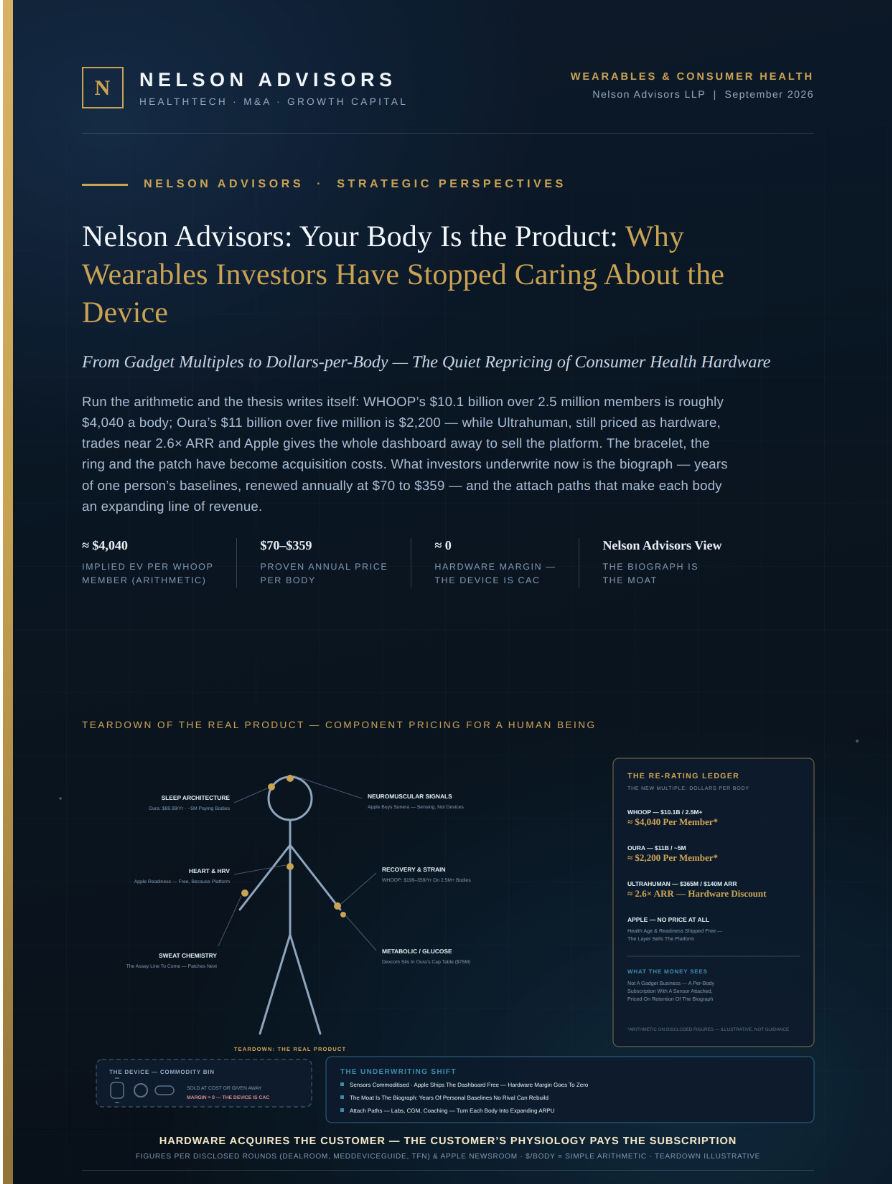
Market Value of Oura | $11 Billion | Standing as the most valuable private wearable firm | Underpins strong consumer appeal and brand leverage |
Strategic Outlook and Regulatory Challenges
The partnership between ResMed and Oura reflects a broader transition in sleep medicine from basic tracking toward comprehensive, diagnostic-adjacent monitoring. This transition is driving innovation across multiple device classes, including smart oral appliances developed by firms such as ProSomnus, Dianyx Innovations, and Slow Wave Sleep. These oral appliances, such as the Slow Wave DS8 (marketed as BROSA), have received dual FDA clearance for mild-to-moderate OSA and sleep bruxism, allowing dentists to fit patients with custom 3D-printed devices while patients track physiological responses via consumer devices like the Apple Watch or Oura Ring.
The accumulation of continuous biometric data is also shifting clinical focus from raw frequency metrics, such as the Apnea-Hypopnea Index (AHI), toward more predictive risk markers like hypoxic burden and pulse rate variability.
The integration of AI-driven diagnostic platforms, such as EnsoSleep PPG, which utilises machine learning to analyse photoplethysmogram signals captured by pulse oximeters, is expected to accelerate home-based diagnosis.
Additionally, independent platforms like SleepHQ have emerged, allowing users to integrate sleep data from Apple Health, Oura Ring, and Withings Sleep Tracking Mats with detailed therapy data from cloud-connected CPAP machines. This trend toward open data sharing empowers patients to take a more active role in managing their long-term health, bridging the traditional gap between consumer wellness and clinical care.
Regulatory dynamics present another complex layer of consideration. Chief Medical Officer of Oura, Dr. Ricky Bloomfield, has advocated for the development of new, streamlined regulatory pathways for wearable health features.While the FDA has established clearance protocols for specific notification algorithms, such as those utilised by the Apple Watch or Samsung Galaxy Watch, the process remains highly complex for multi-biometric wearables tracking general sleep health.
Overcoming these regulatory hurdles will be crucial as companies seek to expand their devices' capabilities from simple risk identification to proactive medical screening, ultimately transforming how the global healthcare system manages chronic sleep and breathing disorders.
Nelson Advisors > European MedTech and HealthTech Investment Banking
Nelson Advisors specialise in Mergers and Acquisitions, Partnerships and Investments for Digital Health, HealthTech, Health IT, Consumer HealthTech, Healthcare Cybersecurity, Healthcare AI companies. www.nelsonadvisors.co.uk
Nelson Advisors regularly publish Thought Leadership articles covering market insights, trends, analysis & predictions @ https://www.healthcare.digital
Nelson Advisors publish Europe’s leading HealthTech and MedTech M&A Newsletter every week, subscribe today! https://lnkd.in/e5hTp_xb
Nelson Advisors pride ourselves on our DNA as ‘Founders advising Founders.’ We partner with entrepreneurs, boards and investors to maximise shareholder value and investment returns. www.nelsonadvisors.co.uk
#NelsonAdvisors #HealthTech #DigitalHealth #HealthIT #Cybersecurity #HealthcareAI #ConsumerHealthTech #Mergers #Acquisitions #Partnerships #Growth #Strategy #NHS #UK #Europe #USA #VentureCapital #PrivateEquity #Founders #SeriesA #SeriesB #Founders #SellSide #TechAssets #Fundraising #BuildBuyPartner #GoToMarket #PharmaTech #BioTech #Genomics #MedTech
Nelson Advisors LLP
Hale House, 76-78 Portland Place, Marylebone, London, W1B 1NT
Meet Nelson Advisors @ 2026 Events
Digital Health Rewired > March 2026 > Birmingham, UK
NHS ConfedExpo > June 2026 > Manchester, UK
HLTH Europe > June 2026, Amsterdam, Netherlands
HIMSS AI in Healthcare > July 2026, New York, USA
Bits & Pretzels > September 2026, Munich, Germany
World Health Summit 2026 > October 2026, Berlin, Germany
HealthInvestor Healthcare Summit > October 2026, London, UK
HLTH USA 2026 > October 2026, USA
Barclays Health Elevate > October 2026, London, UK
Web Summit 2026 > November 2026, Lisbon, Portugal
MEDICA 2026 > November 2026, Düsseldorf, Germany
Venture Capital World Summit > December 2026 Toronto, Canada





Comments