The Acquisition Readiness Checklist: What Buyers Actually Diligence in a €25M to €250M HealthTech, MedTech, Healthcare AI, Health IT, Digital Health Deal

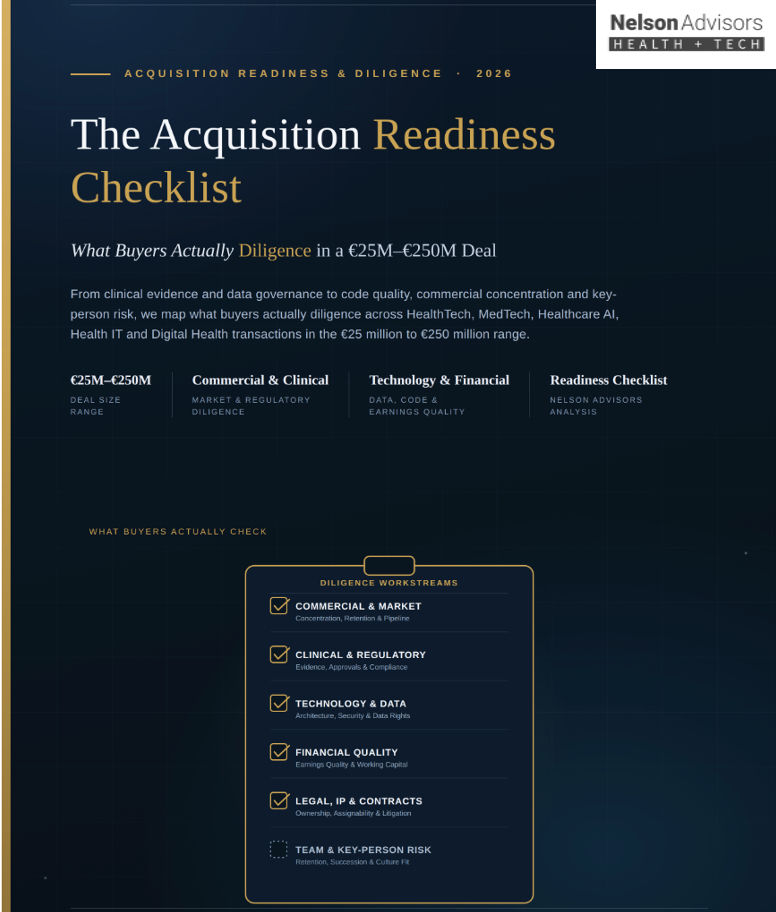
Driven by corporate portfolio realignments and substantial private equity capital reserves, global healthcare M&A transaction value reached $546.7 Billion in 2025, representing a 38% year-over-year increase. Within Europe, private equity healthcare buyout value scaled to $80.9 Billion in 2025 and is projected to surpass $95.0 billion in 2026.
While mega-cap transactions exceeding $1 Billion in Enterprise Value (EV) attract headline coverage, intense competition among bulge-bracket sponsors and strategic acquirers in that upper tier has inflated entry multiples to 15x–25x EBITDA. Consequently, institutional investors and strategic buyers increasingly focus on the €25M to €250M EV mid-market middle ground.
This middle market offers attractive risk-adjusted entry multiples and significant opportunity for value creation via buy-and-build strategies, digital enablement, and international scaling. However, operating in this segment requires navigating complex regulatory environments, strict data privacy standards, evolving technology infrastructures, and intricate reimbursement structures. Transaction success in the €25M to €250M sweet spot depends on deep, rigorous pre-acquisition diligence across five distinct operational domains: financial quality of earnings, regulatory and market access pathways, software and artificial intelligence (AI) technology stacks, legal and data governance frameworks, and commercial positioning.
Sub Sector Valuation Mechanics and Market Multiples
Valuation dynamics within the €25M to €250M transaction band vary significantly based on regulatory classification, recurring revenue visibility, clinical evidence, and payor mix. Strategic acquirers typically pay higher enterprise value-to-revenue multiples for high-growth, IP-protected medical devices or high-retention software assets. Private equity sponsors prioritise EBITDA predictability and expansion potential.
Subsector / Cohort | EV / Revenue Multiple | EV / EBITDA Multiple | Key Valuation Drivers & Moats |
Public Medical Device (Median) | 4.20x | 14.1x | Clinical differentiation, established reimbursement, global distribution. |
Private MedTech (Strategic Buyers) | 1.9x – 6.0x+ | 8.0x – 18.0x | Clear FDA/CE clearance, patent portfolio, clinical trial endpoints. |
Private MedTech (PE Sponsors) | 1.5x – 3.0x | 10.0x – 20.0x | Cash-generative products, recurring consumables, platform suitability. |
Healthcare IT (Profitable SaaS) | 4.0x – 6.0x | 10.0x – 14.0x | Net Revenue Retention >110%, low churn, EMR/EHR integration. |
Healthcare AI & Digital Health | 3.0x – 8.0x | N/A (or >18.0x) | Proprietary training data, PCCP readiness, CPT reimbursement. |
Tech-Enabled Provider Services | 0.8x – 1.8x | 6.0x – 12.0x | Commercial payor mix, clinician retention, regional density. |
Recent benchmark acquisitions illustrate the market's willingness to pay significant premiums for clinical differentiation and commercial visibility. Johnson & Johnson’s acquisition of Shockwave Medical at ~17.9x LTM revenue ($13.1B EV) and Boston Scientific’s acquisition of Axonics at ~9.0x LTM revenue ($3.3B EV) demonstrate the valuation expansion available to targets that successfully de-risk both regulatory clearance and reimbursement.
In the mid-market space, transactions such as Boston Scientific’s acquisition of Silk Road Medical (~6.0x EV/Revenue) and Becton Dickinson’s acquisition of Edwards Lifesciences’ Critical Care unit (~4.5x EV/Revenue) highlight how clear reimbursement visibility and solid gross margins maintain floor valuations even during periods of broader macroeconomic volatility.
A primary valuation factor across HealthTech and Digital Health targets is the commercial payor mix. The proportion of revenue derived from commercial payors directly affects the valuation multiple applied during underwriting.
Commercial Payor Share of Revenue | Valuation Placement | Structural Rationale |
Greater than 70% Commercial | Top of Range / Premium Multiple | Higher fee-for-service rates, lower administrative denial friction, strong pricing power. |
40% to 70% Commercial | Middle of Subsector Range | Balanced exposure; stable cash flow with moderate margin pressures. |
Less than 40% Commercial (Medicaid/Medicare Heavy) | Bottom of Range / Multiple Discount | Subject to statutory rate caps, legislative shifts, audit exposure, and moratoria. |
Quality of Earnings and Financial Due Diligence
Financial diligence in €25M to €250M HealthTech deals goes beyond simple historical EBITDA verification. Buyers evaluate the durability, underlying gross margins, and capitalisation policies of the target's earnings.
Revenue Quality and Subscription Analytics
For Health IT and software targets, buyers analyze software-as-a-service (SaaS) operational metrics. A frequent point of audit friction involves targets misclassifying one-time professional service revenue, bespoke EMR integration fees, or custom hardware setup costs as recurring Annual Recurring Revenue (ARR). Buyers reclassify these items, often leading to downward adjustments in normalized ARR and lower valuation multiples.
Net Revenue Retention (NRR) must be calculated on a cohort basis, deducting gross churn and down-sells while isolating price expansion from volume growth. Customer concentration is also scrutinized: if a single hospital system or payor client accounts for more than 15% of ARR, buyers often apply a concentration discount or require contingent earn-outs.
In hybrid MedTech and digital hardware-software models, targets that successfully transition from capital equipment sales to integrated subscription licensing command higher multiples. Diligence checks whether software licenses are tightly bound to recurring maintenance contracts, and if gross profit margins reflect this transition.
Metric | Pre-Transition Baseline | Target Post-Transition Model | Diligence Focus & Verification |
Software & License Recurring Revenue | 20% of Total Revenue | >60% of Total Revenue | Verify contract length, auto-renewal clauses, and multi-year subscription terms. |
Capital Hardware & Setup | 60% of Total Revenue | <25% of Total Revenue | Audit hardware manufacturing costs, warranty liabilities, and supply chain commitments. |
Professional & Field Services | 20% of Total Revenue | <15% of Total Revenue | Reclassify one-time implementation fees out of core ARR calculations. |
Overall Gross Profit Margin | 40% – 45% | >60% – 65% | Assess true variable cost of deliverable cloud infrastructure vs. support staff. |
Gross Margin Mechanics and Cost Capitalisation
Gross profit margin quality serves as a key operational efficiency metric. Buyers conduct granular adjustments on reported gross margins to uncover hidden operational costs. A major focus of this audit is the distinction between customer success and account management personnel. Targets often place customer success and technical support teams within indirect operating expenses, such as sales and marketing or general administrative expenses, to artificially inflate gross margins. Diligence teams reallocate personnel dedicated to customer retention, onboarding, and platform troubleshooting into Cost of Goods Sold (COGS), which frequently reduces reported gross margins by 500 to 1,200 basis points.
Cost capitalisation policies under IAS 38 or US GAAP (ASC 350-40) represent another area requiring significant financial restatement. Targets frequently capitalize internal software development expenses and clinical trial expenditures. Buyers evaluate internal time-tracking systems to separate genuine platform enhancements from routine maintenance, bug fixes, and patch updates.
Excessive cost capitalisation is reversed into COGS or operating expenses, resulting in direct reductions to normalised EBITDA.
Additionally, cloud infrastructure hosting expenses and third-party API licensing costs are analysed to determine their operational scalability. Diligence verifies whether hosted cloud infrastructure costs and AI model inference fees scale linearly with patient processing volume or cause margin degradation as transaction volumes increase.
Pre-LOI Financial Screens and Recall Remediation
Pre-LOI screen processes regularly uncover operational risks, surfacing significant EBITDA risks driven by referrer brand decay, payor recall gaps, and unexpected caregiver drag. In MedTech and connected health deals, historical field safety actions, voluntary product recalls, or FDA Warning Letters present major financial liabilities.
Large-scale medical device recalls, such as the Philips Respironics field action, illustrate how field remediation expenses, voluntary recall provisions, customer litigation, and resulting revenue losses can severely impair operating cash flows and compress adjusted EBITA margins. Diligence teams analyze target recall reserves, product liability insurance coverage limits, and historical customer concessions to ensure appropriate indemnification and escrow holdbacks are incorporated into the final purchase agreement.
Regulatory Compliance, Quality Systems and Market Access
Regulatory failure represents one of the primary drivers of deal termination or severe post-close value destruction in the €25M to €250M segment. Acquirers scrutinize regulatory clearance files, quality management compliance, and international market access strategies.
US FDA Premarket Pathways and Cyber Compliance
In the US market, buyers evaluate the target’s regulatory authorisation pathway. For 510(k) clearances, diligence verifies predicate selection justifications, substantial equivalence claims, and design control documentation. Missing or expired clearances, unapproved labeling expansion, or unfiled product modifications constitute material regulatory liabilities.
For novel technologies navigating the De Novo pathway without an established predicate, buyers inspect FDA Pre-Submission meeting minutes to confirm that special controls and performance testing protocols align with agency expectations. Class III Premarket Approval (PMA) assets require comprehensive audits of pivotal trial data, Good Clinical Practice (GCP) compliance, design history files (DHF), and current Good Manufacturing Practice (cGMP) readiness under 21 CFR Part 820.
Regulatory Pathway | Typical Direct Cost Range | Timeline to Clearance | Primary Diligence Audit Focus |
510(k) Clearance | $50,000 – $400,000 | 6 – 18 Months | Valid predicate match, substantial equivalence data, non-clinical bench testing. |
De Novo Authorization | $250,000 – $1,500,000+ | 12 – 24 Months | FDA Q-Sub alignment, special controls compliance, clinical safety evidence. |
Premarket Approval (PMA) | $10,000,000 – $75,000,000+ | 3 – 7 Years | Pivotal clinical trial integrity, 21 CFR Part 820 cGMP, manufacturing site audit. |
Software as a Medical Device (SaMD) and connected medical equipment face enhanced cybersecurity scrutiny under Section 524B of the US FD&C Act. Diligence requires targets to present comprehensive Software Bills of Materials (SBOM), vulnerability disclosure frameworks, and a secure patch update architecture capable of addressing Known Exploited Vulnerabilities (KEVs) without triggering the need for new 510(k) filings.
Dimension | US FDA Regulatory Framework | European Union MDR (2017/745) / IVDR |
Primary Regulatory Authority | US Food and Drug Administration (FDA). | Decentralized via independent Notified Bodies & National Competent Authorities. |
Core Quality Standard | Quality System Regulation (21 CFR Part 820) / QMSR alignment. | EN ISO 13485:2016 Certification & Annex IX/XI Quality Audits. |
Risk Management Standard | ISO 14971 / FDA Guidance on Safety Assurance Cases. | Mandatory compliance with EN ISO 14971:2019 benefit-risk ratio requirements. |
Software Lifecycle Standard | IEC 62304 / FDA Guidance on Premarket Cybersecurity. | Harmonized EN IEC 62304 (MDCG 2019-11 Medical Device Software Guidance). |
Post-Market Obligations | Medical Device Reporting (MDR), MedSun, annual PMA reports. | Periodic Safety Update Reports (PSUR), Post-Market Clinical Follow-up (PMCF). |
European Union MDR/IVDR Execution and Technical Documentation
In Europe, the transition from the Medical Device Directive (MDD) to the EU Medical Device Regulation (EU MDR 2017/745) and In Vitro Diagnostic Regulation (IVDR 2017/746) has introduced stringent compliance requirements. Buyers review the target’s Technical Documentation Files against MDR Annex II and Annex III standards.
Diligence begins with a precise review of the target's Intended Purpose Statement under MDR Rule 11, which governs software classification and dictates the scope of required clinical evidence. Buyers cross-reference marketing materials against technical files to ensure that commercial claims do not exceed cleared clinical indications. Compliance with the General Safety and Performance Requirements (GSPR) listed in Annex I must be established through structured, traceable verification testing data.
Under Article 61 and Annex XIV, targets must maintain active Clinical Evaluation Reports (CER) supported by continuous post-market evidence. Notified Bodies increasingly reject historical reliance on clinical equivalence, requiring targets to demonstrate primary clinical data or structured Post-Market Clinical Follow-up (PMCF) registries. Finally, buyers confirm that the target's Notified Body maintains active designation under MDR/IVDR for the specific product codes, ensuring that CE certificates remain valid to avoid commercial disruptions post-acquisition.
Intellectual Property Protection and Patent Term Extension Dynamics
Intellectual property diligence focuses on patent prosecution, freedom-to-operate (FTO) clearances, and patent lifecycle management. A key area of value capture involves Patent Term Extension (PTE) under 35 U.S.C. 156 in the US and Supplementary Protection Certificates (SPCs) in Europe.
Parameter | Class III PMA Medical Devices | Class II 510(k) & SaMD Assets |
US PTE Eligibility (35 U.S.C. §156) | Eligible; subject to regulatory review period calculations and statutory caps. | Excluded; 510(k) clearance does not meet the statutory regulatory review definition. |
Statutory Extension Cap | Up to 5 additional years of protection; maximum 14 years post-PMA approval. | Not Applicable (0 Years). |
European SPC Eligibility | Excluded; CE Marking under EU MDR is a conformity assessment, not an MA. | Excluded; no European equivalent extension available for standard device CE marks. |
Strategic Diligence Impact | High NPV impact; extend monopoly period for high-margin PMA hardware. | Defensibility must rely on continuous software updates, PCCP filings, and workflow integration. |
PMA targets qualify for up to five years of patent term extension under 35 U.S.C. 156 to offset regulatory review delays. However, Class II 510(k) devices and Software as a Medical Device (SaMD) are statutorily excluded from PTE eligibility. Diligence teams adjust financial valuation models accordingly: PMA assets can support extended high-margin terminal cash flows, whereas SaMD and 510(k) targets must maintain commercial defensibility through ongoing software enhancements, continuous regulatory filings, and deep workflow integrations.
Technical, Interoperability and Artificial Intelligence Diligence
Software and AI targets require specialised technical due diligence. Institutional buyers evaluate code quality, system scalability, enterprise interoperability, and AI model architecture to avoid acquiring unresolved technical debt.
Evaluating Healthcare AI: Avoiding Commercial Failure
Many healthcare AI startups operate in a state of clinical promise coupled with limited commercial viability. Technical diligence uses a structured evaluation scorecard to assess long-term viability.
Assessment Dimension | Audit Criterion | Benchmark Standard / Green Flag | High-Risk Red Flag |
Model Validation & Clinical Efficacy | External Multi-Center Validation | Peer-reviewed multi-center trials across heterogeneous patient cohorts. | Overfitted model validated solely on single-center retrospective data. |
Training Data Provenance & Rights | Explicit Commercial & AI Training Consent | Documented, fully traceable GDPR Art. 9 explicit consent / HIPAA BAA data rights. | Scraping patient datasets without explicit commercial AI training authorization. |
Algorithmic Lifecycle Management | FDA Predetermined Change Control Plan (PCCP) | Approved PCCP enabling pre-specified model updates without new clearance filings. | Static algorithm incapable of updating without triggering full regulatory re-clearance. |
Workflow Integration & Usability | Zero-Footprint EMR/PACS Integration | Native FHIR/HL7, VNA, and DICOM integration with no secondary app login. | Standalone portal requiring manual clinician data re-entry or separate login. |
Continuous Performance Monitoring | Drift Detection & Incident Logging | Automated real-world performance logging and model drift alerts. | Absence of post-deployment performance tracking or automated incident logs. |
Diligence verifies whether the target maintains a Predetermined Change Control Plan (PCCP) aligned with FDA expectations. A well-structured PCCP allows machine learning algorithms to update based on real-world training data within defined parameters, avoiding commercial disruptions or costly re-clearance submissions.
Enterprise Interoperability and Cloud Infrastructure
Healthcare providers are increasingly migrating workload capabilities to cloud ecosystems. Targets operating legacy on-premise software models face clear valuation discounts. Diligence evaluates cloud architecture, prioritising multi-tenant SaaS infrastructure built on cloud platforms with automated deployment pipelines.
Enterprise interoperability is scrutinised to confirm native support for FHIR APIs, HL7 v2 messaging, and pre-built integrations with major electronic medical record (EMR) platforms such as Epic, Cerner and MEDITECH. For diagnostic and imaging software platforms, compatibility with Vendor-Neutral Archives (VNAs) and deployment of zero-footprint web viewers are essential to support broad provider adoption without requiring secondary client installations.
Cybersecurity, SBOM and Software Governance
Software assets undergo static and dynamic code security analysis to identify software vulnerabilities. Buyers require targets to present an open-source license inventory to protect against copyleft open-source infection and an active Software Bill of Materials (SBOM).
Audit Area | Diligence Checklist Items | Verification Mechanism |
Software Lifecycle Standard | Compliance with EN/IEC 62304 software engineering standards. | Audit of Software Architecture Description, Traceability Matrix, and Bug Tracking. |
Vulnerability Management | Assessment of Known Exploited Vulnerabilities (KEVs) & Common Vulnerabilities and Exposures (CVEs). | Penetration testing reports, static application security testing (SAST), and dynamic testing (DAST). |
Open-Source License Audit | Analysis of open-source software libraries and copyleft licensing risk. | Automated code scan (e.g., Black Duck, FOSSID) to identify viral GPL/AGPL code dependencies. |
Update Pipeline | Remote update capability and patch deployment without workflow disruption. | Verification of zero-downtime deployment pipelines and rollback mechanisms. |
Legal, Data Governance and Regulatory Overhangs
Legal diligence in HealthTech transactions focuses on sensitive health data processing, professional practice regulations, and evolving antitrust scrutiny.
GDPR Article 9 Special Category Health Data Governance
Under European data protection law, health data is categorized as "Special Category Data" under Article 9 of the General Data Protection Regulation (GDPR). Processing such data is prohibited unless the entity satisfies a specific exception under Article 9(2).
Article 9 Exception | Legal Basis Description | Diligence Audit Requirement & Risks |
Article 9(2)(a) | Explicit consent of the data subject for specified processing purposes. | Audit patient consent forms to confirm explicit authorization for commercial AI training. |
Article 9(2)(f) | Processing necessary for the establishment, exercise, or defense of legal claims. | Restricted to active litigation or direct legal advisory work; cannot support product R&D. |
Article 9(2)(i) | Public interest in public health (e.g., cross-border health threats, quality standards). | Requires clear statutory backing under EU/Member State law; scrutinized by DPAs. |
Article 9(2)(j) | Archiving, scientific research, or statistical purposes. | Subject to strict proportionality tests, pseudonymisation, and organisational safeguards. |
A common diligence finding involves targets that train proprietary commercial AI models on historical patient datasets using broad, generic consent forms. If patient consent lacks specific authorization for commercial software development and AI training, the target faces severe regulatory risk. Under GDPR Article 83, administrative fines for data processing infringements can reach up to €20 Million or 4% of total global annual turnover, whichever is higher. Furthermore, national Data Protection Authorities (DPAs) retain statutory powers to issue definitive bans on non-compliant processing activities, potentially invalidating the target’s core proprietary AI algorithms.
Target entities must also demonstrate that mandatory Data Protection Impact Assessments (DPIAs) were formally executed under GDPR Article 35 prior to launching high-risk AI processing activities. In addition, compliance with Article 22 restrictions regarding automated individual decision-making must be supported by documented human-in-the-loop clinical review protocols.
US Healthcare Regulatory Overhangs
For target platforms operating within or expanding into the US market, legal diligence audits three major federal and state regulatory constraints.
Legal Constraint | Core Statutory Prohibition / Scope | Transactional Impact & Diligence Focus |
Corporate Practice of Medicine (CPOM) | Prohibits non-physician business entities from employing physicians or directing medical decisions. | Audit of Management Services Organization (MSO) / Friendly PC structures and management fee arrangements. |
Certificate of Need (CON) Laws | State-level regulatory requirements restricting health facility expansion or equipment purchase. | Verify state CON approvals for operating centers, radiation/imaging equipment, and geographic expansion. |
False Claims Act (FCA) & Data Mining Scrutiny | Prohibits submitting false or fraudulent claims to federal healthcare programs (Medicare/Medicaid). | Diligence on risk adjustment algorithms, managed care billing, and DOJ FOCUS initiative compliance. |
The US Department of Justice (DOJ) FOCUS initiative scrutinises False Claims Act (FCA) violations driven by data miners and automated electronic health record algorithms that artificially inflate patient risk adjustment scores. In addition, regulatory scrutiny of private equity "roll-up" strategies by the FTC, DOJ, and HHS requires comprehensive review of regional market consolidation to prevent antitrust delays or compulsory post-close divestitures.
Master Acquisition Readiness Checklist
The following matrix synthesises the core diligence requirements that institutional buyers, private equity sponsors, and strategic corporate development teams audit across €25M to €250M transactions.
Diligence Pillar | Focus Area | Mandatory Data Room Artifacts | Common Red Flags & Deal-Breakers |
Financial & Revenue Quality | ARR / Gross Margin Validation. | Historical customer contracts, cohort NRR schedules, gross margin bridge, R&D capitalization detail. | One-time integration fees reported as ARR; customer concentration >15%; COGS understated by placing customer success in OpEx. |
Financial & Cost Structuring | Recall & Warranty Reserves. | Historical field action log, product liability claims history, warranty expense analysis. | Unfunded product recall liabilities; open class-action customer litigation; under-reserved warranty exposure. |
Regulatory Pathways | US FDA Premarket Approvals. | 510(k) clearance letters, De Novo decisions, PMA approval orders, Pre-Sub Q-Sub minutes. | Marketed product features exceeding cleared intended use; unfiled design modifications; missing 510(k) predicates. |
Regulatory Quality Systems | Global QMS Compliance. | ISO 13485 certificates, FDA Form 483s (last 10 years), Establishment Registration, Warning Letters. | Unresolved FDA 483 observations; non-conformities in ISO 13485 audits; lack of internal QMSR/21 CFR Part 820 readiness. |
Regulatory European Access | EU MDR / IVDR Documentation. | Technical Documentation Files (Annex II/III), GSPR checklist, CERs, PMCF plans, Notified Body contracts. | Reliance on legacy MDD certificates without MDR technical files; Notified Body capacity bottlenecks; insufficient PMCF clinical data. |
IP & Market Protection | Patent Term Extensions & FTO. | Patent prosecution logs, FTO legal opinions, PTE calculation files, provisional/utility filings. | Inability to extend Class II/SaMD patent terms via PTE; unaddressed competitor infringement risks; unassigned founder IP. |
AI Efficacy & Governance | Algorithm Efficacy & Lifecycle. | Multi-center clinical validation studies, FDA PCCP documentation, model drift tracking logs, red-team reports. | Overfitted single-center training models; static software update model requiring frequent re-clearance; absence of model drift alerting. |
Technical Software Architecture | Interoperability & Architecture. | Code base audits, FHIR/HL7 API documentation, cloud multi-tenancy design, third-party software stack. | Heavy technical debt; legacy on-premise architecture; lack of native EMR integration; unmanaged GPL open-source code dependencies. |
Cyber Security & Patching | SBOM & Vulnerability Defense. | Software Bill of Materials (SBOM), penetration test reports, KEV patching logs, ISO 27001 / SOC 2 Type II reports. | Unpatchable software operating systems; high-severity unaddressed KEVs; lack of Section 524B FDA cyber compliance. |
Legal Data Governance | GDPR Art. 9 & Privacy Rights. | Patient consent forms, DPIAs (GDPR Art. 35), Data Processing Agreements (DPAs), cross-border transfer mechanisms. | Commercial AI training on patient data lacking explicit consent under GDPR Art. 9(2)(a); absence of DPIAs; exposure to 4% turnover fines. |
Healthcare Legal Overhang | CPOM, CON & FCA Scrutiny. | MSO/PC agreement structures, state CON certificates, risk adjustment coding compliance reviews. | Defective CPOM management structures; missing state CON approvals; data mining algorithms triggering DOJ FCA scrutiny. |
Conclusions and Strategic Execution Roadmap
Navigating an acquisition within the €25M to €250M HealthTech, MedTech and Digital Health landscape requires aligning financial performance, technology architecture, and regulatory requirements. For target founders and private equity sponsors preparing an asset for sale, exit readiness depends on identifying and resolving operational and regulatory vulnerabilities prior to launching a formal sale process. Buyers operate with specialised diligence teams that systematically evaluate revenue durability, data provenance, and market access pathways.
Achieving premium valuations requires proactive preparation across all diligence pillars. From a financial perspective, targets must normalize ARR calculations, properly categorize customer success costs within COGS, and maintain defensible R&D capitalization policies. Regulatory and quality systems must be aligned with both FDA Section 524B cybersecurity standards and European Union MDR technical documentation requirements, supported by prospective post-market clinical evidence.
From a technical and legal standpoint, artificial intelligence assets must demonstrate multi-center clinical validation, maintain approved Predetermined Change Control Plans, and verify that training data rights comply with GDPR Article 9 explicit consent requirements. By resolving operational friction points early, targets can streamline transaction execution, minimize indemnity escrow holdbacks, and capture maximum platform value within the mid-market healthcare ecosystem.
Nelson Advisors > European HealthTech, MedTech, Digital Health Investment Banking
Nelson Advisors specialise in Mergers and Acquisitions, Partnerships and Investments for Digital Health, HealthTech, MedTech, Health IT, Consumer HealthTech, Healthcare Cybersecurity, Healthcare AI companies. www.nelsonadvisors.co.uk
Follow Nelson Advisors LinkedIn Page > https://www.linkedin.com/company/nelson-advisors/
Nelson Advisors regularly publish Thought Leadership articles covering market insights, industry trends, deal commentary, market analysis & predictions. https://www.healthcare.digital
Nelson Advisors publish Europe's Leading Healthcare Technology Investment Banking Newsletter every week, join 5000+ HealthTech and MedTech subscribers today! https://lnkd.in/e5hTp_xb
#VentureCapital #PrivateEquity #Founders #SeriesA #SeriesB #Founders #SellSide #TechAssets #Fundraising #BuildBuyPartner #GoToMarket #PharmaTech #BioTech #Genomics #NelsonAdvisors #HealthTech #MedTech #DigitalHealth #HealthIT #Cybersecurity #HealthcareAI #FemTech #Mergers #Acquisitions #Partnerships #Growth #Strategy #NHS #UK #Europe #USA #Canada
Nelson Advisors LLP
Hale House, 76-78 Portland Place, Marylebone, London, W1B 1NT
Meet Nelson Advisors @ 2026 Events
Digital Health Rewired > March 2026 > Birmingham, UK
NHS ConfedExpo > June 2026 > Manchester, UK
HLTH Europe > June 2026, Amsterdam, Netherlands
HIMSS AI in Healthcare > July 2026, New York, USA
Bits & Pretzels > September 2026, Munich, Germany
World Health Summit 2026 > October 2026, Berlin, Germany
HealthInvestor Healthcare Summit > October 2026, London, UK
HLTH USA 2026 > October 2026, USA
Barclays Health Elevate > October 2026, London, UK
Web Summit 2026 > November 2026, Lisbon, Portugal
MEDICA 2026 > November 2026, Düsseldorf, Germany
Venture Capital World Summit > December 2026 Toronto, Canada



Comments