Nelson Advisors Big Questions in HealthTech Series: Who Are The European Mental Health Pioneers to Watch in 2027?

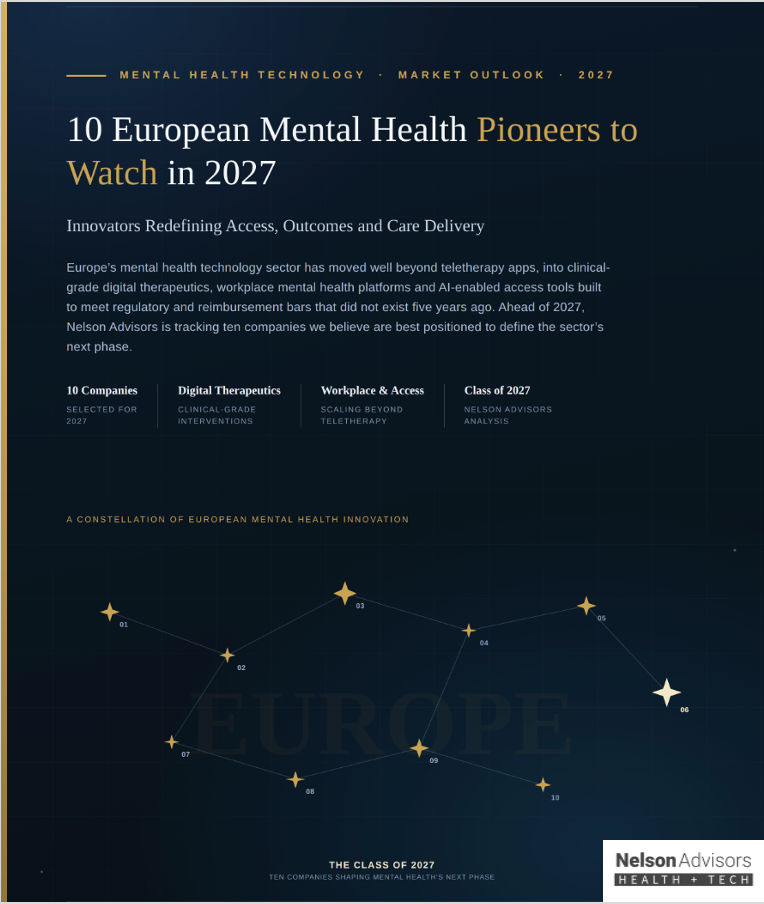
Executive Summary
The European behavioural health technology ecosystem is undergoing a structural paradigm shift. The initial wave of digital mental health, dominated by general consumer wellness, unguided meditation apps, and simple direct to consumer therapy marketplaces, has given way to a clinical grade ecosystem. As public healthcare systems across Europe face chronic clinician shortages and mounting therapy waitlists, governments, enterprise employers and institutional insurers are demanding validated, scalable and cost-effective behavioural healthcare interventions.
The global digital health market is expanding rapidly, growing from approximately $268.4 billion in 2024 toward more than $1.15 trillion by 2033. Within this broader ecosystem, the specific sector dedicated to healthcare chatbots, AI triage engines, and automated symptom assessment was valued between $1.20 billion and $1.44 billion in 2024–2025 and is projected to reach $1.80 billion in 2026 before expanding to over $4.32 billion by 2030, representing a compound annual growth rate (CAGR) of 24.0% to 24.9%. In Europe, this trajectory is accelerated by pivotal regulatory and reimbursement frameworks.
Germany’s Digital Health Care Act (Digitales Versorgungsgesetz) and its DigiG legislation have established performance-based reimbursement standards for prescription digital therapeutics (DiGA), introducing a 20% performance-based pricing component tied to patient-reported outcome measures (PROMs) and patient-reported experience measures (PREMs). Simultaneously, France’s PECAN fast track pathway is opening national health insurance reimbursement for digital medical devices, while the UK National Health Service (NHS) is systematically integrating Class IIa medical device certified AI engines directly into primary care referral pathways.
Concurrently, European scale-ups are achieving international momentum, utilising European regulatory clearances to capture reimbursement models in the United States, such as Medicare’s digital mental health treatment (DMHT) G-codes.
The companies poised to dominate the landscape in 2027 are those that converge clinical efficacy, hardware innovation, multimodal artificial intelligence, precision psychiatry and full-stack multidisciplinary care delivery.
Company Name | Country of Origin | Primary Focus Area | Technological Core | Capital & Scale Status | Key Strategic Catalyst for 2027 |
Flow Neuroscience | Sweden | Neurotechnology & MDD Treatment | At-home tDCS brain stimulation headset paired with behavioral therapy | Later Stage VC; CE-marked Class IIa & FDA cleared | Expansion of NHS trust coverage and US Medicare DMHT reimbursement rollouts |
Limbic | United Kingdom | Clinical AI Triage & Intake | Class IIa medical device AI chatbot for automated e-triage & intake | Series A; Deployed across NHS supporting 600k+ patients | Scaled adoption across US health systems and NHS Confederation deployment |
HelloBetter | Germany | Prescription Digital Therapeutics (DiGA) | Software-as-a-Medical-Device CBT courses for insomnia, depression, & panic | €31M+ total raised; Multiple approved DiGAs | Adaptation to Germany’s DigiG performance pricing and expansion via France’s PECAN |
Serenis | Italy | Multidisciplinary Digital Medical Center | Integrated platform combining therapy, psychiatry, nutrition, & coaching | $23.4M raised; €12M Series A; €25M+ ARR | Scaling direct general practice care and international Southern European expansion |
HMNC Brain Health | Germany | Precision Psychiatry & Biopharma | Genetic companion diagnostics linked to targeted neuro-pharmaceuticals | $50M Series B first closing; Clinical-stage | Phase 2/3 trial readouts for Ketabon (KET01) and Nelivabon (BH-200) |
Thymia | United Kingdom | Gamified Neuropsychological Biomarkers | Speech, text, and facial expression AI models via interactive video games | Seed ($3.8M raised); Validated on 30k+ active subjects | Integration into routine psychiatric drug trials and clinical EHR diagnostics |
Unmind | United Kingdom | Enterprise Mental Health Ecosystem | B2B platform blending self-care, predictive HR analytics, and global therapy | Series C ($82M total raised); 2.5M+ users across 110 countries | Scaling Unmind Talk and global expansion across APAC and North America |
Koa Health | Spain | Enterprise & Clinical Behavioral Care | Behavioral health platform combined with predictive EHR crisis algorithms | Series A (€30M raised); Telecommunications spin-out | Commercialization of machine learning models for early psychiatric crisis prevention |
France | Corporate Wellbeing Infrastructure | Combined 1-on-1 mental health coaching, therapy, and organizational prevention | Series A ($19M total raised) | European enterprise expansion addressing corporate employer duty-of-care laws | |
NOWATCH | Netherlands | Wearable Neuro-Tracking Hardware | Screenless bio-tracking smartwatch assessing EDA, HRV, and real-time stress | Venture-backed (€8M+ raised) | Commercial scaling of continuous stress prediction algorithms for corporate and clinical use |
Flow Neuroscience (Sweden)
Flow Neuroscience, headquartered in Malmö, Sweden, has pioneered a novel vertical in non-invasive, drug-free electrical medicine for mental health. Founded in 2016, the company manufactures a CE-marked Class IIa medical device that delivers transcranial direct current stimulation (tDCS) directly to the brain’s dorsolateral prefrontal cortex, a region consistently underactive in patients suffering from Major Depressive Disorder (MDD). By pairing a portable hardware headset with a structured behavioral therapy mobile application, Flow restores neural activity in targeted cortical circuits without the systemic side effects associated with pharmacological antidepressants. The complete package, priced at £399 in the UK with optional clinical subscription add-ons, includes the stimulation device, companion therapy software, and regular treatment pads.
The clinical efficacy of Flow Neuroscience's platform was demonstrated in a fully remote, double-blind, randomised controlled trial published in Nature Medicine, where 45% of patients receiving active tDCS treatment achieved complete depression remission over 10 weeks, compared to 22% in the placebo group. Real-world registry data further indicates that 77% of users experience clinical improvement within three weeks, with 57% achieving depression-free status after ten weeks. Having secured FDA clearance for at-home depression treatment and initiated deployments across select UK NHS Trusts, including West London, Northamptonshire and Leicestershire, Flow Neuroscience is positioned for market leadership as US Medicare and European public healthcare systems roll out formal reimbursement codes for clinician-supervised digital mental health devices.
Limbic (United Kingdom)
London-based Limbic has emerged as a cornerstone of clinical AI infrastructure within public and private behavioral health networks. Its flagship platform, Limbic Access, functions as an empathetic, conversational AI agent designed to automate patient intake, risk screening and clinical triage for mental health services. Limbic was the first mental health AI chatbot in the world to earn Class IIa medical device status under UKCA regulatory frameworks, backed by peer-reviewed clinical studies validating its safety, diagnostic accuracy and engagement rates.
By serving over 600,000 patients across the UK National Health Service, Limbic has demonstrated a capacity to reduce administrative burden on clinicians while uncovering unreported patient symptoms. Following its Series A funding and receipt of FDA Breakthrough Device Designation in the United States, Limbic established a strategic partnership with the NHS Confederation to scale clinical AI adoption nationally. The platform captures unstructured patient dialogue and converts it into structured clinical assessments prior to the first human therapy session, effectively increasing the billable capacity of healthcare providers while mitigating early-stage drop-off rates.
HelloBetter (Germany)
Operating out of Hamburg, HelloBetter stands as a pioneer in evidence-based prescription digital therapeutics (DTx). Founded in 2015 by CEO Hannes Klöpper, Elena Heber, Hanne Horvath and Pierre Alexis Cantegril, the scale-up develops specialised software-as-a-medical-device programs delivering Cognitive Behavioural Therapy (CBT) for conditions ranging from major depression and panic disorder to chronic insomnia and stress management. Multiple HelloBetter programs are officially listed in Germany's Federal Institute for Drugs and Medical Devices (BfArM) DiGA registry, making them fully reimbursable by German statutory health insurers for over 73 million citizens.
Backed by over €31 million in total capital, including a €6 million financing round in March 2025 led by Mutuelles Impact alongside HealthCap, DVH Ventures and Expon, as well as a €3 million injection in late 2024 to advance its MindFIT AI companion, HelloBetter is pursuing international market expansion. Crucially, HelloBetter became the first digital therapeutic provider to submit a formal coverage dossier under France's PECAN fast-track pathway for its insomnia therapeutic (HelloBetter Insomnie). As Germany’s DigiG law mandates outcome contingent performance pricing starting in 2026, HelloBetter’s extensive portfolio of randomised controlled trials positions the company to capture maximum reimbursement value.
Serenis (Italy)
Founded in Milan in 2021 by CEO Silvia Wang and Daniele Francescon, Serenis has scaled rapidly from an online therapy portal into a full-stack digital medical centre. The company provides an integrated care ecosystem covering video based psychotherapy, psychiatric evaluations, clinical sexology, nutritional guidance, career coaching and primary care medical support. Supported by a network of over 3,000 licensed medical and psychological professionals with an average of 11 years of clinical experience, Serenis represents the leading digital health platform in Italy.
Financially, Serenis reached €25 million in revenue in 2024, with targets set between €40 million and €50 million. The scale-up secured a €12 million ($14 million) Series A funding round in September 2025 led by Angelini Ventures and CDP Venture Capital, alongside participation from Invictus Capital, Club degli Investitori and Exor Ventures, bringing its total funding to $23.4 million. Serenis demonstrates the commercial viability of a multidisciplinary digital clinic model in Southern Europe, generating strong unit economics by seamlessly cross-referencing patients across psychological, psychiatric and physical health domains within a unified regulatory platform.
HMNC Brain Health (Germany)
Headquartered in Munich, HMNC Brain Health is a clinical-stage biopharma and neuro technology scale-up pioneering the field of precision psychiatry. HMNC addresses a fundamental inefficiency in traditional psychiatric medicine: the trial-and-error prescribing of psychotropic medications, which often leaves patients waiting months to discover whether an antidepressant or anxiolytic is effective. HMNC develops targeted neuro-pharmaceuticals coupled with predictive genetic diagnostic platforms that identify how a patient’s specific genomic profile will respond to a therapeutic compound prior to treatment initiation.
In mid-2026, HMNC closed a $50 million first tranche of its Series B financing round, led by European healthcare company MEDICE The Health Family. This capital directly supports late-stage clinical trials, including Ketabon (KET01), an oral, prolonged-release formulation of esketamine designed for treatment-resistant depression and Nelivabon (BH-200), an investigational targeted therapeutic. By linking AI-driven companion diagnostics with proprietary neuro-therapeutics, HMNC de-risks clinical trial development and optimizes patient response rates, positioning the company as a key precision psychiatry asset in Europe.
Thymia (United Kingdom)
Thymia, established in London by neuroscientist Dr. Emilia Molimpakis and theoretical physicist Dr. Stefano Goria, uses artificial intelligence to make mental health assessments objective, rapid, and quantifiable. The platform employs neuropsychology-based digital video games that prompt patients to complete cognitive and verbal tasks. While the patient plays, Thymia’s multimodal AI engine continuously records and analyses complex streams of biomarker data: voice acoustics, linguistic semantics, facial micro-expressions, visual gaze tracking, and motor response latency.
Thymia’s core machine learning architecture utilises a joint Bayesian network capable of inferring symptom-level severities for major depression and generalised anxiety disorder, achieving high diagnostic accuracy metrics (ROC-AUC of 0.842 for depression and 0.831 for anxiety across large-scale validation cohorts). Backed by seed capital from specialized investors like Kodori and Calm/Storm Ventures, the platform is used by clinicians to shorten diagnostic timelines from months to minutes. Thymia’s strategic value lies in replacing subjective self-reporting surveys with objective computational biomarkers, providing essential technology for pharmaceutical clinical trials and clinical electronic health record (EHR) diagnostics.
Unmind (United Kingdom)
Unmind, founded in London in 2016 by Dr. Nick Taylor and Steve Peralta, has evolved from an employee self-care app into an enterprise mental health scaleup. Totaling over $82 million in funding from investors including TELUS Global Ventures, Project A, and Sapphire Ventures, Unmind covers over 2.5 million employees across 110 countries for enterprise clients such as Uber and Disney.
The scale-up underwent a major structural evolution following its acquisition of Dublin-based Frankie Health, integrating a global network of accredited human coaches and therapists alongside its self-directed digital modules. The unified platform, anchored by services like Unmind Talk and AI-driven "Predictive Insights" for HR leadership, enables corporate risk assessment, preventative mental wellness, and rapid human-led clinical interventions. By connecting employee usage data directly to organizational outcomes, such as reduced sickness absence and decreased turnover, Unmind is expanding aggressively across APAC and North America to compete with global behavioral health platforms.
Koa Health (Spain)
Headquartered in Barcelona and operating globally, Koa Health originated as Alpha Health within Telefónica’s innovation incubator before spinning out as an independent entity led by Dr. Oliver Harrison. Supported by a €30 million Series A funding round from investors including Ancora Finance Group, Wellington Partners, and Telefónica, Koa Health delivers an integrated behavioral care platform designed for employers, health insurers, and clinical health systems.
Koa’s care continuum ranges from preventative mental well-being tools (Koa Foundations) to structured digital therapeutic interventions. A central technological differentiator for Koa Health is its development of machine learning algorithms capable of predicting acute mental health crises by analyzing anonymized Electronic Health Record (EHR) data. By deploying predictive models to identify individuals at elevated risk of psychiatric crisis before severe decompensation occurs, Koa provides health systems and insurers with an effective cost-containment tool that shifts behavioral care from reactive crisis intervention to continuous, preventative risk management.
moka.care (France)
Paris-based moka.care, founded in 2020 by Pierre-Étienne Bidon and Guillaume d'Ayguesvives, has established a strong presence in the French and Western European corporate mental health markets. Having raised $19 million in total funding, including a $16 million Series A round led by Left Lane Capital, Singular, and Origins Fund, moka.care partners with mid sized and enterprise businesses to integrate mental health into corporate management structures.
The platform offers employees direct, confidential access to licensed psychologists, certified therapists, and executive coaches for 1-on-1 sessions, alongside group workshops and preventative educational content. The software equips managers with team-level analytics to identify workplace stressors without compromising individual employee anonymity. moka.care benefits from tightening European regulatory compliance standards surrounding workplace psychosocial risks, leveraging corporate duty of care obligations to drive enterprise adoption across France and neighbouring EU markets.
NOWATCH (Netherlands)
Amsterdam-based NOWATCH, established in 2020, operates at the intersection of consumer health hardware, ambient bio-sensing, and preventative mental wellness. NOWATCH manufactures a screenless wearable device featuring natural stone faceplates, designed specifically to eliminate continuous screen notifications and digital fatigue. Packed with advanced biometric sensors, the device continuously tracks electrodermal activity (EDA), skin conductance, heart rate variability (HRV), movement and sleep patterns to estimate real time cortisol fluctuations and physical stress responses.
Supported by over €8 million in funding, the NOWATCH mobile application translates continuous biometric streams into actionable feedback, prompting users to engage in mindfulness exercises, breathing techniques, or physical rest when elevated stress levels are detected. By replacing manual self-reporting logs with passive, continuous physiological bio-tracking, NOWATCH provides an effective early-warning tool for managing chronic stress and burnout across enterprise and consumer cohorts.
Industry Dynamics and Structural Vectors Shaping 2027
Objective Biomarkers and At-Home Neuromodulation
A primary structural development in European mental health is the transition from subjective self-reported surveys toward continuous, objective biological measurement and direct physical intervention.
Platforms such as Thymia demonstrate that multimodal AI models analysing acoustic properties of voice, speech syntax, and facial movement can quantify depressive severity with precision that rivals traditional clinical rating scales.
Simultaneously, non-invasive neuromodulation hardware, exemplified by Flow Neuroscience’s tDCS headset proves that electrical, device based treatments can be self administered at home under remote clinical supervision. This combination of passive digital biomarkers and at-home physical interventions offers a scalable alternative to traditional pharmaceuticals, addressing mild to moderate psychiatric conditions without drug-related side effects.
Clinical AI Triage and Administrative Automation
Clinician burnout and administrative overload represent major operational bottlenecks in healthcare systems across Europe. AI platforms like Limbic are evolving from novel customer interfaces into core infrastructure. By managing intake, risk stratification and routine documentation automatically, clinical AI triage engines allow human therapists to operate at the top of their licenses.
These tools do not replace the therapeutic relationship; rather, they serve as clinical co-pilots that capture subtle risk factors during intake. Because these tools integrate directly into electronic health record workflows, they establish high switching costs and defensible enterprise moats.
European Regulatory Harmonisation and Reimbursement Pathways
The commercial trajectories of European digital health scale-ups are governed by regional reimbursement policies. Germany’s DiGA framework established a global benchmark by creating a direct pathway for statutory health insurance coverage of digital therapeutics.
The 2026 DigiG performance pricing mandates force DTx vendors to demonstrate tangible clinical outcomes (PROMs/PREMs) to maintain premium pricing tiers, favouring established operators like HelloBetter over unvalidated competitors.
Concurrently, cross border regulatory harmonisation is accelerating. France’s PECAN pathway allows European digital health companies to leverage clinical trial data gathered under DiGA to secure accelerated French coverage. Additionally, European scaleups that obtain Class II medical device certifications under UKCA or EU MDR are increasingly securing FDA approvals, positioning them to access lucrative US Medicare billing frameworks (such as the 2025 DMHT G-codes).
Country / Region | Framework / Pathway | Target Device Classification | Primary Qualification Metrics | Market Evolution |
Germany | DiGA / DigiG Framework | Software-as-a-Medical-Device (Class I & IIa) | Proven positive care effect via RCTs; real-world PROM/PREM tracking | 20% of reimbursement tied directly to performance metrics |
France | PECAN Fast-Track Pathway | Digital Medical Devices & Telemonitoring (Class I to III) | Demonstrated clinical efficacy or fast-tracked innovation profile | Accelerated temporary coverage pending definitive HAS evaluation |
United Kingdom | NHS / NICE Evaluation Pathways | Class IIa Medical Device AI & Digital Therapeutics | Rigorous clinical safety data; integration with NHS Talking Therapies | National adoption partnerships via NHS Confederation |
United States (Target Export Market) | FDA Clearance & CMS G-Codes | Breakthrough Device / Class II Devices | FDA clearance + clinical supervision for DMHT G-code billing | Direct Medicare/Medicaid reimbursement for European software exports |
Precision Psychiatry and Biomarker Personalisation
The historically low response rates to first-line psychiatric medications stem from the biological heterogeneity of mental illnesses. Munich-based HMNC Brain Health illustrates a shift toward precision psychiatry, using predictive genetic tests to match specific neuro-biochemical endophenotypes with targeted therapeutic molecules.
By identifying how a patient’s genetic profile will interact with drugs like esketamine formulations before prescribing, precision platforms minimize drug-switching cycles and improve clinical efficacy. This convergence of pharmacogenomics, companion diagnostics, and targeted drug delivery creates high-barrier IP assets that appeal to institutional life science investors.
Enterprise Consolidation and the Full-Stack Digital Medical Center
In the B2B corporate benefits market, employer demand has shifted from point solutions to unified ecosystems. Providers like Unmind, Koa Health, and moka.care have expanded beyond wellness content to offer comprehensive care continua: preventative self-care, AI predictive analytics for HR, and direct 1-on-1 human therapy.
Simultaneously, direct to consumer platforms are transforming into full stack digital medical centers. As seen with Serenis in Italy, combining psychotherapy, psychiatric medication management, nutritional health and primary care under a single digital roof improves unit economics. Bundling multiple health disciplines addresses the bi-directional relationship between physical and mental health, driving long-term patient retention and sustainable operational margins.
Critical Bottlenecks and Strategic Risk Factors
Navigating European mental health market expansion entails addressing key commercial, clinical, and regulatory risk factors. A major hurdle involves navigating regulatory friction and market access rejections across fragmented European jurisdictions. Unfavorable assessments from national health technology evaluation bodies, such as France's Haute Autorité de Santé (HAS), can stall market entry and consume capital before achieving reimbursement.
Furthermore, as countries adopt performance-contingent pricing structures, such as Germany’s DigiG regulations, digital therapeutic vendors face direct financial exposure. Failure to maintain rigorous real world patient engagement and document positive clinical outcomes can lead to automatic 20% reductions in statutory reimbursement rates, squeezing operational margins.
Simultaneously, clinical safety guardrails and artificial intelligence governance present ongoing compliance challenges. As conversational AI platforms scale across intake and triage pathways, providers must comply with the European Union Artificial Intelligence Act and regional medical device frameworks. Ensuring that algorithmic systems maintain zero tolerance for clinical hallucinations, correctly flag acute self harm risk, and avoid demographic bias requires resource-intensive human in the loop oversight and continuous clinical trial validation.
Finally, hardware based neuromodulation and precision biopharma ventures face high capital intensity. Developing proprietary physical devices or conducting multi-center pharmaceutical trials demands substantial capital, exposing these ventures to dilution and execution risks during broader macroeconomic contractions.
Strategic Outlook and Recommendations
For venture capital firms and institutional investors, capital deployment strategies should prioritise scaleups possessing clear technological moats and regulatory clearances. Investments in Class IIa medical device AI engines, objective computational speech/video biomarkers, non invasive neuromodulation hardware, and companion genomic diagnostic platforms offer strong defensibility and pricing power.
Conversely, unvalidated direct to consumer wellness software lacking clinical trials or reimbursement coverage faces commoditisation and elevated customer acquisition costs.
For public healthcare system directors and hospital administrators, integrating clinical-grade AI e-triage platforms represents an immediate opportunity to address systemic capacity constraints. Deploying validated intake algorithms reduces administrative overhead, lowers emergency department wait times, and ensures patients are directed to appropriate care pathways on day one. Healthcare providers should also initiate structured pilots for at home neuromodulation devices to expand non pharmacological treatment options for depression.
For enterprise HR leaders and corporate benefits purchasers, employee wellbeing strategies should consolidate isolated point solutions into unified, full stack care platforms. Selecting vendors that combine self directed mental health tools, 1 on 1 global coaching, and clinical therapy with predictive workplace analytics ensures high utilisation rates.
Furthermore, partnering with platforms that assist employers in fulfilling European duty of care obligations mitigates corporate legal risks while improving workforce retention and productivity.
Nelson Advisors > European HealthTech, MedTech, Digital Health Investment Banking
Nelson Advisors specialise in Mergers and Acquisitions, Partnerships and Investments for Digital Health, HealthTech, MedTech, Health IT, Consumer HealthTech, Healthcare Cybersecurity, Healthcare AI companies. www.nelsonadvisors.co.uk
Follow Nelson Advisors LinkedIn Page > https://www.linkedin.com/company/nelson-advisors/
Nelson Advisors regularly publish Thought Leadership articles covering market insights, industry trends, deal commentary, market analysis & predictions. https://www.healthcare.digital
Nelson Advisors publish Europe's Leading Healthcare Technology Investment Banking Newsletter every week, join 5000+ HealthTech and MedTech subscribers today! https://lnkd.in/e5hTp_xb
#VentureCapital #PrivateEquity #Founders #SeriesA #SeriesB #Founders #SellSide #TechAssets #Fundraising #BuildBuyPartner #GoToMarket #PharmaTech #BioTech #Genomics #NelsonAdvisors #HealthTech #MedTech #DigitalHealth #HealthIT #Cybersecurity #HealthcareAI #FemTech #Mergers #Acquisitions #Partnerships #Growth #Strategy #NHS #UK #Europe #USA #Canada
Nelson Advisors LLP
Hale House, 76-78 Portland Place, Marylebone, London, W1B 1NT
Meet Nelson Advisors @ 2026 Events
Digital Health Rewired > March 2026 > Birmingham, UK
NHS ConfedExpo > June 2026 > Manchester, UK
HLTH Europe > June 2026, Amsterdam, Netherlands
HIMSS AI in Healthcare > July 2026, New York, USA
Bits & Pretzels > September 2026, Munich, Germany
World Health Summit 2026 > October 2026, Berlin, Germany
HealthInvestor Healthcare Summit > October 2026, London, UK
HLTH USA 2026 > October 2026, USA
Barclays Health Elevate > October 2026, London, UK
Web Summit 2026 > November 2026, Lisbon, Portugal
MEDICA 2026 > November 2026, Düsseldorf, Germany
Venture Capital World Summit > December 2026 Toronto, Canada


Comments