Nelson Advisors: The Lower to Middle Market is where the real structural transformation of European Healthcare is happening

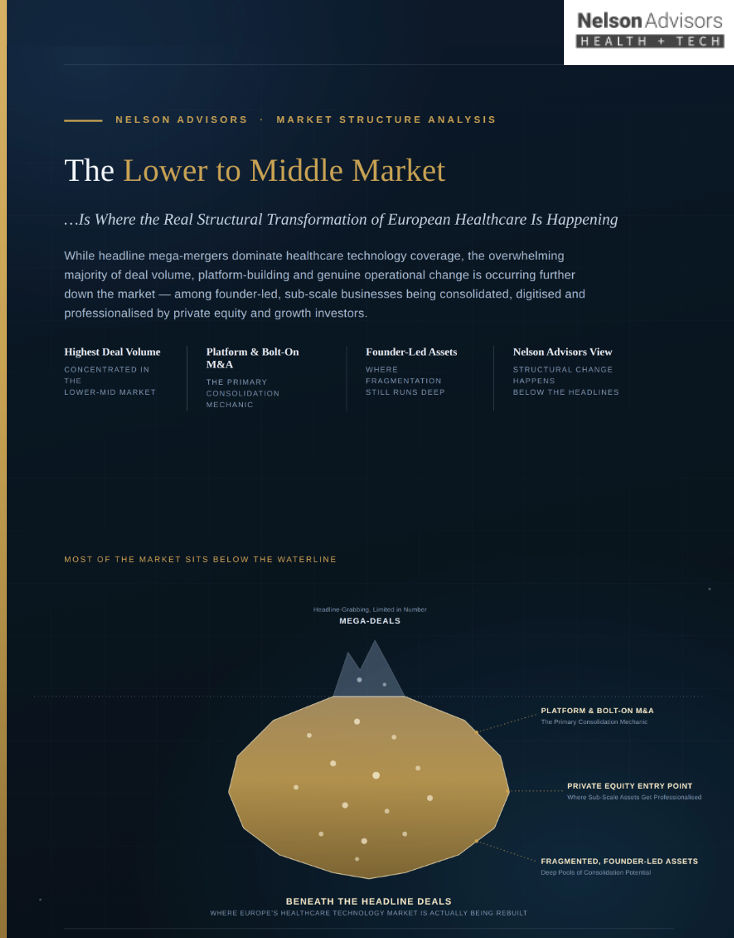
For years, the headlines in European healthcare technology have belonged to the mega deals: the billion euro platform buyouts, the unicorn funding rounds, the flagship acquisitions by global strategics. But beneath that headline layer sits a much larger, much less visible engine room, the lower to middle market (LMM).
These are the founder led and family owned HealthTech and MedTech businesses generating roughly €5 million to €50 million in annual revenue, with enterprise values typically in the €25 million to €250 million range. They rarely make the front page of the financial press, yet collectively they represent the deepest pool of innovation, consolidation opportunity and investable growth in European healthcare today.
As 2026 heads into the final third of the year and dealmakers, operators and investors begin building their playbooks for 2027, this segment deserves far more attention than it typically receives. The lower to middle market is where regulatory pressure, technological disruption, private equity appetite and demographic necessity all collide and where the next generation of European healthcare champions is quietly being built, bought and scaled.
Defining the Lower to Middle Market Opportunity
The European lower to middle market in healthcare technology is not a residual category left over after the mega deals are counted. It is a distinct and structurally important segment with its own dynamics. These are companies past the earliest venture stage, they have product-market fit, paying customers and often clinical validation, but they have not yet reached the scale, balance sheet, or corporate development sophistication of the large cap MedTech and HealthTech incumbents.
Many of these businesses are founder led, several generations deep in family ownership, or spun out of university research groups and hospital systems across the UK, DACH region, Nordics, Benelux and Southern Europe. What unites them is a common set of challenges: limited access to growth capital, thin internal corporate development and M&A expertise, and increasing exposure to a regulatory burden that was originally designed with much larger organisations in mind.
This is precisely why the lower to middle market has become such fertile ground for specialist advisory firms, buy and build private equity platforms and strategic acquirers looking for bolt-on capability rather than transformational scale. It is also why the segment's fortunes are now so closely tied to some of the biggest structural forces reshaping European healthcare: the EU's regulatory overhaul, the artificial intelligence wave and a decisive shift in how investors think about value.
Key Players Shaping the Segment
Specialist Advisory Boutiques
One of the clearest signs that the lower to middle market has matured into a serious asset class is the rise of specialist advisory boutiques built specifically to serve it. Traditional bulge bracket investment banks are generally not economically motivated to run a rigorous, high touch process for a €40 million enterprise value transaction, the fee economics simply do not work at that scale relative to their cost base. Into that gap has stepped a new generation of focused boutiques.
Firms such as Nelson Advisors have built a "Founders for Founders" model specifically oriented around the $25–$250 million transaction range, working directly with the entrepreneurs and management teams who built these businesses rather than treating them as a smaller version of a large cap mandate. Alongside them, firms like WG Partners bring deep scientific and clinical expertise, often described as having several hundred combined years of MD and PhD-level experience, to bear on complex clinical stage and MedTech transactions. Clipperton has carved out a niche applying digital economy valuation metrics to clinical and health-data assets, while ConAlliance has become the go to specialist for DACH region MedTech transactions requiring deep MDR compliance fluency. TH Healthcare & Life Sciences operates as a genuinely global mid-market boutique with a presence across some 14 countries.
What these firms share is a recognition that lower to middle market healthcare deals require a different skill set than large-cap M&A: founder psychology and succession planning, hands on regulatory and reimbursement diligence and the patience to build relationships with acquirers years before a transaction is ready to close.
Private Equity as Consolidation Catalyst
Private equity has emerged as perhaps the single most important actor in the European healthcare lower to middle market. Sponsor backed buyouts in European healthcare surged dramatically through 2025, with sponsor buyout value increasing by more than 270% year to date to roughly €29.6 billion, a pace that pushed 2025 PE deal volume past the previous 2021 peak. That capital is not chasing the handful of available mega caps; it is being deployed through buy and build strategies that acquire multiple lower to middle market platforms and stitch them together into pan European champions.
This buy-and-build logic is particularly powerful in fragmented sub sectors such as diagnostics, elderly care, ophthalmology, aesthetics, dental services and specialty clinics, where scale delivers procurement leverage, shared compliance infrastructure and cross-border commercial reach that no single lower to middle market business could achieve alone. Spain has been a particularly active example of this dynamic, featuring in well over a hundred European healthcare transactions in 2025 alone, with private equity heavily concentrated in hospitals, clinics, ophthalmology and aesthetics.
Strategic Acquirers and Corporate Development Teams
Large MedTech and pharmaceutical strategics remain highly active buyers of lower to middle market assets, though their motivations differ from private equity. For strategics, these acquisitions are rarely about scale for its own sake, they are about capability. A large diagnostics company acquiring a lower to middle market AI imaging business is buying an algorithm, a dataset, or a clinical workflow integration it could not build as quickly or as cheaply in-house. With patent cliffs looming over an estimated $180–400 billion of branded pharmaceutical sales between 2026 and 2030, pharmaceutical strategics in particular are under pressure to replenish pipelines through smaller, de-risked and often lower to middle market bol on acquisitions rather than betting everything on internal R&D.
The Founders and Scale-Ups Themselves
It would be a mistake to treat the lower to middle market purely as an M&A category rather than a community of operating businesses. Across Europe, thousands of founder-led HealthTech and MedTech scale-ups are quietly building the clinical AI tools, remote monitoring platforms, revenue cycle automation systems, and diagnostic technologies that will define the next decade of care delivery.
Many of these companies are still deciding whether their future lies in continued independent growth, a private equity partnership to fund buy and build ambitions of their own, or a strategic exit. That optionality and the advisory ecosystem that has grown up to support it — is itself a sign of the segment's growing sophistication.
Key Issues Facing the Segment
The lower to middle market's growing importance does not mean its path is easy. Several structural issues define the operating environment heading into the last third of 2026 and into 2027.
Regulatory Complexity Disproportionately Burdens Smaller Companies
The European regulatory calendar for 2026 is unusually dense, and its effects fall unevenly. The EU Medical Device Regulation and In Vitro Diagnostic Regulation transition deadlines in May 2026, alongside mandatory EUDAMED registration later that same month, mean that MedTech certification has effectively become a prerequisite financial asset rather than a compliance afterthought, a company without a clear regulatory pathway is very difficult to sell or scale.
Simultaneously, the EU AI Act's requirements for high-risk systems, including AI enabled medical devices, took full effect in August 2026, requiring notified body assessments that many smaller companies are only now scrambling to complete.
Large incumbents can absorb these costs across a broad revenue base and a dedicated regulatory affairs function. Lower to middle market companies frequently cannot. The consequence is a well documented acceleration of consolidation, as under-capitalised SMEs unable to fund compliance independently become acquisition targets for larger players who already possess the infrastructure to absorb them. This is simultaneously a genuine threat to founder independence and a significant driver of deal volume in the segment.
Capital and Expertise Gaps
Unlike well capitalised late-stage venture businesses or large strategics with dedicated corporate development teams, most lower to middle market healthcare companies lack in house M&A expertise, sophisticated financial reporting infrastructure, or straightforward access to growth capital. Founders who are brilliant clinicians, engineers, or operators are frequently navigating their first and only major transaction without the benefit of having done it before.
This information and expertise asymmetry is exactly what has fuelled demand for specialist boutique advisory support, but it remains a structural vulnerability for the segment as a whole, particularly around valuation setting, deal structuring, and post-transaction integration.
Fragmentation Across 27+ Regulatory and Reimbursement Environments
Europe's healthcare markets remain deeply fragmented. A digital health or MedTech company that achieves reimbursement approval and clinical adoption in Germany faces an almost entirely separate process in France, Italy, or Poland.
Analysts covering the funding market have pointed out that go to market cycles for European digital health companies are slowed by more than two dozen distinct regulatory and reimbursement regimes, a stark contrast to the more unified US market that increasingly draws American capital and, eventually,
European company relocations or dual listings. For lower to middle market companies with limited resources, this fragmentation makes truly pan-European scale extremely difficult to achieve organically, reinforcing the case for consolidation via M&A rather than country-by-country expansion.
Valuation Discipline Has Replaced Growth at All Costs
The market has undergone what some advisors are calling "the great rationalisation", a structural shift away from the liquidity fuelled, growth at any cost valuations of the early 2020s toward a highly disciplined, metrics centric approach.
Enterprise value today is driven by demonstrable clinical utility, regulatory resilience and integration into established clinical and reimbursement pathways, not by revenue growth rate alone. The "Rule of 40", growth rate plus profit margin equalling at least 40%, has become a real benchmark investors apply when assessing lower to middle market targets.
Companies with proprietary AI and strong data assets can still command premium multiples of six to eight times revenue, but standard HealthTech businesses without a defensible technological or clinical moat are trading at a much more modest four to six times and undifferentiated consumer health assets lower still. For founders who built their businesses expecting the exuberant multiples of 2021, this recalibration has been a difficult but necessary adjustment.
Exit Infrastructure Still Lags
Even as funding and deal activity recover, Europe's exit infrastructure, IPO markets in particular, remains underdeveloped relative to the United States. This has pushed an increasing share of exit activity in the lower to middle market toward trade sale and private equity secondary routes rather than public listings, which in turn shapes how founders and early investors think about timing and structuring a transaction.
Massive Potential: The Scale of the Opportunity
Set against these challenges is a genuinely enormous addressable opportunity. The European HealthTech market alone was estimated at roughly $96.7 billion in 2025 and is projected to reach approximately $222 billion by 2030, implying a compound annual growth rate above 18%.
European MedTech, a more mature but still expanding market, stood at roughly €170 billion. Layered on top of these figures is a broader $2.38 trillion annual market opportunity identified globally for "health-enabled living" solutions spanning prevention, diagnostics and care delivery across major developed economies.
Within this, specific sub-segments are compounding especially quickly. Women's health is projected to exceed $600 billion globally by 2030, up from roughly $430 to 440 billion today, with nearly $60 billion of private capital already deployed into the space since 2020.
Preventive health funding in Europe rose 88% year-on-year to reach $869 million, reflecting a broader pivot from reactive treatment toward proactive, data-driven care models, precisely the kind of innovation that lower to middle market companies, unencumbered by legacy infrastructure, are often best positioned to deliver.
Crucially, much of this growth potential sits not in the handful of companies large enough to be considered blue-chip acquisition targets, but in the long tail of lower to middle market businesses that are still early enough in their scaling journey to generate outsized returns for the investors, acquirers and partners who back them now, before consolidation compresses the opportunity set.
Growth Drivers Heading Into 2027
Several forces are converging to drive activity and value creation in the lower to middle market over the next twelve to eighteen months.
Artificial intelligence remains the dominant catalyst.
AI captured 58% of Europe's digital health funding in 2024, and that concentration shows no sign of reversing. For lower to middle market companies, proprietary AI, whether in ambient clinical documentation, diagnostic imaging, revenue cycle automation, or predictive care pathways, has become the clearest differentiator between a business that commands a premium multiple and one that is treated as commoditised infrastructure.
Ambient clinical intelligence tools, in particular, are moving rapidly from pilot to mainstream adoption as clinician burnout and administrative burden remain acute pressures across European health systems.
The pharmaceutical patent cliff is forcing acquisitive behaviour.
With $180 to 400 billion of branded drug revenue facing patent expiry between 2026 and 2030, including major products like Eliquis, Keytruda and Opdivo, large pharmaceutical companies are under structural pressure to acquire innovation rather than wait for it to mature internally. This directly benefits lower to middle market biotech, diagnostics and digital therapeutics companies positioned as bolt on targets.
Private equity buy and build capital continues to flow.
With sponsor buyout value already up nearly threefold year to date through 2025 and fresh vehicles, such as Sofinova Partners' €650 million fund targeting earlier-stage companies, continuing to raise, the capital available to consolidate fragmented lower to middle market sub-sectors is not in short supply.
If anything, the scarcity is on the sell-side: well-prepared, exit ready lower to middle market companies remain harder to find than the capital chasing them.
Policy and procurement shifts are opening new demand.
The UK's NHS Ten-Year Plan is redirecting roughly £10 billion in annual MedTech spending toward outcome driven procurement rather than legacy purchasing models, creating a meaningful opening for smaller, more agile suppliers able to demonstrate real-world clinical and cost outcomes. Similar outcomes based procurement reforms are under discussion or already underway in several other European health systems.
American capital is increasingly underwriting European growth.
US investors participated in 62% of European late stage digital health deals in 2025, roughly triple their share just two years earlier. This trend, while concentrated at the later stage today, has clear implications for the lower to middle market: it signals growing international confidence in the durability of European clinical evidence and regulatory pathways and it creates a natural pipeline of future acquirers and growth partners for smaller companies as they scale.
Demographic and structural healthcare demand keeps compounding.
Ageing populations, workforce shortages, and rising chronic disease burden across Europe are not cyclical trends, they are multi decade structural tailwinds that ensure sustained demand for the efficiency, automation and outcomes improvement technologies that lower to middle market HealthTech and MedTech companies are built to deliver.
The Upside for H2 2026 and 2027
Several specific developments point to 2027 as a genuine inflection point for the lower to middle market segment.
The European Health Data Space is scheduled to see Digital Health Authorities established across member states in 2027, a milestone that should materially ease the cross-border data sharing friction that has long constrained lower to middle market companies attempting pan European expansion.
Combined with dynamic, GDPR compliant consent models already emerging under EHDS, this infrastructure could meaningfully lower the fragmentation costs that have historically forced smaller companies into single market strategies.
By 2027, the bulk of the 2026 regulatory transition, MDR/IVDR certification deadlines, EUDAMED registration, and EU AI Act high-risk system compliance, will have worked its way through the market. Companies that survive this compliance gauntlet independently will emerge as genuinely de-risked, premium-valued assets; those that could not will largely have been absorbed into larger platforms. Either outcome clarifies the investable universe and should support more confident, faster moving deal processes than the cautious, diligence heavy environment of 2025 and 2026.
The private equity buy-and-build platforms being assembled today, across diagnostics, elderly care, specialty clinics, ophthalmology and dental services will be reaching maturity by 2027, creating a wave of secondary buyouts, strategic exits and potential IPO candidates. For lower to middle market founders and early backers, this suggests 2027 could be a strong window for exits, as consolidated platforms built from 2024–2026 vintage acquisitions reach the scale where they become attractive to larger private equity funds, strategics, or public markets.
Continued AI maturation should also widen the gap between winners and laggards further, but in a way that specifically benefits well positioned lower to middle market companies: as AI shifts from pilot programmes to embedded, reimbursed clinical workflows, companies with genuine clinical validation and proprietary data, rather than thin wrappers around large language models, should see valuation premiums expand rather than compress, even as overall market discipline remains firm.
Finally, continued growth in American capital participation, if it extends further down the deal size spectrum from late-stage into lower to middle market territory, would represent a significant unlock. European lower to middle market companies with strong clinical evidence, credible AI differentiation and a clear regulatory pathway are increasingly well positioned to attract this capital, whether as a growth partner, a bridge to a larger transaction, or eventually a platform for US market entry.
Conclusion
The European healthcare technology story of the past few years has often been told through its largest deals and its most visible unicorns. But the lower to middle market, the thousands of founder-led, regionally rooted, clinically grounded businesses generating tens of millions rather than billions in revenue, is where the real structural transformation of European healthcare is happening.
It is where regulatory pressure is forcing genuine consolidation rather than superficial partnership announcements, where private equity capital is finding its most productive fragmented markets to build platforms in and where the next generation of AI-enabled clinical tools is being built, validated and brought to market.
The challenges are real: regulatory complexity that falls disproportionately on smaller companies, persistent capital and expertise gaps, deep market fragmentation and a valuation environment that no longer rewards growth without discipline. But the underlying drivers, an addressable market moving from under $100 billion toward a projected $222 billion by 2030, an AI wave still in its early innings, a pharmaceutical patent cliff forcing acquisitive behaviour and policy reforms actively redirecting billions toward outcomes-based procurement, are powerful and durable.
For investors, advisors, founders and strategic acquirers alike, the second half of 2026 and full year 2027 looks set to be the period this segment's importance becomes impossible to overlook.
The lower to middle market is not the warm up act before the real action in European healthcare technology. Increasingly, it is the main event.
Nelson Advisors > European HealthTech, MedTech, Digital Health Investment Banking
Nelson Advisors specialise in Mergers and Acquisitions, Partnerships and Investments for Digital Health, HealthTech, MedTech, Health IT, Consumer HealthTech, Healthcare Cybersecurity, Healthcare AI companies. www.nelsonadvisors.co.uk
Nelson Advisors regularly publish Thought Leadership articles covering market insights, industry trends, deal commentary, market analysis & predictions @ https://www.healthcare.digital
Nelson Advisors publish Europe's Leading Healthcare Technology Investment Banking Newsletter every week, join 5000+ HealthTech and MedTech subscribers today! https://lnkd.in/e5hTp_xb
Nelson Advisors pride ourselves on our DNA as ‘Founders advising Founders.’ We partner with entrepreneurs, boards, corporates, venture capital and private investors to maximise shareholder value and investment returns www.nelsonadvisors.co.uk
#NelsonAdvisors #HealthTech#MedTech#DigitalHealth #HealthIT #Cybersecurity #HealthcareAI #FemTech#ConsumerHealth #Mergers #Acquisitions #Partnerships #Growth #Strategy #NHS #UK #Europe #USA#Canada#Commonwealth#CorporateDivestitures #VentureCapital #PrivateEquity #Founders #SeriesA #SeriesB #Founders #SellSide #TechAssets #Fundraising #BuildBuyPartner #GoToMarket #PharmaTech #BioTech #Genomics
Nelson Advisors LLP
Hale House, 76-78 Portland Place, Marylebone, London, W1B 1NT
Meet Nelson Advisors @ 2026 Events
Digital Health Rewired > March 2026 > Birmingham, UK
NHS ConfedExpo > June 2026 > Manchester, UK
HLTH Europe > June 2026, Amsterdam, Netherlands
HIMSS AI in Healthcare > July 2026, New York, USA
Bits & Pretzels > September 2026, Munich, Germany
World Health Summit 2026 > October 2026, Berlin, Germany
HealthInvestor Healthcare Summit > October 2026, London, UK
HLTH USA 2026 > October 2026, USA
Barclays Health Elevate > October 2026, London, UK
Web Summit 2026 > November 2026, Lisbon, Portugal
MEDICA 2026 > November 2026, Düsseldorf, Germany
Venture Capital World Summit > December 2026 Toronto, Canada


Comments