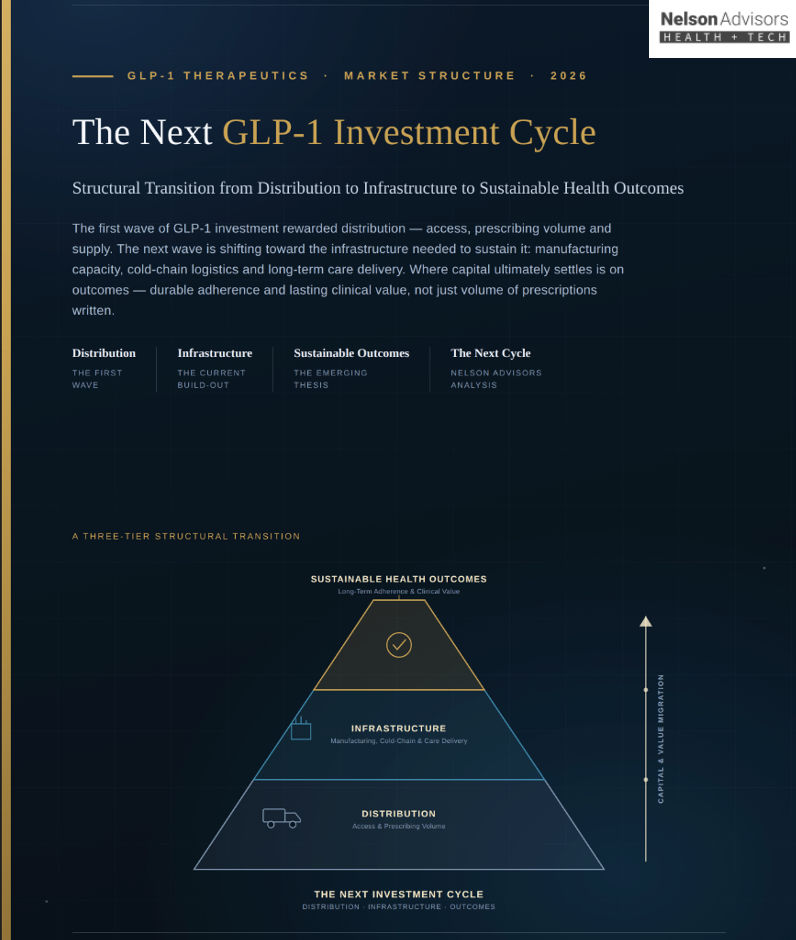
The Next GLP-1 Investment Cycle: Structural Transition from Distribution to Infrastructure to Sustainable Health Outcomes

Executive Summary
The initial expansion of the glucagon-like peptide-1 (GLP-1) receptor agonist and dual incretin market was defined by a direct-to-consumer distribution race. Early digital health platforms, telehealth prescribers and compounding pharmacies capitalised on immediate consumer demand, focusing heavily on patient acquisition, friction free prescribing and medication fulfilment. However, as the market matures, the fundamental bottleneck has shifted from initial access to long term clinical persistence, metabolic quality preservation, and financial sustainability for risk-bearing entities.
Real world evidence demonstrates a stark gap between the clinical efficacy reported in randomised controlled trials and real-world long-term patient retention. While phase 3 clinical trials reported adherence rates exceeding 85% to 95%, real-world claims analyses reveal that 12 month patient persistence historically hovered around 32% to 33%, dropping to 15% at two years and just 8% at three years for individuals utilising GLP-1s for obesity without type 2 diabetes. Although resolving drug shortages improved 12 month persistence to 63% for new initiators in early 2024, multi-year drop-offs remain a significant hurdle. When patients prematurely discontinue therapy, they routinely regain up to two-thirds of their lost weight, neutralising cardio-metabolic improvements and converting high-cost pharmaceutical expenditure into stranded capital for health plans and self-insured employers.
Consequently, value creation in digital health and metabolic care has moved away from basic telehealth prescribing toward durable enterprise infrastructure. Capital is flowing into platform solutions capable of proving that patients remain on therapy at month twelve, preserve lean muscle mass, manage gastrointestinal side effects, and generate measurable total cost of care reductions.
This report analyses the real world persistence crisis, economic paradoxes confronting payers, core pillars of metabolic care infrastructure, and the emerging investment thesis defining the second phase of the GLP-1 market cycle.
The Persistence Breakdown: Real World Attrition versus Clinical Trial Expectations
A primary challenge facing commercial payers and self-insured employers is the variance between clinical trial persistence and real-world medication retention. In pivotal clinical trials such as STEP and SURMOUNT, controlled protocol enforcement, frequent clinical touchpoints, and fully subsidized medication costs yielded protocol completion rates near 90%. In contrast, broad population claims analyses depict severe long term drop-off across commercial cohorts.
Comprehensive longitudinal claims research tracking commercially insured cohorts without diabetes reveals that non-persistence begins early in the treatment journey. Upward of 40% of initial demand is rejected at the pharmacy counter due to coverage restrictions, prior authorisation requirements and step-therapy edits. Among prescriptions approved by payers, an additional 21% of demand is lost to patient abandonment prior to the first fill. For patients who successfully initiate therapy, cumulative attrition steadily escalates over a 36 month horizon, resulting in 90% of total initial potential demand going unrealised by the end of year one.
Metric or Cohort Horizon | Clinical Trial Expectations | Real-World Claims Data (Obesity without T2D) | Key Drivers of Disparity |
12-Month Persistence | 85.0% – 95.0% | 32.3% – 33.0% (2021 cohort) 63.0% (Q1 2024 cohort) | Gastrointestinal intolerance, out-of-pocket costs, prior authorization renewal friction, supply shortages. |
24-Month Persistence | ~80.0% (Trial extensions) | 15.0% overall (Wegovy: 24.0%, Ozempic: 22.0%) | High cumulative copays, coverage loss, plateaued weight loss, waning motivation. |
36-Month Persistence | N/A | 8.0% overall (1 in 12) 14.0% for high-potency GLP-1s | Long-term financial fatigue, product switching (38%), lack of integrated lifestyle support. |
Product Switch Rate | Minimal (<5.0%) | 38.0% over 3 years | Formulations changes, employer formulary shifts, managing tolerance, access gaps. |
Total Demand Leakage | Minimal | 90.0% unfulfilled or discontinued by Year 1 | Systemic access barriers combined with behavioural drop-off. |
The drivers of real world attrition are multi-faceted. Gastrointestinal adverse effects, including severe nausea, vomiting, constipation, and delayed gastric emptying, frequently emerge during dose titration, causing unmanaged patients to discontinue therapy within the first 90 to 180 days. Economic friction further accelerates drop-off; high monthly deductibles, co insurance burdens and annual plan prior authorisation renewals create recurring exit ramps.
Furthermore, supply chain disruptions between 2021 and 2023 forced involuntary treatment gaps, though the resolution of manufacturing bottlenecks in 2024 demonstrated that securing drug supply alone only partially mitigates long-term behavioural drop-off.
The Payer and Employer Dilemma: Navigating the GLP-1 Cost Paradox
The rapid adoption of weight-loss pharmacotherapy has introduced a financial paradox for risk bearing entities. While anti-obesity medications yield substantial clinical improvements, including average body weight reductions of 15% for semaglutide (Wegovy) and 21% for tirzepatide (Zepbound), the immediate pharmacy expenditure vastly outperforms short-term medical cost offsets. Over 40% of U.S. adults meet clinical criteria for obesity, representing nearly 58 million commercially insured individuals, making unmanaged coverage financially unsustainable for most enterprise benefit plans.
Commercial plan claims evaluations demonstrate that covering GLP-1s for non-diabetic obesity leads to a net increase in total healthcare expenditure. In matched-control cohort studies, annual post initiation total cost of care for GLP-1 users increased by 59% (an average net increase of $7,286 to $7,727 per member) compared to control groups. For members who remained fully adherent over 12 months, annual healthcare spending virtually doubled, rising from a pre-period baseline of $13,048 to $25,850.
Product Name or Benchmark | Manufacturer or Entity | Wholesale List Price (28-Day) | Estimated Net Monthly Price | Direct-to-Consumer / Alternative Channels |
Wegovy | Novo Nordisk | $1,349.02 | $569.08 | $349.00 (DTC Cash Vial) |
Zepbound | Eli Lilly | $1,086.37 | $664.41 | $299.00 – $449.00 (Single-Dose Vial) |
Medicare Bridge Program | Centers for Medicare & Medicaid Services (CMS) | N/A | $245.00 (Manufacturer Rate) | $50.00 Monthly Copay Cap |
Baseline Non-Diabetic Obesity Spend | Commercial Market Average | N/A | $1,050.00 ($12,600 Annual) | 2.6x higher than non-obese baseline spend |
This dynamic creates an acute structural misalignment for self insured employers. Given that average U.S. worker tenure ranges between 3.5 and 4 years, employers bear the full upfront cost of high priced pharmaceuticals ($569 to $664 estimated net monthly cost) without retaining the employee long enough to capture downstream financial returns from reduced cardiovascular events, lower joint replacement rates, or prevented type 2 diabetes onset.
When a patient drops off therapy after six to nine months, the employer absorbs the drug expense without securing permanent health improvement, as weight regain occurs rapidly post-cessation. Consequently, fewer than 20% of commercial employers offer unconstrained obesity coverage, driving enterprise purchasers to demand structured management frameworks to restrict access to high-responder populations and enforce structured off ramps.
The Phase 2 Infrastructure Stack: Three Pillars of Sustainable Metabolic Care
To address the limitations of standalone pharmacotherapy, digital health innovation has shifted toward building comprehensive infrastructure layers. Strategic frameworks established by clinical evaluation bodies, such as the Peterson Health Technology Institute (PHTI), emphasise that sustainable GLP-1 deployment requires structured intervention across three distinct operational phases: Initiation, Maintenance, and Supported Discontinuation.
Pillar 1: Targeted Initiation and Gatekeeping through Narrow Networks and Algorithmic Triage
Unrestricted prescribing creates systemic adverse selection, allocating expensive drugs to patients with low baseline readiness for lifestyle change or low clinical need. Phase 2 infrastructure introduces control mechanisms before a prescription is written. Employers utilise custom National Provider Identifier (NPI) filters within Pharmacy Benefit Manager (PBM) engines to reject coverage unless the medication is prescribed by an approved, high-value virtual clinical network.
In parallel, algorithmic eligibility engines synthesise longitudinal medical claims, continuous glucose monitor streams, cellular connected scale metrics and metabolic panel markers to confirm clinical necessity and predict patient adherence probability before authorisation. Requiring members to complete structured multi month digital behavioural modification or intensive lifestyle intervention programs prior to pharmaceutical unlock filters for high-engagement patients while controlling drug utilisation.
Pillar 2: Clinical Wraparound and Metabolic Quality Preservation
Achieving weight loss is insufficient if a significant proportion of mass lost consists of lean skeletal tissue. In standard GLP-1 monotherapy, lean muscle mass accounts for 15% to 40% of total weight loss, increasing the risk of sarcopenic obesity, reduced resting metabolic rate, compromised neuromuscular function and systemic bone mineral density reduction. Infrastructure platforms mitigate muscle degradation through evidence-based nutritional and mechanical protocols.
On GLP-1 therapy, severe satiety suppresses appetite, making standard food intake challenging. Wraparound infrastructure implements precision nutrition plans targeting 1.6 to 2.2 grams of protein per kilogram of total body weight daily, paired with targeted supplementation to sustain muscle protein synthesis. Digital care platforms complement nutrition by deploying home-based mechanical loading protocols operating at 75% to 85% of 1-repetition maximum, delivered three to four times weekly. Mechanical loading activates mTORC1 signalling pathways and satellite cell recruitment, mitigating sarcopenic loss during steep caloric deficits.
Next generation clinical models are also incorporating dual-action biologics. Clinical trials, such as the BELIEVE Phase 2b study evaluating bimagrumab, an activin receptor type II blocker, combined with semaglutide, demonstrate that pharmacologically inhibiting myostatin pathway signalling selectively maximises fat mass loss while preserving or increasing lean body mass. Automated symptom tracking systems further support this pillar by monitoring early-stage gastrointestinal discomfort, deploying micro-dose adjustments, anti-emetic support, and dietary fibre modifications to prevent early drop-offs within the initial 90-day window.
Pillar 3: Structured Discontinuation and Tapering Protocols
To break the assumption of perpetual pharmaceutical dependency, Phase 2 infrastructure focuses on off-ramping programs. When GLP-1 therapy is abruptly stopped, appetite suppression rapidly wanes while resting metabolic rate remains depressed due to lost muscle mass, driving immediate weight regain. Step-down titration protocols gradually reduce drug serum concentrations while assessing a patient's self-regulated satiety control.
Physician supervised micro-dosing models and extended dosing intervals maintain minimal receptor occupation while transitioning the patient toward lifestyle autonomy. Intensive lifestyle coaching, continuous weight monitoring via cellular scales and protein-dense feeding strategies are scaled post-discontinuation to prevent rapid regain and protect the employer's long-term health return.
Digital Health Investment Dynamics and Market Landscape
The broader digital health investment environment reflects a clear flight to quality. Following the market reset of 2023–2024, U.S. digital health funding reached $7.4 billion across 244 deals in the first half of 2026, driven by a heavy concentration of capital in top-tier platforms. Mega-deals ($100 million or greater) captured 45% to 59% of total deployed funding.
Weight management and obesity care established itself as the second most heavily funded clinical indication, trailing only mental health. However, capital allocation within weight management has fundamentally shifted. Investors are deprioritising commoditised direct to consumer prescribing platforms in favour of scalable enterprise infrastructure, value-based wraparound platforms, and specialty care models.
Company Archetype | Key Representative Platforms | Core Business Model | Enterprise Value Proposition | Strategic Vulnerability |
Pure Direct-to-Consumer Prescribers | Ro, Hims & Hers, RemedyMeds | Direct-to-consumer cash subscription; compounded or branded drug delivery. | High consumer brand awareness; immediate friction-free drug access. | Vulnerable to compounding regulatory crackdowns, high customer acquisition costs, and severe long-term churn. |
Virtual Wraparound Platforms | Omada Health, Vida Health, Form Health, Nourish | Enterprise SaaS; per-member-per-month or value-based fee structure. | Integrated behavioral support, protein/dietary coaching, and high 12-month retention. | Must continually prove incremental clinical value above standard PBM disease management offerings. |
Value-Based Metabolic Infrastructure | eMed, Virta Health, Calibrate, 9am Health | Capitated risk contracts; shared savings tied to drug deprescribing and TCOC reduction. | Direct financial alignment with payers via structured off-ramping and metabolic remission. | Higher operational complexity; requires rigorous longitudinal clinical data integration. |
Strategic consolidation has accelerated as larger platforms acquire smaller players to gain infrastructure capability. For example, eMed secured a $200 million financing round at a valuation exceeding $2 billion to advance its agentic artificial intelligence capabilities and scale its capitated GLP-1 care model. Similarly, nutrition-focused platforms like Nourish ($100 million) and specialised virtual providers like Midi Health ($100 million) expanded their core infrastructures to manage metabolic therapies for targeted enterprise populations.
Mergers and acquisitions activity surged with 115 transactions finalized in H1 2026, as legacy digital health vendors acquired lower-priced assets to build out multi-specialty care platforms. This consolidation occurred alongside valuation resets across direct-to-consumer assets, highlighted by Thirty Madison acquiring RemedyMeds after its valuation fell from $1 billion to $500 million, and distressed exits for legacy virtual care providers.
This shift aligns with findings from independent evaluation bodies like PHTI, which revealed that early-generation digital diabetes tools failed to deliver meaningful clinical improvements or net savings, amplifying buyer demand for rigorous, evidence-backed GLP-1 infrastructure.
Venture capital and private equity investors should focus allocation strategies on digital health platforms that utilise shared-savings or capitated risk models tied to drug spend reduction, persistent metabolic health improvements, and successful medication off-ramping. Underwriting processes must evaluate "metabolic quality" defensibility by prioritising platforms that incorporate precise body composition tracking (fat versus lean mass), protein nutrition integration, and progressive resistance training interventions over simple weight tracking software. Capital allocators should avoid un-differentiated direct-to-consumer prescribing pipelines reliant on high consumer acquisition costs and direct drug markups, as regulatory scrutiny surrounding compounded formulations and employer coverage locks will constrain their addressable market.
Health systems and self-insured employers must modernize benefit architectures by deploying phase-based coverage gatekeeping. Implementing NPI-blocked prescribing networks, algorithmic eligibility screening, and mandatory lifestyle step-therapy ensures GLP-1 coverage is targeted strictly to high-readiness, clinically appropriate members. Enterprise purchasers should structure vendor agreements around 12-month persistent health metrics, functional body composition markers and total cost of care reductions rather than vanity metrics like app downloads or initial logins.
Finally, benefit leaders must require virtual weight management partners to offer formal, clinically supervised drug tapering and post-discontinuation behavioural support programs to prevent weight regain and protect financial returns.
Conclusions
The hyper-growth phase of GLP-1 distribution has concluded, giving way to an era focused on accountability, infrastructure and long-term outcomes. While GLP-1 receptor agonists present therapeutic opportunities for treating obesity and associated cardio-metabolic conditions, their real world impact is constrained by high drop off rates, sarcopenic muscle loss and financial costs for risk bearing entities.
The winners of the second GLP-1 investment cycle will not be the companies that simplify drug access, but those that solve the real world persistence and economic equations. Long term value will accrue to digital health platforms that serve as enterprise infrastructure: gating drug initiation to appropriate patients, preserving metabolic quality through integrated nutrition and resistance exercise, extending treatment persistence, and orchestrating structured off-ramps.
By aligning technology, clinical protocols, and economic incentives around sustainable metabolic health, these platforms will transform GLP-1s from volatile pharmacy expenditures into foundational components of durable healthcare delivery.
Nelson Advisors > European HealthTech, MedTech, Digital Health Investment Banking
Nelson Advisors specialise in Mergers and Acquisitions, Partnerships and Investments for Digital Health, HealthTech, MedTech, Health IT, Consumer HealthTech, Healthcare Cybersecurity, Healthcare AI companies. www.nelsonadvisors.co.uk
Follow Nelson Advisors LinkedIn Page > https://www.linkedin.com/company/nelson-advisors/
Nelson Advisors regularly publish Thought Leadership articles covering market insights, industry trends, deal commentary, market analysis & predictions. https://www.healthcare.digital
Nelson Advisors publish Europe's Leading Healthcare Technology Investment Banking Newsletter every week, join 5000+ HealthTech and MedTech subscribers today! https://lnkd.in/e5hTp_xb
#VentureCapital #PrivateEquity #Founders #SeriesA #SeriesB #Founders #SellSide #TechAssets #Fundraising #BuildBuyPartner #GoToMarket #PharmaTech #BioTech #Genomics #NelsonAdvisors #HealthTech #MedTech #DigitalHealth #HealthIT #Cybersecurity #HealthcareAI #FemTech #Mergers #Acquisitions #Partnerships #Growth #Strategy #NHS #UK #Europe #USA #Canada
Nelson Advisors LLP
Hale House, 76-78 Portland Place, Marylebone, London, W1B 1NT
Meet Nelson Advisors @ 2026 Events
Digital Health Rewired > March 2026 > Birmingham, UK
NHS ConfedExpo > June 2026 > Manchester, UK
HLTH Europe > June 2026, Amsterdam, Netherlands
HIMSS AI in Healthcare > July 2026, New York, USA
Bits & Pretzels > September 2026, Munich, Germany
World Health Summit 2026 > October 2026, Berlin, Germany
HealthInvestor Healthcare Summit > October 2026, London, UK
HLTH USA 2026 > October 2026, USA
Barclays Health Elevate > October 2026, London, UK
Web Summit 2026 > November 2026, Lisbon, Portugal
MEDICA 2026 > November 2026, Düsseldorf, Germany
Venture Capital World Summit > December 2026 Toronto, Canada



Comments